Summer ’25: IV – Pandering

Train G1756 darted from Guiyang in Guizhou to Sichuan’s capital Chengdu. 640km (397 miles) on a bullet-nosed train. It’s streamlined front glided rather than rattled like a British medium-speed train. This high speed travel in China doesn’t hold back.

Within the cauldron of Chengdu’s heat, we sizzled like steak straight off a barbecue. Greeted by 40°C heat at around 9pm, we suckered in deep breaths of fire, and wheeled our luggage beyond the great subway network. After finding our night dwelling, we grabbed food at a Dongbei restaurant. A friendly ginger tomcat the size of a small dog greeted us and with that we left the restaurant stuffed and sleepy. Every dish had spice, something Chengdu is famous for. We quickly noted that future meals will need better vetting.

中国人爱塑料袋 (Chinese loves plastic bags) should be a slogan. Bags for fruit with skins on. Bags for single pieces of shopping. Bags for life are out there. Bags for bags. Too many bags. The ocean, the parks, the mountains, and every nook and cranny, seem littered with bags. Those that are lucky make it to landfill or rubbish bins. Out of the system, only to be replaced by more plastic bags. Don’t get me wrong, the U.K. has had far too many plastic bags and is transitioning away from bags at a more sedate pace but plastic use is far lower for packaging. In fact, in China, it is evident from my travels, that disposable single-used plastic seems just as high as when I arrived in 2014. In a nation of a billion plus people, that has global implications. And it causes arguments. Too many plastic bags. Our daytime backpack featured several.

The lodgings chosen sat close to the Chengdu Research Base of Giant Panda Breeding (成都大熊猫繁育研究基地). We entered via the relatively quiet west gate, after boarding a 15RMB bus, that sling-shotted around the giant site. We were quickly dashing from enclosure for enclosure, enjoying every moment we could alongside giant black and white pandas. Due to the excessive and oppressive summer heat, every panda utilised their extensive indoor enclosures. Having visited the place in 2021, I was surprised at how big the expansion and refurbishment of the whole panda breeding centre was. It was truly inspiring to see such a delightful upgrade. Panda-labelled orange coffees and Italian-style hotdogs were needed, as well as copious amounts of water. Some walking was done. A day’s worth.

After exiting the red panda enclosures, we were hounded out of the park and departed for dinner and a rest. Many pandas seen. “Full mouths ate quiet mouths”, I uttered as we tucked into a buffet-style dinner. It had been a brilliant day out. The following day called for a visit to the Chengdu Natural History Museum, complete with many dinosaur fossils and stuffed animals. No stuffed pandas. People are funny about pandas and taxidermy. Seems every other animal is fair game but the national symbolised animal is prized too well for a stuffing. Cuddly toys, however, are everywhere. And huge sculptures. You name it and a panda is on it in Chengdu. Clothing: check. Cigarettes and alcohol: check. Umbrellas, magnets, books, and more: on it.

Summer ’25: III – Bamboozled

Treated by family to a spot of travel and unwinding, we set off from a station nearly an hour from the place of residence.

In Guangdong, like many cities in China, you can drive by taxi for an hour and not leave the jurisdiction of that same city. Not even close. So, we arrived at station one, departed for station two, and arrived at station three in Yangshuo. 300 miles [482km] travelled across 2 hours and 42 minutes. Or further than London, and quicker than any British railway journey. Huizhou is massive at around 4,217 square miles [10,922 km²]. It is substantially large compared to neighbouring Dongguan, Shenzhen, and Guangzhou. A formidable region to navigate.

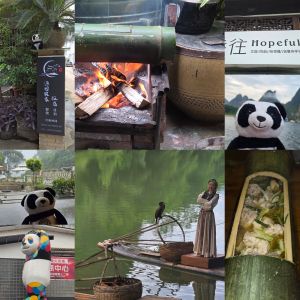
Badly Drawn Boy’s Everybody’s Stalking marked the train journey’s early moments through the tunnels of Guangxi. Through fine lyrics befitting the view out of train D1814’s window, the train rolled into the Karst-mountain surroundings of Yángshuò (阳朔). A quick lift from our hotel owner seen us dropped off at the digs, 阳朔源园饭店(20元人民币风景区店) 兴坪镇画山厄根底村76号, which is with Ergendi village. A bag of huángpí (黄皮) wampees (Clausena lansium) followed a delicious dinner. The grape-sized fragrant fruit, with a large seed core, sat well on a belly of bamboo-cooked sticky rice, some baby bamboo shoots, and pork sliced between taro. After seeing the cormorant fishing birds posing, the Li River (漓江Lí Jiāng) flower, and a multitude of tourist boats, nightfall followed a heavy storm. Bedtime soon followed.

Seems like many paradise regions become Piccadilly Gardens: that once flowery bowl of sunshine now covered in concrete and steel. The village of XingPing, near Yangshuo, has undertaken drastic growth in little over two decades, and really symbolised the idiom rén shān rén hǎi (人山人海) or people mountain, people sea. Allegedly the river Li below flows with over 215 cubic metres per sec9nd. The people on the shores seemed equally dense. Photographers, fashion people, tourists, local canvassers, and every manner of people seemed to congest the tiny footpaths of XingPing (兴坪) village.

We had a plastic bamboo raft trip upstream on the Li river, savouring the humongous Karst peaks and bends of the powerful river. More food, including a full chicken boiled in a soup within a bamboo tune followed. Plenty of wandering was had. Sadly, without speedy legs, the waterfall pond, Pubutang and Tiger Mountain Waterfall shall have to wait. Our train outwards to Guiyang was caught on time.

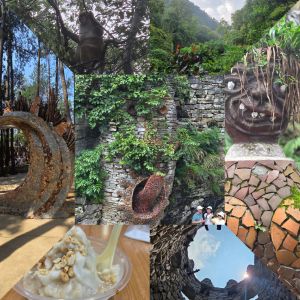
Guiyang straddles the eastern edge of the Yunnan-Guizhou Plateau and is apparently around 1100m [3600′] in altitude which may seem debatable as you traverse districts. The roads resemble Spaghetti Junction in Birmingham (England) with bridges crisscrossing lengthy tunnels and slopes throughout the surface routes. A decent subway and rail system serves the city and outer region. The Yelang valley was a pleasure to visit, a truly unique and hidden gem within China. Twenty years were taken for the recreation of an ancient culture. The stone sculptures and artwork are fantastic. Song Peilun’s vision is a highly recommended visit. Oh, and we saw a monkey at the Qianling Mountain Park, having clambered a large peak and being consumed by a passing storm. That was fun.

Stage IX: Dali (and the mysterious Aubergine)

你好!Nihao! Hello!

Salvador Dali has nothing to do with the Yunnan city of Dàlǐ (大理). The draw to Dali has been the art district, cycling, the coffee and cafe culture and my friend Echo. Also, wherever I’ve been in China, everyone mentions the comfortable weather of Yunnan.

Echo or Eck published a poetry little picture book recently. She’s made her nomadic home in Dali. Here she’s honing her artistic talent, existing comfortably and living happily. I dropped by (via Guiyang and Kunming) from Chengdu, Sichuan province to say hello. I told Echo I’d arrive on Sunday but Saturday afternoon, walking by the Terra coffee shop seemed as good a time as any. Yunnan is great for growing coffee and Dali has no shortage of coffee shops.

A good old chinwag and catch up preceded a walk through the ginnels of Dali’s ancient old town to a door in a wall. The door was open and smooth tempting beats were gently rolling out. Ducking below the low entrance, an Old-styled yard with greenery and tables greeted us. Echo’s friend (or should I say complication?) Yali and his brother were serving up delicious pizzas. The pomegranate tree nodded towards the range of locally-produced liquors. Here Echo introduced me to Myrtle Bee, a girl named QiéZi (茄子 or eggplant/aubergine). There were several others but my recollection for names had by now been overwhelmed.

Meanwhile my mouth had been delighted by a cream cheese and tomato pizza, followed by a further shared pizza with zucchini and deliciousness on top. The pesto dip was a smart move. A side salad featured a baked cheese and rocket lettuce. It was a bit too salty for my pallet, but overall very tasty. The funky beats faded and a disappointing bar called King Cat followed. The music wasn’t my cup of tea, but it saved wading through deep puddles and high-bouncing rain. After a later than expected hour, I arrived back to the Jade Emu China Australia International Youth Hostel, only to find my swipe card to enter didn’t work. The matter resolved itself and I slipped off into dreamland.

I didn’t need a sign for Cāngshān (苍山). The imposing green and cloud-kissed range of peaks. The Didi taxi driver from Dali railway station to the hostel had given ample chance to view the waving weaving green peaks. So, with a late rise and a belly full of good food, I set out for a waterfall recommended by a friend. On passing a set of small waterfalls, I headed up a track made by goats or sheep or possibly very narrow humans. The steep track disappeared and I soon found myself jutting between soft earth, trees and huge fluffy plants. By which stage I’d reached a ridge, with a very confuddled water turbine worker, who then directed me up a hidden pathway towards the top ridge. It was a tough but pleasant trail.

The undergrowth swept away to reveal a near-hidden valley tucked between two mountain ridge lines. I wandered down, dipped my feet, watched the butterflies and listened to the idyllic birdsong. One can definitely relax when clouds cuddle the mountains above, and gentle breezes softly drift around your chest whilst your feet are in chilly flowing waters.

Once again Busa called for dinner. Their second opening night led me to catch up once again with Echo, her Yali and other friends. The waitress Hazel, from Changde, took an interest in the book I was reading. A few days later, the tatty and soggy paper back was left for her to read. Echo’s friend QiéZi invited herself to my next walk the following day. Cāngshān (苍山) once again would be the wandering space.

With little barefooted QiéZi (who is no taller than 155cm), we set out towards the Cloud Jade pathway of Cāngshān. Passing the chair lift to our left, then our right, then left again we ascended. Stopping for Pu’er tea, a coffee and a snack at a park Police point seemed reasonably normal. The local boss had her grandson playing with leaves as she served a refreshing brew to us both. We left behind the options of hospitality and wandered paths here, there and everywhere. My pigeon Chinese and a relaxed mood made the afternoon to evening a satisfying and contented ramble.

By about 8pm, after almost eight hours of moving forwards, we descended through dark shadows and paths more at home in the deepest darkest parts of JRR Tolkien novels. Emerging from utter darkness, with only the company of fireflies, seemed to take a while but the adventure was nevertheless a great day out!

The next day (which is today, now) I decided this town needs a little more of my presence. I decided for the remainder of the holiday that I’d be here or there, but not so far from Dali. Why not? A place that puts a smile on your face and opens you to the nature around it, isn’t all bad! Ian Fleming penned some of his books in his Jamaican home of Goldeneye. Perhaps a few days in Dali and I may have found my Goldeneye.

However, a few hours later, I changed my mind. Have shoes, will walk. I will keep looking for answers and smiles.

Zai Jian! 再见!Goodbye!