To be determined.

你好/ Ní hǎo / Nín hǎo / Hello / How do / S’mae / Namaste,

https://sunyatsens.com/

I opted not to take headphones with me, or earphones for the trek around Nepal. The soundtrack would be life and nature. However, if I was to take one song on that journey, then I’d struggle. Today, I watched the video of Ting Bu Dong by Sun Yat Sens. The track opens with producer Ryan Chambers on the didgeridoo. Throughout the track he continues flitting between this instrument, an acoustic guitar and backing vocals. Sometimes he manages two of the three. Talented bugger! Some of us can’t even play the spoons. The vocals kick in from Chris Bradshaw, who puts a J between his names. It could mean juggernaut or John, as in Lennon, I don’t know. Rob Laughlin on base, alongside Eric Charette on drums and a session guitarist in Brandane Mullane form the band’s entirety. The reason that I namedrop these guys, because somehow, somewhere and someday these boys could reach high. They’ve evolved since I first watched them at Magic Island Music Festival back in December 2016. They’ve gone from a group capable of pub gigs, to a professional looking, well-marketed and confident outfit. They’re more A-Team than A-list still. That’s a good place to be. With videography by the talented Ryan and drone footage, alongside their graphic design they can do anything they want.

The dreamy didgeridoo-opening has a touch of This Garden by The Levellers, and I’m feeling a touch of Dido in there. It has the played down nature of early Oasis-acoustic tracks without the overpowering aggression of a cocksure Gallagher on board. I’m expecting, “Today is gonna be the day…” but instead the song smashes in some Chinese. Why not? The reggae-indie rap is dreamy. The chorus is clear and takes me back to Nepal on that last walk. Songs that unlock memories and emotion are powerful things. The video showcases life in China, a wandering figure and gives your imagination an opportunity to test itself. Sun Yat Sens and their previous song WeChat was more Feeder and jolliness in style. My students feature somewhere in there around the minute mark. I hope that we all see and hear more of this band soon.

#15 – PYRAMID – GORAK SHEP 1300 – EVEREST BASE CAMP – GORAK SHEP 1800 ~ 12km


8th February 2019

We set out from Pyramid (5050m / 16,568ft) to Gorakshep (5100m) and then onwards to EBC (5360m). On Earth’s lands there isn’t much surface area above us at this point. The upper points above 7,000ft (2133m) is only about 7% of the total of Earth’s surface. 29.2% of Earth has land above sea level or uncovered by lakes and rovers. Our oblate spheroid of a planet has bumpy bits. The Himalayas (China/Nepal/India)) with the Karakoram range (China and Pakistan) are the only places to see peaks over 8000m. Only Bhutan, Kyrgyzstan, Afghanistan and Tajikistan (a country I know nothing about) can be added to those countries for mountains over 7000m. Going to other countries and looking for big mountains is near pointless. Aconcagua (6962m) in the Andes (Argentina) is as close as you will get. Anyway I now found myself above 5164m for a night’s sleep. The highest that I have ever snoozed.

If Lobuche is bleak, then Gorakshep could have meant shithole in English. The smooth mountain top of Kalapatthar hovers over the lakebed that sits by Gorakshep. We arrived, ditched our things at the Buddha Lodge, ate a late lunch and then started the Everest Base Camp trek. The final leg towards a hidden shadow beneath Everest. The lodges are mostly supply drops and shelters. There is discarded waste in piles, banners and tents ripped to shreds scattered here and there. Armageddon refused to stop in Gorakshep on account of it being totally dilapidated and uninhabitable.

The worst night’s sleep ever followed. Firstly, the windows were rattling amd pccasionally flying open. Cracks in some panes threatened to explode. The roof was rattling. Each room had a temperature lower than -25°C. Snow slipped through the edges of the window frames. The lodge shook with each gust. Worse still – we were running out of yak shit. The main lounge room was starting to cool. As I lay my head down headaches came and went. Even if I wanted to descend downwards, this was not the weather to open any doors.

In the lodge a group of three from the U.K. with their The Baton flag slept, alongside Rhys, Al and Spanish Albert. Everyone seemed to endure a restless night of anti-sleep. Hope of making ot through a night without the roof blowing off was broken up by regular piss breaks to the toilet at the end of the cold corridor. The frozen stinking cesspit in the ceramic western toilet was perhaps the warmest thing for several kilometres.

The great thing about having a sleeping bag comfortable to -25°C is that when it finally teeters over that temperature limit, you’re still a little warm. An extra blanket on top helped. The noise of the howling winds did not. Gritty frozen grains pounded the windows outside. It seemed that the outside desperately wanted to be inside. Sporadically the dirt of the outside world slapped the windows like bullets being fired from a gun.


9th February 2019

Morning arrived. Breakfast was devoured. We set out.

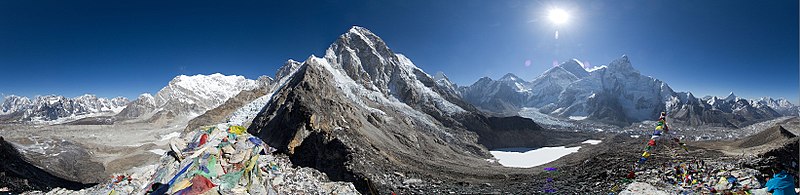
Kala Patthar is 5,545 metres (18,192 ft). It might as well be higher. It is no mean feat to get to the top and capture a panoramic view of the Khumbu glacier like all the postcard shops have obtained. A panoramic sweep of clouds in all directions and zero visibility doesn’t sell the same. To quote trekker Rhys from Cardiff, “Well it is the mountains and that means clouds.” It is what it is. Simple. Black rock, as Kala Patthar means in Hindi, might well just translate as bleak rock. I read somewhere that the ‘The world’s highest webcam, Mount Everest webcam, was located here’ on Kala Patthar. In those clouds, you could lose anything – including life! No prayer flags were visible yet needed. No mountain climbing permit was required – making this the highest point to scramble without license to do so.

The Khumbu glacier is supposed, by scientists, to have formed in the last Great Ice Age. That was around 500,000 years ago. On reaching Lobuche (4910m), my legs were feeling equally as old. The Khumbu region stretches from Namche Bazar out to Thame in the west and Gokyo. Gorak Shep, and Chukung mark the northern and western areas.  The Khumbu subregion is a third of the region known as the closely named Khambu. The lowest point is 3,300m high around Lukla. Visibility was so low, that my feet were barely in sight. The gamble and decision to stay an extra day was not appealing. With heavy snow forecast, we headed down – our target, “as far as we can go.” Well, after struggling over the open boulder and rocks fields lining the banks of glacial death below, we dropped into a valley leading towards the Pyramid. We’d later show some pretty bad windburn on our skin – and thankfully we escaped anything more serious.

Having sought cover just before lunchtime, we had cut a path through deep snowdrifts and found shelter. We were the only ones at the Pyramid International Laboratory/Observatory. We hadn’t intended to stay again but we had no choice. After an hour a Chinese man and his porter/guide joined us. They said they were close to death out there. It was believable and no embroidery on their part. Barely two hours later and the blizzard vanished. The whiteout faded to a grey unsettling day. We chilled out in the warm lounge watching cricket, volleyball and eating too much. It passed the time before bedtime. Outside did not appeal to us.

#16 GORAK SHEP – PYRAMID ~ 10km

This slideshow requires JavaScript.

10th February 2019

The walk continued as in the spirits of each day before. It was always about just going forwards, and not rushing. Some loose targets and aims were handy but they were never set in concrete. The journey was to be lived. The destination was just for inspiration. Some target Everest Base Camp for status, spirituality or homage. Some push themselves as far as they can go. Some want to do their best. There had never been a race to get anywhere and likewise we weren’t descending fast for the sake of it.

Within an hour, I did not think that I could walk any more. My head was pounding at the rear and I was walking so slow, that deep down I was beginning to worry. Fatigue had turned to exhausation and my mental condition was slipping to the negative. Ten minutes after passing Ishwor, Srirang and Livia on their way up, I had to stop. Here the cough that had been niggling me for nearly two weeks began to rasp at my throat. I tried to catch my breath. A moment later, I was staring at my breakfast on the floor. My nose stang. I smelled terrible. My mouth tasted like a yak’s arse. After a few moments of composure, I explained to Maria we must head down fast – but steadily and for her to keep an eye on me. Barely an hour later and I felt great – reinvigorated and fully oxygenated. Resurrection in a Buddhist land is possible afterall.

We soon appeared at the tombs and monuments, standing tall under a sunlit sky. The spiritual air of the location fell away as we descended the pathway to Thukla. Here we continued over the glacial rover’s stepping stones, banked left and followed a pebble-stoned pathway into the valley around Pheriche (4371m).

I was told by many not to stay at Pheriche when doing this trekking route. It sits deep in the shadows of the mountains around it and on a cloudy day, little light makes it to the village. This day it was basked in splendid sunshine. The Tsola River flowed beneath it. The Himalayan Rescue Association (HRA) are based here but we dodn’t stop by. We spent an hour hiding from yaks, by squating by a frozen stream as they passed by and then doubled back. Eventually we joined a British couple, their guide and porter to pass by. The top end of Pheriche village seemed to have a melting-yet-dangerously-frozen-river-road down the middle. That had to be negotiated slowly. Empty buckwheat and potato fields lined the pathways. Following the top end of the village a few kilometres before the lower village appeared. The neighbours there must be quite fit.

Arriving at Deboche (3820m) today we had dropped about 1230m. That’s 1.23km (4053 feet – about 7/10 of a mile). Burj Khalifa is the tallest building at 828m (2717’) tall. It had taken just a few hours. The walk up had been broken down.

#17 0900 PYRAMID – 1600 DEBOCHE; #18 0930 DEBOCHE – NAMCHE BAZAR 1700: ~ 40km
#19 NAMCHE BAZAR – LUKLA ~ 21km
#20 LUKLA: ~ 4km

More to follow.


再见/ Zài jiàn / Bài bài / Ta’ra / Goodbye / Hwyl Fawr / Dhanyabaad / Alavidā

Sagamartha: Realm of wonders

The next morning, I felt energised, I practically skipped back enjoying the wonderful views and stopping more frequent to take it all in. Wonderful. At Khayangjuma I stopped at Three Sisters Lodge for lunch and enjoyed talking with the owner. I bid my farewell and strolled on into the nearby Namche Bazaar. After a struggle finding lodgings, avoiding the Yak Hotel of my previous visit, I found the Kala Patthar Lodge. I checked in. No hot showers due to frozen pipes. I had only showered in Jiri, Sete and Bupsa Danda by that time. 15 days, 3 showers. They did however provide me with a bucket full of hot water. It was bliss. I felt clean again. That evening I talked with two Australian ladies hiking up the trail. I also invested in a new book. I ploughed through Jon Krakauer’s book, Into Thin Air: A Personal Account of the Mt. Everest Disaster, inside 24 hours. A very good read.

My hotel didn’t have a recharge point for my phone. I opted for a cappucino, cake and a pot of black tea. The afternoon disappeared pretty fast in Sherpa Barista Bakery. I enjoyed plush leather seats and my book. I was the only customer and the two staff present were very welcoming.

I ate at Cafe de 8848 once and enjoyed good teas alongside wifi access for free. They show the Sherpa movie daily at 3pm. Well worth a gander. Very revealing movie. Lovely views from the balcony bar.

I clambered from my lodge up the pathway to Everest Base Camp. This time I opted for a lefthand spur, towards Khumjung.

Rising over the ridge, the land flattened, a plateau of sorts, with the odd boulder. The cargo airport, Syangboche (3750m/12,303ft) stood to my left. A Russian helicopter, lacking beauty in design, unloaded wood and busy Rai porters dashed back and forwards. Two red-beaked choughs dug soil and fed in the foreground.

I passed along a field resembling a golf course green and approached the Japanese-owned Everest View Hotel (http://www.hoteleverestview.com/). Part James Bond baddy lair, and part paradise, this hotel is state of the art. In 2004, the Guinness Book of World Records listed it as the Highest Placed Hotel in the world. The blurb online says, “With a view of Mt. Everest from every room, visitors can immerse in this mesmerizing scene in luxury.” That is impressive. I had a milky tea and steak sandwich, taking in the view. It truly is an astonishing location with superior unmatchable panoramic views of the region.

The monastery in Khumjung (3780m) was undergoing a refurbishment. The supposed yeti skull inside was not on public showing. My inner skeptic grew. Over the valley floor from the monastery, the Khumjung school was built by Sir Edmund Hillary’s Himalayan Trust in 1961 stood closed. 350 students share the limited classroom space from pre-school to secondary school. Some have gone on to university and studies overseas. The stone-walled village sits at the base of Mount Khumbu Yül-Lha. This 5761m tall mountain has never been summitted. Said to be a god, it is a fiercesome looking sharp and dry looking gargantuan crag. Bamboo spikes stand festooned in prayer flags honouring the overlooking god.

I trekked on towards Khunde (3840m). Sign posts pointed me to the  Khunde Hospital (founded in 1966 by Sir Edmund Hillary) and the Sir Edmund Hillary view-point. From here I went rock-scrambling down the valley into Phurte before hiking back to Namche Bazaar. Red and blue Himalayan pheasants, vultures, eagles, Himalayan Tahrs and a possible leopard footprint added much nature to a wonderful walk.

I entered Namche Bazaar’s horseshoe-shaped bowl from the western ridge, having climbed from the north-eastern ridge. The masses of mani stones, prayer flags and fading light made for a very spiritually powerful twilight. The following day I read several books and relaxed all day. I chatted with a convalescence group of trekkers. Eight trekkers had fell ill on various stages between Namche Bazaar and Everest Base Camp. Their guide group had sent them back with one porter to spend a few nights at Namche Bazaar’s Kala Patthar Lodge. A Bulgarian, a Costa Rican, a Newzealander and an Australian went into a bar… it was a very international.

With my flight booked from Lukla to Kathmandu for the morning of 23rd, I opted to try and hike the full path to Lukla the morning of the 21st. I managed as far as Thadokoshi, and chose the Everest Summitter Lodge, ran by a Sherpa family. I felt sick on arrival but put it down to hunger, I had skipped lunch, trying to make Lukla in one day. Two days hike in one day was optimistic at best. It would have taken nine solid hours trekking. I was an hour shy as dusk set in. Bunking down was a good idea. I needed food. I ordered food. Spaghetti with cheese and tomato sounded simple. Before the food arrived, I went to the toilet, and vomited several times. Very odd, I just felt tired. Nothing else. I washed my face and returned to the dining lounge. I drank some black tea and tentavily probed the food. I ate a few pieces. I could eat no more. I went to bed at 7 o’clock, devoid of hunger. The middlest of family’s three boys had been in the lodge playing domino-rally with business cards. Entertained in a world where toys are marketed and sold with aggression, by something so simple. He looked happy. I felt guilty of the days when I begged my Mum for the lastest Lego sets or Ghostbusters figures. In talking to him, I learnt he was nine year’s old. In Nepal, children often lose school before they are teenagers. His younger brother slammed a glass window shut and opened it again. He repeated this until it became white noise. Their oldest brother was 15 year’s old. A porter, lifting anything from the airport to whereever it was required.

After a breakfast of porridge, I left Thadokoshi for Lukla. At Lukla, I lodged at Lukla Lodge. I had lunch in the lodge, Yak steak, then explored the village. I stopped at Starbucks Lukla. It was a rip-off branded coffeeshop with a delightful sunroom and a vast array of birdwatching books. I slumped into the leather sofa there and enjoyed a very good cappucino.

I walked around the Sagarmāthā National Park conservation office, eyes on a path marked Red Panda area. Glancing back at Lukla’s Tenzing-Hillary Airport below. The short and steep airstrip’s tarmac twinkled in the intense afternoon sunlight. It had held the title of Most Extreme Airport for around twenty years. The 11.7% gradient, and dimensions of 527m (1,729 ft) × 30m (98 ft) and drop into a valley below at the southern runway end. The northern end being a mountain wall.

Friendship Youth Club F.C.’s field had to be explored. I left a bunch of Shenzhen Blues bags, badges and stickers there, with my SZB t-shirt. I donated all but a few of my clothes, supplies and boots to a Sherpa trust charity, figuring the materials will be of more use to local people than me in the sub-tropics of Guangdong. Later in the afternoon, John and Will rolled in from their trek, having reached Kala Patthar and Everest Base Camp a few days after we last me. Fair play to them! Their flight was scheduled 30 minutes after mine.

Tara, in Nepali means green goddess, in Hindi it means star, in Catalan or Italian it means defect, in Gaelic it means queen and in Welsh it means goodbye. Flight TA144 sounded a tad omnious for me.

I boarded the Twin Otter on the side area of the runway. Two flights had already departed. Those planes, a Dornier Do 228 and a Let 410, had looked much more modern. My aircraft had a more rustic feel. I guess with 22 aircraft split between 5 domestic airlines, not counting Nepal Airlines, choices are few and far between. Tara airlines have a history of crashes, 4 in less than 6 years. Two of their eight fleet are no more, and sadly 45 people perished in two serious crashes.

Everest rest restaurant

Dropping down the valley to Deboche (3820m), passing a newly built lodge called Rivendell, drifting through low moss-cloaked trees, a plain to the left opened, beyond clumsily-stacked Mani stones. Inside a sign advised of a nunnery. It looked far poorer and less well-maintained than the monk’s residence at Tengboche Monastery. Perhaps this is a clear sign of inequality? The sign Parque del Retiro giving hints it was a home for those of later years?

After Milingga hamlet, I branched up the upper pathway into Upper Pangboche. I’d caught up with John and Will and they opted for the lower road into Lower Pangboche. My pathway swept amongst small Gompa after Gompa and Mani Stone walls, eventually reaching the village of Upper Pangboche (3985m). I passed around the walls of a square monastery, reported to hold a Yeti skull. I wasn’t allowed beyond the hall containing chanting and drumming, standing there admiring haunting sounds, “Oṃ maṇi padme hūṃ…” (唵嘛呢叭咪吽). The very same phrase being inscribed into Mani stones, prayer wheels, prayer flag streamers,

I passed Pangboche school as built by Sir Edmund Hillary’s Himalayan Trust in 1963. It stands at 4000m above sea level. Beyond this my path converged with the lower Pangboche pathway at Shomare village. I stopped for Sherpa stew and a sandwich, watching Will and John pass by on the lower pathway. Satisfied with my tomato sandwich, I trundled onwards. Next up, Worshyo, and into the broad and high-mountain surrounded Imja Valley. Rock falls and landslides marking almost barren terrain beneath the imposing beauty of Ama Dablam’s western and northern faces. Through huge empty plains and between mounds of loose rocks, over dirt trails and down a steep crevice, I crossed a bridge. Upwardly, the path became substantially drier and dustier. At the top of a valley-hugging path, the pathway cut inwards amongst debris of many mountains and their violent histories.

In the village of Dingboche, many lodges lined a stone-wall lane as wide as a car, yet without cars possible. Oh, and covered in thick ice. Exposed to the elements and at some stage flooded by flowing water, it marked a slippery pathway through a town. Thankfully the odd rock and patch of barren embankment stood out beneath the neatly placed stone walls (built after farmers simply removed obstacles to ploughing their fields). I walked through the village, noting most lodges as closed. After ten minutes, I heard my name; John and Will had opted for the Solukhumbu Lodge. I greeted them and met the owner, a Khambu Rai, a people from the Sikkim and Darjeeling Hills. He welcomed me and shown me to a plywood room. By now I was used to these sorts of basic rooms. The only luxury was a light switch. I rolled my sleeping bags out, prepared my torch and laid out clothes for the next day. It was only five o’clock in the evening, yet when night came in; light would be limited and the desire to get to sleep early, strong. Almost every night so far had ended in bed by 8 or 9 o’clock at night.

Sat eating pork curry, around a Yak-shit powered stove, with the Solukhumbu Lodge owner answering questions in a kind of politely curious interview of new acquaintances it felt cosy despite extreme cold lapping at the single-glazed windows. He told us how two men, porters, lugged and regularly lugs the slate base of snooker tables from Namche Bazaar (two days hike away). Each porter takes ten minute stints to lift the 150kg load before passing the load onwards. They rotate time and time again. 22km of carrying 150kg between two souls sounds as tortuous as climbing Everest’s peak itself! A sign had boasted “world’s highest billiard hall.” I hadn’t doubted that. They would earn 50NPR per kilogram for every item they lugged from Namche Bazaar to Dingboche. That was the standard rate.

The mule trains are only permitted as far as Namche Bazaar. Some yaks are okay here after, but not so many. Porters, human labour, make the bulk of anything. I ordered a Coca-Cola, priced 200NPR above the manufacturer’s recommended price. To pay five times as much, here, seemed justified. I’d seen people carrying crates of beers, boxes of Red Bull energy drinks, gallons of bottled water. If it was packaged or meat, it came from lower down the valley. Our pork curry’s meat came from a village south of Lukla, where the lodge owner’s family had moved from. They sought the busier tourist routes for their living, renting a lodge for the year and living off the income. His wife, two year’s younger than him, aged 27, sat on one side, breastfeeding their tiny chubby baby, massively-wrapped up in a down jacket and down trousers. The nearest school was Pangboche, 10km away, but they intended to raise their kid until old enough to be taught in Kathmandu, like most kids on the region. The Yak-shit oven crackled as the owner slid the lid open, dropping on dried yak turds. The lower oxygen levels make burning yak pooh quite difficult. It isn’t actually that flammable. Wood fires are not permitted, as they destroy forests – also at this altitude, trees are not present. Following a good natter, I retired to bed, with a 3L thermal flask of ginger tea.

I entered my room. It was freezing. Way below zero. Ice had formed on a sweat-lined ski hat I had left by my bed earlier. I dived into my sleeping bag, pulled up the zip high, placing an extra blanket in the room over my body. I wore my dust-mask and spare ski hat to sleep. Gloves on.

I have never had such a restless sleep. I needed to water the plants too often. I had an unquenchable thirst. Headaches squeezed my skull and seemed to strangle my thoughts. At 9 o’clock in the morning I took some paracetamol. I napped until noon. On entering the lounge dining area, warm sunlight beat through the window panes. John and Will had finished their breakfast and were playing backgammon. They were heading for an acclimatisation walk up to Chhukhung. I was not. My head, as much as I wanted to wander, was not right. My ears hurt, my nose and sinuses seemed clogged and unclearable. If I lay my head flat it felt much more painful.

Had I allowed my body time to adjust to reduced oxygen and changes in air pressure? I thought hiking from Jiri and two nights in Namche Bazaar was enough, having read numerous accounts and heard many pieces of advice. Above sea level, altitude sickness can occur at heights over about 2,500m (8,000 feet). The affects are mild usually. In the severe form, anything above 3,600m (about 12,000 feet) is possible. At 5000m, oxygen is at 50% of the level as found at sea level. I was warned that a loss of appetite and shortness of breath were warning signs. I had neither. I did have a feeling of unsteadiness and like I was going to vomit. But, it wasn’t so bad. I decided to rest. The dizziness of the morning swept away. I read a book and enjoyed the warm dining room, napping on the late afternoon to be awoken by the owner knocking on my door. It was almost seven o’clock when I awoke. I ordered spaghetti and tomato sauce.

The next day was not as bad. My head hurt a little and I would classify myself as having “reduced performance and coordination.” I packed my bag, brushing the thick curtain over the window, “Well, I’ll be damned!” I cursed out loud, to nobody. Two nights of sleep, with the window open. The outside extreme weather had been cuddling my breathing at night. Keeping me company, keeping me dehydrated.

With a slight freshness to my mind, I set off for Lobuche (4410m), determining I could make it. I would be okay. The cold harsh peak of Taboche loomed to my left. I thought, I could turn around if I did not feel better. Armed with excessive flatulation (I later learnt this to be a sign of altitude sickness), I soldiered on. And laboured. Really laboured. Sweating profusely in cold is not comfortable. Sweat freezes fast. I checked my hands for swelling. None. My feet were okay that morning, but now they felt unusually warm. Sudden fatigue, a wave of weakness, swept over my body at Dughla (Thukla). Standing at 4620 metres, my mind argued with itself. Go on? Turn around? The mountain pass suddenly felt a million miles away from life. A small hutted hamlet with little attraction. It was a place to pass through and not stay for more than a night’s sleep. I checked my pulse. It was rapid. Persistently rapid. My breathing had quickened and finding my resting level was proving difficult. In my lightheaded state, I heard the thud of a struggling helicopter coming from towards Gorak Shep. Another rescue helicopter. The fourth, I had seen that day. I was around ten kilometres from Kala Patthar and Everest Base Camp.

I decided to turn around. It was emotional. A really, really tough decision. I didn’t want my minor altitude sickness to become the reason for death by high altitude pulmonary edema (HAPE) or high altitude cerebral edema (HACE) or Monge’s disease. Kala Patthar would have to wait. My nausea was close to that of wishing to vomit. I hate the feeling of wanting to be sick, but being unable to trigger a splurge. I could feel paresthesia, pins and needles. My body needed more oxygen. Welcome to the world malaise. I about turned. Passing through Nauma, Pheriche, Jamdang, Somsobuk, and Orsho, the path along the Pheriche Pass went almost unnoticed. As I approached Lower Pangboche (3930m), I watched as a helicopter landed, collected a man clutching an oxygen-cylinder on a medical stretcher. Only now, did I feel I made the right choice. Turning around was probably the wisest move of my life. If I didn’t think of loved ones and friends, I probably would have pushed myself. Too far. Having dropped from 4620m to 3860m at Tengboche, I could feel myself relax. The headaches lifted. I lodged once again at the welcoming Tashi Delak lodge. The log stove burnt well, filling a small area with heat and allowing for comforting conversation with Rai and Sherpa porters gathered alongside me. A group of Taiwanese hikers had aimed to go to Everest Base Camp but fell ill at Pangboche. They sat reasonably quietly, immersed in their glowing mobile phone screens. After a large meal of a yak burger, cheese spring rolls and potato chips, I slipped into my sleeping bag. I slept like a baby. All altitude sickness had gone.