Thank Athens.

A stench of heated and dried piss, dead kittens, riot Police and crippling heat are just some of the things Athens offers. And graffiti. On the positive side, thousands of years of preserved cultures, warfare history, sports, and great cuisine are to be had.

Accommodation was booked via Airbnb. A basic room with access to a shower was all I needed. The lodging on 4-8 Delfon (Kalithea), once found after a lengthy walk, did the job. Although standing in the shower, I found the top of my head touching the ceiling. The shower itself is more of a half-bath with a seated step and a shower hose and head, unattached to the wall. The sink and toilet were more functional, thankfully. A kitchen, straight out of the stereotypical filmsets of U.S.S.R. rounded off the communal areas, with a small balcony hosting a decent washing machine. The bedroom, bland, but cosy had the necessary air-conditioning unit.

Beyond the Airbnb lodging, Athens offers ample walking opportunities and plenty of ruins. Ruins in subway stations. Ruins by the road. Ruins in parks. Ruins, modern and old. This ancient city has experienced quite a modern crash of its own. Successive economic nosedive, political turmoil, earthquakes, and a lack of tourism during the CoViD-19 pandemic have ensured that you’re never far away from another ruin, abandoned outlet or sign that things aren’t so well. Not that the U.K. is any better.

The constant summer sunshine and incessant heat are stark reminders of recent wild fires and how the climate of August 2023 isn’t quite balanced. With that in mind, I hopped from shadow to shadow, under every available tree like a kangaroo-sized squirrel. Breaking to drink more and more water, fruit juices, and some much needed nibbles allowed some respite from the overhead sun. Hadrian’s Library, exposed to the baking solar rays, allowed viewing of wild tortoises and the first proper gander in a closed area of ruins.

The impressive columns, shattered walls, and flooring of Hadrian’s Library are impressive. The baking heat under your feet equally of impact. With toes on fire, hopping around the views led to an eventual passage to Piraeus and the Super League fanzone by UEFA. Satisfied the fanzone was not too exciting, save for photo opportunities with a range of Treble-winning Manchester City’s silverware and the UEFA Super Cup, I scattered for a coastal wander of Piraeus. The relentless heat guaranteed a sit down, some great local scran, and a few beers. Following that, a game of football at the G.K. Stadium, involving City’s win over Spanish side Sevilla. The win, on penalties, concluded just after midnight. It was probably the first time I saw a football game live ending the following morning.

City had won the UEFA Super Cup of their debut. Fittingly, it wasn’t far from the historic Panathenaic Stadium (also known as Kallimarmaro, meaning beautiful marble). This flash stadium has origins as far back as 330BC, remodelled in 144AD, and was rebuilt in 1896 (two years after Manchester City’s name began) as the first modern Olympic Stadium. Every Olympic flame handover is completed here before travelling to the host country and city. Without the Olympic Games, there would have been no British Empire Games, then Commonwealth Games, and no events in Manchester during 2002. Manchester City may not have left Maine Road for the now Etihad Stadium. The UEFA Super Cup may not have been lifted. Cheers Athens for helping Manchester City progress.

Amongst other wanders of Athens, several football grounds (the churches of football fans) were visited. The impressive Agia Sophia Stadium actually had a church Chapel inside (next to the bookmakers and the bookmakers). As impressive as the A.E.K. Stadium was, the dilapidated stadium of Panathinaikos could easily be mistaken as heavily graffiti-covered ruins. The whole city of Athens, to be fair, is daubed with varying football teams and their tribal colours. Gate 13, the cheaper seats in years gone by, gives its name to a supporter group and hooligan outfit. The gravity of the dark graffiti is bleak. Leoforos Alexandras Stadium was opened in 1922 and probably had more gallons of spray paint on the outside than years of existence.

Whilst I get the homage to working class seating areas, I do not understand the need for violence at football. Gate 13 has a bizarre friendship with Dinamo Zagreb ultras. This likely contributed to Zagreb thugs fatally stabbing an A.E.K. fan, ahead of a Champions League game. Over 100 Croatians attended court in the aftermath of a bloody night. This happened at a game where away fans were actually banned in advance. Many others were injured and hospitalised. The game was postponed as a result. A.E.K. rightly questioned how the game could go ahead. Rest in peace, Michalis.

“There is) no place for violence and hooliganism in European football” – Margaritis Schinas, vice president of the European Commission & Greek politician

A diverse visit to Athens for ruins, football, and reflection concluded with an early morning taxi to the airport. I dropped my luggage off after checking in. It would be the best part of a week before Aegean Airlines would get my backpack back to me. Still, as with others going to see the football, at least I came back safe and sound. Nobody should go to see a sack of air being twatted around by foot, and not return.

XL

Lately the glasshouse whiteflies fly all around like shattered and scattered autumnal snowflakes. That’s during daylight. Not at 4.35am on a Monday morning. After just 4 hours of sleep, I departed for and then arrived at Manchester Airport, by bus and then train. I felt sleepy.

Walking through Terminal 3’s Customs they checked my toothpaste and deodorant in some kind of smear test. The need to stay fresh had to rule out that I’d joined Al Qaeda. Post-September 11th, 2001 has really made air travel irritating. My flight from Manchester to Katowice was smooth enough. Landing in Poland, I had to await the check-in desk to open. A walk outside revealed this Polish airport was closer to the Arctic Circle than the city of Katowice.

With two hours to go until take-off, I paid my bargain forty-eight quid boarding pass fee in Zlotys. Later Trip.com refunded this having not shared my data to the airline for the connecting flight. The wait was pleasant enough, at a modern and clean airport devoid of the failings of Manchester International Airport. The flight rumbled down a runway, complete with a toppled-over turboprop aircraft just in view. That positioning of a busted plane surely needs a review on TripAdvisor.

Landing in Dortmund, I walked through a crowd of Manchester City fans with shirts and things to sign. The odd Dortmund fan littered amongst them. I shuffled myself aside and watched as the reigning Premier League Champions dribbled through. Dressed in black sportswear, most of them looked like they were straight out of JD Sports. Waiting for that made me miss the bus to the city centre.

About an hour later I paid for my bus to town, and a fellow Blue who didn’t have cash to hand. European standards about card payments are so inconsistent and often inconvenient. Not that Great Britain is much better. I miss the convenience of the Wechat application in China and its ability to do anything, even issue toilet paper.

German efficiency is a phrase often banded about, with seriousness and wit. I found my apartment in the district of Funkenberg after a quick U-bahn-tram journey. A local dinner at a taverna of mushrooms and schnitzel quickly found its way to my belly before I went back for a good night of shut eye.

Having slept well, I checked out, darted to the Dortmund Haubtbahnhof at Königswall 15. I grabbed a coffee from a generic bakery chain and locked my bag away for 4 euros a day. I returned back to my locker after realising I’d locked my coffee in the locker, before crossing the road to the Deutsches Fußballmuseum. I like football. I like museums. I like Germany. The arrangement could have worked out well.

Sure enough the varied exhibits, mostly bilingual, were diverse, organised and engaging. A 3D holographic show, some nostalgia, loads of World Cup materials and a display on Women’s football feature throughout the museum but the 19 Euro charge in to see Paul the octopus encased and a sweaty Mario Götze World Cup winning boot seems excessive. England’s National Football Museum is suggested donation entry, but Germany has won four trophies to England’s one, so perhaps they’ve earned the right to price their security accordingly.

After the football museum, I had a ponder around the city of Dortmund, Germany’s eighth most populated city and noticed how many concrete and modern buildings there. In 1945, allied troops from the west flattened approximately 98% of homes, factories and other buildings of inner city Dortmund. Dortmund was Germany’s most bombed city in one night and one month. A month later the ground assault rolled through and Dortmund’s Nazi days were over.

Ballspielverein Borussia 09 e. V. Dortmund are one of Germany’s most successful and colourful football clubs. They also have handball, athletics, ice hockey and countless other sports because they’re a sports club with 145,000 active members and not just a footy club. Die Schwarzgelben play in black and yellow, resembling bees and have a fantastic fan base, even if they do sing You’ll Never Walk Alone.

Prior to the game friendly beer drinking, schnitzel and sausage tasting could be found outside the ground in picturesque settings, as well as every pub in town. The concourse in the ground was similar before, during and after City’s frustrated draw. The home team and fans celebrated their progression to the knockout stage. City took it in their stride.

The swift return to collect my bag at the railway station postmatch, followed a brusque walk to the central station. I grabbed it from the locker and went to get a sandwich for the late train at 23:30ish. The train went a whole stop, with everyone aboard experiencing a crush like stampede experience and sweating crazily. At Bochum it stopped and allowed an ambulance crew to attend to an emergency. Then another train arrived, also destined for Dusseldorf, as musical chairs started. Everyone wanted to be on the first train out.

The train arrived on Dusseldorf, close to 3am. I had a hotel booked for the next night, check in from noon. I was lucky and found a scenic spot by the Rhine until then. During my time in Dusseldorf I walked the banks of the Rhine, admired the architecture and increased my step count. Good food, great culture and a pleasant trip ended on a Thursday flight to Manchester.

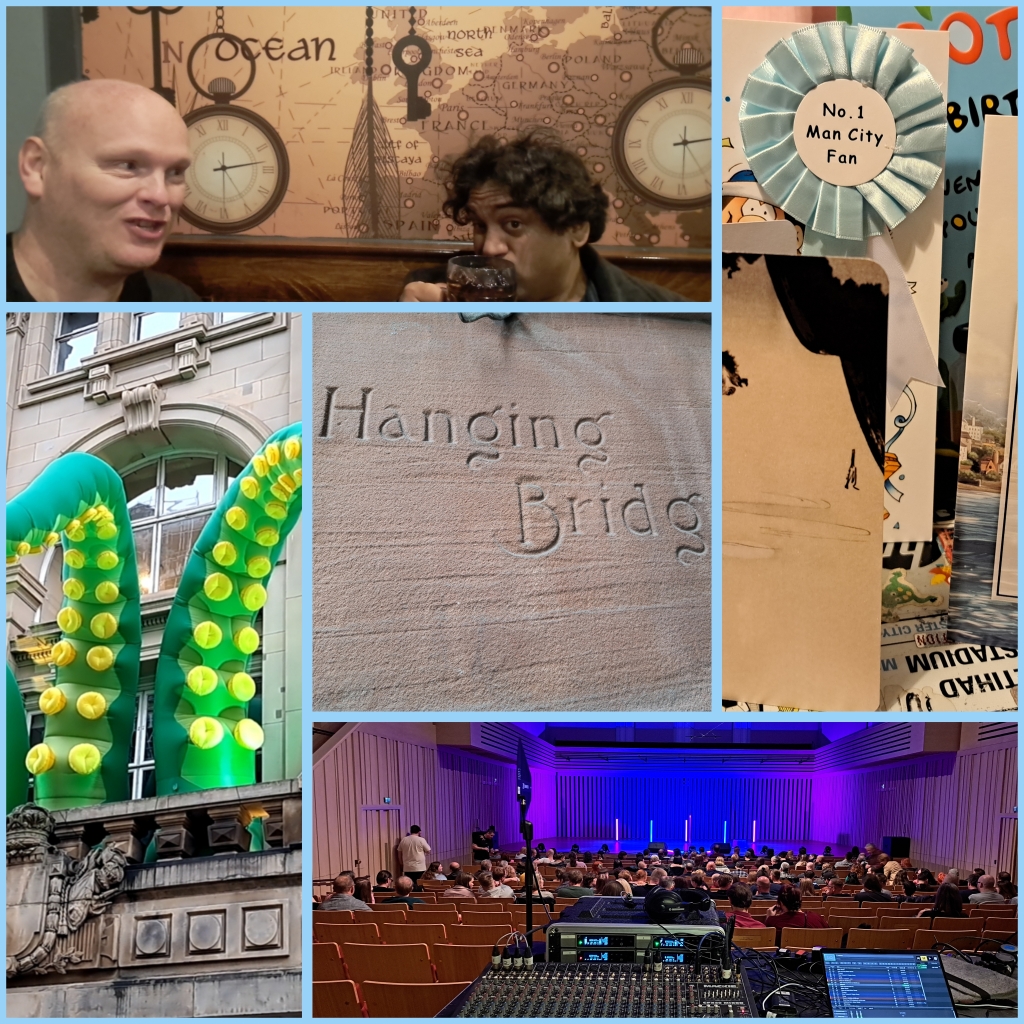
By Friday, I had added one to thirty-nine and reached forty (XL in Roman numerals). A pleasant Vimto ice cream with Brahma after coffee in The Rascals Cafe (Manchester Royal Exchange Theatre) with my sister Christina took up the afternoon. In the evening I met my Mum, Paul and Kat from Shenzhen Blues for dinner and to see comedian Nick Helm at The Stoller Hall. After getting back, I walked Panda and the pleasant day ended with slumber time. A happy birthday.

Next stop: Nanjing

你好/ Ní hǎo / Nín hǎo / Hello / How do / S’mae / Namaste,

34 years ago, Richard Skinner mentioned, “It’s 12 noon in London, 7am in Philadelphia. And around the world it’s time for Live Aid!” That’s the legendary concert that plays ever so well time and time again. But, whilst Twitter is trending, did the concert have an actual reason for showing? Seems to be of little note in all the flashbacks across the interweb. Whatever the problem was, it must have been fixed.


“All we hear is 👏Radio Ga Ga 👏…”


CITY OF SHANGHAI

SHANGHAI PIN BADGE IDEA 1My checklist from 2016, of things I must do in China has been reduced. I ticked off visiting Qingdao, flying a kite, and in five days, Shanghai, a city my grandfather visited will be marked off. I triefd Chinese art, caligraphy and kung fu. All were insults to their heritage. At least I tried once or twice.

Changning, Baoshan and Pudong districts of Shanghai once had Marks & Spencers. The city has a French concession region and the Bund is world famous. So, will I be in China or a European city? I’ve been reading up on things to do, places to see etc. Aside from City’s game versus Newcastle Utd or Wolves, I’ll get cultured in five days when I visit Shanghai.

#1 Shanghai Museum #2 China Art Museum (Line 8) #3 M50 for urban art & Jade Temple (玉佛寺/Line 13, Jiangning Road) #4 Xuhui Riverside Park wander. #5 Jewish Refugees Museum – and the ghetto in Hongkou #6 YuYuan Park #7 Sculpture Park #8 Wusongkou Paotaiwan (Line 3: Shuichen Road) #9 The 1933 Old Millfun #10 Zhujiajiao water village (Pine 17) #11 Huangpu’s Garden Bridge #12 Chuansha park #13 复兴公园 Fùxīng gōngyuán

I’m still trying my best to understand customs and Chinese culture. I’ll mark it as done. It will go on forever. I’m still trying to learn Mandarin (slowly).

The things remaining from that list of 33 now stand at just 5:

1. Visit Kunming and Yunnan.

2. See the Terracotta Warriors.

3. Visit Hangzhou, “Paradise on Earth”

4. Check out Jiuzhaigou.

5. Visit Chengdu.


CITY OF NANJING

NANJING PIN BADGE IDEAFirst up, tomorrow I travel to the 2008 Habitat Scroll of Honor of China city that is Nanjing. I’m looking forwards to seeing the City Wall of Nanjing (南京城墙 Nánjīng chéngqiáng), a wall that heavily influenced the Forbidden City of Beijing. The Jùbăo gate (聚宝门 Jùbăo Mén) looks atmospheric. I may start my wall walk from Zhonghuamen Station. Keeping with the word city, there is Shítóu Chéng [石頭城] or Stone City by Hanzhongmen Station. Maybe I can look up Purple Mountain ( Zĭjīn Shān) because of City’s new purple trim. It has UNESCO status of some kind and many places to view that you wouldn’t see every day (the Imperial Tombs of the Ming and Qing Dynasties: 明孝陵/Míng Xiào Líng). The Ming Palace [明故宫Míng Gùgōng] located by Minggugong Station will be a good place to explore too. Most call it the ‘Forbidden City of Nanjing’. Or, for ceramc value, I can check out the Great Bao’en Temple [大报恩寺].

Nanjing seems to be a city famed for mausoleums and the massacre during China’s bitter war with Japan. The museum of the massacre [Nanjing Massacre Memorial Hall 侵华日军南京大屠杀遇难同胞纪念馆 – Yunjinlu station, line 2] will be an emotionally addition to seeing the Nanjing Museum. Then there is a museum dedicated to Nazi Party member John Heinrich Detlef Rabe who saved sheltered approximately 200,000-450,000 Chinese people from slaughter by the Japanese. Rabe was the Nazi party’s local head, as a Deputy Group Leader in China. On one hand, he saved, on the other hand, he supported the Nazi cause. However, he did something monumental and saved many, many lives. Following his return to Germany, the Gestapo prevented Rabe from reaching Hitler. In his hand letters and documentation. His desire to influence Adolf Hitler and pass a message to the Japanese to cease their activity never was heard.

“It is not until we tour the city that we learn the extent of destruction. We come across corpses every 100 to 200 yards. The bodies of civilians that I examined had bullet holes in their backs.” – Rabe’s diary notes: December 13, 1937.

Soviet NKVD agents for Russia and then the British Army interrogated John Rabe following the war. He had a miserable few years following de-Nazifying. However, The Good German of Nanking (his wartime diary title), received food, aid and cash packages from the grateful people of Nanking. This continued until the Communists took over the city of Nanking. In 2009 a Chinese and a western movie portrayed John Rabe’s wartime experiences.

In 1948, the citizens of Nanking learned of the very dire situation of the Rabe family in occupied Germany and they quickly raised a very large sum of money, equivalent to US$ 2 000 ($ 21,000 in 2019). The city mayor himself went to Germany, via Switzerland where he bought a large amount of food for the Rabe family. From mid-1948 until the communist takeover the people of Nanking also sent a food package each month, for which Rabe in many letters expressed deep gratitude.[18]

The south bank city of Nanjing sits in the Yangtze Basin. It was historically known as Nanking, which I believe was purely to confuse me. China’s Three Furnaces are Wuhan, Chongqing and Nanjing so I won’t be expecting to see any snow. The average July temperature is 28.1°C (82.6°F) and I’ll be using the subway’s Jinlingtong (also known as IC-tong) to escape the heat between places.

On matchday, I’ll have a gander at My Town Bar around 3pm with fellow City fans. I wonder which City Legend will be alongside City mascots Moonchester and Moonbeam. Then it will be over to the Nanjing Olympic Sports Centre Stadium – and I must get a quite unique photo opportunity with the Premier League trophy, FA Cup, Carabao Cup and Community Shield.


After Shanghai, I fly back to Shenzhen, whiz up to Dongguan and then zip over to Hong Kong the next day…

CITY OF HONG KONG


再见/ Zài jiàn / Bài bài / Ta’ra / Goodbye / Hwyl Fawr / Dhanyabaad / Alavidā