“No warmth could warm, no wintry weather chill him.” – A Christmas Carol, Charles Dickens
Over 179 years have passed since Chapman & Hall published A Christmas Carolon December 19th, 1843. The original title Charles Dickens has been lost to time. A Christmas Carol. In Prose. Being a Ghost Story of Christmas remains. Have times changed? Is the novella outdated and irrelevant? Or, is their a reason why its story remains an enduring feature of the stage, silver screen, print and audiobooks? Crikey, even Sir Patrick Stewart reads parts on TikTok. “That is what it is to be human: To make yourself more than you are.”
“You may be an undigested bit of beef, a blot of mustard, a crumb of cheese…” – A Christmas Carol, Charles Dickens
The book, a well-visited tale is divided into five staves. These parts allow three spirits to visit between an introduction and a conclusion. The structure of the novel is clear and flows, making translation to multiple language feasible and lasting. Its story takes place in just a 24 hour period, making it the inspiration for Kiefer Sutherland’s Jack Bauer (not the cyclist from New Zealand). As tough as Jack Bauer is, the central character Ebenezer Scrooge appears unbreakable. A tough old boot.
“I mean to give him the same chance every year, whether he likes it or not, for I pity him.” – A Christmas Carol, Charles Dickens
A plethora of retellings, re-imaginings and interpretations have crossed political and social borders. Whether it is that of Bill Murray, Ebenezer Blackadder, or Michael Caine opposite Kermit the Frog, the central character Ebenezer Scrooge is instantly recognisable. Look closely at Dr Seuss’s The Grinch and you’ll see Scrooge in cold-hearted green. Stave one sees cheerful and kind-hearted Fred visits his mean Uncle Ebenezer at his counting house. He persists and resists spirits being dampened by Scrooge’s venomous tongue. Invited to a meal, Ebenezer Scrooge declines. As he does for a charitable donation request. Charity muggers are sent away. Soon, at his home, he sees a dead business colleague in his door knocker. Startled by that encounter, he is later visited by the chained ghost of Jacob Marley. Marley warns penny-pinching Scrooge that his future is bleak, should he not change his ways. He also warns that salvation can be sought following the visit of three ghosts. Plot delivered.
“I’ll keep my Christmas humour to the last. So A Merry Christmas, uncle!” – A Christmas Carol, Charles Dickens
Stave two sees the Ghost of Christmas Past, take Scrooge back in time. Here he views his previous boss Mr Fezziwig. In an old-fashioned take on BBC’s The Apprentice, Scrooge’s version of Alan Sugar is seen within the workplace displaying all forms of warmth, generosity and benevolence. The jovially affectionate nature of Fezziwig contrasts with his moderate profiteering and highlights how bigger traders were sweeping aside the small ownership family businesses of the 19th century. Fezziwig is very much a Baron Sidney Lewis Bernstein (Granada TV founder) of his time.
“Hard and sharp as flint, from which no steel had ever struck out generous fire; secret, and self-contained, and solitary as an oyster.” – A Christmas Carol, Charles Dickens
The ending of the stave is too sad for Scrooge to take. Scrooge protests and resists, waking up in his bedroom once more. His ephemeral encounter had been well-meaning, yet here Scrooge must have known that more was to come. He could not have known what those next two likely encounters would entail. Scrooge’s welfare was safely out of his hands for the moment. Could he rise and walk again?
“Most of all beware this boy, for on his brow I see that written which is Doom, unless the writing be erased.” – A Christmas Carol, Charles Dickens
Bob Cratchit is the uncomplaining clerk to the parsimonious Scrooge. He does what he is told, almost like an obedient dog. This timid man is married to Mrs Cratchit. His wife in her “twice-turned gown” is the gratuitous optimist. She makes the best of a bad situation. Next in the family is Martha Cratchit, a hatter, just like many Stockport folk once were. It remains to be seen if she suffered from Mad hatter disease (a form of chronic mercury poisoning, associated with the hatting industry). The Cratchit family have a son, and here forms stave three. Bob Cratchit’s mundanely repetitive job counting cash for his superior could ill-afford him time of leave to stay with family at a Victorian-era Christmas. As Christmas grew, so could Bob’s internal worries. Tiny Tim appeared a condemned young soul.
“”It’s only once a year, sir,” pleaded Bob, appearing from the Tank.” – A Christmas Carol, Charles Dickens
Tight-fisted Scrooge joins the jollily prophetic and welcoming Ghost of Christmas Present to visit Tiny Tim. Tiny Tim, not to be mistaken for the late singer-activist Hebert Butros Khaury, is ill and proper care cannot be given. The Cratchit family suffer in the same niche as many Mancunian families do in the 21st century when seeking mental healthcare. Tiny Tim may have had origins on a real boy in the old mills of cotton-factory Manchester. Kind, thoughtful and incapacitated as Tiny Tim is, this character radiates positivity and reflects his family’s attitudes to challenging shortcomings. To quote my elder brother Asa, “It is what it is.”
“If he be like to die, he had better do it, and decrease the surplus population.” – A Christmas Carol, Charles Dickens
After being told that Tiny Tim will snuff it, the Ghost of Christmas Present visits Fred’s house and highlights two hideous representations of ignorance and want. Danger was afoot. Gratefulness and sympathy lay firmly in Bob Cratchit’s court, yet the bad-tempered leader Scrooge’s connections and empathy lay far away from humanity. Think Wolverhampton-born, St John’s College-educated Immigration Minister Robert Jenrickpainting over murals in a Kentish centre of children’s asylum. Scrooge would have been proud? His leadership team in Parliament are just after stopping immigrants on boats. And welcoming children.
“Still the Ghost pointed with an unmoved finger to the head.” – A Christmas Carol, Charles Dickens
The Ghost of Christmas Yet to Come enters stave four. His ominous, dark and silent presence guides Scrooge to the possible death of Tiny Tim. Other visions also guide Scrooge from the dark side to the side of the angels. One of which sees a grave with the etchings of Scrooge’s name. After you’ve seen scallywags sifting through your abandoned rucksacks and filing cabinets, I challenge you not to feel glum. Imagine listening in on relatives bickering about your Last Will and Testament. Let’s hope that’s not too relatable. Balance your books before you go.
“…a solemn Phantom, draped and hooded, coming, like a mist along the ground, towards him.” – A Christmas Carol, Charles Dickens
Stave five ends positively, as the latter stage of the book follows the transition of Scrooge from out and out despondent miser to benevolent altruist. He gives,. He rewards. He feels joy again. Tiny Tim doesn’t die. In fact, Tiny Tim gets the equivalent of a Godfather. Christmas once again is filled with merriment. Solitary death averted, Scrooge is reformed. He can even take a joke. Redemption in under 24 hours.
“Let him in! It is a mercy he didn’t shake his arm off.” – A Christmas Carol, Charles Dickens
During the Victorian era, Love Actually and E.T. couldn’t be screened on televisions. Those technologies hadn’t arrived. Ghost stories were the hip way to spend time. Dickens went further than most, smothering his with wealth, injustice and all the injustices of wealth distribution of Victorian England. It pre-dated Downton Abbey but equally its conflict in social responsibility is shared. The importance of family and love at Christmas is growing, with dinners, carol singing, trees, cards and high spirits increasing. Christmas is seen as a time to bring people closer together. Its religious meaning is present, yet less announced. Those without would, no doubt, see what they are missing. Inequality was rife and obvious.
“Emancipate yourselves from mental slavery; None but ourselves can free our mind…” – Redemption Song, Bob Marley & The Wailers
The aftermath of diving into A Christmas Carol slams home the message that children are the responsibility of all mankind. Not that Robert Jenrick would agree. Perhaps he shall read this novella realise the failings of only thinking of oneself. Or, like many Conservative ministers, likely maintain a selfishness that the richer elements of Victorian society once held. Poor laws, prisons and workhouses once dealt with the poor destitute working class. These days we have zero-hour contracts at Amazon and less-than-living wages at McDonalds. Perhaps, the final stave and its message of completion and possibility should be explored as a mandatory fit-to-govern the U.K. test. A bit of pity goes a long way. “The sound of” children playing and shouting should be “so delightful that even the ‘air’ is laughing.”
“God bless us, every one!” – A Christmas Carol, Charles Dickens
Here we go again… firstly Jimmy Savile was a vile and disgusting man who manipulated life and entertainment whilst preying on the vulnerable. Using his image was not an easy choice but it does carry an appropriate image. This man gained a knighthood in an Honours list selected by our state. Others have too. For less and for more. The Honours list is seen as a bit of a joke. Politicians and entertainers are put on a level field with those who do great things for others. Selfless acts placed alongside profiteers and pioneers of their own self-interest.
Do not underestimate the determination of a quiet man. That was his party slogan, because Iain, Duncan and Smith, is and was a dull guy. Iain Duncan Smith celebrated as he passed welfare cuts to society’s most vulnerable people. This Conservative MP has previously claimed breakfasts as part of his expenses totalling around £39. School pupils, under his government were allocated just 7 pence. 557 children could have eaten something for the cost of his breakfast. Didn’t he know Gregg’s bakery do a bacon barm and coffee for about two quid. I doubt this Edinburgh-born former military man would ever be seen drinking a mug of coffee in Gregg’s with the small people.
IDS was caught out lying about his university education at the University of Perugia he later was found to have dropped out of the Università per Stranieri. Later his website claimed fictious qualifications from the Dunchurch College of Management. IDS has been eternally sceptical about the UK’s membership of the dictatorship-like EU (it lets terrorists in), and was supported by Margaret Thatcher, the original Darth Vader of politics. IDS sat with Americans following the September 11th terrorist attacks and backed the invasion of Iraq ( a nation that has dropped in literacy, food availability and domestic fuel usage since the allied invasion). The quiet man turned up the volume in Iraq. Still it kept his wife (the ostensibly impoverished daughter of the 5th Baron Cottesloe) in good money (see Betsygate).
Following his demise as Prime Minister, Iain Duncan Smith seemed to be doing something right. He soon became the Chairman of the Social Justice Policy Group in 2005. It’s reports Breakdown Britain and Breakthrough Britain. Breakdown Britain were noted by the European Court of Justice, as “unfit for a modern democracy” and “verging on frighteningly authoritarian”. Very 1984 indeed. Whilst he re-joined the political foreground he noted a worrying rise in Anti-Semitism in Britain, but on the other hand, called for more British involvement in Iraq.
In 2010, Iain Duncan Smith ended employer’s rights to use mandatory pensionable retirement at the age of 65. On one hand, good. On another, it would mean people working for longer, with fewer jobs on the market. So, to suit longer lives, people need to work longer. In the same year Universal Credit arrived. This was a man who could live on £53 a week, presumably £39 for a single breakfast was a weekly treat. But then, he would have been too busy battling human rights laws and forcing people into work for welfare – and taking wealthy pensioners’ winter payments back without an actual way to do so. But then, he never was good with numbers.
Under his watch, Iain Duncan Smith has seen a huge increase in the use of foodbanks. Non-governmental organisations and charities. Even Oxfam questioned why the seventh wealthiest nation on the planet is struggling to feed its people. And on the 2012 United Nations’ International Day of Persons with Disabilities, people on benefits were told they could lose their support. These people with disabilities or illnesses ranging from cancer to paralysis or mental health would be forced by the UK government to work for free. This announcement came in December, to make for a lovely Christmas and New Year ahead. Personal Independence Payment would work alongside the Department of Work & Pensions, to ensure that being vulnerable could and would have meant death – around 2000 people died. Work your way out of poverty!
“We won’t lift you out of poverty by simply transferring taxpayers’ money to you. With our help, you’ll work your way out of poverty.” – Iain Duncan Smith, Conservative Party Conference, Manchester, October 2012
In 2016, Iain Duncan Smith quit the government. He didn’t like the “government’s austerity programme for balancing the books on the backs of the poor and vulnerable”. Presumably, it was because someone else had found a bigger and more aggressive axe than he could hold. But, forget all these minor problems, because in 2020, Iain Duncan Smith will be knighted for the for political and public service. He joins the late Sir Jimmy Savile (deceased so he is stripped of the title after death), [former Sir] Fred Goodwin, Rolf Harris, spies Anthony Blunt and Kim Philby, Sir Philip Green, Robert Mugabe (honorary knighthood, 1994-2008), Romanian Dictator Nicolae Ceaușescu (honorary knighthood 1978-the day before his execution on Christmas Day, 1989), Jean Else, television entertainer Stuart Hall, Benito Mussolini (honorary knighthood in 1923), Denis McShane, Bishop Donald Shearman, convicted child abuse photographer Chief Fire Officer Francis John Sheehan and Donald Tsang [曾荫权]. There are others including former Prime Minister David Cameron’s advisor Patrick Rock. Every single name in that list is inappropriate – and sadly many were not discovered for years, so who will join the notorious Honours list of shame next? Enjoy your honours.
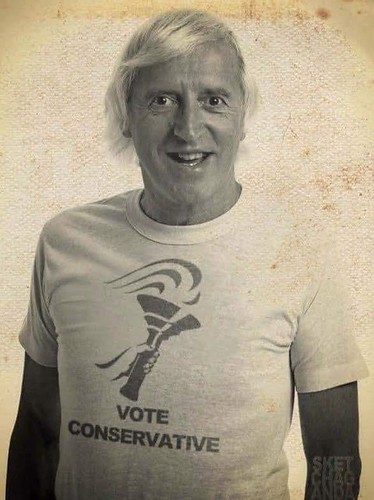 Here we go again… firstly Jimmy Savile was a vile and disgusting man who manipulated life and entertainment whilst preying on the vulnerable. Using his image was not an easy choice but it does carry an appropriate image. This man gained a knighthood in an Honours list selected by our state. Others have too. For less and for more. The Honours list is seen as a bit of a
  AGAINST THE FLOW OF TRAFFIC - ACTON28.BLOG