Summer ’25: VII – Dali (again) x Nanning

A cuddly panda left behind. It needed rescuing. A stop in Dali was a necessity. Between wanders to temples and another cable car ride, things were taken easy, in a way holidays should be taken. Slowly and steady.

Stomach bugs are horrid. Talking on the porcelain telephone to the Almight above between vomiting and laying liquid pooh at a dramatic rate is no fun. A day of rest and little else felt like a waste. Sometimes you have to stay still to move forwards. Such crappy days demand rest. And water. Lots and lots of water. No matter how much was drank and how much medicine, it didn’t seem to shift. Until it shifted. And then it took a day for an appetite to reappear.

Cable car ride two (Zhonghe ropeway) required dangling legs and the breeze in our hair. The climb upwards had close views of squirrels on treetops and butterflies drifting below. At the summit of the ride, midway up Cangshan’s slopes, the Zhonghe Temple spreads across, underneath a relatively level footpath stretching for miles in each direction. The Cloud Pass (or Jade Belt Road) pathway runs for 20km (12.5 miles). Crossing waterfalls, jutting views, and numerous pools of water make the walk through fresh air and greenery a pleasant one.

Yunnan is famous for its connection to Tibetan living, Buddhist beliefs, cats, and nature. The mountains, valleys, and produce of the region are all closer to nature than other Chinese provinces. Behind the commercial fronts, there is a more open conversation being had, and with that more freedoms. It is rare to see women smoking, same-sex relationships, or plentiful pet dogs and cats around China’s huge cities and metropolitan areas. In Yunnan’s Dali and Shangri-la, this is the norm. Old values and West met East refusing to let go. The attraction of Yunnan is visible and bold. Fresh air and nature invite tourism and migration. This Tibetan plateau is much more than a tourist spot. It makes you feel. Connection never switches off.

A journey to Nanning would break our return to Guangdong. A late night arrival and a late morning departure made finding a hotel close to the station essential to the plan. If you enjoy living underground like the Teenage Murant Ninja Turtles, then Geli hotel is for you. Located in the shiny expanse of the Nanning East Railway Station there is little reason to see daylight again. A choice of late nights foods, drinks, and delivery services help you to chill deeper underground.

The railway check in level is just above the lair, so be prepared for bright light when you choose to resurface. A decent room with an unusual view behind massive curtains. Expect comfortable beds and a decent rainforest effect shower. The toilet pumps are a tad loud, like the underground railway system, but sleep comes as easy as a fox in a den. With sleep in the bag our 1128 train to Guangzhou South was easy. The 17 minutes to transfer at the other end was a tad tight. All in all, we did it. We connected well. Job done.

From wanders on high to hours on trains, the pleasantries of travel made way for return.

Summer ’25: VI – Shangri-la III

The slow ride on the altitude-gaining train involved various stops. Passing loops. Halts. Two stations. Sales pitches along the railway carriage. Glorious views sandwiched by lengthy tunnels. More tunnels. A relaxed pace ride through even more tunnels. The usual high speed of China’s modern rail network suddenly felt more sedate. The 304km (189 miles) Dali to Shangri-la train ride didn’t whiz by, but the views between the tunnels were nonetheless fascinating. 4 hours and 19 minutes later, we arrived. My third time to purposefully visit Shangrila.

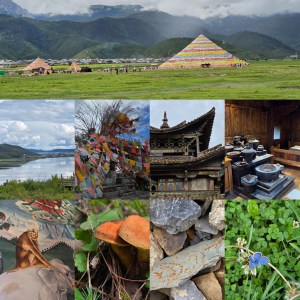
Departing straight into a local taxi (Didi滴滴) the flats of Xiānggélǐlā 香格里拉 spread out. A wide valley of farmland amongst mountains and foothills. Picturesque didn’t fit the description well enough. Cattle crossed the narrow road. Horses in lines moved with passengers on their backs. Many visitors wore Tibetan attire for photographs. Vast colourful prayer pyramids rose from the ground. Much was geared for photographers and travellers. Between the lines, the real Tibetan vibes and cultures intertwined a rapidly growing western front of China.

3km to the west of the railway station, a lodging was booked. The Lodge, Shangri-la Lao Shay Youth Hostel [香格里拉老谢车马店] is a dated yet cosy wooden lodge of three floors on the Napahai grasslands of Xiānggélǐlā at [石卡雪山纳帕海景区石卡路吉奴古村]. The sharp roof, underlay by two floors with fully-covered balconies, and timber towered over a small open courtyard. A secondary building, like a letter-L, stood to its left, housing an internal courtyard. The hotel’s names stretched across the side. A small faded sign erected at the roadside broke up a field of emptiness. In Tibetan the name looks better [སེམས་ཀྱི་ཉི་ཟླ།]. The barley wooden frames scattered by roadside and along the grasslands

A trip to the Shangri-La Alpine Botanical Garden (香格里拉高山植物园) didn’t disappoint. Seeing wild hares, a plethora of birds and insects, and countless plants filled the majority of an afternoon. The high-altitude 7,247 hectare garden of flora overlooked the expansive Napa lake below. The world first low and high altitude garden happens to be the Tibetan plain’s sole dedicated botanical garden. 30RMB well spent. We exited the park at 1830, slightly after the 1700 closing time. On returning, we walked to Gongbi Village Stop (贡比村站) and admired the drones flying iver the farmland spraying whatever it is on whatever was growing. Over the road the traditional hand methods tended to wheat fields.

Later, I’d research the longest tunnels and be shocked that a ten mile long tunnel we’d passed through didn’t even make China’s top 395 railway tunnels! The engineers of China have built incredible spans of bridges and underground tunnels, making it hard for you to comprehend or imagine the scale of the great nation of China. Its lands are 9.57 million km² (3.7 million miles). All of the land of Europe is 10.53 million km² (3.933 million miles²). And bigger than the USA. Only Russia (almost double) and Canada (by a smidgeon) are greater in size. Travelling in China really shows you how far and how diverse the landscape is, even if cities and towns take on a copy and paste feel. You’re never more than a mile from a Luckin Coffee (China’s equivalent to Starbucks or Costa Coffee). Other coffee shops are available.

Summer ’25: III – Bamboozled

Treated by family to a spot of travel and unwinding, we set off from a station nearly an hour from the place of residence.

In Guangdong, like many cities in China, you can drive by taxi for an hour and not leave the jurisdiction of that same city. Not even close. So, we arrived at station one, departed for station two, and arrived at station three in Yangshuo. 300 miles [482km] travelled across 2 hours and 42 minutes. Or further than London, and quicker than any British railway journey. Huizhou is massive at around 4,217 square miles [10,922 km²]. It is substantially large compared to neighbouring Dongguan, Shenzhen, and Guangzhou. A formidable region to navigate.

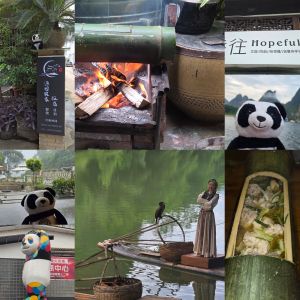
Badly Drawn Boy’s Everybody’s Stalking marked the train journey’s early moments through the tunnels of Guangxi. Through fine lyrics befitting the view out of train D1814’s window, the train rolled into the Karst-mountain surroundings of Yángshuò (阳朔). A quick lift from our hotel owner seen us dropped off at the digs, 阳朔源园饭店(20元人民币风景区店) 兴坪镇画山厄根底村76号, which is with Ergendi village. A bag of huángpí (黄皮) wampees (Clausena lansium) followed a delicious dinner. The grape-sized fragrant fruit, with a large seed core, sat well on a belly of bamboo-cooked sticky rice, some baby bamboo shoots, and pork sliced between taro. After seeing the cormorant fishing birds posing, the Li River (漓江Lí Jiāng) flower, and a multitude of tourist boats, nightfall followed a heavy storm. Bedtime soon followed.

Seems like many paradise regions become Piccadilly Gardens: that once flowery bowl of sunshine now covered in concrete and steel. The village of XingPing, near Yangshuo, has undertaken drastic growth in little over two decades, and really symbolised the idiom rén shān rén hǎi (人山人海) or people mountain, people sea. Allegedly the river Li below flows with over 215 cubic metres per sec9nd. The people on the shores seemed equally dense. Photographers, fashion people, tourists, local canvassers, and every manner of people seemed to congest the tiny footpaths of XingPing (兴坪) village.

We had a plastic bamboo raft trip upstream on the Li river, savouring the humongous Karst peaks and bends of the powerful river. More food, including a full chicken boiled in a soup within a bamboo tune followed. Plenty of wandering was had. Sadly, without speedy legs, the waterfall pond, Pubutang and Tiger Mountain Waterfall shall have to wait. Our train outwards to Guiyang was caught on time.

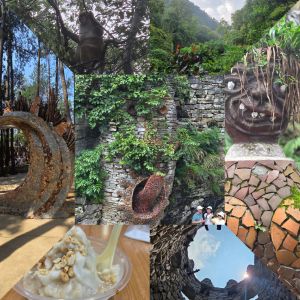
Guiyang straddles the eastern edge of the Yunnan-Guizhou Plateau and is apparently around 1100m [3600′] in altitude which may seem debatable as you traverse districts. The roads resemble Spaghetti Junction in Birmingham (England) with bridges crisscrossing lengthy tunnels and slopes throughout the surface routes. A decent subway and rail system serves the city and outer region. The Yelang valley was a pleasure to visit, a truly unique and hidden gem within China. Twenty years were taken for the recreation of an ancient culture. The stone sculptures and artwork are fantastic. Song Peilun’s vision is a highly recommended visit. Oh, and we saw a monkey at the Qianling Mountain Park, having clambered a large peak and being consumed by a passing storm. That was fun.

Summer ’25: II – Resurrection.

Kitted out with 20kg of luggage, first a tram then a train before midnight allowed Manchester International Airport to be reached. After an evening and afternoon sleep from 1600-2300, I felt refreshed and raring to go. I pottered around with my Greggs breakfasts and waited to fly.

Even as the alloted 0300hr check-in desk opening came, I still had energy to burn. My bags would rejoin me at Brussels Airport, having flew with Brussels Airlines. The world’s longest lines at passport control and the outbound gate were troublesome. The sign reading “last call” for boarding came and went. Without doubt, being second to last on the Hainan Airlines flight was nerve-wracking and not one to recommend Trip.com’s self transfer routes! I had to plead to move up the queue many times. I begged. I pleaded. I reached a wall of negative responses but managed to get there. I hate queue-jumping but I had to force the movement. Needs must!

Mickey 17, Gladiator II, and a few episodes of David Attenborough’s Asia wildlife documentary sandwiched attempts at sleep. The former of the two movies comes highly recommended for reasons of originality within the sci-fi genre. Also, fine acting from numerous characters and a fair dollop of wit gave the movie a largely good rating in my eyes. I rested as much as possible.

Landing at Shenzhen around 0500hrs on the Saturday after departing Manchester at 0600hrs on the Friday remained a good move. The timezone difference of 7 hours, a delayed departure from Manchester, and all the stress of Brussels lifted. I had made it: much thanks to family and friends for helping me to get there. Better late than never. One small step for reunification, one giant leap for family-kind.

Holes in the Earth: A Wander

Manchester Victoria train station has a huge map on tiles. It’s part of the historic Lancashire and Yorkshire Railways station. Before split ticket applications. Before multiple rail network and ticket prices. Simpler times. A glorious end point, or a beginning, or an interchange. My Dad worked here many times. He fell off a ladder there too. Dad’s memory hasn’t been right since! Today, Friday, May 30th, a train departed at 07:21 to Leeds. Panda and I boarded it.

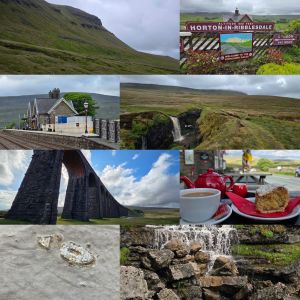
Hull Pot is surprisingly close to Horton in Ribblesdale village. A reasonable sub-hour wander up a gradual incline lined with stone makes for a decent ascent. The only difficult aspect was to turn left after around 5 minutes of leaving the B6479 (Pennine Way road) onto the Pennine Way footpath, just after Horton Beck, heading away from Brackenbottom. Head straight forward and ignore any left or right turns. Hull Pot is toward the hamlet of Foxup. Horton in Ribblesdale station has a small cafe and ample amounts of lodgings for walkers. We needed neither so trod onward and upward.

Hull Pot (91m/300′ long) is neither ceramic nor cannabis or belly. It is a quaint chasm (18m/60′ wide), opening into a gully (18m/60′ deep) of water and greenery, with thunderous cascading water pouring down a steep face of bare rock. The incredible flow of a visibly disappearing river thumped downward into a gap of glistening rock. Not the sort of place to dangle your legs unaided, yet certainly a place to watch every step. The next one may be your last. Watching Panda on a shortened lead warned me of how simple one step beyond could become fateful. Just a trip over the lead; And then a step to the right; Put your hands on your hips; and pray you don’t fall. No more Time Warp references. Sorry Richard O’Brien.

After the great view, heading as the crow flies towards the visible pathway up Pen-y-Ghent takes you away from Hull Pot‘s waterfall vista. Pen-y-Ghent, devoid of trees, shows the passage of time, weathered and individually steeply rising from a patchworked green landscape. Like Hull Pot, there are collapsed limestone features, just of rock, and streams like the one that submerges at Hull Pot only to re-emerge at Brants Gill Head. Sheep, and lambs during lambing season, are everywhere. They’re either looking for selfies or confused by Panda the border collie not trying to round them up. Today’s climb involved clouds and battering winds at the higher points, only to part for sunshine and calmness as I set off downward again. The view at the summit being somewhat shrouded by rolling clouds.

On the path downward, and barely yards from many passing feet sits another hole (Hunt Pot) in the ground. Again a waterfall slips into the broken gash of earth and a huge volume of water disappears from the ground above. Hunt Pot (60m/197′ deep) is a spot more than worthy of a good sit down, rest, and respite. Butties of radish and prawns, katsu coleslaw, and an avocado alongside a gallon of Vimto did the trick. I tucked into Ben Macintyre’s A Foreign Field, devouring a few pages as Panda rolled around in the grass. Photographs were taken of the hole and its waterfall, at which point, I decided the Ribblehead viaduct (detectable from the peak of Pen-y-Ghent) was now the walk’s targeted end point. That and the Ribblehead station, a few yards away.

Following the footpath, near parallel to the discernible flow of the River Ribble, Panda and I passed through farm fields, traversed High Birkwith, the wild flow of Coppy Gill, Brow Gill Beck, and the charming Cam Beck. Emerging onto Inman Lodge Road (B6479), turning right, the bends of Gauber Road reach Low Sleights Road (B6255) and The Station Inn (1879), at Ribblehead Viaduct. A brew, coconut cake, and a sit down were necessary. I’ve always found this area magical. It has an aura. It always calls me back. The oystercatchers, fossils, viaduct, green, and solace. My fortress of solace.

Batty Moss sits beneath the 24 spans of the Ribblehead viaduct. Modern diesel trains roll over this site and have done since the 2nd of August 1875. The picturesque bridge itself was constructed over half a decade. Over a 100 souls perished during its construction and remains of navvy camps can be found in close proximity. Thankfully smallpox, navvy brawls, and the perils of producing a 400m (440 yards) bridge are less of an issue for a rambler in 2025. The 32 metre-height (104′) may cause the odd person to stumble in awe, on a ground covered in natural potholes and squishy mosses. This sensation is often exasperated by steam locomotives crawling over the vast span of bricks and stone. After a wander seeking fossils within the bridge’s gigantic bricks, Panda and I wandered up to the old station at Ribblehead and hopped aboard a train to Leeds. Manchester Victoria was to be our final stop before home and bed. Feet up. Lovely day.

The 15 miles (24km) of walking can be found here (featuring: 2,464 ft/751m up & 2,231 ft/680m down).

Kinder Scout Eggs

There’s a direct line from Brinnington to Hope. A world of differences between Ashburys and Marple. Too few similarities between Reddish North and New Mills Central. Yet the line from Manchester to Sheffield offers gems and escape. Friday the 25th of April 2025 led a path between Piccalilli train station and the quaint village of Edale.

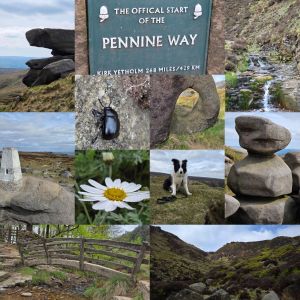
Upstream to Grindslow Knoll, required a short wander through the village of Edale, passing the beginning of the Pennine Way. The Rambler Inn, The Nag’s Head, and Newfold Farm Cafe give a feel of what the tiny village of 400 centres around. An old and active primary school, set amongst the varied farm houses, country cottages, and Edale Parish Church show that life here isn’t all wandering. A path diverts from a truncated road over Grinds Brook. The protected stream will accompany mist walkers until Grindslow Knoll.

The paths start gentle with some undulating, before rocks, boulders, and scree start to appear intermittently. Heathers and moorland flora decorate either side of the funnelled valley. Eventually the bulk of Grinds Brook splinters into two sharp rises. Banking left involves a scramble, some choice pathway making skills, and a substantial incline. The views are increasingly dramatic. At the top, looking toward Mam Tor and Edale, much of the distance appears green and sprawling.

Following an old slabbed walkway, the journey takes explorers to a rock formation known as the Woolpacks. Peat bogs, heather, and alien-looking rocks litter, cluster, and emerge along the Kinder plateau. They mark the final wander to the peak of Kinder Scout and are a highlight for many walkers. Mermaid’s Pool, Charged Rock, and countless unnamed landmarks are worthy of an exploration.

The descent from Grindslow Knoll’s shady rear allows for farmland wanders along wide open pathways and a gentle jaunt on the home straight. Edale awaits. Edale sounds like a cake. The delicious Penny Pot Cafe banana and date oat flapjack was the only cake I had that day. Succulent. Alongside a cappuccino it made for a great reward. Before boarding the 1647 train, Panda found many a crumb landed in his fur. He promptly removed them before flopping back, head on the floor, for a nap.

Return of the Bus Journey

No plan survives contact with the scheduled 76 bus. Nor the second timetabled bus. Arriving late into town meant one of two things. The 192 bus or a train. The train is the quicker option to Stockport. The price, a modest £5.30 one way, demanded a mortgage. The things you do to try to get to work on time. Cycling is off.

Having missed the 0748 Manchester to Bredbury train, I tried to slingshot ahead of the later service arriving to Bredbury at 0835. Sadly, the bus at Stockport’s Heaton Lane bus station was scheduled for 0835, too. Murphy’s Law. My cursed aching muscles and sudden varicose vein development on the right leg suddenly became weighted against a potentially exhausting bike ride to work the next day.

Having rang work to say I’d be late, I questioned how getting up earlier to arrive at work later made sense. This is Britain, formerly Great Britain. The new Manchester Bee Network for public transport is the least integrated and most underwhelming range of services known to mankind. People in Himalayan foothills have more reliable public transport options. Adding a rebrand to buses, trains, and trams in Manchester makes as much sense as being a Public Relations officer for Suella Braverman. Lifestyle choices, my arse.

Better late than never? I want to work. I enjoy my job. Today, however, I still feel worn down, lethargic, and done in. Still, it could be much worse. Jules Verne could turn this morning’s journey into an adventure. Likewise, it could be much better. Here’s to a blessed week.

Hartshead Pike Hill.

About 7.5 miles (12km) from Manchester, towering over Ashton-under-Lyne and Oldham, sits Hartshead Pike. A hill covered in history. Following Mossley Road, then a left turn onto Queens Road, before a left onto Nook Road, will allow walkers a two mile walk to the foot of the hill.

A left after The Lord Nelson pub gets you to Greenhurst Lane and a trail in the top left corner. Old cobbles and bricks line a path towards Knott Hill Reservoir. Many pathways branch away up to Hartshead Pike, and some pass the odd horse or ten. Scenery and rocky places to tuck into sandwiches are also present. The view back to Manchester isn’t bad either. On a clear day, like May the 13th, 2023, you could and can even see Welsh hills, Jodrell Bank Observatory, and Winter Hill. The whole of the Cheshire plain and huge chunks of Greater Manchester are visible.

The historic monument above Lily Lanes has been there since 1863. Before then another. And, before that possibly a Roman beacon. The hill is just 940 feet (290m) high. A walk down Lily Lanes, leads to Broadcarr Lane and eventually the picturesque town of Mossley. A fitting way to slide away by railway, back to Manchester, with Panda and mates to hand. The walk itself and return journey make it possible to visit the area within a long evening. Although, as the weather is sodden, at the time of writing, I’d take wellies and an umbrella now… and a torch, seeing as sunset is about to occur at 21:40ish…

Village Station

The driver of the taxi asked why I was heading out so early. I had told him the train time. He replied, I was “going to station with nothing there.” I said all was well. He repeated that the South station was bigger. The North station is new. Nothing there.

On arrival, I exited the car and strode into the mammoth station. The same station had been visible for miles before. It towered over fields and stood out against the distant mountain backdrop. Construction sights lay to the south. The future, planted over land. Towering carcasses of homes yet to be lived in.

The small station door opened to a gargantuan air-conditioned palace of seats and emptiness. Little life lurked within. A few stragglers ahead of their train sat in the bright space, gloomily surrounded by thoughts and little else. Two places to buy snacks and food shone light outwards. Little else, but the beaming display screens gave any sense of activity. A list of a dozen trains spaced throughout a long barren day highlighting the newness of it all.

After a brief wait, a mouthful of terrible coffee and a chicken-based something or other, I descended to the platforms below. Through one of four gates marked a route to the ten platforms beneath. Four future platforms failed to hide their newness and dust. My gate, 2B, stretched wide before passages led down shiny steps and a string of escalators beating the sound of passage.

The long platform stretched under the concrete mass above. Polished tiles on the footway stretched hundreds of yards each direction. A dozen railway train carriages could fit under here, ten times over. Each tenth of the station could welcome and bid farewell to hordes of people, masses of commuters, and reunite the long divided souls of relationships come and gone.

The platform edge, trimmed in white and yellow, displayed floor electronic information boards, guidance, and warned of peril beyond its edge. Each rail beneath and cable above a guide for the monstrous intercity trains. I watched as the smooth gliding train rolled seamlessly along rails into a wide pit beneath the station platforms. It crept to a silent halt. The few passengers boarded. I waited until last. I stepped on board. The journey begins.

Stanage and An Apple

Eat five fruits and vegetables a day. That used to be the message from health-promoting government officials. Now there’s a message doing the rounds: limit your purchases of cucumbers and tomatoes. Great Britain is experiencing a shortage of fruit and vegetables. Europe is not, on the whole, struggling for green foods. The labour shortages on farms in the U.K. experienced since Britain exited the European Union, are being mirrored by asylum-seeking boat crews and filled seats. Unemployment rates in the U.K. remain high. Jackets and aid packages are being gathered and sent to earthquake-torn Syria and Turkey, whilst homelessness in the UK spirals into greater numbers. The U.K.’s economy is fragilestrike action is booming, and somewhere Shell, BPTescoRio TintoLegal & GeneralUnilever, HSBC Holdings, Vodafone, GlaxoSmithKilen etc are all doing really well. With the world being really stable, Shaun, Christina, Panda and I went for a wander.

The train journey duration from Manchester to the historic two platforms of Grindleford lasted just under an hour. Opened in 1894, the station bridged the lower reaches of Burbage Brook. The station close to Sheffield is just next to the 3.5-mile long (5.7km) Totley tunnel. Our path led from the toilet in the café, up the picturesque upper tributary stream. After a few hundred metres or yards (if you choose), we crossed a wooden bridge and ascended a pathway to a higher level. The deep narrow gauge of Padley Brook is completed by trees, mosses, and steep drops. All were avoided, thankfully. The rich, clean air, a welcome greeting, has left the air of Manchester behind. The temperate rainforest along this route are apparently the furthest inland of their kind, in Britain. Our route led uphill, with relatively unchallenging steps and climbs here or there.

At White Path Moss, a little further north of Toad’s Mouth, the moorland drains and forms the source of Burbage Brook. The gently flowing stream starts somewhere near Stanage Edge. On our walk we didn’t spot any water voles, but we did hear a variety of birdlife including the hawfinch and wood warbler. Nature perfectly cuts into the bleak moorland and offers veins of life amongst the scattered glacial stones and boulders. Dry wintery grasses jutted out from soggy soil and bogs. Walking boots were a cosy necessity.

Soon after crossing a road, stretching over the Burbage Brook once more, and ascending a slope we arrived at Carl Wark (370m/1214ft high). This rocky promontory juts out and on it are the remains of an Iron Age fort. The view from Higgor Tor (434m/1424ft) back to Carl Wark is impressive. You can really see Carl Wark as an island sat atop the sea of the moor. After scrambling through Higgor Tor, we moved onto the Stanage Edge (Stanage means ‘stone edge’). So we were on the edge of the stone’s edge. Popular with climbers, abseiling enthusiasts, walkers and artistic types we meandered a fair distance down the crinkly fragile crust prominence. We explored Robin Hood’s Cave and also crossed the Long Causeway down to Hathersage village for the train back. The famous crags and Panda, loose from his lead at times, make for heart-in-the-mouth opportunities. Luckily a well-behaved and heavier supervised dog could not be found. Panda behaved well when passing by St Michael’s Church and didn’t dig up the remains of the legendary 2.46m (8ft) Little John (Robin Hood’s buddy).

As we boarded the train, all shattered and hungry, I read about the Fat Boys Stanage Struggle and vowed to myself never to enter. The accent from Hathersage (91m/299ft) upwards is firmly not on my bucket list. More likely, a viewing of Pride & Prejudice filmed at parts of Stanage Edge. Perhaps, in the near future, we can wander up there again. The 13.5-mile (22km) route was most enjoyable in good company.

Step back: II.

Striding off the jet, up the steep long gangway into the terminal building, I plodded hard and fast. I walked with conviction. At the Terminal building luggage belt and special items, I had to meet Panda.

Panda, the border collie with attitude, had been boxed for 17 hours plus pre-boarding time, and was fast approaching the 24 hour mark. I passed passport control and wandered off to collect my luggage. Neither Panda nor my backpack had arrived. The conveyor spun around and eventually the 30kg juggernaut of a backpack arrived. I lugged it over to the area for oversized or special baggage and waited.

Amongst the discarded polythene wraps and seemingly forgotten golf buggies and cycling cases, I slipped back and slumped against a wall. Here I reflected that I was already feeling calmer having left China and its measures to achieve dynamic zero CoViD-19. I also was enjoying some diversity of culture, having mostly been surrounded by Han Chinese and Guangdong for three years.

“That mountain you’ve been carrying, you were supposed to climb.” / “你身上背负的大山,是你本该攀登的.”

Panda didn’t arrive quickly. Nor did the five other dogs being awaited by other travelers around me. After querying customer services, the glass door at the end of the annex to luggage slid open. Out on pallets slid a whole kennel of dog crates. Here a whining and happy Panda looked simultaneously pissed-off yet relieved. His owner, equally happy to see his puppy-like eyes.

“每个人都是独立的个体,但我们联系在一起” / “Everyone is an individual, but we’re connected.”

To Customs and the anything to declare section we went, showing our papers, well Panda’s jabs and rabies inoculation sheet, etc. The chilled out inspector handed back our papers and allowed us to depart, having not even looked inside the dog crate. Arrivals was above Amsterdam Schipnol and by a car park. Time to unleash the beast.

I frantically used a small metal key card to remove the straps fastened around Panda’s dog crate. Then we wheeled outside and pondered what to do with the dog crate. From here on, Panda deserved to be back on his leash and free. Immediately on opening the door, near to a tree, an excited Panda leapt out and washed my fast, and just as quick, squatted and deposited a bottom compost pile. I scooped it into a dog pooh bag and discarded it. But, the dog crate, unspoiled and un-soiled was a tougher matter.

“Don’t cry because it is over, smile because it happened.” / “不要因为结束而哭泣,微笑吧,因为你曾经拥有”

I looked around one outer flank of the airport railways station. Nowhere to be found. No places to donate a dog crate in close proximity. Not even an area for recycling or refuse. With time rattling away, I decided a bicycle park seemed a safe bet. I disassembled the dog crate and pushed it into a wide bicycle locker. It wasn’t a good idea to leave an unattended object of that size by a major international airport.

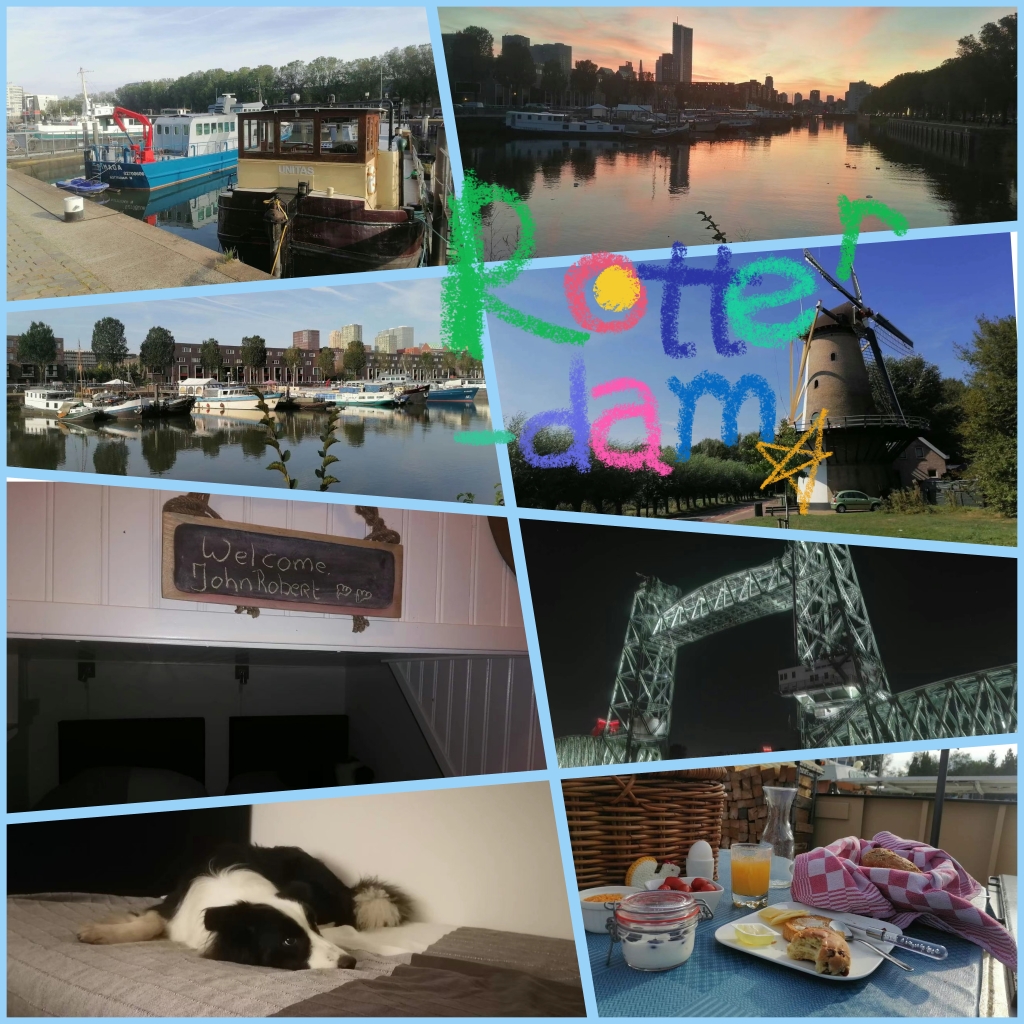
I had a pre-booked train ticket go Rotterdam for a hotel booked in advance. Now, Panda needed a ticket for the journey so I queued ahead of his first dedicated rail ticket. We both scuttled down to the platform for our train to Rotterdam Zuid Station. On the train Panda met a whole range of friendly people and I chatted to an Indian metallurgist working in the Netherlands. The country had made a very special imprint in a short space of time. Great transport, friendly people, diversity, many cycles and cleanliness. We’d only been there an hour and it felt so relaxed.

A brief stroll from the station to B&B Unitas at J.B. Bakemakade on the Binnenhaven Dock didn’t take long. Here the host allowed us on board and shown Panda and I to our room. A brief introduction and then we set out for Panda’s first well-deserved and much needed walk in Europe.

Starting in Rotterdam’s Feijenoord area, we headed towards the centre and admired the architecture. Well, I enjoyed the building shapes and designs, whereas Panda enjoyed the walls, corners, footers of lampposts and other fittings etc. After a good few kilometres, a lot of leg-cocking and no dinner, we arrived back at the quaint boat hotel.

Being about 193cm tall on a boat, I had to duck into the shower cubicle, which was considerably shorter. It wasn’t that I didn’t like it, or felt uncomfortable, but it’s certainly something to be aware of. Actually looking back on the stay aboard Unitas there’s nothing I didn’t like. The gangplank is a metal grill, which I didn’t like carrying Panda over it, because it is shoulder-width at best, however expecting a wider pathway is silly. The boat hotel is quaint, friendly and located close to Rotterdam Zuid train station. Red-eyed Panda and I slept like logs.

The breakfast, ate on deck, was deliciously fresh and hearty, from a basket and full of variety. The surrounding area was great for a wander with Feyernord’s football ground down the road, and plenty of shops around the corner. It’s an idyllic hotel, in a city but seemingly away from the hustle and bustle. I wouldn’t swap the experience for any other hotel.

Our long day walk took us across many parks but notably into Zuiderpark to see a windmill (by Kromme Zandweg), and eat a delicious and filling lunch at the calm setting of De Bonte Keukentafel. A perfect setting for an afternoon wander, complete with historic windmill and farm to its side. Again Panda received a fair share of attention. Welcome to Europe, Panda.

Panda and I stayed at the dog friendly boat hotel, for one night only, en route to Rotterdam Europoort. The hotel helped arrange a taxi towards our ferry, and off we went…

Hard sleeper.

Six cubic square metres. Space teeters.

Six bunks for warm souls. Sheets full of holes.

Sun beating in from the west. No rest.

Mountains to the east. Facing it with a feast.

Crispy chips and crunching cake. Smelly food they did take.

Coughing and spluttering. Aisle cluttering.

Masks off blowing noses. Ring a ring of roses.

Hot as a desert sauna. Flying biting fauna.

Whatever is that smell? Food bell! Food bell!

Smooth until the shunts. Wheels at the stunts.

Clickety-clack along the long track. No way back.

Stage VII: Chaka

你好!Nihao! Hello!

I arrived at Chaka Station (茶卡站, Chákǎ Zhàn) 151km from the gargantuan Qinghai Lake, and 300km from Xining. The smooth railway journey was sandwiched between sweeping views and seemingly endless tunnels. The train ground to a halt on the single track. A chugging diesel engine had swapped with an electrical unit at some stage of the journey. I guess that hour where I had a nap.

The station was immediately at the gate of the scenic area. Chákǎ 茶卡盐湖 Salt Lake (Yánhú) has a salted bed. That’s the reason for such a high level of reflection. There are salt mines around these parts. It’s known as a photographer’s wet dream. For 60RMB (less in off season) and a further 50RMB to board a quaint sightseeing train, there’s much to be seen across the 105 square kilometres of lake. I walked the 3km to my hotel, checked in and then walked back.

Chákǎ is a Tibetan word meaning salt lake. It’s located around 3059m (10,036′) above sea level. That’s probably the reason the Gaoyuanhong Inn has disposable oxygen canisters for sale. That and some salt products. Salt seems to be a thing here, having been mined for three millennia. I read the salt below the water can be 5 to 15 metres in depth. And, every time it rains more salt is brought down the valleys. The once sea area keeps providing. Some claim it is infinite.

There are sightseeing platforms and decking everywhere: a tall 30m tower; a platform with the words ‘I love Caka’; two hearts in love as a platform; and the mirror of sky squares. It’s a real draw for tourism, apparently attracting over a million visitors a year. Sculptures are present and some honour the Wuxian tribes who once harvested the plains and salts of Chaka. Closer to the present there’s an abandoned salt factory and salt-mining transportation hub. There are yachts, helicopters and all manner of ways to see the lake’s splendour.

A smaller lake, Sky Number One Lake, is a little east of Chaka Lake. However, I’m not rushing to it. My experience of saltwater is that it stings broken blisters, makes you really dry and forms a crusty layer over your skin. I’ll take it easy and enjoy the sunrise then have a wander.

Zai jian! Goodbye! 再见

Stage V: Wall’s End (Jiayuguan)

Nihao! 你好! Hello!

The pass at Jiāyùguān (嘉峪关) is the Ming Dynasty‘s western end of the Great Wall of China. From 1368-1644, the Ming Dynasty rid China of Mongols and had 16 Emperors. During which time, 168 years of facial lifts have led the Great Wall to it’s current state of appearance. That and some careful restoration work in the 1980s too. The pass lies on the Hexi Corridor (河西走廊 Héxī Zǒuláng) at the narrowest point, which is a plain between the Tibetan & Mongolian Plateaus.

For the afternoon, I visited the Overhanging Wall (悬壁长城), the First Pier of the Great Wall (长城第一墩; changcheng diyi dun) and Jiayuguan’s original fort area. The taxi driver I had selected had agreed 180RMB for the routes and waiting times. The 120RMB tong piao (ticket) allowed access to all three sites. Although at the pier site an electric car is on offer for 20RMB for those wishing to avoid the baking sunshine. The dry hot sunshine is only comfortable for so long!

The Ming Dynasty’s Great Wall’s western end was a slog down a valley to a closed bridge to look up as the river sloshed by heavily. The River Lai fed by the Qilian mountains gave life to many regions but here few plants braved the unforgiving desert earth. After a while I headed to the museum in the 56 metre high cliff face and the final beacon of the Great Wall. The signposts were published in English, Chinese and Japanese. The English mostly resembled gibberish. Although I ascertained that this part of the Great Wall was built around 1539CE across 18 years. With that I went to the Overhanging Wall, next to a huge desert with military operations under way. Best to avoid that. I looked down from the picturesque wall at a ski slope and wondered how such a hot place could ever get snow!

The final stop was the fortified city of Jiayuguan. The Silk Road’s trading and tax station of old. Rammed earth, yellow and sand-like dried mud mixed with rice pastes, stones and straw have been shaped to scar the landscape around this region. The wall, of course, was a defensive garrison and outpost of a nation growing in strength and stature. It could even be said that some sections would blend into the surrounding desert. For unlucky invaders, trenches would lay hidden on approach to the wall, often filled with hazardous death-and-pain-inducing problems. Gansu’s northwestern city of Jiayuguan is named after the pass. The loess and windswept substrate reflected the sunlight up and at you.

After exiting the ancient walls of Jiayuguan, I found the Great Wall Museum was long closed. It shuts at the odd time of 16:30. It being 19:30, I tottered back to my hotel and ate some local barbecue foods on the way. My aching feet appreciated the early night’s sleep.

Following a good sleep at the Railway Station Ibis Hotel and an okay breakfast, I was lucky enough to hire the same taxi driver for 150RMB. I had initially enquired about the July 1st Glacier and mountain park (七一冰川) but was advised the whole area is closed for safety and conservation reasons. So, a new plan was made. First we stopped at the underground tombs of 魏晋墓葬 (Weijin Muzang). Here you could only visit one of nine unearthed tombs. It being far below the surface. The museum is a little underwhelming as most of the tombs had long been plundered. The few artefacts and coffins on display are nevertheless impressive. On, by cart, to the tomb site, and you alight in a wide open space.

I’m in a wide open space. There’s a wooden shelter. Beside that a concrete block the size of a small garden shed. A mound of earth covered in pebbles and grit protrudes. A small metallic vent sits atop. It looks out of place. The aggressive sunshine beats down. I feel out of place. An electric police cart parks in the shed’s shade. It is out of place. The shed’s metal door opens on aching hinges. A policeman gestures for me to enter. He’s the site security man and ticket officer. He clips my ticket and points to a staircase. I slip down underground. A welcome respite from the heated day overground.

The 36C heat of outside fades in just a few steps. Subterranean coolness wraps around me. After a few dozen steps, I’m at a largely concrete anteroom. Here I see a wall and facade of great detail. A small arch allows access to the tombs beyond. I crouch and enter admiring the majestic brickwork entrance.

Inside the tomb’s tight entrance, the dazzling array of colours leap from the four wall. The brick dome overhead looms over my tall frame. I strangely feel no claustrophobia but do feel calm. The air is still and silent. It’s eerily unmoving. The details of the drawings and the colours envelop my eyes. It’s morbid fascination has grasped me. I visit the three tombs in a line ducking through short archways to enter each ancient gallery. No photography is allowed. The light flickers ever so slightly. I reach for my phone to use the torch function. It radiates a deep pocket within the tomb. The drawings stretch into a smaller tube lined with bricks and stones. It’s a magical piece of history. The region has ruins everywhere to see.

Next the taxi driver kindly visited Yěmáwān Cūn (野麻湾村). This village with a sand and rammed earth fortress nestles between corn and other farmland. Watermelons were being grown across the road. I shuffled around the wire protection fence admiring the sparrows and swifts that had made nests in the crumbling ruins. The front of the fortress faces the main road and the rear is less dramatic but well worth a wander. The flooded farm fields next to this barren piece of earth are suitably contrasting. The modern art of survival alongside the old dried and decayed survival walls. All in sight of the snow capped Qilian Mountains many kilometres away!

The Qilian Mountains (祁连山; Qílián Shān) peaks at Kangze’gyai around 5808m (19055′), not the name of the whole mountain range. Interestingly, the uncle of the notorious flying ace Manfred Albrecht Freiherr von Richthofen (The Red Baron) had once named the almost 800km long mountain range. Uncle Baron Ferdinand went with the local name of Richthofen Range. He also created the name Seidenstraße which these days we know as the ‘Silk Road’.

My silk road following was almost over. The D2758 train at 11:09 from Jiayuguan South will whistled through Zhangye West  on Sunday passing through a place called Mingle before arriving at Qinghai’s provincial capital city Xining for 14:36. The seat I should have been on in carriage 11, had a sleeping individual across three seats on a packed carriage. His snoring was causing perturbation to other passengers. I should him. Nothing. Again. Nothing. I said excuse me in Chinese. Nowt. So, I moved to an empty seat and hoped for the best.

The Qilian Mountains straddled my right hand view. Their snow caps contrasted greatly with the foreground view if rolling desert hills and the northern reclaimed agriculture on a plain once covered in arid nothingness. That’s all for now. Time to enjoy this train journey.

再见Zai Jian/Goodbye

Stage I: Xi’an

Departing Shenzhen International Airport for Xi’an city in Shaanxi province proved a problem. The 1050am flight was cancelled. That was a pretty hefty stumbling block. But, in checking the trains, Mr Oliver and I booked a long haul train from Guangzhou South to Xi’an via Zhengzhou East (wherever that is). We hopped in a Didi car and jumped on a high speed train from Dongguan’s Humen Railway Station.

Almost 11 hours later we arrived at Xi’an and used another Didi taxi car to take us to the Lemon Hotel. The wrong one. Turned out there are more than one, with similar names. We almost ended up at yet another incorrect Lemon Hotel. Bitter luck followed us to the right hotel though. Our reserved rooms with given away because we were late. So, we had a family room and checked out the next day rather annoyed.

We left our bags at left luggage, and gravitated towards to Xian city walls. The walls are around 14km around, although I didn’t do the maths. After just under three hours the circuit was completed. There was annoyingly a lot of sunburn. Oops. Major oops. The wall is a seriously good place to feel the city and get close to the historic grounds. However, most is quite commercial and bare. Nevertheless, the city walls and castle features are vast and photogenic.

Breakfast and dinner has been delightful. Xi’an really lives up to its reputation when it comes to variety and delicious foods! It seems everyone wants you to try something new or local. The belly may grow these days…

With the wall completed, and attempt to see the museum was abandoned due to sold out tickets. Some further walking was had followed by a park with an entertaining roller skating rink. Tomorrow, terracotta and upright old fashioned Action Men figures await.