Holes in the Earth: A Wander

Manchester Victoria train station has a huge map on tiles. It’s part of the historic Lancashire and Yorkshire Railways station. Before split ticket applications. Before multiple rail network and ticket prices. Simpler times. A glorious end point, or a beginning, or an interchange. My Dad worked here many times. He fell off a ladder there too. Dad’s memory hasn’t been right since! Today, Friday, May 30th, a train departed at 07:21 to Leeds. Panda and I boarded it.

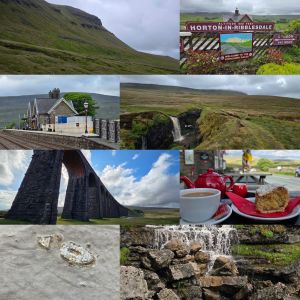
Hull Pot is surprisingly close to Horton in Ribblesdale village. A reasonable sub-hour wander up a gradual incline lined with stone makes for a decent ascent. The only difficult aspect was to turn left after around 5 minutes of leaving the B6479 (Pennine Way road) onto the Pennine Way footpath, just after Horton Beck, heading away from Brackenbottom. Head straight forward and ignore any left or right turns. Hull Pot is toward the hamlet of Foxup. Horton in Ribblesdale station has a small cafe and ample amounts of lodgings for walkers. We needed neither so trod onward and upward.

Hull Pot (91m/300′ long) is neither ceramic nor cannabis or belly. It is a quaint chasm (18m/60′ wide), opening into a gully (18m/60′ deep) of water and greenery, with thunderous cascading water pouring down a steep face of bare rock. The incredible flow of a visibly disappearing river thumped downward into a gap of glistening rock. Not the sort of place to dangle your legs unaided, yet certainly a place to watch every step. The next one may be your last. Watching Panda on a shortened lead warned me of how simple one step beyond could become fateful. Just a trip over the lead; And then a step to the right; Put your hands on your hips; and pray you don’t fall. No more Time Warp references. Sorry Richard O’Brien.

After the great view, heading as the crow flies towards the visible pathway up Pen-y-Ghent takes you away from Hull Pot‘s waterfall vista. Pen-y-Ghent, devoid of trees, shows the passage of time, weathered and individually steeply rising from a patchworked green landscape. Like Hull Pot, there are collapsed limestone features, just of rock, and streams like the one that submerges at Hull Pot only to re-emerge at Brants Gill Head. Sheep, and lambs during lambing season, are everywhere. They’re either looking for selfies or confused by Panda the border collie not trying to round them up. Today’s climb involved clouds and battering winds at the higher points, only to part for sunshine and calmness as I set off downward again. The view at the summit being somewhat shrouded by rolling clouds.

On the path downward, and barely yards from many passing feet sits another hole (Hunt Pot) in the ground. Again a waterfall slips into the broken gash of earth and a huge volume of water disappears from the ground above. Hunt Pot (60m/197′ deep) is a spot more than worthy of a good sit down, rest, and respite. Butties of radish and prawns, katsu coleslaw, and an avocado alongside a gallon of Vimto did the trick. I tucked into Ben Macintyre’s A Foreign Field, devouring a few pages as Panda rolled around in the grass. Photographs were taken of the hole and its waterfall, at which point, I decided the Ribblehead viaduct (detectable from the peak of Pen-y-Ghent) was now the walk’s targeted end point. That and the Ribblehead station, a few yards away.

Following the footpath, near parallel to the discernible flow of the River Ribble, Panda and I passed through farm fields, traversed High Birkwith, the wild flow of Coppy Gill, Brow Gill Beck, and the charming Cam Beck. Emerging onto Inman Lodge Road (B6479), turning right, the bends of Gauber Road reach Low Sleights Road (B6255) and The Station Inn (1879), at Ribblehead Viaduct. A brew, coconut cake, and a sit down were necessary. I’ve always found this area magical. It has an aura. It always calls me back. The oystercatchers, fossils, viaduct, green, and solace. My fortress of solace.

Batty Moss sits beneath the 24 spans of the Ribblehead viaduct. Modern diesel trains roll over this site and have done since the 2nd of August 1875. The picturesque bridge itself was constructed over half a decade. Over a 100 souls perished during its construction and remains of navvy camps can be found in close proximity. Thankfully smallpox, navvy brawls, and the perils of producing a 400m (440 yards) bridge are less of an issue for a rambler in 2025. The 32 metre-height (104′) may cause the odd person to stumble in awe, on a ground covered in natural potholes and squishy mosses. This sensation is often exasperated by steam locomotives crawling over the vast span of bricks and stone. After a wander seeking fossils within the bridge’s gigantic bricks, Panda and I wandered up to the old station at Ribblehead and hopped aboard a train to Leeds. Manchester Victoria was to be our final stop before home and bed. Feet up. Lovely day.

The 15 miles (24km) of walking can be found here (featuring: 2,464 ft/751m up & 2,231 ft/680m down).

Lately

The sight of the Duddon estuary around Foxfield has always tugged on my heartstrings. The rounded railway line hugs the coast and estuary like a wide horseshoe. It runs from Barrow-on-Furness to Millom and up the Cumbrian coastline. The Isle of Man lies out to sea, smothered in thick black clouds. A slight hue of pink gives a clue that sunset is somewhere towards Scotland. A crack of brilliant orange erupts along the northern horizon.

Geese honk and ducks quack as winds carry across the broad flat marshland. Occasionally trees jut out defiantly refusing to be swept away by countless vicious tides. Heather blooms in vivid yellow contrasting the slate skies of spring. Pockets of sky blue shine down on the isolated station of Green Road. A salty fragrance fills the air.

“I saw your message down the line
It gave me hope, it gave us time
So little
Time” – Doves, Strange Weather

There’s an eerie ambience to the region. As shadow on the western reaches of the Lake District. An area with less eyes upon it. The nuclear power plant at Seascale, just over twenty miles away, ensures Millom beach sees fewer visitors than other Cumbrian towns. Twenty six miles separate Whitehaven from Millom, yet little sign of tourism peers beyond the low coastal town. Hodbarrow Point lighthouse and an RSPB birding reserve gather a few feet on their travels. The remains of a windmill and a older lighthouse lurking over the headland. Remnants of another time.

Looking inland, hills dominant and mighty roll towards the many Lake District mountains. Black Combe lurks over the sleepy village of Silecroft. An algae-covered abandoned caravan shares a view back from the infrequently-visited station below. Swinside Stone Circle sits neglected to the east. Further north is Bootle. On a clear day, views from Black Combe are said to include England, Scotland, Wales, and Eire. Not bad.

RAF Millom Aviation & Military Museum parted ways with its collection and now houses His Majesty’s Prison Haverigg. Think Butlins and you’re on the right track. The jewel in the region is Ravenglass for Eskdale. Muncaster Castle and Ravenglass and Eskdale railway are delightful glimpses into the western Cumbrian life. They’re an escape from modernity into past worlds. Owls and narrow gauge steam trains. A Roman bathhouse is also worth a wander.

Wainwright’s walks may lay inland but every turn south of Seascale to Millom has something to offer. At Seascale there is also Greycroft stone circle. Less busy than the famous Stonehenge and more compact for photographers. Drigg’s dunes from Carl Crag to Kokoarrah Scar, its packhorse bridge, and clues to the WWII Royal Ordnance Factory can be found. Just ignore the Nuclear Decommissioning Authority low-level radioactive waste repository. Wasted land, indeed.

Only recently did a wander up Greenfield, near Oldham, across to the Trinnacles fill me with a warmth that is familiar. The need to share such views with loved ones is growing stronger each day. Whether at Dovestones reservoir or trudging along Cumbrian coastline, there is a hunger to live better and enjoy nature more freely. Seeing Dan, Van, Alex, and Damo made me hungry to spend time with good friends and family, as often as possible.

Kinder Scout Eggs

There’s a direct line from Brinnington to Hope. A world of differences between Ashburys and Marple. Too few similarities between Reddish North and New Mills Central. Yet the line from Manchester to Sheffield offers gems and escape. Friday the 25th of April 2025 led a path between Piccalilli train station and the quaint village of Edale.

Upstream to Grindslow Knoll, required a short wander through the village of Edale, passing the beginning of the Pennine Way. The Rambler Inn, The Nag’s Head, and Newfold Farm Cafe give a feel of what the tiny village of 400 centres around. An old and active primary school, set amongst the varied farm houses, country cottages, and Edale Parish Church show that life here isn’t all wandering. A path diverts from a truncated road over Grinds Brook. The protected stream will accompany mist walkers until Grindslow Knoll.

The paths start gentle with some undulating, before rocks, boulders, and scree start to appear intermittently. Heathers and moorland flora decorate either side of the funnelled valley. Eventually the bulk of Grinds Brook splinters into two sharp rises. Banking left involves a scramble, some choice pathway making skills, and a substantial incline. The views are increasingly dramatic. At the top, looking toward Mam Tor and Edale, much of the distance appears green and sprawling.

Following an old slabbed walkway, the journey takes explorers to a rock formation known as the Woolpacks. Peat bogs, heather, and alien-looking rocks litter, cluster, and emerge along the Kinder plateau. They mark the final wander to the peak of Kinder Scout and are a highlight for many walkers. Mermaid’s Pool, Charged Rock, and countless unnamed landmarks are worthy of an exploration.

The descent from Grindslow Knoll’s shady rear allows for farmland wanders along wide open pathways and a gentle jaunt on the home straight. Edale awaits. Edale sounds like a cake. The delicious Penny Pot Cafe banana and date oat flapjack was the only cake I had that day. Succulent. Alongside a cappuccino it made for a great reward. Before boarding the 1647 train, Panda found many a crumb landed in his fur. He promptly removed them before flopping back, head on the floor, for a nap.

Chee

A trail of stones through the River Wye was the target. The locally famous Chee Dale stepping stones have long attracted walkers to the area. Chee Dale sounds like an incomplete name. Was it Cheese Dale? Is it Witch Edale? Perhaps it never was a Dale and was Cheadle? Either way, March’s final weekend involved a fair wander that Chee Dale gorge way into the Peak District.

Sitting roughly 7 miles from Buxton, the number 65 bus bridged that gap to Miller’s Dale (53.2552720, -1.7949950) and Wormhill Road. From here a sharp left, hugging the River Wye led on a craggy pathway with soggy bits toward Chee Gorge stepping stones and links to the Monsal Trail. There’s even abseiling at bridge 75. The gorges appear after a short but rough walk, with short up and down sections permeating the steep river embankment, often sandwiched alongside treacherous hillside banking.

Chee Dale is a green oasis of babbling Wye River brooks and tributaries. Rich with birdsong and imposing limestone cliff faces, lurking with peril overhead, yet surrounded by ash woodland and flowers of vital ecological importance. In the water beneath Dippers, Willow Warblers, and various waterfowl do the bird kingdom justice. Hopeful wildlife photographers hide under canvas and perch precariously for their captures.

External content: discretion advised. May contain footage of a terrifying bird.

Having headed on t’ line at Chee Tor Tunnel, the flat pathway led back toward Buxton. Chee Tor No.1 and its sequel No.2, and the spin off Rusher Cutting led to the end of the cycle trail, where an active line prevents further passing toward Buxton. Here it meant a short wander beyond Wyedale Car Park, turning right over a footbridge. The lack of curbside or space to stand as cars rushed passed was not for the faint-hearted! Keeping Panda, my dog, close by, we stop-started our walk until safe and beyond the rushing road.

The day culminated in 12.5 miles of wandering (20km). Plenty of sideways, backwards, and around-about routes eventually led on a pathway via a short stint on the A6 to Buxton. The wide valley leading uphill from the A6 to a farm overlooking the town appeared to be an old quarry route. Plenty of places to chuck a ball for Panda safely, after his early dips in the scenic River Wye.

A blend of former railway nostalgia, nature, heritage, and peace with a climax at the spa town of Buxton, complete with spring water tap, formed a good day out which was just a short train journey from Manchester. So, where next?

Northern Rail

Points failure. Delayed.

Late from the depot. Cancelled.

Staff member unavailable. Denied.

Leaves on the line. Complained.

Due to a landslide. Declined.

Snow, ice, fog, and high winds. Failed.

Extreme heat and railway line buckling. Inconvenienced.

Overhead line equipment failure. Uncovered.

Signal failure. Terminated.

Poor Victorian planning ahead for population expansions. Unconvinced.

Heavy volumes of rail traffic.Backlogged.

Overrunning engineering works. Poorly planned.

Speed restrictions in place. Underdeveloped.

Trespassers on the line. Stupid.

Telecoms failure. Apologised.

Animals on the line. Departed.

Lineside fires. Transpired.

Death on the line. Expired.

Another tannoy apology by a robot. Delay repayed.

The good old commute.

Review: Ancestors, Professor Alice Roberts

“And the past belongs to everyone.” – Professor Alice Roberts, Ancestors.

I must confess that this burgundy bestseller of a book sat on my shelf for far too long. Gifted by Mum and Paul, in Christmas 2022, it lay on a shelf devoted to books that I will read. Eventually.

Slowly and surely, like the remains of an ancient body arriving at the tip of an archaeological trowel, the book departed the shelf and found eyes upon it. Dusting down the top, it opened, unfurling mysteries, tales, and fables, alongside cutting edge sciences and graphic use of vocabulary.

Professor Alice Roberts first caught my attention on BBC’s Coast, and since then, a variety of television shows. I have a crush on her intellectual prowess and passion for her chosen field of expertise. I love how a bright spark seeks newness, raw knowledge, and extrapolates ideas, developing within a text or a show, or in the good Professor’s case, as a person.

Exploring neolithic, Iron Age, Bronze Ages, and a whole layer of timeliness, British history, human remains, personalities such as Pitt Rivers, and conflicting progressives explore our Before Common Era. Here, Roberts explains the dangers of assumption and the pitfalls of satisfying a narrative.

Final confession time. I spent time savouring this read over a few weeks, intertwining my reading amongst other books. Overall, essential reading is all about exploring a genre or topic of unfamiliar ideas. I am now neither expert nor amateur, but like an archaeologicalist digging ploughed Wiltshire soil, I have a sound glimpse into the past.

Man Up?

Prison population: 96%-ish men.

Least likely to attend a doctor’s surgery: males.

Homelessness and drug abuse: mostly guys.

Donald Trump: a bloke.

Putin, Hitler, Pol Pot, MZD, Boris Johnson: fellas.

Talks less than others about inner-self: fellows.

Hero complexes: mother’s son.

Inclusive of all, at football games: bro, boykie, boyfriend.

Thinks they’re always cool: cat.

Keepers of toxic masculinity: chap.

Reduced sense of importance, when hunter and inner self show weakness: gent.

More likely to dominate, be aggressive, or demonstrate xenophobia, racism, or homophobia: guess who?

Andy’s Man Club attendees: dudes.

So, is it “man up” or man down?

Tiles.

The wrong one may leave you in pieces. The right one will leave you in peace. The right one will find you in pieces but lead you to peace. Or not.

Possibly so: peace or pieces. It’s hard to tell. Much like a party of fools claiming to be a “strong stable government,” tiling floors and walls are not for the weaklings of the mind. Application of a three-dimensional wall covering with sharp bits can tear you apart. Much like a Conservative Party led by too many leaders over a 14-year period. Long may they fall off the walls like loosely grouted tiling! Hip hip hooray!

As one party flops out, the Labour Party moves in, with or without satellite television. Up steps a change that has been coming for years. Forget the British exit from the European Union, and countless money spent on distraction, the Tory government have left Labour up a creak with no paddle. Barely even a tea-stirrer. And then came riots. Far-right insights into their worry and panic. Flags unfurled. Bakeries and phone shops looted. Loose tiles of society.

And now to the prosecutors, the courts, and the overcrowded gaols: their work hindered by foolishness and hate. Their time set back. Meanwhile, social media, or X, or Twitter, sits quietly in the corner in total denial of its involvement. Telegram, and others wander and pander around. Their images on black screened tiles around the world. So, what now?

Shithousery.

The trouble with popular energy drinks, like Monster, is that you can no longer tell who the drunks are in the morning. Those 568ml (a pint) cans they use make the only visible sign of the drinker to be the rapid eye-movement and early signs of an incoming brain seizure. And so, we enter the season of General Election 2024.

“I have friends who are aristocrats, I have friends who are upper-class, I have friends who are, you know, working-class. Well, not working-class.” – Rishi Sunak, before he became Prime Minister

Mud is being slung, the Prime Minister has abandoned D-Day Commemorations, alongside global leaders. Perhaps the 81st Memorial next year is more important. That or he didn’t want to see his last one. Our pint-sized leader Sunak, the Wreck-it-Ralph of political debate, is floundering on the rocks as waves go down or up from a higher point. The debate itself was absolutely shambolic and an insult to viewers. Just like his recorded transgender jibes.

“They were 7.2 million, they’re now 7.5 million. He says they are coming down, and this is the guy who says he’s good at maths.” – Keir Starmer, Labour leader

Rishi “can’t use a bank card” Sunak has scandal in abundance. He loves numbers, and he lives for money. As he battled a debate like a schoolboy in a playground, refusing his challenger a stage to speak, it was clear, Sunak is like a rabbit in the headlights of an oncoming HGV. The former non-domicile tax-evader, holder of a US Green Card, occupant of Scottish Darlington doesn’t know people. His wife’s childcare firm does know his government’s budget, though.

An elitist that defecates on all beneath him is not fit to represent people. Sunak has boasted about taking from poorer regions to feed his more privileged regions. Those supporters may vote for him. Cash-strapped residents of once-okay towns and cities will explore other options. Or likely not abstain from voting. The mandatory identification provision before voting isn’t an ideal world. The Full Monty movie in 1997 tackled social issues that its sequel series in 2023 expanded upon. The latter of the two productions seemed to highlight the magnitude of education, health care, and employment problems faced by everyday people. It was human and touching. Unlike The Conservatives and their Terminator-style governments.

Truss: a woman in form but out-lasted by a lettuce; King of the CoViD epidemic Boris-wannabe-Churchill; Theresa bloody May; and David “where’s the pig?” Cameron have overseen the decline of the UK since 2016. We’ve exited Europe based on a hairline fracture of a public referendum. The Premier League football panel has higher voting standards. The House of Commons and House of Lords, relics of our times, equally need overhauling. People need people looking out for people. At least Rishi helped fill a supermarket employee’s car with fuel once. Once.

The opposition of Keir Starmer and Labour looks relatively bland. After years of ruin and increasingly-larger-than-reality doses of populism, many crave bland. A coalition of minor parties, making prooer decisions may be better. Remain UK and scrotal-face Nigel “Up the Rah” Farage can jerk their movements and jog on. Until July the 4th, U.S. Independence Day, we face weeks of faeces and detritus being tossed. Shithousery is guaranteed. Change is coming. I can feel it in the air.

Through The Leaves

Through the leaves, voices call out loud;

Beyond the tufted grasses wraps ivy thickly.

Through the greenery trees stand proud;

Along the jagged walls, bramble juts out prickly.

The murky Lancaster canal flows towards the sea;

A summer’s gentle breeze casts along its top.

Tits, swifts, and sparrow fly alongside bee;

Blackbirds hop along the mud and crop.

Feet slapping in the mud sinking slightly;

A fragrance of wild garlic hangs in the air.

Through the gaps and spaces, sun rays beam brightly;

Galloping dogs along the path they share.

Chattering and nattering creaks as trunks rub one another;

Regal flowers attract buzzing and zipping flight.

A ripple waves outwards from cygnets’ mother;

From Lancaster to Glasson Flight, a path wrapped in sights of delight.

Beryl Is Dead.

A scuff along my left inner calf. Just beneath that a short slash of loose skin. A sore knee. The result of a power-assisted pedal down an ill-fitting road. What started as a simple ser if errands had quickly escalated into a farce. All in the name of public and green transport.

Many people that I know argue that the best car driving experiences involve hire cars. The same can’t be said for Manchester’s new-ish Beryl bikes. The bee-crested Bee Network bikes have been around the city for some time. Their yellow livery and solid frames, like bees, give off a sense of warning. Many hit accelerate in their hire cars, and some give little care to how they return them. I pride myself on treating all in my possession as my own. I aimed to take this hire bike back safely.

Departing a bus stop in Ardwick, I ran my first errand, and toyed with the idea of a bus back to town and then across to Openshaw. I passed a rack of yellow bikes. I decided to download the Beryl application. I followed the instructions and was quickly away. I slowed past the site of the former Daisy Mill in Longsight. I sped on, deciding to swing via Gorton and then Openshaw before heading for Newton Heath. That was my first error.

The second error was not locking the bike, despite using the screen to lock it. The screen kept flashing with a lock bike message. Then I slid the black rear lock in place. It said I could park for 15 minutes. I gave myself 5 minutes in the shop. Within minutes, 4 phone warnings flashed up. The reasonable minutes per bike riding were okay. The £25 out of zone parking was not. It had not paused the journey. It ended the journey. I soon contacted team Purple on the Beryl application. Displeased was an understatement.

After some careless negotiation, enraged, with sore cold hands on a phone that refused to steady my nerves, I had negotiated my charges back. Just the charges. Not the journey fee. I left it a few days, and even now, 6 days later, I feel angry at such a poor experience. Use more environmental transport? Hmm. No thanks.

I’d managed a loop and ended almost where I’d started. Racking and placing the two locks onto the bumbling Bee bike, I became infuriated by the complexity of a simple enough ride. I’ve used similar services in Germany, China, Japan, and Denmark, yet here in my hometown, hiring a bike seemed as complex as spliting the atom.

加油曼城! C’MON CITY!

2024 will be a year of tidying, organising and shuffling. The below comes from a former page. It is now a post, archived, as my involvement with Shenzhen Blues has ended.

SHENZHEN BLUES 深圳曼城官方球迷会

First Official MCFC Supporters Club in Mainland China 中国内地首家曼城官方认证球迷会 [00164]

Our contact details: (feel free to drop us a line… 欢迎联络, 给我们留言…)

WeChat/Weibo: ShenzhenBluesTwitter: Shenzhen_Blues / www.shenzhenblues.cn / contactus@shenzhenblues.cn / Facebook: SZblues


(你可以躺在床上看比赛/ Watch the game in your bed)

现在来点完全不同的东西吧…  AND NOW FOR SOMETHING COMPLETELY DIFFERENT…

加我们项目负责成员的微信. Wechat :  our team members who can assist you


们是曼城 / WE ARE CITY

1深圳曼城球迷会将会继续分享全中国曼城球迷的各种照片和故事。它不仅是一个展现深圳球迷,更是展现世界所有球迷风采的同好基地。

Shenzhen Blues will share any photos and stories from City fans throughout China. It is a fanzine for all our fans and not just those in Shenzhen.

请分享我们深圳曼城球迷会的官方微信公众号或为它点赞。

Please like and share our official wechat account.
我们在尽力用中英双语呈现出更多信息

We try to have translated materials in English and/or Chinese.

也一定会有过去和现在的各种相关照片

There are always photographs from the past and present.

重要的信息会在这个群里发布,也会有其他部分相关信息

Important information is shared through this channel. There are often other little bits of interest too.

您也可以通过订阅的方式获取第一手的资料,欢迎各位订阅。

You can submit articles, photos or materials too. Please feel free to do so.

SZB BANNER

REALLY EASTLANDS M.C.O.S.C. in CHINA

SHARE YOUR O.S.C.

球迷会名称/Club name: / 球迷会联系方式/Club contacts:
微博或其他社交媒体链接/Weibo or social media links: / 微信账号/Wechat account:
关于我们/About us: / 最后,请分享一些照片。/Finally, please share some photos.
衷心感谢你们/THANK YOU KINDLY. 爱与和平。Peace and love.

SHENZHEN BLUES 深圳曼城官方球迷会

First Official MCFC Supporters Club in Mainland China 中国内地首家曼城官方认证球迷会 [00164]

Shenzhen was the location for the Blues friendly against Borussia Dortmund, which allowed supporters in the region to enjoy much more than the live matchday experience.

The tour was the perfect opportunity for the Club to connect with their Chinese fans and to celebrate this the Shenzhen Blues hosted a special event at their base – McCawley’s Irish Pub.

Tosin Adarabioyo, Angelino, Willy Caballero and Jason Denayer were the guests of honour as they took part in a Q&A and signing session.

The event carried extra significance as the Hong Kong and Melbourne branches were also in attendance as well as participants from City Football Schools’ project in Shenzhen, which made for a memorable coming together of City fans around the world.

With the Capital One Cup on display, supporters had a rare opportunity to capture a selfie with the famous trophy, while our Hong Kong branch’s support was recognised as they were presented with a commemorative plaque from Club Ambassador and City legend, Mike Summerbee.

Our Melbourne branch were an ever present during pre-season, and for member Wade Whitwell, the Shenzhen event topped off an incredible trip following the Blues. He said: “Shenzhen was a highlight of the pre-season tour for me. The great atmosphere in McCawley’s and sharing time with other Australians, the Hong Kong branch, the Shenzhen Blues and those from Manchester City made the trip to China so worthwhile.”

Similarly, Martin NG, the Hong Kong Branch Secretary, was delighted to have the opportunity to meet his City heroes.

“I feel very happy and proud to have taken part in this event and it was great to meet the players, who were all very nice”, he added.

You can see all the action from the event on Inside City 201.

See more: BlueMoon Forum (City China and SZBs post)


Xi’an: The Original Home of Football? Think Cuju (蹴鞠)

球迷会名称/Club name: 西安曼城球迷会 Xi’an Manchester City fans Association Club

球迷会联系方式/Club contacts: 阿圭罗的小媳妇儿 [Aguero’s Wife]

微博或其他社交媒体链接/Weibo or social media links: 西安曼城球迷会(微博名)
微信账号/Wechat account: 西安曼城球迷会(公众号)

关于我们/About us: 古称长安。长安城作为古代第一个人口破百万的国际化大都市,北濒渭河,南依秦岭,八水润长安。在这座古老的城市里,住着一群有着蓝色信仰的人们,这群人的存在给这座城市注入了新的活力,这就是我们——西安曼城球迷会。

不论你是土生土长的西安人,还是身在西安的异乡人,亦或是远在他乡的西安乡党,只要你信仰蓝月,我们都向你敞开怀抱。

Xi’an, is an ancient town, once known as Chang’an. Xi’an was one of the Four Great Ancient Capitals.
Xi’an is the original starting point of the Silk Road. Emperor Qin Shi Huang’s Terracotta Army is based here. Bordered to the north by the Weihe River, the southern Qinling Mountains and known for 8 rivers, the city has great diversity and history. The sky blue and white faith of City reached Xi’an in modern times and adds vitality to a City mostly know for its great food and castle walls. Whether you are a native to Xi’an, or a visitor to Xi’an, Xi’an’s OSC opens their arms to meet you and your love for the Blue Moon. No reds allowed.

Expect to eat: Roujiamo Chinese Hamburger (肉夹馍); Liangpi (凉皮); Paomo Mutton, beef, and Bread Pieces in Soup (羊肉泡馍); Biang Biang Noodles (油泼扯面); Jinggao Steamed rice cake stuffed with honey dates and black beans (甑糕).

Expect to see: Fortifications of Xi’an & Xi’an City Wall (西安城墙); Xi’an Bell Tower (西安钟楼); the Drum Tower of Xi’an (西安鼓楼); Mount Li (骊山); Mausoleum of the First Qin Emperor (Qin Shi Huang) (秦始皇陵); Terracotta Army (兵马俑); Shaanxi Galaxy (陕西银河); Shaanxi Guoli F.C. (陕西国力)Shaanxi Renhe Commercial Chanba F.C. (陕西人和商业浐灞)Shaanxi Dongsheng (陕西东盛); Xi’an Evening News (西安晚报); Qinqiang opera (乱弹).
Did you know? Arthur Gostick Shorrock [from Blackburn, Lancashire, England] and Moir Duncan founded the Sianfu Mission in 1892.

U.K. Twin cities & Towns: Edinburgh, Bury St. Edmunds & Birmingham

爱与和平/Peace and love


DONGGUAN EASTLANDS – MANCHESTER CITY O.S.C.

WE’RE REALLY HERE.

WHERE DO WE MEET? We have a junior club – and we have the more senior options. Sometimes we gather at Irene’s Bar (Dongguan); Murray’s Irish Pub (Dongcheng, Dongguan) & road trips to join the Shenzhen Blues, Huizhou Blues or Guangzhou Blues. Actually, there’re just two of us for now.

WHEN DO WE MEET? Please contact acton28 on WeChat.

WHO ARE WE? Perhaps the smallest collective of Manchester City fans in China, so far.

WHY HAVE A CITY O.S.C. IN DONGUAN? Dongguan is a massive City of around 10 million people and is dominated by basketball, however football is growing. The aim of Dongguan Eastlands is to raise attention of Manchester City and football in general. At the end of the day, build it and they will come. There is no harm in trying. Like Manchester’s past, this city of Dongguan is industrial. Busy worker bees are everywhere.

WHEN WERE WE FOUNDED? On hold. Membership problems.

NOT COMING SOON


Official WeChat: 曼城足球俱乐部 mcfcofficial / Official website: http://www.mancity.com / https://cn.mancity.com/

一线队赛程 / Fixtures

All my people, right here, right now, d’ya know what I mean?
Waterfall… & Worsley

Thursday’s wander (9.5 miles/15.5km) preceded Friday’s wandering (9 miles/15km). Both started beyond 1pm in the afternoon. Both ended as dusk passed to dark. Each walk connected to former mining sites.

Left: Thursday. Right: Friday.

Arriving at Shaw and Crompton by Metrolink, the walk led past The Morning Star public house on Grains Road. Passing The Black Ladd public house and the King’s Arms, the path once again ended up on Grains Road, by Bishops Park golf range. Turning onto a sodden mud track off Ship Lane, the aimed point of the walk entered near-sight. Here, towering over Bishops Park, a stone monument offered views to at least four counties.

Being stood at Oldham’s highest point, it didn’t take much to meander down to the source of the River Medlock. Vast quantities of water bubbled out of a gap barely bigger than a shoebox. Panda, the dog, lapped up the freshwater and hopped amongst the boggy grassland above. My boots were tested well. With that, further steps were taken.

Heading back toward The Black Ladd pub, via farm pathways and a selection of Lancashire’s finest mud. At Dog Hill Lane, the Buckstones Road led to Shore Edge Methodist Church and up a track to Brushes Clough Reservoir. A muddy yet serine picturesque place. Following the pathways around a quarry and skirting Crompton Moor, the pathway looped over Old Brook. Pingot Quarry Waterfall was the icing on a cake after a decent afternoon’s rambling. Naturally, surrounded by mud.

After a delightful waterfall came the walk back to the Metrolink stop at Shaw and Crompton. Full circle. The next day, the Metrolink start would be Eccles. The finale at the Trafford Centre Metrolink terminal. The lengthy wander through Monton passed more coffee shops than I have digits on my hands. After passing Monton Unitarian Church, it was possible to hop onto the Roe Green Loopline cycle and footpath.

The former Tyldesley Loopline railway line passes through Worsley Station. It runs almost parallel, although distancing from, to the Bridgewater Canal. The Dukes Drive green looked flooded from a saturated Folly Brook, sat beneath the raised embankments of the pathway. The pleasant path followed a straight and even course, ideal for cycling, rambling and dogwalkers alike.

At first instance of signage for Old Warke Dam, a left turn led up to a large lake underneath an old house and magical woodlands stretching up and over to Worlsey Delph. Here, like yesterday’s quarry in Crompton, evidence of mining stretched around the cold damp rocks. Worsley, as documented by the excellent Martin Zero, amongst many, is a feature-filled landscape draped in architecture and modern wonder. The Bridgwater Canal, the Alphabet Bridge, and countless old buildings spoil visitors for sights of sites. The canal pointed the remainder of the walk toward the Barton Swing Bridge at Trafford and over the Manchester Ship Canal. A stone’s throw from a place to hop on the Metrolink at the Trafford Centre.

With drier shoes than yesterday, a brew and feet up time were essential. For Panda, bacon sizzlers and some moist and meaty dog food. For Saturday, Mossley… maybe.

Healey Dell Planning

From Rochdale Town centre, passing the statue of Gracie Fields, the roads wound towards an abandoned asbestos factory, and here Panda and I skirted well wide of contaminated lands of Spotland. The so-called Spodden Valley asbestos controversy has scarred the 75-acre site. We didn’t go looking. Instead, we joined a sodden pathway along the River Spodden, heading toward Healey Dell.

Coupled with thoughts and a ball for throwing to make Panda chase, I hunkered down in the drizzling rain.I thought on how about in 2024, I must do something more human. Talk to the lonely. Comfort the desperate. Don’t be a knobhead. Think of others. Bless many, no matter their beliefs. Make the here and now matter. Improve tomorrow. Hug more. Push away negative people, paranoid eejits and fools. Surround yourself with passion, positivity, and vibes. Be kind. With the latter in mind, I threw the ball for Panda.

The river pathway crossed a road, with a higher path leading to a great viaduct, which I assume was once on the Rochdale to Bacup branch line. Passing over a rain-filled view, the bridge led to the old Whitworth station and the ruins of a stone rubbing mill. All soggy and damp. The pathway, more like a steam, carried on to the lower reaches of Whitworth village. Walking up Cown Park Way South, turning left on Tong End, the road led up to the Cown Reservoir.

This sprawling waterlogged body of a reservoir sat beneath crags and a wide valley. Up the valley, north-east, would be the source of the Spodden. At Fairies Chapel, with a cave carved by a waterfall and apparently a fill desk and writing area. The weather didn’t allow a push on to that location. Instead, a loop of the reservoir and a perusal of James Treacle Sanderson‘s memorial. The champion runner lived from 1837-1905 and appeared to be a local character of note.

James Treacle Sanderson dashed up and down the 440 yards of the Eastern shore. Panda and I squelched along as I chatted to various dogwalkers, and Panda sniffed a bottom or ten. A custard slice, a Christmas gift from Dad, made a good snack. Panda ate some dog treats, and we motored back to Rochdale in driving rains. On returning to Healey Dell, we looked at the viaduct from beneath, with Panda leaving a message for other dogs. The Healey Dell heritage centre had long closed, and daylight vanished. We headed into Rochdale Town to catch a Metrolink tram back to Manchester. A good ten and a half miles of wandering (16.8km) albeit on an afternoon of pouring rain.

Windy Hill & Blackstone Edge

Turning right from Newhey Metrolink Tram station, a short ride from Manchester, Panda, and I walked beyond Bird In Hand and The Bird In The Hand signposted public houses of Newhey. We carried on until an old stone bridge and turned left off Huddersfield Road (A640) onto a cobble path parallel to Piethorne Brook. The Brook ran behind a campsite, industrial estate, and eventually a steep cobbled road swept up over Ogden Reservoir.

Ogden Reservoir, in the Piethorne Valley, sits at the lower end of a strong of water bodies. Our path climbed west and away from the giant puddles. Crossing the Brook west of Ogden Reservoir, up some steps and beyond abandoned building foundations, the path stretched upwards towards Tunshill Lane. This battered old farm track lined with rock, split off at 53.6164428, -2.0610034. Here, the road became abandoned, waterlogged, and an ideal testing point for waterproof footwear. The odd abandoned jeep carcas lay along the way, and long lost gate posts led to nowhere in particular. After a gentle ascent, Windy Hill Transmitter sat atop a top, 389 m (1,276 ft).

Banking left from the Transmitter, the Pennine Way Bridge with splayed leg carried the Pennine Way footpath towards Blackstone Edge (1549’/472m) and whisky cave. The low cloud, fierce hailstones, and torrential precipitation tested my face for feeling and hands for the ability to withstand harsh weather. Panda bounded around joyfully despite the brutal onslaught of uncomfortable weather. The gritstone boulders make for suitable shelter in thunderous winds. The Lancashire-Yorkshire border hosts great views of Manchester, although at times, dark clouds hid the growing skyscraper-lined skyline.

The Calder, Aire, and Ryburn have origins here. Each flow east to the North Sea. Similarly, Roch and Irwell have feeder streams here, destined for the Irish Sea. Having read bits afterwards, I recommend a spot of research before rambling and looking for diverse routes to the top. There are plenty of inspirations out there. I opted for the look at a Metrolink stop and study an Ordnance Survey map for interesting features, then get out and follow a map in my head. An inspection of the weather forecast may have been wise, too. The Craghoppers rain jacket I modelled did the job, though it was touch and go!

Once you’re up, you need to take in the views, snap a few shots, or, in my case, cling to a phone camera and pray the winds didn’t rip it from my hands. The hailstone became sleet and then sideways snow. Hands numbed fast. My face felt battered. An about turn and a descent, against altitude and fading light later, and Panda and I boarded an evening tram back to Manchester. Not a bad afternoon wander. 4 hours or so, all in. So, where next?

Christmas ’23

Eight miles there. Eight back. Clayton Vale, Ashton-under-Lyne canal, the old filled in Stockport canal, and the Fallowfield Loopline cycle path paved the way from home to home. A few roads, with the odd crossing, make for a largely traffic-free route. Perfect for the Panda dog walking tight to your legs, and more importantly, good for chasing a kicked or thrown ball. A good wander.

The battle against the big C rages on. Cancer is a horrid thing. It ruins families and strikes at the centre of health, in a way crippling and doesn’t let go. As one beats it, another battles. It claims life whilst brave faces tussle and show determination to win and live go fight another day. Keep battling. You can do it.

A platter of yummy foods, traditional at Christmas, was devoured between five mouths (Panda included). Paul and Mam always know their food. The former more than the latter. Mam did her best to keep us in baked beans and curries as kids. In fact, I’d go as far as saying as Mam has always been a culinary explorer. Mam tried her best and still does to introduce me, Paul Jr. and Astrid to new forms of scran. Corn, however, is still a big no. Paul, being a former chef, knows his onions, shallots, and all the other Allium members. I feel blessed to eat well. Astrid, predisposed, wasn’t around, but hopefully, we can catch up later this week and have some competitive eating.

Christmas 2012 was the last time I ate Christmas Dinner at Mam’s before last year (2022). Those intervening years in China have dampened my mood for Christmas. With new life and youth present, it has reminded me that this special time of year is perfect for celebrating together. 2024 will be much better. I feel it. I hope for it. Christmas Dinner in 2023 consisted of a platter of potatoes, Mediterranean-style vegetables, salmon, sprouts, carrots, chicken, and gravy. It wasn’t the traditional Christmas Dinner. But, sat with Dad nattering and an episode of Last of The Summer Wine, it was pleasant enough. Merry Christmas and a happy new year.

Christmas Day involved copious amounts of dog walking, reading, and generally communicating via the mobile phone to the point of near blindness. Boxing Day would lead to more walking. 16 miles in the legs deserved a drink. The last Christmas gift opened. Belgian beer, Bernardus Abt 12, at 10% volume, sank well. Cheers, Doddsy, for the plonk. The dark quadruple was rich in flavour and suitable for watching Hunter Killer, a disappointing middle-of-the-road Russian-American conflict movie. As paint by number action movies go, it did enough to get my nose back into Flann O’Brien’s The Poor Mouth. Translated text can sometimes be difficult, but the wit and heart of the stories shine through.

Return of the Bus Journey

No plan survives contact with the scheduled 76 bus. Nor the second timetabled bus. Arriving late into town meant one of two things. The 192 bus or a train. The train is the quicker option to Stockport. The price, a modest £5.30 one way, demanded a mortgage. The things you do to try to get to work on time. Cycling is off.

Having missed the 0748 Manchester to Bredbury train, I tried to slingshot ahead of the later service arriving to Bredbury at 0835. Sadly, the bus at Stockport’s Heaton Lane bus station was scheduled for 0835, too. Murphy’s Law. My cursed aching muscles and sudden varicose vein development on the right leg suddenly became weighted against a potentially exhausting bike ride to work the next day.

Having rang work to say I’d be late, I questioned how getting up earlier to arrive at work later made sense. This is Britain, formerly Great Britain. The new Manchester Bee Network for public transport is the least integrated and most underwhelming range of services known to mankind. People in Himalayan foothills have more reliable public transport options. Adding a rebrand to buses, trains, and trams in Manchester makes as much sense as being a Public Relations officer for Suella Braverman. Lifestyle choices, my arse.

Better late than never? I want to work. I enjoy my job. Today, however, I still feel worn down, lethargic, and done in. Still, it could be much worse. Jules Verne could turn this morning’s journey into an adventure. Likewise, it could be much better. Here’s to a blessed week.

How Wythenshawe Park Came To Be.

Listening to Pretty Boy blasting out of loud speakers in Wythenshawe Park, I wandered where the park’s beginnings began… and then I forgot the Noel Gallagher gig but was reminded of it whilst passing Shena Simon Campus in Manchester.

Lady Simon of Wythenshawe sounds an odd name. Yet, many Mancunians will have heard the name Shena Simon. Middle name Dorothy, perhaps. Her life spanned 21st of October 1883 through to 17th July 1972. To most Mancunians, and students of Manchester College, Shena Simon was just a campus of building name. A few may have known her as a politician, feminist, educationalist and writer. Born of London’s Croydon, Sheila moved to Manchester by the 1920s, following marriage to Ernest Simon, 1st Baron Simon of Wythenshawe.

Here Sheila Simon boycotted functions at the St Mary’s Hospital for Women because they had no female board member. From that, she became heavily involved in Manchester Council and social provision. In 1926, Wythenshawe Park was donated to the people, by herself and her husband. Over the years the Simon family pushed for accessible education and her family even have links to the funding of Jodrell Bank Observatory and the Lovell Telescope.

Gustav Heinrich Victor Amandus Simon, a German engineer, founded Henry Simon Ltd and Simon-Carves Ltd in 1878. His son Ernest Emil Darwin Simon was born a year later. By 1947, his son was elevated to Baron Simon of Wythenshawe, of Didsbury in the City of Manchester. This peerage allowed steerage to join the BBC Board of Governors. His son Roger, the 2nd Baron Simon of Wythenshawe was a left wing journalist who championed Campaign for Nuclear Disarmament. His other son Brian became a teacher and professor, after dabbling with Communism and soldiering.

Roger’s child, Matilda Simon, 3rd Baroness Simon of Wythenshawe was born as Matthew and underwent transgender surgery to become first openly transgender peer of the realm of the U.K. In recent years, as a former Green Party, the 3rd Baroness Simon has been involved with tree plantation in Marple Bridge. The name Shena Simon may not be the most well-known but just reading a few bits and bobs has led me to learn that Ernest’s older half-brother Ingo Heinrich Julius William Gustav Simon knows how to fill a birth certificate and that his expansive archery collection made it to Manchester Museum. So, next time I pass Shena Simon college I will be reminded of its links to Wythenshawe Park, Alan Turing sat behind it, and a diverse family lineage stretching from former-Prussia to Marple Bridge.

Manchester to Space

Sackville Gardens, alongside Sackville Street, is home to an unusual statue-bench. Since 2001, here sits the sculpted memorial of Alan Turing. Behind Alan Turing’s resemblance is Manchester College’s Shena Simon Campus. To his right shoulder is Canal Street parallel to the Rochdale canal and to his left Manchester University’s Sackville Street Building. Education and the gay community side by side. The actual statue’s funding fell short of the target and had to be cast as far afield as China (Tianjin Focus Company). At Turing’s feet lies a message, “Father of Computer Science, Mathematician, Logician, Wartime Codebreaker, Victim of Prejudice”. Across from both the Beacon of Hope and Turing is a little-glasshouse atop of the nearby Sackville Building.

Godlee Observatory is located within the realm of the University of Manchester. The astronomical building is perched on the tower of the French Renaissance-styled Sackville Street Building. Opened in 1902, after 7 years of construction, the building shares many famous names amongst its laboratories (e.g., Henry Royce) and libraries (e.g., J.P. Joule). Outside on the walls is a blue plaque to Ivan Levinstein. He went on to develop dyes and chemicals in Crumpsall and is very much a forerunner in synthetic dye manufacturing. Next time a river turns a funky colour, you may blame Manchester.

The building, home of the University of Manchester’s School of Electrical and Electronic Engineering (EEE), has a green dome and glasshouse on its roof. A stone’s throw from the statue-bench of Alan Turing, the dome is made of none other than papier-mâché. It’s not a bad material for a century plus of operation! Francis Godlee’s gift to the people of Manchester is currently under restoration. The winding ornate wrought-iron staircases up lead to a trap door and an impressive made in Dublin Grubb telescope. Now operated by Manchester Astronomical Society, there is no re-opening date. Godlee was drawn to Manchester in the times of cotton trading, manufacturing, and rounded character involved in community, cycling, and astronomy.

This month, the Zdeněk Kopal Memorial lecture is pencilled in to start at 19:30hrs on Thursday, October 19th, 2023, in Blackett Lecture Theatre (Schuster Building, Manchester University, Oxford Road). Lectures are held monthly and are free to attend. Alternative stargazing can be found in Salford at Salford Observatory (M6 7DZ). Or, follow the AuroraWatch website for Northern Lights (aurora borealis) sightings. Alan Turing’s statue holding an apple and in a way Sackville Gardens is part of the core of Mancunian culture and history. Needless to say, above the core, looking down and up over the city is the lesser known Godlee Observatory. Millions of souls have passed by beneath, and few know its story. Thanks to John Burns, a Nottingham Forest friend, for reminding me of this little-known dome.

The People vs. Just Stop Oil

Do we need to give our heads a massive collective wobble? Is a bunch of suffragette-style protest interrupting a fourth set the biggest of our worry? Just how recycled is that Donald Trump-coloured confetti? Will Gladiators return to TV inspire a Last Of Us radicalisation of our survival instincts?

These past 30 calendar days have seen the highest average global temperatures on record. Presumably, a catastrophic event caused higher temperatures prior to an extinction event. Not that thermometers had been invented, and people evolved. As toasted Mediterranean olive bushes and scolded tourist skin fragrances, the air of Italy and record-breaking Sardinia, shouldn’t we be worried?

As a jetsetter, I’m part of the problem. As a consumer, I’m deeply ingrained in the cause. As a descendent of the Industrial Revolution, I’m the offspring of people who came, saw, and conquered all. We’re the revolution, we the collective that is needed to realise that we’ve gone too far. But… leaders are needed to lead. Decisions, immediate laws, and collective change to make a difference are long overdue. Sadly, UK Prime Minister(s) and other global leaders fail us. Our destructive yet beautiful oxymoron of a species is moronic and running around like a headless chicken… with its wings on fire. Totally cooked. Still, at least we can eat spicy chicken wings. Carbonated.

Forest fires? Rising in numbers. Like sea temperatures. Just like air pollution. Build a rocket boy? No! Everyone, country or business, can jettison vast amounts of space exploration gases. Dig up the coal. Burn it! Burn it all! Tax wind farms and milk the profits of oil barrels. Morality to mortality? Just Stop Rishi Sunak and his massive heated outdoor swimming pool. Our leaders and those at the top, interwoven and controlling all, have their pockets being lined, so how do we fight back?

Just Stop Oil are the suffragettes of the 21st century. Their methods may inconvenience many, and some compare them to terrorists in that they’re too active attacking people rather than leadership and authorities, but Just Stop All are making a fight, and that fight is making talk. Actions? Arguably, the actions at oil terminals helped their order.

Just Stop Oil wish to end fossil fuel licensing in the UK. Vandalism, civil resistance, direct obstruction, and road blocks have featured. Alongside tubes of superglue. Leaderless and without hierarchy, Extinction Rebellion and Insulation Britain are similar to Just Stop Oil. Each has targeted sporting events, British institutions, and maximised publicity. Art is bo exception. Glueing to a viewing. I’m not a fan of destroying heritage and culture, but isn’t it more on the line than our artistic history?

Hundreds of arrests, fines, and Police hours have been dedicated to protests and those seeking change. If it wasn’t for my profession, the consequences, and my own cowardice to abandon responsibility for protest, I’d happily join Just Stop Oil. Sadly, it’s all just my own hot air. Public Order Bill involvement seems a bit too far for this Mancunian from a city famed for radicalism. That real-life James Bond baddy, Drax, can keep pumping harmful gases in peace. As Norway taxes fossil fuel companies at 78% rates to support its economy and move to natural resources, Britain is left behind by greed and corruption. God save the King?

As for the contradiction of supporting an oil-backed football club, sporting an Etihad Airways sponsorship logo, whilst also wanting to support Just Stop Oil, that’s life, filled with contradiction… never simple. If only leaders could regulate and guide us from total destruction. Labour under Keir Starmer and the Conservatives under Rishi Sunak seem no better than one another. Both seem to vilify Just Stop Oil. Wishful thinking to think either can fix this environmental mess?

An Inspector Keeps Calling

Toby Jones, now seemingly everywhere, went a tad crazed in the recent Indiana Jones and the Dial of Destiny. As Harrison Ford searched for the thermostat settings, our man Jones, Toby that is, acted impeccably. His rise to Hollywood from the University of Manchester has been truly Marvellous. Just as Toby floats in and out of Marvel superhero movies, he can be seen on local stories such as The Detectorists and true stories such as Neil Baldwin’s surreal biopic Marvellous. One radio production that does stand out is that of An Inspector Calls. The 2010 production has been lauded, and Inspector Goole, played by Toby Jones is just one character in a story as relevant now as it was when penned by John Boynton Priestley.

“Arthur Birling is a heavy looking, rather portentous man.” – An Inspector Calls, J.B. Priestley

J.B. Priestley was a man of all trades: novelist, playwright, screenwriter, broadcaster and commentator. Raised in Manningham, part of once industrial Bradford, Priestley grew up in the shadow of mill chimneys and his headmaster of a father. His mother passed away in J.B.’s toddler years, but by the time he had reached Belle Vue Boys’ Grammar School, his father had remarried. On the banks of the Bradford Beck river, up from Belle Vue Terrace at Bradford City’s historic valley parade, the young writer J.B. was well placed to see the social norms of those who attended either grammar school or state schools. The Great War and wounds interrupted his early foray into journalism. Survival of the war allowed this ambitious writer the chance to attend the University of Cambridge. Trinity Hall. Having Boris Karloff star in one of his novels adapted to a movie did no harm. J.B. Priestley found time between writing to barrage words towards writers Graham Greene, George Bernard Shaw and pretty much all of Ireland. His prejudice and opinions placed him well during World War II. Here his voice became a BBC mainstay, second only to Prime Minister Sir-to-be W.L.S. Churchill.

“…no longer competing but are working together – for lower costs and higher prices.” – An Inspector Calls, J.B. Priestley

Perhaps Churchill or his cabinet led to J.B. Priestley being removed from the airwaves, for one reason or another. Perhaps not. It led to new pathways for the aspirational writer. The 1941 Committee, charged with increasing efficient war efforts called. Actors, Lords, writers, evolutionary biologists, and prominent people explored ways for people to live after the conclusion of the way. Chairing the committee was J.B. Priestley. Later he formed the breakaway Common Wealth Party, in some ways a forerunner of the political party, the Liberal Democrats. Oddly that put him on George Orwell’s radar. Orwell, tasked with identifying writers with pro-communist leanings, labelled J.B. Priestley as questionable. J.B. Priestley was with his second wife, in the last few years of that marriage. By this stage, the play An Inspector Calls was causing quite a stir. The stage play had debuted in the Soviet Union in 1945. It would be almost a year before London’s New Theatre would stage this drama. Did World War II bring Britain’s classes together?

“When you marry, you’ll be marrying at a very good time. Yes, a very good time – and soon it’ll be an even better time.” – An Inspector Calls, J.B. Priestley

The morality play focuses slaps capitalism down, clutches at the hypocrisy of the middle-class, and stamps down on outdated Victorian social values. Capitalism and socialism can be viewed through Arthur Birling and Inspector Goole, respectively. Set in 1912, neglect and prejudice thread between the dialogue and consequent suicide of working class Eva Smith. She died a death by Donald Trump’s preferred form of CoViD-19 cure, disinfectant. Inspector Goole grills the Birling family over entries into the departed Eva Smith’s diary. Arthur the patriarch alongside cold, yet superior, Mrs Sybil and their offspring Sheila and LadBible.com reader Eric make up the cast, alongside their mate Gerald Croft. Edna is the Mrs Doyle of the family, brewing up for all. The play features gentlemanly chivalry befitting a James Bond movie without the action. There’s a mention or two of the poor deserving this, that, and the other.

“Fiddlesticks! The Germans don’t want war. Nobody wants war…” – An Inspector Calls, J.B. Priestley

An Inspector Calls raises many questions with respect to its interpretation and content. How does Priestley present Mr Birling in An Inspector Calls? How does Priestley use Mr Birling to get his ideas across in the rest of the play? Does this character change? Why does Mr Birling use certain language? The play moves through Eva Smith’s stages as a factory worker, a shop worker, near homelessness and as a pregnant and potential future mother-to-be. The latter stage of deceased is speculative. It is both a morality crime thriller and an intricate crafted play, requiring the reader or watcher to pay attention. The use of repetition, cliff-hangers, shock (“Burnt her inside out”), twists (“That was the police.”), pauses, gasps, asides, and fluent dialogue. What effect does this have on the audience? How does Priestley use language to create drama?

“There’ll be peace and prosperity and rapid progress everywhere.” – An Inspector Calls, J.B. Priestley

An Inspector Calls is a play often referred to as J.B. Priestley’s masterpiece. It has been staged beyond then BBC, as far as Iran, as translated by political activist and writer بزرگ علوی. Good luck reading his name! Bozorg Alavi, incidentally. Richard “I don’t believe it!” Wilson even produced a version with Hugh Grant fluttering his eyes in the Royal Exchange Theatre, Manchester. It is possible to encounter multiple versions and imaginings of this play. BBC Radio with Bob Peck, Hong Kong (浮華宴), Bengali and Russian (Inspektor Gull) movies exist. In the U.K., it forms a backbone of G.C.S.E. English Literacy. The theme of age and the age of the play are as relevant as ever. As are the themes of class and gender, if you look at state of current world politics. Do we look after each other in society? Ask this question in the U.K., Italy and Norway for perhaps very different responses. How do older and younger generations perceive one another? Do children reflect their parents? Or, have younger generations progressed, regressed or adapted to new conditions?

“If you don’t come down sharply on some of these people, they’d soon be asking for the earth.” – An Inspector Calls, J.B. Priestley

The dialogue is sharp and shocking, full of Titanic-sized dramatic irony, rank and status, as well as the obsession of money. Tragedy and hoaxes are banded about like rumour and jokes. Boris Johnson and his Conservative government during and after the 2019 CoViD pandemic would have been proud of the Birling family’s reaction and inaction. Business experience appears to bypass humanity, favouring ability to profit over the death of an innocent person. The finale of the play draws the viewer in, building tension and raises questions. Who was Inspector Goole? What was his involvement? What is social responsibility? The characters, themes, form, structure and language coupled with the plot blend to create a sharp and dark story. Similarly, do leaders in our society take responsibility for their behavior?

John Boynton Priestley (13th September 1894-14th August 1984)


Hartshead Pike Hill.

About 7.5 miles (12km) from Manchester, towering over Ashton-under-Lyne and Oldham, sits Hartshead Pike. A hill covered in history. Following Mossley Road, then a left turn onto Queens Road, before a left onto Nook Road, will allow walkers a two mile walk to the foot of the hill.

A left after The Lord Nelson pub gets you to Greenhurst Lane and a trail in the top left corner. Old cobbles and bricks line a path towards Knott Hill Reservoir. Many pathways branch away up to Hartshead Pike, and some pass the odd horse or ten. Scenery and rocky places to tuck into sandwiches are also present. The view back to Manchester isn’t bad either. On a clear day, like May the 13th, 2023, you could and can even see Welsh hills, Jodrell Bank Observatory, and Winter Hill. The whole of the Cheshire plain and huge chunks of Greater Manchester are visible.

The historic monument above Lily Lanes has been there since 1863. Before then another. And, before that possibly a Roman beacon. The hill is just 940 feet (290m) high. A walk down Lily Lanes, leads to Broadcarr Lane and eventually the picturesque town of Mossley. A fitting way to slide away by railway, back to Manchester, with Panda and mates to hand. The walk itself and return journey make it possible to visit the area within a long evening. Although, as the weather is sodden, at the time of writing, I’d take wellies and an umbrella now… and a torch, seeing as sunset is about to occur at 21:40ish…

A Gem by the Etihad

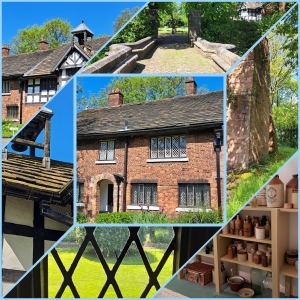
A pleasant and overlooked piece of Manchester’s diverse history. Fitted rooms, detailed and decorated with real artefacts and displays, echo the ambience of past and give our present an opportunity of reflection.

There are connections to Shakespeare, witchcraft, gardening, and nature amongst extensive grounds surrounded by the historic moat.

Throughout the visit, the historic walls, belfry, and varied facades make for good photography. The welcoming staff of volunteers are an asset to a hidden gem only a stones throw from the Etihad Stadium.

Manchester’s Metrolink is across the road at Clayton Hall stop, with the Ashton canal, and Clayton Hall in close proximity to allow more exploration. The hall is a must for historians, families, and those with a curious eye.

Visit https://claytonhall.org/ for more information.

Shipping Out.

19th January 1863


Dear Manchester,

put your money where your mouth is, this slavery malarkey has to end. End of.

Peace and love,

Abe Lincoln


(P.S. United don’t exist as a club yet, but they’ll probably worship the devil).


The above letter is a paraphrased example. Like much of the world Manchester was wearing the latest clothing of the time around that time. Gucci? Not born. Cotton? Everywhere. The bustling smog of Manchester coated moths, as much as provided clothing to men and women alike. Transgenders were around but less represented. It was, of course, different times. Cash was made. Lots of it. Karl Marx and Friedrich Engels had met in Manchester a few years earlier and released their Waterstones best seller The Condition of the Working Class in England. Jack Reacher novels were nowhere to be seen.


Turn-und Sportverein München von 1860 hadn’t even started kicking a football until 1899. Die Blauen had other sports, and all could have worn cotton garments made in Lancashire. Those kits wouldn’t have featured cotton picked by slaves in the U.S. of A. No. No way. Lancastrian workers had principles. Rather than make a quick Queen Victoria penny, cotton mill workers took a stand. Southern bastards from U.S.of A. were attacking their northern kin and union. The Confederacy could no longer count on cash from much of the north west of England. Unlike England’s Liverpool, where Confederate flags flew proudly. As some households went hungry, more than half of the mills and looms lay silent.

“I know and deeply deplore the sufferings which the working-men of Manchester, and in all Europe, are called to endure in this crisis” – letter: To the Working-men of Manchester, Abraham Lincoln.

Manchester’s Manchester Guardian opposed the blockades. It wanted to put food back on the people’s table. Yet, workers gathered in the Free Trade Hall stuck two fingers up at a proposal to drop the blockade. They backed Abraham Lincoln and his northern union. Starvation and destitution followed. A tad like how the prices of tomatoes have been on the rise after the U.K. backed the Ukraine, whilst simultaneously telling Europe to go away. As the army read the riot act, and Lincoln (the man, not the city) earned himself a future statue in Manchester, praising “”sublime Christian heroism”. Ships full of provisions were also sent, which was a relief for many in Manchester. Within two years slavery was added to the U.S. Constitution and Manchester’s mills were back pumping crap into the air, allowing families to feed themselves once again.


Abraham Lincoln’s fate wasn’t so pleasant and before he had chance to visit Manchester, he was gunned down. This process has been repeated a few times since and seems integral to U.S. culture.


So, when The Guardian, The Daily Mail, etc. manipulate headlines to flag Manchester City, and even MUFC’s crest as being a symbol of slavery, they need to dig into their research skills and work on their journalistic talents before blindly printing misinformation. Even the Manchester Evening News and MUFC’s historian had the decency to highlight the city’s backing of the abolitionist movement. The Manchester Guardian, founder, John Edward Taylor had partnerships with slavers and their companies. History is littered with profits being made over humanity. Let’s learn from it. We’re better for it. We can’t hide our history!

Man U added their ship to a badge in 1902. City used Manchester’s heraldic design from 1894 to 1960. The ship on both is that of a merchant ship to symbolise the city’s link to the Manchester Ship Canal. The Guardian’s writer connects the ship to black history in an insulting an incorrect way. History matters. Get it right. Stop trying to revise history and change a country’s shame based on a misplaced reckoning.

The Guardian writer Simon Hattenstone even suggested the bee of Manchester’s industry replaces the ship. If he had been a tad more industrial in his research and knowledge, he may have published a more compelling argument. Instead, he created a woke debate and accidentally made The Sun look like a paper of good response. And to agree with Man Utd historian J.P. Neill, I close with this quote: “’Not only did the club badges long post-date the abolition of slavery, the clubs themselves were only founded decades after slavery was ended.”

Stanage and An Apple

Eat five fruits and vegetables a day. That used to be the message from health-promoting government officials. Now there’s a message doing the rounds: limit your purchases of cucumbers and tomatoes. Great Britain is experiencing a shortage of fruit and vegetables. Europe is not, on the whole, struggling for green foods. The labour shortages on farms in the U.K. experienced since Britain exited the European Union, are being mirrored by asylum-seeking boat crews and filled seats. Unemployment rates in the U.K. remain high. Jackets and aid packages are being gathered and sent to earthquake-torn Syria and Turkey, whilst homelessness in the UK spirals into greater numbers. The U.K.’s economy is fragilestrike action is booming, and somewhere Shell, BPTescoRio TintoLegal & GeneralUnilever, HSBC Holdings, Vodafone, GlaxoSmithKilen etc are all doing really well. With the world being really stable, Shaun, Christina, Panda and I went for a wander.

The train journey duration from Manchester to the historic two platforms of Grindleford lasted just under an hour. Opened in 1894, the station bridged the lower reaches of Burbage Brook. The station close to Sheffield is just next to the 3.5-mile long (5.7km) Totley tunnel. Our path led from the toilet in the café, up the picturesque upper tributary stream. After a few hundred metres or yards (if you choose), we crossed a wooden bridge and ascended a pathway to a higher level. The deep narrow gauge of Padley Brook is completed by trees, mosses, and steep drops. All were avoided, thankfully. The rich, clean air, a welcome greeting, has left the air of Manchester behind. The temperate rainforest along this route are apparently the furthest inland of their kind, in Britain. Our route led uphill, with relatively unchallenging steps and climbs here or there.

At White Path Moss, a little further north of Toad’s Mouth, the moorland drains and forms the source of Burbage Brook. The gently flowing stream starts somewhere near Stanage Edge. On our walk we didn’t spot any water voles, but we did hear a variety of birdlife including the hawfinch and wood warbler. Nature perfectly cuts into the bleak moorland and offers veins of life amongst the scattered glacial stones and boulders. Dry wintery grasses jutted out from soggy soil and bogs. Walking boots were a cosy necessity.

Soon after crossing a road, stretching over the Burbage Brook once more, and ascending a slope we arrived at Carl Wark (370m/1214ft high). This rocky promontory juts out and on it are the remains of an Iron Age fort. The view from Higgor Tor (434m/1424ft) back to Carl Wark is impressive. You can really see Carl Wark as an island sat atop the sea of the moor. After scrambling through Higgor Tor, we moved onto the Stanage Edge (Stanage means ‘stone edge’). So we were on the edge of the stone’s edge. Popular with climbers, abseiling enthusiasts, walkers and artistic types we meandered a fair distance down the crinkly fragile crust prominence. We explored Robin Hood’s Cave and also crossed the Long Causeway down to Hathersage village for the train back. The famous crags and Panda, loose from his lead at times, make for heart-in-the-mouth opportunities. Luckily a well-behaved and heavier supervised dog could not be found. Panda behaved well when passing by St Michael’s Church and didn’t dig up the remains of the legendary 2.46m (8ft) Little John (Robin Hood’s buddy).

As we boarded the train, all shattered and hungry, I read about the Fat Boys Stanage Struggle and vowed to myself never to enter. The accent from Hathersage (91m/299ft) upwards is firmly not on my bucket list. More likely, a viewing of Pride & Prejudice filmed at parts of Stanage Edge. Perhaps, in the near future, we can wander up there again. The 13.5-mile (22km) route was most enjoyable in good company.

Over Exposed.

The train from Manchester to Glossop was ideal and on time. Unlike yesterday, I didn’t end up in Hadfield. Having slept well, with the owls of Newton Heath’s Clayton Vale sounding their calls, I felt refreshed for a morning and headed off with the energy of my trusty dog Panda. Rounding the town of Glossop, the Derbyshire Levels road led onto a pathway up into the hills and moors.

The first major hurdle was squelchy and muddy but largely passable, especially once Panda and I found the footpath. The footpath, largely lined with flat stone slabs, passed in a meandering pattern towards Snake’s Pass Summit. The largely quiet A57 connects Manchester to Sheffield, ensuring Owls fans can watch SWFC when they face Manchester City again. The Thomas Telford designed road hits 1,680 feet (510m) at its highest point – the point where Panda and I crossed onto Bleaklow.

Having traversed Kinder Scout’s surrounding moorland at Featherbed Top, the walk through Devil’s Dike seemed to do the impossible. How it could have got wetter, heaven knows. Views back towards Cheshire, Snowdonia in the far sunlight and Manchester were the only reminders that Earth isn’t entirely soggy. Groughs of mosses (Sphagnum), heathers, and moorland species seemed drenched. The pathway lay submerged at times. Hares bounded around, splashing, whilst grouse landed with plops. Navigating to get back on the pathway over Featherbed Top was difficult.

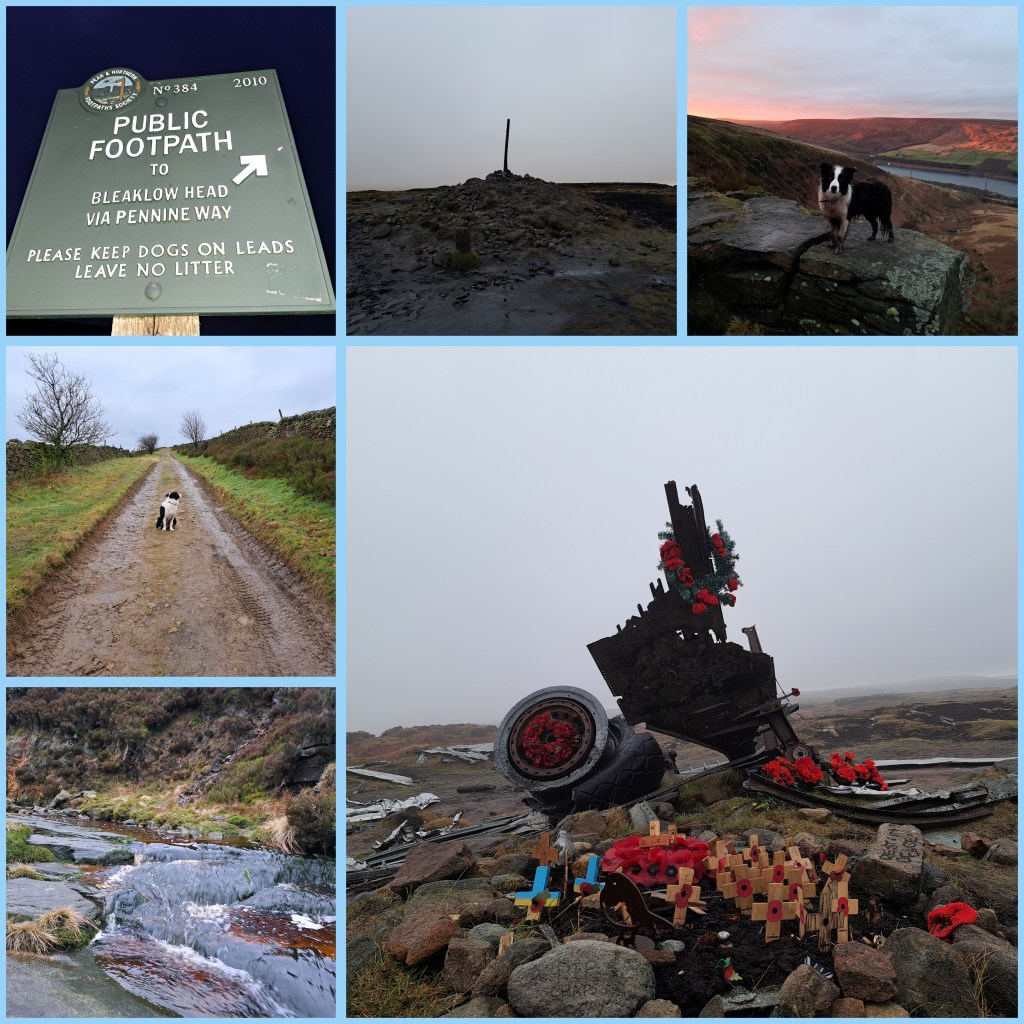
The pathway through Devil’s Dike was more like a stream. The stream and path sat side by side. Sometimes on top. Often below. The two had become intertwined in a kind of natural Kama Sutra. The pathway panned out and eventually reached the 2,077 feet summit (633m). First of all, wreckage from the reconnaissance USAF aircraft, Boeing RB-29A Superfortress 44-61999 (named: Over Exposed), scattered over a huge patch. The remains featured a memorial patch. This eerie spectre sat atop an area of mud and tuft-shaped groughs.

Flying over a hill in low clouds takes guts. Sadly, some pilots and their navigation crew have succumbed to nature’s will. These wicked Dark Peak and Pennine hills have claimed many lives from World War II to the present day. Looking at the Peak District Air Crashes website, it’s instantly apparent that night or day clouds are lethal barriers. The descending path from Bleaklow to Torside had several more crash sites, including a Bristol Blenheim and Lancaster Bomber parts.

The pathway from Bleaklow to Torside went from the high Hewitt (Hills in England, Wales, and Ireland over two thousand) to the edges of the Torside reservoir’s neighbouring farms (by B6105 Crowden to Glossop road) . The 453rd highest Hewitt features more than enough featureless boggy crags to last you a lifetime. Plenty of broken walls, paths and steep drops await the rambler as they descend or ascend the soaked landscape. A word to the wise: wear waterproofs and tough boots. Views of Black Hill and Holme Moss, amongst others greet you. The ground, with plenty of sinking points, also comforts you on the inevitable fall. Wainwright called it an “inhospitable wilderness” and I’d call parts of the trail an abomination on the feet.

Glossop train station to Bleaklow is about 7.5 miles (12km). Bleaklow to Torside is 3.3 miles (5.3km). Torside to Royston Vasey (Hadfield) is about 3 miles (4.8km). Not surprisingly, today’s walk totalled over 44000 steps. 13.8 miles (22.1km) was the minimum distance covered. In reality, it was closer to 18 miles (28.9km) all in. Definitely, longer than yesterday. Next, sore feet and a lazy Tuesday. Also, it will be time to reflect on the mountain hares spotted at a distance. A great pleasure, indeed. Unlike Alfred Wainwright, who said of Bleaklow, “All who get on it, are glad to get off,” I fancy a return soon. It was a great but arguably an arduous walk.

The Long Longdendale Trail

The Longdendale Trail is 6.5 miles (10.5km) long. To walk from the beginning and back again is about 13 miles (21km). Add a waterfall trail near the sealed former railway Woodhead Tunnel entrances, and you’ve easily hit 16 miles (25.7km). Factor in prawn sandwiches, a brief sit down to feed Panda, and the best part of 11am to 6.15pm will evaporate. Just add 38000 steps.

The day’s walk began at Hadfield Station, which was weird because I was supposed to be getting off the train at Glossop. It seemed silly to wait for another train, so Panda and I set off at pace. The low gradient path rises and is ideal for cycling, horses, or dogwalking like what we were doing. The trail is part of the Hull to Liverpool Trans Pennine Trail, or national cycle route 62. Several reservoirs line the lower side, and the upper crags, swamps, and Bleakmoor.

You could even use the route as part of Cork (Ireland) to Istanbul (Turkey). The E8 European long-distance path runs past the River Etherow and the picturesque Derbyshire town of Hadfield. Hadfield, like Glossop, is about 40 minutes by train from Manchester Piccadilly. This High Peak Town sits over Bottoms Lake. That man-made reservoir forms part of the Longdendale Chain. The most upper reservoir is Woodhead Reservoir. Since around 1884, millions of gallons of water have been captured and sent to Manchester and Salford as Corporation Pop (drinking water).

Our walk also passed Arnfield, Valehouse, Rhodeswood and Torside Reservoirs. Hollingworth Reservoir has been reclaimed as a woodland. Like the woodland, the whole of the Longdendale valley is scenic and green. Tintwistle and a selection of hamlets make for great places to admire the views. UFOs and strange lights have been noted. The closest we came to this were a few deer on the dusky walk back. That and headlights over the valley on the Woodhead Pass (A628) as the walk reached the final act. Panda earned his ham on the bone treat. I’ll have Coco Pops.

The treat at the far end from Hadfield was a wander up Middle Black Clough to a spread of waterfalls and steep green vales. The walk alone was great. The extra trail at the end was excellent. It was a real challenge for the four legs of Panda and an opportunity to do some rock-scrambling. All in all, it was a lovely day out. So, where next?