Are there many novels that celebrate and champion persistence? Do all cops in novels ignore authority and tackle the weight of bureaucracy through ignorance? Early reviews pointed me to a challenge.
Inspector Imanishi Investigates by Seichō Matsumoto is a post-World War II novel originally penned in 1989. The lead protagonist, unsurprisingly, is Inspector Imanishi. He is a world apart from the rebellious bulldozing Harry Bosch found in Michael Connelly’s novel series. Instead, Imanishi is methodical, modest, and clinically human in his approach. He persists without need of a lightbulb moment or an act of genius. At every turn Inspector Imanishi displays empathy. He listens. He feels the victims’ lives. He endures whilst remaining ethical and responsible. The fog of guilt lurks. Grief and shame wallow. The good Inspector appears to put himself in others’ shoes.
What happens when guilt becomes unbearable? Drawing on a contrast of a post-war reshaping metropolitan Tokyo and that of rural provincial Japan, this book uses geography, culture, and traditional etiquette to deliver the truth. Themes of memory and recollection, urban alienation, interconnectedness, societal and historical tensions. The slow movement of justice’s machine underlines the need for structure and hierarchy but appears to comment on a lack of urgency. What secrets live between city lights and village shadows? Can you bury a crime in a country still healing?
How well can you really hide from who you were? The plot features new names, misdirection, reinvented pasts to escape guilt, shame, and consequences shows disguise as social-cultural adaptation. In an ambiguous world, the detective is a constant: deeply moral. Rarely does a slow-burn of a book stand out, yet from the opening chapter to the conclusion, I was hooked. The jigsaw was essentially a lesson in the importance of detail. Like a cold-poured Guinness, “Good things come to those who…. wait.” The novel’s ending seemed more reflective than triumphant yet left me wanting more. Was reluctant justice enough? Does empathy make the best detective?
Matsumoto’s Inspector Imanishi Investigates is a novel celebrating persistence and realism. It is the antidote to flashy books filled with spectacle and glamour. The notes of fading traditional values give hints at a nation’s people suffering an identity crisis – or at least instability causing a social flux. I found myself pondering, how much of our world’s remembered reality was misremembered? Can patience solve what brilliance cannot? Is closure enough when lives have already been lost?
literature
Christmas ’23
Eight miles there. Eight back. Clayton Vale, Ashton-under-Lyne canal, the old filled in Stockport canal, and the Fallowfield Loopline cycle path paved the way from home to home. A few roads, with the odd crossing, make for a largely traffic-free route. Perfect for the Panda dog walking tight to your legs, and more importantly, good for chasing a kicked or thrown ball. A good wander.
The battle against the big C rages on. Cancer is a horrid thing. It ruins families and strikes at the centre of health, in a way crippling and doesn’t let go. As one beats it, another battles. It claims life whilst brave faces tussle and show determination to win and live go fight another day. Keep battling. You can do it.
A platter of yummy foods, traditional at Christmas, was devoured between five mouths (Panda included). Paul and Mam always know their food. The former more than the latter. Mam did her best to keep us in baked beans and curries as kids. In fact, I’d go as far as saying as Mam has always been a culinary explorer. Mam tried her best and still does to introduce me, Paul Jr. and Astrid to new forms of scran. Corn, however, is still a big no. Paul, being a former chef, knows his onions, shallots, and all the other Allium members. I feel blessed to eat well. Astrid, predisposed, wasn’t around, but hopefully, we can catch up later this week and have some competitive eating.
Christmas 2012 was the last time I ate Christmas Dinner at Mam’s before last year (2022). Those intervening years in China have dampened my mood for Christmas. With new life and youth present, it has reminded me that this special time of year is perfect for celebrating together. 2024 will be much better. I feel it. I hope for it. Christmas Dinner in 2023 consisted of a platter of potatoes, Mediterranean-style vegetables, salmon, sprouts, carrots, chicken, and gravy. It wasn’t the traditional Christmas Dinner. But, sat with Dad nattering and an episode of Last of The Summer Wine, it was pleasant enough. Merry Christmas and a happy new year.
Christmas Day involved copious amounts of dog walking, reading, and generally communicating via the mobile phone to the point of near blindness. Boxing Day would lead to more walking. 16 miles in the legs deserved a drink. The last Christmas gift opened. Belgian beer, Bernardus Abt 12, at 10% volume, sank well. Cheers, Doddsy, for the plonk. The dark quadruple was rich in flavour and suitable for watching Hunter Killer, a disappointing middle-of-the-road Russian-American conflict movie. As paint by number action movies go, it did enough to get my nose back into Flann O’Brien’s The Poor Mouth. Translated text can sometimes be difficult, but the wit and heart of the stories shine through.
Robert Ebenezer Jenrick Scrooge 1843-
“No warmth could warm, no wintry weather chill him.” – A Christmas Carol, Charles Dickens
Over 179 years have passed since Chapman & Hall published A Christmas Carol on December 19th, 1843. The original title Charles Dickens has been lost to time. A Christmas Carol. In Prose. Being a Ghost Story of Christmas remains. Have times changed? Is the novella outdated and irrelevant? Or, is their a reason why its story remains an enduring feature of the stage, silver screen, print and audiobooks? Crikey, even Sir Patrick Stewart reads parts on TikTok. “That is what it is to be human: To make yourself more than you are.”
“You may be an undigested bit of beef, a blot of mustard, a crumb of cheese…” – A Christmas Carol, Charles Dickens
The book, a well-visited tale is divided into five staves. These parts allow three spirits to visit between an introduction and a conclusion. The structure of the novel is clear and flows, making translation to multiple language feasible and lasting. Its story takes place in just a 24 hour period, making it the inspiration for Kiefer Sutherland’s Jack Bauer (not the cyclist from New Zealand). As tough as Jack Bauer is, the central character Ebenezer Scrooge appears unbreakable. A tough old boot.
“I mean to give him the same chance every year, whether he likes it or not, for I pity him.” – A Christmas Carol, Charles Dickens
A plethora of retellings, re-imaginings and interpretations have crossed political and social borders. Whether it is that of Bill Murray, Ebenezer Blackadder, or Michael Caine opposite Kermit the Frog, the central character Ebenezer Scrooge is instantly recognisable. Look closely at Dr Seuss’s The Grinch and you’ll see Scrooge in cold-hearted green. Stave one sees cheerful and kind-hearted Fred visits his mean Uncle Ebenezer at his counting house. He persists and resists spirits being dampened by Scrooge’s venomous tongue. Invited to a meal, Ebenezer Scrooge declines. As he does for a charitable donation request. Charity muggers are sent away. Soon, at his home, he sees a dead business colleague in his door knocker. Startled by that encounter, he is later visited by the chained ghost of Jacob Marley. Marley warns penny-pinching Scrooge that his future is bleak, should he not change his ways. He also warns that salvation can be sought following the visit of three ghosts. Plot delivered.
“I’ll keep my Christmas humour to the last. So A Merry Christmas, uncle!” – A Christmas Carol, Charles Dickens
Stave two sees the Ghost of Christmas Past, take Scrooge back in time. Here he views his previous boss Mr Fezziwig. In an old-fashioned take on BBC’s The Apprentice, Scrooge’s version of Alan Sugar is seen within the workplace displaying all forms of warmth, generosity and benevolence. The jovially affectionate nature of Fezziwig contrasts with his moderate profiteering and highlights how bigger traders were sweeping aside the small ownership family businesses of the 19th century. Fezziwig is very much a Baron Sidney Lewis Bernstein (Granada TV founder) of his time.
“Hard and sharp as flint, from which no steel had ever struck out generous fire; secret, and self-contained, and solitary as an oyster.” – A Christmas Carol, Charles Dickens
The ending of the stave is too sad for Scrooge to take. Scrooge protests and resists, waking up in his bedroom once more. His ephemeral encounter had been well-meaning, yet here Scrooge must have known that more was to come. He could not have known what those next two likely encounters would entail. Scrooge’s welfare was safely out of his hands for the moment. Could he rise and walk again?
“Most of all beware this boy, for on his brow I see that written which is Doom, unless the writing be erased.” – A Christmas Carol, Charles Dickens
Bob Cratchit is the uncomplaining clerk to the parsimonious Scrooge. He does what he is told, almost like an obedient dog. This timid man is married to Mrs Cratchit. His wife in her “twice-turned gown” is the gratuitous optimist. She makes the best of a bad situation. Next in the family is Martha Cratchit, a hatter, just like many Stockport folk once were. It remains to be seen if she suffered from Mad hatter disease (a form of chronic mercury poisoning, associated with the hatting industry). The Cratchit family have a son, and here forms stave three. Bob Cratchit’s mundanely repetitive job counting cash for his superior could ill-afford him time of leave to stay with family at a Victorian-era Christmas. As Christmas grew, so could Bob’s internal worries. Tiny Tim appeared a condemned young soul.
“”It’s only once a year, sir,” pleaded Bob, appearing from the Tank.” – A Christmas Carol, Charles Dickens
Tight-fisted Scrooge joins the jollily prophetic and welcoming Ghost of Christmas Present to visit Tiny Tim. Tiny Tim, not to be mistaken for the late singer-activist Hebert Butros Khaury, is ill and proper care cannot be given. The Cratchit family suffer in the same niche as many Mancunian families do in the 21st century when seeking mental healthcare. Tiny Tim may have had origins on a real boy in the old mills of cotton-factory Manchester. Kind, thoughtful and incapacitated as Tiny Tim is, this character radiates positivity and reflects his family’s attitudes to challenging shortcomings. To quote my elder brother Asa, “It is what it is.”
“If he be like to die, he had better do it, and decrease the surplus population.” – A Christmas Carol, Charles Dickens
After being told that Tiny Tim will snuff it, the Ghost of Christmas Present visits Fred’s house and highlights two hideous representations of ignorance and want. Danger was afoot. Gratefulness and sympathy lay firmly in Bob Cratchit’s court, yet the bad-tempered leader Scrooge’s connections and empathy lay far away from humanity. Think Wolverhampton-born, St John’s College-educated Immigration Minister Robert Jenrick painting over murals in a Kentish centre of children’s asylum. Scrooge would have been proud? His leadership team in Parliament are just after stopping immigrants on boats. And welcoming children.
“Still the Ghost pointed with an unmoved finger to the head.” – A Christmas Carol, Charles Dickens
The Ghost of Christmas Yet to Come enters stave four. His ominous, dark and silent presence guides Scrooge to the possible death of Tiny Tim. Other visions also guide Scrooge from the dark side to the side of the angels. One of which sees a grave with the etchings of Scrooge’s name. After you’ve seen scallywags sifting through your abandoned rucksacks and filing cabinets, I challenge you not to feel glum. Imagine listening in on relatives bickering about your Last Will and Testament. Let’s hope that’s not too relatable. Balance your books before you go.
“…a solemn Phantom, draped and hooded, coming, like a mist along the ground, towards him.” – A Christmas Carol, Charles Dickens
Stave five ends positively, as the latter stage of the book follows the transition of Scrooge from out and out despondent miser to benevolent altruist. He gives,. He rewards. He feels joy again. Tiny Tim doesn’t die. In fact, Tiny Tim gets the equivalent of a Godfather. Christmas once again is filled with merriment. Solitary death averted, Scrooge is reformed. He can even take a joke. Redemption in under 24 hours.
“Let him in! It is a mercy he didn’t shake his arm off.” – A Christmas Carol, Charles Dickens
During the Victorian era, Love Actually and E.T. couldn’t be screened on televisions. Those technologies hadn’t arrived. Ghost stories were the hip way to spend time. Dickens went further than most, smothering his with wealth, injustice and all the injustices of wealth distribution of Victorian England. It pre-dated Downton Abbey but equally its conflict in social responsibility is shared. The importance of family and love at Christmas is growing, with dinners, carol singing, trees, cards and high spirits increasing. Christmas is seen as a time to bring people closer together. Its religious meaning is present, yet less announced. Those without would, no doubt, see what they are missing. Inequality was rife and obvious.
“Emancipate yourselves from mental slavery; None but ourselves can free our mind…” – Redemption Song, Bob Marley & The Wailers
The aftermath of diving into A Christmas Carol slams home the message that children are the responsibility of all mankind. Not that Robert Jenrick would agree. Perhaps he shall read this novella realise the failings of only thinking of oneself. Or, like many Conservative ministers, likely maintain a selfishness that the richer elements of Victorian society once held. Poor laws, prisons and workhouses once dealt with the poor destitute working class. These days we have zero-hour contracts at Amazon and less-than-living wages at McDonalds. Perhaps, the final stave and its message of completion and possibility should be explored as a mandatory fit-to-govern the U.K. test. A bit of pity goes a long way. “The sound of” children playing and shouting should be “so delightful that even the ‘air’ is laughing.”
“God bless us, every one!” – A Christmas Carol, Charles Dickens
[Christmas Carole, Sky TV, starring Oldham’s Suranne Jones]
Review: The Big Book…
The Big Book of Literacy Tasks by Nancy Akhaven is targeted for grades K-8. As per the cover, it aims to give teachers 75 activities that are balanced and suitable for students to complete. This reference book is engagingly colourful, well illustrated and concise. It provides instructional plans that can be tailored or differentiated to the need of a teacher.
The book helps teachers to hand off the tasks to the student. It moves very much from, “I” to “You”. The book is well-structured to allow students to be challenged, and reduce teachers from dilly-dallying, which in an era of electronic media and distraction, helps a teacher try to engage a student deeper.
The author Nancy Akhavan, an assistant professor of Educational Leadership draws on her experience and dedication to professional development research to illuminate daily planning. The tasks can be divided into useful everyday skills, weekly practices and a few slightly more complex challenges. They are each applicable to reading circles, workshops or other literacy tasks. The book is loaded with tips, things to look out for and insights to allow English acquisition learners to progress into fully-fledged literacy learners. The author delivers far more than a lengthy book title.
This book offers Guru-like support, with practical advice and encouraging ideas that are easy to drop into the classroom. In a world often flooded by educational text resource, the bright cover with a climbing wall, Akhaven’s guide acted like a beacon for inspiration this week – and shall continue to be picked at until all is imparted and transferred appropriately.
The Big Book of Literacy Tasks by Nancy Akhaven has been published by California’s Corwin Literacy, a sample can be found online here.
Reading Draft.
Dear readers,
“I have a passion for teaching kids to become readers, to become comfortable with a book, not daunted. Books shouldn’t be daunting, they should be funny, exciting and wonderful; and learning to be a reader gives a terrific advantage.” – Roald Dahl
The below is a huge draft that will be edited and chopped probably into less than 150 words, or maybe just a handful of sugar, or likely whichever earns me the most coffee cups. It all started when Miss Hannah in marketing asked me to create something for social media in relation to holiday reading. I immediately wanted to share Roald Dahl. Then, I thought about international mindedness, books with messages and genres that leave your heart tickling. Of course, there are many mainstream examples and some are quite well-known, but that’s the magic of a good book – it cannot stay shut! It fails to remain quietly shut in a dark corner of a room. Books cry out for attention. They’re living breathing monsters that grip you, hug you and leave sloppy kisses on your cheeks. So, that’s the introduction to the opener below.
“I can’t imagine a man really enjoying a book and reading it only once.” – C.S. Lewis
Do you remember the first time you opened a book and it truly grabbed your attention? Perhaps that text took you away to a whole new world. Maybe that story whisked you off on a never ending story. Certainly the protagonist had your attention. You were hooked! You find yourself nose-deep in the book, living and feeling the words! Breathing in a rollercoaster ride or feeling the love from the rows and rows of the word beneath. Importantly, age groupings are never always accurate. Students read and write at various levels of ability across age and year groups. It’s important to differentiate to an appropriate reading level. It is worth noting that opening new books may not prove too challenging, however, it can always awaken a part of a new imagination.
“There are many little ways to enlarge your child’s world. Love of books is the best of all.” – Jacqueline Kennedy Onassis

Whether you’re an avid reader or a book guru, books such as The Animals of Farthing Wood (Colin Dann) can stick with you for life. Reading about characters such as Tintin and adventures such as The Lord of The Rings can shape our expectations of movies or provide us with hours of conversations amongst thinkers and friends. As we reflect in life, we’re often granted opportunities to communicate our recommendations. Here are a few books to get you going.
Emerging readers: Kindergarten & PYP levels 1-2 / grades 1-2 / UK nursery school or years 1-2 (5-7 years)
Books at this level should be packed full of sight words, colour and invention. A trio of examples shall follow. The Reverend W. Awdry wrote Thomas the Tank Engine and friends. His 26 stories were aimed at his child Christopher. It must have worked because later on, son followed father, adding a further collection to the series! Eric Carle was a colourful writer, creating a list of books as long as my arms and legs (which are very long indeed). The Very Hungry Caterpillar is an iconic place to start reading his works: “One sunny Sunday, the caterpillar was hatched out of a tiny egg. He was very hungry.” Janet and Allan Ahlberg are no strangers to children’s fiction. This married couple worked together for over two decades. Funny Bones, Mr Biff the Boxer, and Kicking a Ball.
“Oh, magic hour, when a child first knows she can read printed words!” – Betty Smith
At these ages students are now working out how to segment words using phonics and recognising an increasing number of sight words. They’re differentiating homonyms whilst learning to love books. Read daily and often with your kids now and they should develop at their fastest! To that mind look up the following books: All Join In (Quentin Blake – one of the greatest and most distinctive illustrators of all time); Peace at Last (Jill Murphy); The Runaway Wok (Ying Chang Compestine); Mr Wolf’s Pancakes (Jan Fearnley); Owl Babies (Martin Waddell & Patrick Benson); Suddenly (Colin McNaughton); Grumpy Frog (Ed Vere); Oi Frog! (Kes Gray & Jim Field); The Squirrels Who Squabbled (Rachel Bright & Jim Field); Flotsam (David Wiesner); Guess How Much I Love You? (Sam McBratney); Slow Loris (Alexis Deacon); I Want My Potty! (Tony Ross); Dear Zoo (Rod Campbell); Meg and Mog (Helen Nichol and Jan Pienkowski) and so many more… (further inspiration can be sourced here).
PYP 3-5 / grade 3-5 / UK years 3-5 (7-9 years)
Flat Stanley, penned by Jeff Brown, tells the story of a boy squashed by a bulletin board. His newfound flatness allows him to slip under doors like a piece of mail. He can even fly like a kite! This story series has been around for more than fifty years. The authors six original stories have inspired a catalogue of stories by other authors. There is also the Flat Stanley Project which brings together an awful lot of people around the world. Jackie Chan approves of it.
“Never trust anyone who has not brought a book with them.” – Lemony Snicket
Anything from the collections of Dr Seuss, A.A. Milne (Winnie the Pooh), Astrid Lindgren (Pippi Longstocking) and Roald Dahl should capture attention at this age. René Goscinny and Albert Uderzo‘s Asterix the Gaul series can open up new frames as to how a story can appear. I would recommend this following group too. The Nothing to See Here Hotel (Steven Butler); The Bee is not Afraid of Me (Fran Long & Isabel Galleymore); King Kong (Anthony Browne); Dilly the Dinosaur (Tony Bradman); The Diary of a Cat Killer (Anne Fine); Mrs Cockle’s Cat (Philippa Pearce); The Owl Who Was Afraid of the Dark (Jill Tomlinson); Where The Wild Things Are (Maurice Sendak); Mr Majeika (Humphrey Carpenter); How to Train Your Dragon (Cressida Cowell); The Sheep-Pig (Dick King Smith’s book was made into the movie Babe); Charlotte’s Web (E.B. White); The Iron Man (Ted Hughes) Cliffhanger (Jaqueline Wilson); Peter in Peril (Helen Bate); Coming to England (Floella Benjamin) and other great books for PYP3, PYP4 and PYP5.

“The more that you read, the more things you will know. The more that you learn, the more places you’ll go.” – Dr. Seuss
MYP 1/2 / grades 6-7 / UK years 5-6 (9-11 years)
“The reading of all good books is like conversation with the finest (people) of the past centuries.” – Descartes
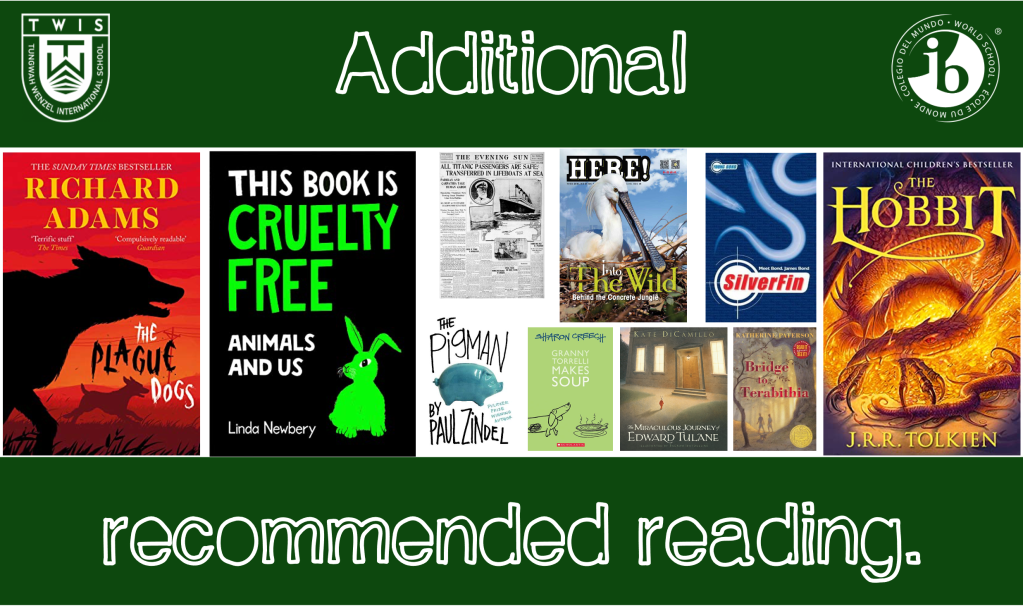
After developing imagination and experiencing adventure, books tend to favour realistic fiction and serious topics for older students. At this age, books open doors into many new worlds and offer insights into many other cultures. Encyclopedia-style texts lure in the curious and student inquirers. Hard-hitting and dark stories sit between classics and familiar friends of the literature world. Look up: The Boy At the Back of The Class (Onjali Rauf); Illegal (Eoin Colfer – think Artemis Fowl); Abomination (Robert Swindells); The Hobbit (J.R.R. Tolkien); What Katy Did (Susan Coolidge); The Chronicles of Narnia (C.S. Lewis); The Borrowers (Mary Norton); Silverfin (Charlie Higson’s young James Bond series) and so on.
“So please, oh please, we beg, we pray, go throw your TV set away, and in its place, you can install a lovely bookshelf on the wall.” – Roald Dahl
MYP 3/4 / grades 8-9 / UK years 7-8 (11-13 years)
“I find television very educating. Every time somebody turns on the set, I go into the other room and read a book.” – Groucho Marx
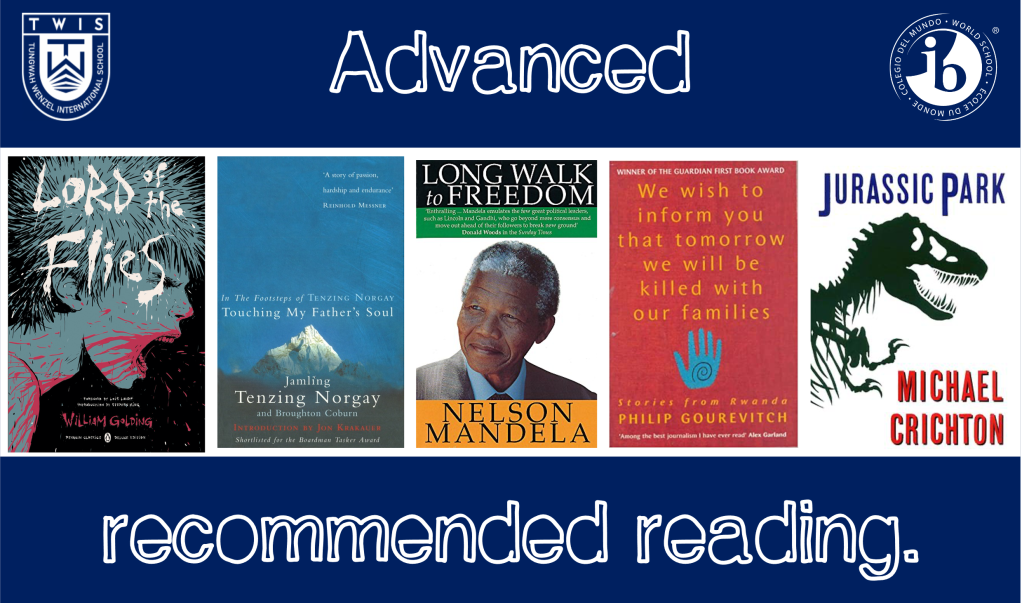
Recently the language and literature class tackled Bridge to Terabithia by China-born Katherine Paterson. This novel became a Disney-adaptation. Few students favoured the movie over the book. Books have often been adapted for the silver screen, the television or the stage. A great checklist to read and then watch can include the following: Madame Doubtfire (Anne Fine); The Outsiders (S.E. Hinton); The Curious Incident of the Dog in the Night-time (Mark Haddon); The Day of the Triffids (John Wyndham); The Hound of the Baskervilles (Arthur Conan Doyle’s Sherlock Holmes); The Plague Dogs (Richard Adams); The Woman in Black (Susan Hill); Watership Down (Richard Adams); and The Giver (Lois Lowry).
“Reading is essential for those who seek to rise above the ordinary.” – Jim Rohn
MYP 5/DP / grades 10+ / UK years 9+ (13+ years)
“A reader lives a thousand lives before he dies . . . The man who never reads lives only one.” – George R.R. Martin
At this age level, the vocabulary is expanding with new words dropping down like rain. Students are better armed to scaffold and learn these familiar unfamiliar phrases and terms. Using their decoding techniques they can swiftly move through lengthy text. The classic The Time Machine by H.G. Wells, Khaled Hosseini’s The Kite Runner and Maus by Art Spiegelman are fine examples of texts that would sit well on a student’s bookshelf. Students who watch movies such as Dune and Jurassic Park, should at this point, now be lifting the text that inspired these movies. The respected authors Frank Herbert and Michael Crichton have sizable and diverse reading catalogues suitable for those who claim to be knowledgeable. Writers and readers alike should explore diverse texts, such as: This Book is Cruelty Free (Linda Newbery); Atonement (Ian McEwan); Long Walk to Freedom (Nelson Mandela); Touching My Father’s Soul (Jamling Tenzing Norgay). I would also thoroughly recommend Paddy Clarke Ha, Ha, Ha by Roddy Doyle and William Golding’s Lord of The Flies because by now a rounded reader is a communicator of text. Just ask the students of language and literature at TWIS. Further reading suggestions can be found here and there.
“You can never get a cup of tea large enough or a book long enough to suit me.” – C.S. Lewis
Tired of heavy paper books? Do your children favour electronic devices? Try a popular e-reader like Kindle or Kobo. They may be devices that are limited, but that’s the beauty of it. Why worry about bad eyesight or distractions? There are stacks of available titles, some free and many can be read from .PDF documents. Many are portable. The anti-glare screens and lack of blue light make most devices unobtrusive to eyesight. Some even have onboard dictionary features.
Consult your librarian or find a suitable booklist, then check off or list how many books you have read! Be principled!
Many of us are traditional and favour paper because of the smells and textures, as well as the tangible aspect. We like to touch things. Make sure the next thing your son or daughter touches is one that reaches back and captures their heart. On top of that, books exercise brains, and to quote Roald Dahl, “If you are going to get anywhere in life you have to read a lot of books.” There you have it. Read it. Read it all. Read everything! I read everything. I read every little thing. That’s not true. I wish I did. I’m still working on it.
Thank you kindly for your time and reading.
Mr John
 AGAINST THE FLOW OF TRAFFIC - ACTON28.BLOG