CN Lit.

Picking up a book, that usually I would never have picked up, one short story caught my eye. Then another. And another. Suddenly, I’d hit the halfway point of the annotated bilingual edition of the Selected Modern Chinese Essays 1.

The book, whilst a little gentle, rendered into英语 (English) by Zhang Peiji features a bland cover with a bare tree. The flimsy pages and cover almost feel disposable. Shanghai Foreign Language Education Press didn’t even supply a blurb on the 38RMB book. Never judge a book by its cover? Well, this book has all the appeal of a Mancunian skyline during the peak industrial revolution during a grey wintery rain shower.

“His name has spread far and wide and become more and more celebrated with the passing of time. Innumerable people have come to follow his example so that everybody has become a Mr. Cha Buduo.” – Mr About-the-Same – Hu Shih.

Despite the outward appearance and an inside cover telling you about the translator, little is given away as to the themes of the essays nor the 377 pages. So, reading on is the only way to delve deeper. First published in 2007, this edition arrived a decade later.

Through writing by the likes of Li Dazhao, Lu Xun, Xu Dishan, Hu Shih, Xia Mianzum, Ye Shengtao, Zhu Ziqing, Ba Jin and 24 other authors, I found myself transported from modern life to various times within Chinese history and at varied points of culture. Mosquitoes featured every now and then. Phrases and parodies of tales that I had heard clung to pages like my sweaty underwear in a Guangdong summer.

“A fighter is perennially young. He is never irresolute or inactive. He plunges deep into teeming crowds in search of such vermin as flies and venomous mosquitoes.” – Be a Fighter, Ba Jin*

Plenty of themes feature throughout, including hope, faith, and the need for family and friends. The book itself is deep in meaning and easily interpreted in many different ways. Rereading a few pages, I quickly realised how the Bible, the gospels, and other religious texts could be manipulated under one light or another. Books are powerful things. We should read more to understand more and always adapt or change to whatever life needs, rather than desires. Equally, we should read for pleasure in a diverse way.

I enjoyed something different.

*See also: Carpenter Lao Chen and Dreams but the same author, Ba Jin.
Man Up?

Prison population: 96%-ish men.

Least likely to attend a doctor’s surgery: males.

Homelessness and drug abuse: mostly guys.

Donald Trump: a bloke.

Putin, Hitler, Pol Pot, MZD, Boris Johnson: fellas.

Talks less than others about inner-self: fellows.

Hero complexes: mother’s son.

Inclusive of all, at football games: bro, boykie, boyfriend.

Thinks they’re always cool: cat.

Keepers of toxic masculinity: chap.

Reduced sense of importance, when hunter and inner self show weakness: gent.

More likely to dominate, be aggressive, or demonstrate xenophobia, racism, or homophobia: guess who?

Andy’s Man Club attendees: dudes.

So, is it “man up” or man down?

Guava plant pots

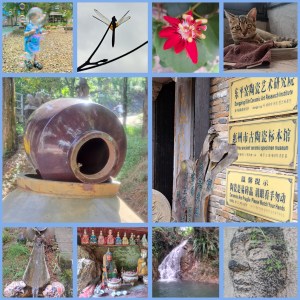
Never take a bull to a china shop. Equally, a toddler in a Chinese china museum and tourist spot is of little recommendation. Said toddler tumbling a plant pot into a fish pond, whilst trying to rip a leaf off a plant is quite an embarrassing happening.

Munching on hakka dim sum and 番石榴 Fān shíliú (Guava) with the sound of running water is quite relaxing. Even if the temperature is 33°C, with 75% humidity,  presenting a real feel temperature of 40°C. On top of that, your body melts, runs with sweat, and staying hydrated is a priority. Beyond these minor issues, the state of relaxation as birds tweet, red dragonflies fly past and and butterflies flutter between the bamboo tufts. Mosquitoes feast relentlessly. Relaxing.

Wandering around the extensive ceramic kilns, wood carving lodges, farm restaurants, and sculptured gardens was relaxing. The whole arena is fenced off and reasonably safe if you keep an eye on the deep water, fragile articles, and sharp bits all over the floors and walls. Complimentary kittens are provided in one of the toilets, and a local waterfall at temple XiHeGuMiao (西河古庙) is a pleasant stroll up a steep concrete road. Eagles and other wildlife like frogs, tree frogs, snakes, and mosquitoes can be seen.

The restaurant provides cabins, lodges, and open areas for a range of local food cooked well and enjoyed with the ambience of a dark evening. There are turtles, cats, and a happy dog. The centre and studios offer pottery experiences, fan making, and other activities for all. A few hours can be had away from city life.

Dongping Yao Ceramic Museum/ Dongping Kiln Cultural Scenic Spot, Huizhou City, Huiyang District, Huiyang District

Top Marks: GaoBangShan 高榜山

229.66m high isn’t much to an adult. But to a person of 83cm in height, it might as well be Mount Everest. That’s the gist of GaoBangShan mountain in Huizhou. A decent hill with a selection of pathways swoops around the summit. At the summit, a modern collection of Sinology, medicine experts, and important Chinese cultural architecture awaits.

Under moon and floodlights, it is highly recommended to blow bubbles like a fan of West Ham Utd. Expect to see bats, moths of various sizes, and shapes. The odd preying mantis amongst the night insects (mosquitoes included) can be found hunting alongside geckos and amphibians.

Smells range from dirty bins to humid dank dark paths lined with fragrant tropical flowers. At the summit and several points, the usual food outlets sell overpriced food and drinks. Beyond the hundreds of steps, lighting and piped music fill the air opening to the northern skyline of Huizhou and its surroundings. Your heightened awareness grows under tree canopies. Their umbrella canvas with limited lighting along the lower pathways shades out the light pollution beyond the treetops. It cakes those who walk beneath in humidity.

The steps up are a struggle. They’re uneven, yet modern. Each step appears slippery, and with damp patches of leaves and giant snails throughout, they’ll test the best sporting footwear. The knobbly-bits of pebbles on some footpath interludes are equally perilous. All part of the parcel in a dark park walk. The dense foliage, abundant with local species, although manicured at the path edge, gives an authentic taste of more wilder parkland.

For a few hours of wandering, the park features toilets at the foot of the main gate pathways, a few temple structures, and benches here and there. It is a short distance from Xihu (West Lake) in Huizhou. Xiao Crocodile Lake and Luoshan mountain are visible from the rear of the mountain. The name GaoBang means something to do with first and study, I’m told. When the Chinese Gaokao exams happen, many family people and students come and ask for good luck. The moon over the hill looks pretty, and a nightwalk is most recommended, even in the heat of summer.

Address: 惠州市惠城區江南街道共聯東路紅花湖景區附近

The Return of the Whippyman?

[INTENSE MUSIC BUILDS]


Liam Gallagher as Narrator (deep, commanding voice):


In a world where precision meets power…

 
Where every touch can change the course of history… 


One man stands at the heart of the action.


[CUT TO: A football pitch, Ilkay Gündoğan in slow motion, controlling the ball with effortless grace]

Narrator:


He’s the maestro, the conductor of the beautiful game. 


From Dortmund to Manchester, and now to Barcelona… 


He’s taken on the world’s greatest challenges.

[CUT TO: Gündoğan threading a perfect pass, the crowd roaring.]

Narrator:


But it’s not just skill that sets him apart… 
It’s the vision, the leadership, and the heart of a champion.


[CUT TO: Gündoğan lifting the Champions League trophy,  eyes focused.]

Narrator:


This August, get ready to witness the next chapter… 
As Ilkay Gündoğan steps onto the grandest stage once more. But where?

[CUT TO: Close-up of Gündoğan, determination in his eyes.]

Ilkay Gündoğan (voiceover):


“This isn’t just a game. It’s my passion, my life. And I’m just getting started.”


[FINAL CUT: A powerful shot of Gündoğan striking the ball, the screen fades to black.]

Narrator:


Ilkay Gündoğan. 
The midfield maestro.  Mr Whippy.
Coming soon to a stadium near you?

[END WITH THE SOUNDS OF A CHEERING CROWD, TITLE CARD APPEARS: “GÜNDOĞAN: THE GAME CHANGER”]

Drip, drop, drip.

Drip, drop, drip, rain begins to fall, 
A soggy blanket over us all. 
Pitter-patter, drop, drop, plop, it’s quite absurd, 
Each raindrop whispers a moistened quiet word.

Many flowers giggle, the trees all prance and dance, 
Worms pop up, taking their chance. 
A puddle forms, a tiny sparkling sea –
A stranded haven for boats made of leaves, yippee, yippee!

Splash, splosh, splish, what a watery flowing treat, 
Raindrops tip-tap-dancing over the street. 
Forget not your brolly, dear old chap, 
Or just you might drown in your very own lap!

The rain it mocks, it rattles, it laughs, it jeers, 
Sneaking down necks, alongside strands of hair, tickling ears. 
But oh, dear rain, you do as you must, 
For without you, we’ll be dry and towels trust.

So drop, drip, drop, and have some fun, 
For when you’re gone and done, out comes the red hot sun. 
But until then, I’ll wear a joyful grin –
And a very large bucket hat to keep you from getting in!

Origins.

“This is a traditional children’s song.”

“It’s Take Me Home, Country Roads with Chinese words.”

“The rhythm is ancient and traditional.”

“It’s John Denver.”

“Don’t you like this old Chinese melody?”

“No, they sing it at Old Trafford. It’s from 1971.”

“No, it’s much older than that.”

“John Denver went to China?”

“Probably. It’s copied.”

“Possibly. Possibly not.”

“You don’t believe our culture. What about this next song?”

“Wolfgang Amadeus Mozart adapted to accommodate Twinkle Twinkle Little Star lyrics.”

“And the next song?”

“Jingle Bells, by James Pierpont. 1857. It was possibly a drinking song.”

Pour the next coffee

Pour the next coffee

When the cup gapes open

And the mouth yearns for another filling.

Let us know how it feels

When the drops flow with warmth

And flow down the gullet

Each ounce a production of love

Stimulating rapid growth of irises

Sharpening senses and awakening the mind

How does it feel to feel the heat?

The steamed milk and familiar fragrances

The deep brown darkness of hope in a cup

The riot of swirls as milk blends to coffee

The sound of a sugar lump dropped deep into an ocean

The reflection of soul upon the surface’s light reflection

The handle proudly standing out

Grip me, it calls loudly to you

You reach out, and the joy begins.

Sea Burial.

I visited HuiDong, Guangdong (China) one January during the CoViD-19 pandemic, and it was quiet. On the August 2023 trip, it was the opposite of quiet. I no longer recommend the area. Too much litter, noise and far too many people. I just visited once at a much quieter time.

At 5.30am, on August 9th, a young kid was throwing sand at her pet duckling, and the duckling tried to escape. She put it in a carrier bag. One of her parents then stamped on it. To further this heinous crime against life, her parent tossed it into the sea. Plastic bag, dead duckling, and the shittest sea burial ever. That was a morning sunrise with Indigo spoilt by the grimness of an unwanted morning observation. I’d like to say that was all I witnessed during my time in Guangdong over the last decade. Similar crap happens on the U.K. I’m not naive enough to believe it doesn’t. The scale of bleakness and disposable life is grim: like painted turtles, flea-ridden kittens full of worms in small block cages and hamsters.

Beyond the disappointment, tree frogs, egrets, snails, and geckos made a change from legs being wrapped in sea plastic and watching bottles float out to sea. The sea could be seen as a glorious slumber of nature battling humanity’s demise. Our global oxygen provider and carbon dioxide sink act in a complex structure of processes so dependent on balance that any changes lead to stressed environmental twists. The tree frogs and egrets will know the difference. As will man. And woman. And LGBTQ+.

Henry VIII had his own purpose-made football boots, from Italian leather. That rough and ready game led to football and shirts being made and these days from recycled polyester materials. Not that the cost of recycled material ever shows in the cost of football shirts. Stood in a rock pool, looking at tiny crabs, anemones, and sea snails, I could feel the belting heat on my City shirt. The manufacturer Puma hadn’t accounted for Guangdong’s blistering humidity and heat, even in the shade of towering rocks. I pondered how the piles of plastic at the top of the beach could be used to produce future City kits. Or for team China. All it could take is a few lawmakers, employment of people to tidy and educate. Leave only footprints. Take only memories. Or not?

Tiles.

The wrong one may leave you in pieces. The right one will leave you in peace. The right one will find you in pieces but lead you to peace. Or not.

Possibly so: peace or pieces. It’s hard to tell. Much like a party of fools claiming to be a “strong stable government,” tiling floors and walls are not for the weaklings of the mind. Application of a three-dimensional wall covering with sharp bits can tear you apart. Much like a Conservative Party led by too many leaders over a 14-year period. Long may they fall off the walls like loosely grouted tiling! Hip hip hooray!

As one party flops out, the Labour Party moves in, with or without satellite television. Up steps a change that has been coming for years. Forget the British exit from the European Union, and countless money spent on distraction, the Tory government have left Labour up a creak with no paddle. Barely even a tea-stirrer. And then came riots. Far-right insights into their worry and panic. Flags unfurled. Bakeries and phone shops looted. Loose tiles of society.

And now to the prosecutors, the courts, and the overcrowded gaols: their work hindered by foolishness and hate. Their time set back. Meanwhile, social media, or X, or Twitter, sits quietly in the corner in total denial of its involvement. Telegram, and others wander and pander around. Their images on black screened tiles around the world. So, what now?

Beneath Everest.

Some time ago, I tried to imagine a show similar to Father Ted, filmed within Asia. I genuinely came close to emailing script writers and asking for tips. Then the idea faded. The absurdity of Buddhists in China behaving awkwardly didn’t sit right. The Communist surroundings wouldn’t remotely support humour on television. Yesterday, the thought came back. I pondered more. What if it was set in Nepal? In the valleys and foothills of Everest?

Imagine the beloved British-Irish sitcom Father Ted, reimagined in the serene, mystical mountains of Nepal. Instead of a small Irish parish, the setting is a remote Buddhist monastery. Meet Beneath Everest (working title), a comedy series that captures the hilarity and absurdity of monastic life in the Himalayas.

Nestled high in the mountains of Nepal, the Namche Khenpo Monastery is a place of tranquillity, spiritual study, and unexpectedly, a hub of comedic chaos. The monastery, with its ancient stupas, prayer wheels, and stunning views, is home to a group of eccentric monks whose daily lives are anything but serene. The valleys around the Khenpo Monastery are mostly impassible.

Head Monk Tashi is a middle-aged monk who was exiled to the remote Khenpo Monastery after a series of misunderstandings and minor scandals at his previous, more prestigious monastery in Kathmandu. See also Father Ted. Clever, somewhat cynical, and often frustrated with his lot in life, Tashi tries to maintain a semblance of order and dignity, despite the antics of his fellow monks.

Monk Karma is a young, naive monk who came to the monastery with the purest of intentions but often gets confused about Buddhist teachings and the basic principles of monastic life. He is innocent, kind-hearted, and endlessly enthusiastic, Karma’s misunderstandings and childlike logic are a constant source of humour.

Monk Dorje is an elderly, cantankerous monk who spends most of his time meditating or napping in a secluded corner of the monastery. Despite his outward appearance of spiritual dedication, Dorje has a fondness for rice wine and often spouts incoherent mantras. Grumpy, unpredictable, and occasionally wise, Dorje’s outbursts and peculiar habits keep everyone on their toes.

Ani Pema is the monastery’s cook and caretaker, a devout nun who believes in the sanctity of hospitality and the importance of offering tea to everyone, at all times. Cheerful, persistent, and slightly overbearing, Pema’s relentless insistence on serving butter tea and her exaggerated sense of duty provide endless comic moments.


Throughout the series, the show explores the daily routines of the monks, from morning meditations and teachings to dealing with local villagers seeking advice or blessings. Each episode features Tashi’s efforts to maintain spiritual discipline amidst the chaos caused by Karma’s misunderstandings and Dorje’s eccentric behaviour. Karma’s literal interpretations of Buddhist teachings lead to humorous situations, such as trying to meditate under water to find enlightenment or misunderstanding the concept of detachment and giving away the monastery’s prized possessions.

Periodic visits from the head lama or dignitaries from other monasteries add to the comedy, as Tashi scrambles to present an image of a well-run and devout monastery while keeping Karma and Dorje out of trouble.

The monks’ interactions with the local community, including helping with festivals, resolving disputes, and participating in cultural ceremonies, provide a rich backdrop for exploring Nepalese traditions and customs with a comedic twist.

The show would retain the heart and humour of Father Ted while offering a fresh, culturally rich setting. The serene yet unpredictable world of the Khenpo Monastery serves as a perfect stage for exploring themes of faith, folly, and friendship. As the monks navigate their spiritual journey amidst a whirlwind of comedic misadventures, viewers are treated to a delightful blend of laughter and life lessons, all set against the breathtaking beauty of the Himalayas.

Of course, I wanted to contact Graham Linehan and others to see if the idea had traction, but Graham is too busy being nasty and divisive. So, this idea lands here, ready to be buried. That being said, I could contact Channel 4 for their view. All production and scripting should be worked with a local crew and thoroughly ensure respect for Nepal and their people. So, it’s probably a tough job to bash out. Arthur Mathews could do it, I’m sure. Does anyone have a contact at Hattrick?

Diane Charlemagne – Underrated Mancunian

Diane Charlemagne wasn’t Dido. She didn’t feature on Eminem’s Stan. She could have. Instead, her voice permeated a string of hits, club classics, and iconic songs. Sadly, discovering her name and back catalogue, I realised that I was too little, too late. And she’s a Manc. Why hadn’t I heard of her?

For many years, I had the song, “The key, the secret” bouncing around my head. Diane’s voice held that tune. Having sang alongside Moby and Elton John, having featured on Goldie’s Inner City Life amongst others, Diane Charlemagne deserves greater recognition – and she was Mancunian.

In the vibrant tapestry of Manchester’s music scene, where every note finds its rhythm and every song tells a story, one voice soared above the rest: Diane Charlemagne. With a name that echoes through the annals of music history like a perfectly pitched chorus, Diane was more than just a singer; she was a force of nature, a vocal virtuoso, and the beating heart of Manchester’s melodic soul. Oddly, few people know her name.

Born, February 2nd, 1964, in Manchester, Diane was destined for musical greatness from the heave-ho-get-go. Apparently, even as a child, she had a knick-knack for turning mundane moments into impromptu concerts, much to the bemusement of her family and neighbours. Her early years were a symphony of talent shows and local gigs, each performance adding a note to the masterpiece that would become her career.

Diane first strutted onto the big stage with the band 52nd Street, a group that effortlessly blended soul, funk, and jazz into a sound as smooth as silk and as infectious as a catchy jingle. Their single “Tell Me (How It Feels)” rocketed up the charts, and Diane’s voice, with its rich timbre and emotional depth, was the secret ingredient that left listeners hooked. Manchester’s very own diva with a voice that could melt butter and a stage presence that could ignite fireworks. Yet, only amongst a select audience.

Yet, Diane was no one-hit-wonder. She was seen as a musical chameleon, seamlessly transitioning from the sultry vibes of 52nd Street to the pulsating beats of dance music. Her collaboration with the band Urban Cookie Collective on the track “The Key, The Secret” became an anthem of the 90s rave scene, propelling her to international stardom. With her powerful vocals driving the song’s euphoric energy, Diane became the queen of the dance floor, commanding crowds with a single note. And that got her noticed.

Like any true artist, Diane was not content to rest on her laurels. She sought new challenges and found them in the world of drum and bass. Teaming up with Goldie, the genre’s godfather, Diane lent her voice to the iconic track “Inner City Life.” Her haunting, soulful delivery added a layer of poignancy to the song, transforming it into a timeless classic. Critics and fans alike hailed her as the undisputed siren of drum and bass, a title she wore with grace and humility.

“Inner city life; Inner city pressure; Inner city life; Inner city pressure taking over me (yeah, yeaaah); But I won’t let go” – Inner City Life, Goldie

Despite her impressive accolades and the glitz of the spotlight, Diane remained grounded. She was known for her generosity, her infectious laughter, and her unwavering dedication to her craft. Her collaborations with artists across genres (from jazz maestro Moby to pop sensation Beverley Knight) demonstrated her versatility and her boundless passion for music.

Tragically, Diane’s vibrant life was cut short in October 2015, when she passed away after a battle with cancer. However, her legacy endures, resonating through the speakers and headphones of music lovers around the world. Manchester lost a star, but the universe gained a voice that may echo through the ages. In the end, Diane Charlemagne was much more than a singer from Manchester. She was a musical luminary whose voice could paint emotions and conjure memories. Her journey from local talent shows to international stages is a testament to her extraordinary talent and indomitable spirit.

Compassion for all?

Is it possible to argue with some Conservatives? Or near-to-far right fascists? I can’t explain to them, without their true listening and understanding, about why they should care about people other than themselves. I can’t explain that people are people, and getting along is something a communal species should do.

I can’t explain that the “what-ho”, “pip-pip” and “down with this sort of thing” attitude of those who fought wars against oppressive regimes, invasive war machines, and Nazi overlords was for good purpose and to allow us as people to grow freely and fairly.

Stories from the bible, the Koran, and other holy books, alongside children’s tales, often educate and inform us about looking after one another. I don’t know how to tell someone that they should have learned how to be nice. Respect is given, not just earned. Britishness, national pride, and flag-waving has its place. There’s room for it. The problem is: are you proud to wave the Union Flag and St George’s cross when it’s claimed as a symbol of “us versus them”? I was brought up by parents, with input by grandparents, to accept people and respect all. It isn’t difficult. I can even respect Man Utd fans.

Yes, there are differences and clashes of belief. Hence, conflict. Conflicts by world powers playing Team America World Police have knock-on effects. The most visible being refugees. If you bomb for oil or to control an uncontrollable region, in an already divided place, creating a vacuum for absolute bastards to take over with unforgivable and inhumane laws, expect a few thousands of people to leg it.

Where do refugees go? The most appealing and tolerant places must appeal more. Off they pop. Through risks. Through high seas. In the back of trucks. Legal routes. Illegal routes. Whatever it takes. Along the way, lives are shed. Lost. Gone. Babies and children die. Ships sink. Boats fail. Lives are torn apart. And then the lucky ones arrive somewhere welcoming. The really lucky ones get support and they contribute.

Yet, a country that fought the Axis of Evil has its own right wing of hatred, xenophobic distrust, and insecurities. Fear spreads. The participants are sometimes unaware of their manipulation by power and money. And it hurts. It divides. It conquers people who want to get on with life – and live. Life is for living. Why can’t we understand that this way is not the way?

Peace and love. 🐝

A seed of hope.

A Muslim hand could hold a Jewish hand.

White van man, Audi driver, and all around us should be survivors.

Creation and creatives devour words and art, feeding us new days and ways.

A Palestinian should be born under safe skies.

No guns, no knives, no fear: just lives.

The Scottish, English, or Welsh must walk together.

Whatever you believe, be able to show it. Be able to grow it.

Let the music of Bob Marley show one love.

Switch of the division. Let videos and lies fly away like fireflies.

Their dreams and plagues will no longer taunt and haunt us.

Together is always better. A community of unity.

Failure to success; pain to redress; broken to fixed. Live forever.

Some day we’ll find a brighter way.

It starts now: I give you a seed of hope.

Godwin’s Rule, justified?

Book burning? Check.

Imprisonment due to voices and radical protesting? Check.

Torching the roofs of those in asylum? Check.

Seeking out and spelling out hatred of those with different sexuality? Check.

Refugee hosting state turning to refugee producing state? Work in progress, perhaps.

“An all but universally accepted definition of evil, a fixed point on our moral compass” – Professor Alec Ryrie (historian) on Nazism

These are difficult times. The landscape has gone to the dogs. Godwin’s Law is rife. And, why not? It feels like comparison of current troubles echo that of the 1930s Weimar Republic. Thankfully, by a minority, and not by a government (Israel, aside). But, can you speak your thoughts out loud? Yes, with the right audience. Heaven forbid you should write it down. Worse still, make a video and distribute it via social media. The Left are to blame, of course. Or the reigning government, even in their infancy. Modern-day Britain is a shitshow.

Everything is seemingly dumbing down. U.S. Presidents used to talk and have words that sounded both educated and reassuring, even as their fingers hovered over nuclear buttons. Nowadays, failed (thankfully) assassination attempts appear to inspire confidence and show defiance in a likely pathway to ruling. As Trump, Putin and other loony leaders play with our future, the world is truly heating up.  Modern day Britain can’t even safeguard a Greggs bakery from looters. And the saddest part, the kids who lost their lives in Liverpool. 

The victims: the kids should be remembered, and their stupendously-short, meaningful yet unfulfilled lives celebrated. It is criminal that they did not live longer. Evil swept them away. Their futures eradicated.  More should be done to make their young friends and families safe. An open platform for debate could drive changes and give hope to all. That’d be a good memory rather than riots in Rotherham, London, and Manchester. Is this what life has become? Mourning under madness?

Let the authorities get on with resourcing the criminal actions of evil in hand and stop this cancerous social media disinformation that is treacherous to all who live on the green and pleasant lands of a supposed Great Britain. Or, burn it all down? Otherwise, history will repeat itself. We can’t go on this way.

Peace and love. 🐝