James Naughtie’s The Spy Across the Water: Review

Head of Zeus publishers release The Spy Across the Water by James Naughtie caught my eye through its cover. Between the covers unfurls an intricate web of intrigue via a fascinating yarn of espionage and loyalty. The backdrop of a familiar Cold War sees our protagonist’s pathways into a dangerous game of intelligence and counterintelligence. Trust is a rare commodity. However, through Naughtie’s evocative and gripping writing, tension rises and falls, maintaining a grip on the reader whilst bringing to life a Cold War era uncertainty.

Fans of Mitch Rapp (Vince Flynn), Jack Reacher (Lee Child), and James Bond (Ian Fleming) will find the characters make it a compelling read that will resonate with fans of spy fiction. Naughtie’s pace of plot plods along through intellectually stimulating layers of authentic tension and historical accuracy. This book, with lead Will Flemyng, is a must-read for anyone who enjoys sophisticated spy stories that challenge the mind and keep the reader engaged from start to finish. 

James Naughtie is a BBC special correspondent deeply knowledgeable in democracy and respected throughout his field, except for on X (Twitter) because nobody is respected there. Not even the dead.

Now, it’s time to find the previous books in the series… The Madness of July and Paris Spring shall follow, even though they’re prequels to the book I’ve just read.

Katie Fforde’s Island In The Sun: Reviewed + Keane

Island in the Sun by Katie Fforde is a feel-good novel. I get why it’s popular. The age-old tried and tested niceties of its contents are visible from the cover to the blurb. It isn’t for me. That also applies to Keane, although this band does have some gorgeous tunes that are worthy of many playlists, including my own. If you like uplifting stories and music, pair up this novel with Keane’s Hopes and Fears.

“We’re spiraling; We’re tumbling down. We’re spiraling; Tied up to the ground.” – Keane lyrics, Spiralling

Usually, I would’t pick this kind of book up. Island in the Sun by Katie Fforde is a warm and enchanting story that transports readers to a beautiful, sun-drenched island. The book’s themes of love, self-discovery, and new beginnings are beautifully explored through the eyes of the protagonist, whose journey from uncertainty to confidence is both relatable and inspiring. The island setting serves as a perfect backdrop for the blossoming romance and the personal growth that occurs throughout the story. I also wouldn’t usually be found listening to Keane for too long.

Attending Keane’s 20th anniversary tour of their debut album, Hopes and Fears, was a pleasure. The tunes are melodic, the fans impassioned, and the band itself, divine. Tom Chapman, on lead vocals, alongside Tim Rice-Oxley and Jesse Quin, sit on the softer edge of rock, somewhere between indie and soul, and all the other gentle musical genres. Slow to mid-tempo rarely jump up beyond their distorted piano and instruments, but it works. Somewhere Only We Know is a gorgeous ballad. My sister Astrid was certainly enjoying the gig. She seemed to know every lyric instinctively. If ever Tom Chapman needs a break, Astrid is ready and waiting.

“I hold you in cupped hands; And shield you from a storm; Where only some dumb idiot; Would let you go.” – Keane, Sunshine lyrics

The Katie Fforde book is highly recommended for fans of feel-good romance novels, especially those who enjoy stories set in idyllic locations. It’s a perfect summer read for anyone looking to escape into a world of love and sunshine. I am not sure that I would pick this book up again. Much like the novel by Katie Fforde, the band Keane is sun-soaked, cheery, and filled to the brim with credible content. It is easy to imagine scenes of the book with the background music, This Is the Last Time. It doesn’t mean I won’t be revisiting the author’s or band’s works.

Katie Fforde’s Island in the Sun is a charming novel beautifully capturing both the themes of second chances and rediscovery. Richly drawn characters take a journey through a central landscape of warmth and magic. Dollops of personal growth land alongside love found at an older age. Expect whimsical blends of romance throughout vivid escapism. Much like the lyrics of Keane, satisfyingly atmospheric moments will occur. Perfect symmetry, indeed. Keane’s gig was postponed, much like the opening of Coop Live in Manchester. The wait was well worth it. An emotional Tom Chapman cut the stage-audience interactions perfectly, and on reflection, Keane delivered fantastically.

Boosting Literacy: Strategies for Active Reading in Schools

Introduction 

Before the 2023 summer holidays ended, I planned for the 2023/24 academic year, within the role and remit of the Literacy Mentor. A Padlet noticeboard started as out as a few scrappy ideas and a clutter of things to consider.  As the year went on, I tracked the progress in many ways. Looking back is a way of looking forward. A good way to track changes, evaluate and expand ideas.

Hypothesis 

Predictions for the outcome are dependent upon active engagement from students, applied alongside that of rigorous and well-compiled materials. To this end, it is predictable that an increase in reading engagement is forecastable.  

Methods 

Active Reading That Reading Thing In Class Support Book Club Writing Club 
Inference and vocabulary-based tasks from an active reading booklet, tailored to the specific needs of the students. Students work from sound to print using age-appropriate vocabulary and authentic reading material. The method is rooted in linguistic phonics but has grown its own way of working with older learners for the fastest possible results. An instructional arrangement in which a paraprofessional provides education services in the general education setting, to allow students to access the materials and develop their ideas. Metacognitive techniques, Active Reading, etc. can be applied. Reading For Pleasure’s masthead allows exploration of text and words for a small group, but is promoted to the entire school community, through modelling, displays and visibility. 

Results 

Active Reading results largely demonstrated an upward turn. Results were shared internally and to the school governors.

Reading For Pleasure has been researched and implemented in greater depth than the autumn-winter term. Below are some highlights: 

  • Writing and reading competitions (multiple entries have been permissible in some cases). Winners roll of honour established with 12 books containing students’ works.
  • 2 online video author meets (Tom Palmer/Joseph Coelho) 
  • World Book Day voucher distribution, alongside sponsored Readathon event (in progress) 
  • Over 140 books have been obtained from publishers, book groups and, online video events. A list is available. 

In Class Support was provided across year 10 and 11 classes. All students completed entry assessments (YARC). Due to impending GCSEs and other assessments, no exit assessment was completed. This is something to amend for the future.

Form time reading groups Year 10 (Friday) and Year 11 (Wednesday) have completed their Active Reading booklets. Year 10 Tuesday has been affected by behaviour barriers, with the challenging students removed, allowing others to continue uninterrupted. Future provision for disruptive students and how to support them better would need to be considered.

That Reading Thing (TRT) allowed one student to be considered a model of success. Documented spelling, grammar and reading (with inference skills) have been logged. He has developed a great sense of reading for pleasure and is turning into a bookworm. That student had attempted writing book reviews, poetry and article writing, to deepen his TRT experience. It is arguable that he could leave the TRT sessions, however, to further good habits and create encouragement throughout this academic year, he will remain with the TRT programme. 

One student joined TRT, and at first, was receptive and engaged. He eventually felt intimidated by one-to-one approach. Said student eventually scored highly in YARC, LAO assessments and NGRT – allowing him to exit TRT. He remains an at-risk student but was never truly in need of the TRT programme.  

Another student resisted TRT from the offset. Again, this student was an at-risk student who likely would benefit from this programme. He was heavily influenced by a previous TRT student. As that TRT student left our school for another school, it may be feasible to reinstate that student into the TRT programme with less resistance. 

Two further students joined TRT sessions on a Monday morning. Each made steady progression in efforts and output. Both require more sessions of TRT. 

Conclusion 

Due to reading comprehension being vitally important in secondary education, the active reading intervention is also important for educators to be mindful of because of the huge impact it can have on reading fluency as students transition from KS3 to KS4. The methods utilise a stacked approach of research-based methods, including reading aloud, assisted reading, and repeated reading in order to give students the chance to be active readers. In addition to this, it encourages reading habits for pleasure and curiosity by selecting appropriate and engaging materials.  

Supplementing regular classroom instruction with Active Reading successfully accelerated the reading development of the vast majority of students. On the whole, the methods increased each student’s word recognition, automaticity, reading prosody, decoding skills, word knowledge, and reading comprehension. Focusing on phonemic awareness, phonics, fluency, vocabulary, and comprehension allows students to access a greater deal of text.  

Evaluation 

Strengths:  

    1. Ease of use of available materials for Active Reading. 
    1. Talented and enthusiastic staffing for literacy throughout the school community. 
    1. Knowledge and skill base of teachers and support staff allows for shared good practice. 
    1. Recognition that evidence-based and evidence-informed methods need to be partnered with challenging and suitable reading materials. 

    Opportunities:  

      1. Reluctant and ignored students can be caught and empowered. 
      1. Literacy partners are available via local libraries and bookshops. 
      1. Increased demand for well-read individual talent, with opportunities to perform, compete and be published. 
      1. In the future, a further noticeboard has been created to plan the Reading for Pleasure remit of our school in a deeper and broader look at possibilities, angles and ways to entice both the established and the most reluctant of readers.  
      1. Further opportunities to replicate the scheme to target a greater population of students. 
      1. Continued possibility to adapt materials and include a greater diversity of targeted reading texts. 
      1. Social and media promotion opportunities, e.g. blow our own trumpet. 

      Weaknesses:  

        1. Better Reading foundation and transition from this programme to Active Reading can clash with the Maths department’s intervention programmes. 
        1. Lack of graphic novels/comic books/recent publications. 
        1. Other schools have clearly set spaces for reading, library and micro-libraries; as well as tablet computers dedicated to reading. 
        1. Resource limitations (regionally and nationally). 
        1. Unclear visibility of long-term literacy goals? 

        Threats:  

          1. Numerous schools have established models for literacy or are re-evaluating literacy based on evidence-based and evidence-informed models. We should not be left standing. 
          1. Literacy censorship and availability of some texts? 
          1. Negative press of reading materials (e.g. The Secret Garden, etc.) 
          1. Changing social and behavioural habits towards reading. 
          1. Budgeting constraints, room availability, and student attendance. 

          Further Evidence 

          Further evidence has been kept securely and privately within school, as per GDPR.

          CN Lit.

          Picking up a book, that usually I would never have picked up, one short story caught my eye. Then another. And another. Suddenly, I’d hit the halfway point of the annotated bilingual edition of the Selected Modern Chinese Essays 1.

          The book, whilst a little gentle, rendered into英语 (English) by Zhang Peiji features a bland cover with a bare tree. The flimsy pages and cover almost feel disposable. Shanghai Foreign Language Education Press didn’t even supply a blurb on the 38RMB book. Never judge a book by its cover? Well, this book has all the appeal of a Mancunian skyline during the peak industrial revolution during a grey wintery rain shower.

          “His name has spread far and wide and become more and more celebrated with the passing of time. Innumerable people have come to follow his example so that everybody has become a Mr. Cha Buduo.” – Mr About-the-Same – Hu Shih.

          Despite the outward appearance and an inside cover telling you about the translator, little is given away as to the themes of the essays nor the 377 pages. So, reading on is the only way to delve deeper. First published in 2007, this edition arrived a decade later.

          Through writing by the likes of Li Dazhao, Lu Xun, Xu Dishan, Hu Shih, Xia Mianzum, Ye Shengtao, Zhu Ziqing, Ba Jin and 24 other authors, I found myself transported from modern life to various times within Chinese history and at varied points of culture. Mosquitoes featured every now and then. Phrases and parodies of tales that I had heard clung to pages like my sweaty underwear in a Guangdong summer.

          “A fighter is perennially young. He is never irresolute or inactive. He plunges deep into teeming crowds in search of such vermin as flies and venomous mosquitoes.” – Be a Fighter, Ba Jin*

          Plenty of themes feature throughout, including hope, faith, and the need for family and friends. The book itself is deep in meaning and easily interpreted in many different ways. Rereading a few pages, I quickly realised how the Bible, the gospels, and other religious texts could be manipulated under one light or another. Books are powerful things. We should read more to understand more and always adapt or change to whatever life needs, rather than desires. Equally, we should read for pleasure in a diverse way.

          I enjoyed something different.

          *See also: Carpenter Lao Chen and Dreams but the same author, Ba Jin.

          Bedrock… notes

          Bedrock Learning, review to date:

          Functions well, clear and well laid out. Accessible.
          Follows a pathway/block system.
          Loads fast and smoothly.
          Good feedback from users in China, U.S.A. and other teachers in the U.K. Data apparently clear and concise.
          Confidence boosting.
          Competitive grouping of students possible.
          Runs on e-devices. Accessible in school and at home.

          Looking at it from a student’s point of view:

          Bedrock doesn’t appear to have a feedback function following an activity. It appears to give points and not correct errors.
          It uses many technical terms and the language could be more simpler at times.
          Accepts simpler words in some scenarios, but rejects other suitable words.


          Functionality:

          Can’t change students in and out.


          Users:

          Public reviews appear worrying, although many are written by students.


          Alternatives:


          Lexonik.


          Others to explore & review:

          Literacy Company

          Flex, Advance and Cloud available (“rapidly improve reading, vocabulary, spelling and comprehension”)
          U.K. standardised assessment for pre- and post-testing.
          Lexonic Vocabulary online-based training & school-wide or subject specific.
          Lexonic Leap supports English as an Additional Language learners
          Peer to peer/tutor to learner style (Flex)
          1:4 (Advance)
          Lexonic Develop is independent learning, with face-to-face and pre-recorded materials
          Lexonic Grammar is mostly online, with a broad range of materials
          Excellent feedback online.


          I have downloaded numeroud pieces to review.

          LexiaUK (trial requested)
          Rapid Plus (currently in our library) & Catch Up Literacy (reading through the guide booklet)
          Webinars online
          Pathways to Read programme for primary schools (KS2) only.

          NPQ Literacy Lead: Notes

          Reading is more than being able to say words out loud. Reading is the ability to process and understand a text. If the reader can’t decode or comprehend something they lose out. Those who don’t understand it, will not enjoy it. We must make sense of something, whether words, sentences or wider language aspects in order to have the key to access the content. To close word gaps, we must listen, engage and allow responses at every possible avenue. Giving opportunity to answer, question, respond to asides or talk with a partner can allow that moment of reflection or self-correction. Using modelling through sentence starters or stems gives students a step up onto a ladder that can serve as a basis for getting the output right. Alongside stories, rhymes, poems, sing-a-long opportunities, and conversation, there are various opportunities to drill, repeat and replicate or create. Students should be allowed freedom of expression to demonstrate a foundation of comprehension via discussion

          The Chinese linguist Rèyīlā Dáwútí (热依拉·达吾提) recently has been confimed of “endangering state security”. As one of many intellectuals in China and its western province, she has been active as a director of her founded Minorities Folklore Research Centre. To many, this text alone, about an imprisoned anthropologist offers challenging textual content. To allow students to access this material, thinking aloud is essential. An educator must model the contents, perhaps explaining an impartial background to the region of Xinjiang Autonomous Region, or explaining how ethnic Uyghur people like geographer Tǎxīfǔlātí Tèyībài (塔西甫拉提・特依拜) and economists like Yīlìhāmù Tǔhèt (伊力哈木·土赫提) face extremely life-threatening situations for allegedly “splitting the state”. On the other hand, the educator can extend their tasks to see the points of view of the Chinese Communist Party and how those who undermine or critique policies could be seen as a danger to the state. Cases such as the hijacking of Tianjin Airlines Flight 7554, the Pishan hostage crisis, the 2010 Aksu (阿克苏市) bombing, July 2009 Ürümqi (乌鲁木齐市) riots, and the 2012 Yecheng (叶城) attack indicate the situation is not black and white. Students could collaborate with peers in a way where they discuss what they know, what they could research and how they could link it to other local or international situations. The educator could probe and question to allow students to demonstrate their understanding through talking to read and learn. These methods should be transformational in a student’s ability to take inferences from conversation. Inference skills in conversation can be transferred to reading. Rereading and processing a text helps. Repetition is key. Using predictions, clarifying skills and questions, modelling through talk gives opportunity to develop. 

          Adults must have a positive attitude to reading. I know that my mother reads often and has always read a large variety of text. I know my fathe reads infrequently, yet has always worked hard to surround my siblings and I with books. Most have been of his interests, trains, birds and British places. Through these reading role models, I have formed a passion for reading. Well-trained teaching staff like Mr Andrew Jones (Chapel Street Primary School, Manchester) and Mr Tony Mack (Reddish Vale High School, Stockport) have always stood out in my memory. They have reinforced my reading habits, however, neither were heavily influential with the deep decoding, vocabulary, fluency and comprehension. That, came earlier in primary school at New Moston Primary School and Clayton Brook Primary School. At these primary schools, through a variety of echo reading, choral reading, partner reading and independent reading tasks, I developed my reading comprehension. The three primary schools I attended used fidelity to programmes, with clear intent, pace, and direction. Biff and Chip, amongst others allowed myself as a student to follow the pedagogy from the teaching teams. I recall targeted support for classmates and evidence of effective assessment. Targeting the next levelled reader or colour of books was always my aim as a youngster. In hindsight, I now understand why. Those self-inflicted aims and targets also stimulated my reward and pleasure in reading. 

          The Education Endowment Foundation (EEF), a charity dedicated to smashing the gap between families on low incomes having access to education and doing better for themselves. Through evidence and support, the EEF improve teaching and learning opportunities. The EEF (another acroymn, sorry) note that robust training is essential for teachers, and how teachers manage their own responsiveness. The teacher should be matching student pace, responses, whilst responding to their needs. As with many education groups and foundations, they champion the need for engagement. If a class or lesson is more interactive and enjoyable, then by doing the work it is more likely to stick with the learner. Classes need adaptive teaching and learning because those adaptations shall scaffold and shape the learner’s access and focus. Keys open doors, but not all keys fit all locks. Educators must select appropriate keys. 

          The best teachers know their pupils. They put knowledge into practice. They think over timing, assessment, resourcing (including additional targeted support), allowing time (“Go on, give it a little more time.”), expert delivery and teacher links to reality and the wider world. 

          Vocabulary, knitted tight with all manner of bespoke definitions and its purposeful variations can either create an active interest or not. The words that can be used maybe fascinating and diverse, but education is not about churning out another Susie Dent or other such experts. Vocabulary does, however, need a degree of immediate interaction or repetition of use to allow deep processing. William Shakespeare played with words, coined new words, pairings and phrases. Those who used these intended or unintended mistakes and uses evolved over time. Prioritising vocabulary is natural. We use many tier 1 words (e.g., this, that and the other) frequently to access text. From that, tier 2 words (e.g. calf), allow us to access text, but these appear infrequently. Up above are the tier 3 words that are specific to subjects, e.g. globalisation. 

          Mathew effect word-rich students become richer in knowledge. Word-poor students fall behind. This may be due to the quality of parents’ talk, or a lack of role models. Students may not have a bookshelf. They may be too distracted by TikTok or social media. The importance of allowing students opportunity to explore text through talk and stories allows exposure to greater depth of text and vocabulary. Through this students can become word-rich. Robust exposure to vocabulary will increase accessibility to text. It needs repetition to strengthen and embed. They should be hearing and seeing words over and over again. Imprinting vocabulary repetitively. Again and again. Literacy is a key that opens doors and opportunities. Without it, education is likely impoverished.  

          Comprehension is not a simple matter. It is a combination of skills. It is the sum of many bricks in a pyramid. Comprehension makes the pinnacle. Beneath it, a duo of blocks including word reading and language comprehension. The lowest blocks, above the surface, include decoding, full word recognition, fluency, inferencing, comprehension monitoring and text structure. Under the ground a line of foundation blocks stop the pyramid going all Tower of Pisa. These include elements of phonological awareness, print knowledge, vocabulary, grammar and syntax. Thinking in big words, these cross all aspects of orthography, semantics, etymology, lexicon, executive function, morphology and syntax. Master all of these skills, knowingly or unknowingly and doors open to treasures within. 

          English schools teach synthetic phonology from an early age. We simply champion it. It is first on the agenda. This allows chance for young learners to copy and prepare themselves for later phonics screening checks. With this in place, phonology leads to fluency. That consistent implement of accuracy and speed builds towards automaticity. This will likely boost motivation and increase overall comprehension. All of which can be visible indicators towards future success. Here a reader can develop prosody. Those appropriate stresses, intonations and variety in volume develop phrasing and pace smoothing. Gaps in knowledge need filling in, to prevent the crumbling of comprehension. To support this, a variety of methids can be applied. Understanding a student is important. Some may follow a mathematical process, some may be more literal. Books enable. As does conversation. Reading for Pleasure, is both a way to access and inspire students. This can act to model and scaffold, as well as act as a powerful influence. 

          The Independent review of the teaching of early reading (Jim Rose, March 2006) compiled for the Department for Education & Skills recommended teaching and training in literacy as “building quality rather than capacity”. It identified five key competencies that children must be able to show before they can progress in their successful acquisition of reading skills. Without these, then secondary school reading content becomes a barrier. 

          Do not discourage a student trying a difficult text. Let the student own their challenge.  

          DFE Reading Framework 2023 “same alphabetic code” for all students 

          Tim Rasinski advocates using song, poetry and games to teach and familiarise vocabulary within reading. The Bridge is a fluency bridge with phonics and comprehension as islands, with prosody and automacity as bridge foundations. 

          Alex Quigley ‘Closing the Writing Gap’ / ‘Closing the Reading Gap’ / ‘The Confident Teacher’ 

          Share the secret. Stimulate curiosity. Active their prior knowledge. Teach ‘keystone vocabulary’ / ‘read related texts’ 

          Andy Taylor, F.F.T. reciprocal reading, C.P.D.s, developing vocabulary etc 

          O.F.S.T.E.D. state daily reading is a non-negotiable and staff hear pupils read regulary. 

          The new book

          Opening the cover beyond the title and an author’s name, ignoring the blurb in the rear, smelling the pages, and anticipating what lies within. The smell of books decomposing ever so slowly, losing their cellulose and lignin is known as bibliosmia. A book shed that information to me once. A bibliophile needs to know that. Some folk say books smell and attract us. It could be. I’d have to read about that to understand it.

          The peaty, earthy, and slightly musty smell is neither a grotesque or pleasant smell. It is a familiar one. So, today, on my 41st birthday, I open Vince Flynn’s American Assassin. I’m unsure if I have seen the movie by the same name. It’s insignificant. All I know is that I want to read the book and feel the author’s words. My Aunty Christine rehomed this book with me. She recommended it. That was some time ago. Good things come to those who wait?

          The nostalgia of feeling a book in your hand has made me ignore my Kobo e-reader, almost immediately after Mum gave it to me years ago. I’ve used it for reading literacy documents and nonfiction. That’s all. The bibliochor fragrance is all too tempting. Tiny dust mites, squashed spiders lost in the pages, and the odd note by a predecessor of a reader make books a fair journey into timelines and places beyond the text. Each book, even the crap ones, packs potential for a new world or inspiration to read more, write better, or seek new nostalgic texts.

          Some books are unpardonable and need discarding. Some can not be put down. Some demand full attention, and some will sit silently awaiting the caress of a gentle reader. A few books will get battered and lay tattered. Many will touch hearts, and others may heal, or hug, or wrap amongst the DNA of the eyes upon the pages. Emotions and feelings from junior texts to deeper heavier lexile demands may equally challenge or relax a reader. The duality of opening a book and opening a door to a new story awaits.

          Simon & Schuster, the publishers sits on the spine. The New York Times Bestseller awaits. So, prelude, page one… off we go… over to you, Vince Flynn. I’m ready to read.

          TRT II

          Lesson 6 focused on getting the most from text. The key points were about using That Reading Thing to supplement texts, levelled readers and those furthering their literary journey.

          Reading must:
          · Be of interest.
          · Not be embarrassing.
          · Be encouraged by the teacher or mentor.
          · Be of a suitable size of text.
          · Be matched to high school students, whether the lowest level or readers, intermediate readers, or those most able.
          · Allow students to decode the text.
          · Encourage fluency with minimum pausing and misunderstanding of punctuation, etc.

          The teacher or reading mentor should:
          · Challenge the student appropriately.
          · Ask relevant inference questions, e.g., “Can you picture what is going on whilst you are reading?” To visualise the book is a good way to understand it.
          · Reread and clarify a selection of key points.
          · Encourage the student to connect to prior knowledge, context, and within the text.
          · Discuss points of possible empathy.
          · Prompt the students to find facts, infer the gist of the main ideas, and summarise them accordingly.
          · Encourage questions and predictions from the text.
          · Build on enthusiasm and embolden the habit of reading. That energy needs direction.
          · Promote the use of a thesaurus and synonyms. Challenging the student to replace words with alternatives can be a useful tool for learning.

          Useful strategy:
          someone
          wanted
          but
          so

          [MacOn, Bewell & Vogt, 1991; Beers, 2003]

          Combined with my knowledge of reading, Malcolm Pryce’s How to Write a Kick-Ass First Novel website, Jolly Phonics and the best part of my education delivery, I feel that That Reading Thing has stripped back a few basics, highlighted and reinforced some ideas and methods that will not just supplement or enhance my methods of delivery, but add a freshness that always follows any personal development.

          Tricia Millar and her That Reading Thing course have made me, like many a good self-development session, want to dig deeper, do better, and expand my own knowledge. That desire is one that I hope carries through every session and class, inspiring readers and writers and perhaps planting the seed of a love for words. Some students may not know it now, but later, when the bulb flashes and the green man at the crossing lights up, a jolly new route may be taken. In closing, I have identified the necessary key parts and take homes of the That Reading Thing training, and now I must deliver them. With the access to materials, a good That Reading Thing guidebook to hand in, and seven weeks of access to the initial course, I feel confident in my ability to improve my output. Wish me luck. And, make sure you join the course, if you’re into that sort of thing…

          That Reading Thing: First Notes

          That Reading Thing: Lesson One

          Humorous friendly, laid-back learning environments matter. High expectations and totally safe workspaces must be guaranteed.  

          An investment in education of £192 gets an individual access to That Reading Thing for around 7 weeks. My journey began on April 26th, 2023. Armed with several instructions and a few printed materials, I opened the guidebook sent by Tricia Millar. The course has been recommended by experienced colleagues, external assessment and a variety of reviews are available globally.  

          Each topic is split into sections. The first section is titled, “How do you teach a teenager to read?” This featured a background, some decoding and a briefing on struggling or confident readers approach unfamiliar words. The 24-minute-long online training video advised how to make phonics age appropriate. Tricia Millar (not from Orange is the New Black, different spelling of course!) mentions the work of Professor Diane McGuinness (University of Florida) and linguistic phonics, or speech to print phonics. Teenagers, as highlighted by Tricia Millar, who cannot read or struggle to read are often humiliated, embarrassed, and subject to social stigmas. That’s where That Reading Thing began. It fills a gap.  

          Struggling readers may have given up reading for meaning and may substitute similar-looking words for alternatives, e.g., vitamins in place of victims. Some may look for words within words and not actually be able to make any sense of morphology in the first place. There are skills we need. We must read left to right, as learned in English as a kid. Words can be thought of as whole objects by some learners. Knowing how to segment and blend is a learned skill. Those syllables and words don’t just appear in our heads at birth. Sounds and voices are key. Sounds can be spelt with 1-4 letters. Graphemes are like that. Those spellings of sounds are pesky. Accents are normal, too. Things that look the same but sound different happen, yet the likelihood of one sound of the other is more feasible. Break bread on a beach. The former word has a sound uncommon, to the middle word bread, which is still far less common than the sound ‘ea’ in the beach. Some sounds will also look differently. ‘Ee’ sounds can spelled as ‘ee’, ‘i’, ‘e’, ‘y’, ‘ea’, less so as ‘e…e’, ‘ey’, ‘ie’, ‘ei’, ‘eo’, and super rare in ‘ay’, ‘is’, ‘oe’ and ‘ae’. The phoenix’s foetus beats a pizza for its babies and their keys. Dialects can impact this, too. Remember, some rules have outliers like station to ration. Rules in reading are wasted effort. It is better to focus energy in other ways…

          Here, I went for a coffee. Then, back to That Reading Thing, with Tricia Millar, and we glanced at the 6 key ingredients of That Reading Thing. Removing labels is key, smashing away the past. She prescribes, “You don’t have to know anything we haven’t learned together” for a good reason. The clean slate is often needed. What happened before, isn’t constructive to confidence and learning. By saying this to a student, you set high expectations and agree that “you do have to know what we have learned together”. We’re enabling the students to make progress and remove stigmas. A positive effect should see a student attend class, be punctual and feel secure in their learning environment.

          Multi-sensory“say the sounds” approaches give tools to the student whilst the teacher be clear with their sounds. Sting-free error correction needs to be applied. Turning negative responses to more encouraging and positive approaches. Show the error, say something (show and tell), and ask a question to prompt the student to respond using their own knowledge to correct or work out something is amiss. Teaching-free zones can be applied. There’s no need to explain everything. This isn’t a science-based approach to English. This is an enabling ploughing-on mission that allows pace-setting. Discussions come later. Answer questions quickly. Stay on track and use scripts, but not that of scripted teaching. Stay efficient and allow students to respond to the unfamiliar by using independent learning.

          Another coffee was needed. I supplemented my coffee with a Tunnock’s caramel wafer. Other wafers are available but few are as satisfying as the 30 grams of wafer, layered in 4 parts of caramel, wrapped in milk chocolate. Much like this snack, words and literacy teaching comes with its own layers.  As a teacher, we allow the student to ascend a mountain, and talk them over crevices and ledges as and when they get stuck. At the top of the mountain is their first novel. We coach building and spelling a short and long word. Visual clues, charts of sounds and puzzle cases follow. These help to read short or long words when a student is stuck, overhanging a precarious drop. Support comes in a harness, but little more. They need their hands, cams, nuts, draws, slings, carabiners, crampons and ropes. “Say the sounds, tell me what you hear.” Words that I have heard from these videos included: sprag, hodmandod, blunge and tintinnabulation. The takeaway point of the second video was simple: allow conversation to develop long word understanding.

          In closing, my notes are not for profit, duplication or to undermine the course. They’re here for my own use and to encourage others to subscribe or buy the informative course at That Reading Thing.  

          Glossary:

          Comprehensive: including something or other fully, or dealing with all or nearly all elements or aspects of something.

          Decoding: the ability to apply our knowledge of letter-sound relationships, including knowledge of letter patterns, to then correctly pronounce written words. Words we don’t know when we read them are often words we don’t know when we hear them.  

          Enable: give (someone) the authority or means to do something; make it possible for. For example, enable someone to read /ɪˈneɪ.bəl/.

          Grapheme: a letter, or group of letters, that acts as the smallest unit in a written language.

          Latent knowledge: knowledge that only becomes clear when a person has an incentive to display it. Things that some students don’t already know that they already know.

          Syllable: a unit of pronunciation having one vowel sound, with or without surrounding consonants.

          That Reading Thing: Lesson Two

          “I don’t know is a fine answer.” – Tricia Millar, That Reading Thing

          I knew education was powerful, but this was incredible. The course on That Reading Thing resumed after lunch. It was my personal choice. I was enjoying the experience and Wednesday’s timetable was forgiving. So, off I delved, deeper into the well-organised lesson content of assessment, building with charts and reading/spelling of short words… Here Tricia Millar reminds me that a Fairtrade bag arrived with foundation sound charts, a “try it” board, multisyllable spelling board and boards to note words that sound the same, but look different. The training manual and a Zippa Bag full of pens, a pointer pencil, some fine tipped dry wipe pens, sticky notes, and puzzle pieces.  

          “You don’t know what you don’t know.” – Socrates, Greek philosopher

          Through the window, I could see shadowy figures taking their positions. Tools are required. Students should each have a project folder, lesson pieces from TRT2, and their minds. They also need to be placed and engaged. To start, an assessment will help titrate where to begin. During assessment, teachers will note how fast or slow they move with a student. The words to be read are noted on a yes, no, and best answer sheet, with space for notes. There are 3 pages in level 1. The online TRT2 website has multiple levels and pages, working in a sequence from a foundation to advanced level. Tricia Millar ploughs through examples, featuring child actors and scenarios. The video reinforced that many students will not know why they have been sent to literacy invention.  

          I was finally holding a new map. Explaining to new learners that you are learning about them and following your own guidance will be freeing to the student who joins your intervention. Always planning ahead and showing the steps will reassure the student of their future journey. The students should take ownership of the flow of a lesson. Their tools and charts are in their hands. Repetition and reminders about the sound, not the spelling, are useful. We must engage their ears. Circle options for those who need extra support.

          “you can, you should, and if you’re brave enough to start, you will.”- Stephen King, On Writing: A Memoir of the Craft

          There it was. Placed before me looking as expert as ever, video examples of lessons in action. Introduced. Explained. Unwrapped. Delivered with error correction. Minimal support. In some first lessons, throw in a few free answers if the student needs encouraging. There is no harm in support. Checking sounds likes b and d side by side could narrow out some interpretations of those letters. If a student chooses a letter like ‘l’ to sound ‘ll’ then simply ask that he, she or they find an alternative sound from the choices. Make sure they know that the two sound the same. No technical terms and no micro-teaching. Simples. Practice and action need to be forward in motion.  

          Saying sounds, telling you what the student hears, and allowing students to connect to words will empower them. Unearthing habits to aid visual learners to use their ears is crucial. What’s the first, second, third, blah, blah, blah sound that you hear in the word blah, blah, blah? Now spell it. Using words to double-check sounds is a good idea. Consonant clusters and blends need separating with some students. Signalling the individual letters and encouraging every sound to be drawn out will encourage the student. The student may spray, spring and splinter their way to the word, but puzzle pieces can be used. Spellings can avoid your cake being published on cakewrecks.com.  

          That Reading Thing: Lesson Three

          Building with puzzle pieces, reading and spelling long words, and decodability and reading sentences would be the focus of today’s work. Decodability itself is a word that needs decoding, unpacking, and all the ability in the world to follow. The videos ground out, repeat and stress the need for confidence, skills, and habits to push on in their complex coding.

          That Reading Thing: Lesson Four

          Rhotacized schwa, anyone? None here. Just ‘sh’, ‘th’ and ‘ch’ accompanied by split vowels, foundations and extra support lesson briefings.  

          That Reading Thing: Lesson Five

          Here be dragons, or… look the same, sound different, and sound the same, look different, as well as the rest of the advanced levels. Breaking up syllables with lines, the use of word visuals on tables and other tips were noted. Adding context to new words often helps. Kakorrhaphiophobia featured: fear of failure. See: κακορραφία  (scheming, evil planning). From kakós, ’bad’ + rháptō, ‘to sew’ + –ía. Learning unusual graphemes is something to keep in mind for future learning. And, to avoid failure.  

          That Reading Thing will return…

          …in the That Reading Thing: Lesson Six & Conclusion/Review, which shall get a more catchy title.

          Review: The Big Book…

          The Big Book of Literacy Tasks by Nancy Akhaven is targeted for grades K-8. As per the cover, it aims to give teachers 75 activities that are balanced and suitable for students to complete. This reference book is engagingly colourful, well illustrated and concise. It provides instructional plans that can be tailored or differentiated to the need of a teacher.

          The book helps teachers to hand off the tasks to the student. It moves very much from, “I” to “You”. The book is well-structured to allow students to be challenged, and reduce teachers from dilly-dallying, which in an era of electronic media and distraction, helps a teacher try to engage a student deeper.

          The author Nancy Akhavan, an assistant professor of Educational Leadership draws on her experience and dedication to professional development research to illuminate daily planning. The tasks can be divided into useful everyday skills, weekly practices and a few slightly more complex challenges. They are each applicable to reading circles, workshops or other literacy tasks. The book is loaded with tips, things to look out for and insights to allow English acquisition learners to progress into fully-fledged literacy learners. The author delivers far more than a lengthy book title.

          This book offers Guru-like support, with practical advice and encouraging ideas that are easy to drop into the classroom. In a world often flooded by educational text resource, the bright cover with a climbing wall, Akhaven’s guide acted like a beacon for inspiration this week – and shall continue to be picked at until all is imparted and transferred appropriately.

          The Big Book of Literacy Tasks by Nancy Akhaven has been published by California’s Corwin Literacy, a sample can be found online here.

          ERIC CARLE June 25th 1929 – May 23rd 2021

          224 words shaped so many bedtime reading sessions. Bedrooms around the world were greeted with a heart-warming tale of growth, albeit through humour and a spot of seemingly obesity. The story has radiated like the light from the moon, from pages in over 60 languages to beaming eyes looking at the colourful intricate nature of the tale.

          “That’s something I learned in art school. I studied graphic design in Germany, and my professor emphasized the responsibility that designers and illustrators have towards the people they create things for.” – Eric Carle

          Eric Carle didn’t just write that one book of course. His designs, illustrations and words have appeared in numerous texts. Having dropped his first drawings in 1965, Aesop’s Fables for Modern Readers (Peter Pauper Press), the new-to-the-scene and relatively young illustrator was spotted by educator and author Bill Martin Jr. One red lobster in an advertisement led to a lifetime of colour and creation.

          “We have eyes, and we’re looking at stuff all the time, all day long. And I just think that whatever our eyes touch should be beautiful, tasteful, appealing, and important.” – Eric Carle

          Brown Bear, Brown Bear, What Do You See? was an award-winning book collaboration with the late author Bill Martin Jr. Thereafter cardboard editions, die-cut holes, inflatables, plastic pockets and multiple versions of artwork with words began to grow and filter from Eric Carle to the world. Countless children have lived and learned through rhyming picture books and used string in one of his many creations.

          “One day I think it’s the greatest idea ever that I’m working on. The next day I think it’s the worst that I’ve ever worked on – and I swing between that a lot. Some days I’m very happy with what I’m doing, and the next day I am desperate – it’s not working out!” – Eric Carle

          The story of the story-teller is ever more remarkable. This was a man, who his wife Barbara Morrison, strongly believed had held a form of post traumatic stress disorder. He’d dug trenches on the dreaded Siegfried Line of a World War II battlefield. He’d seen death at first hand, aged only around 15 years of age. But then, darkness turned to light over the years: “One Sunday morning the warm sun came up and – pop! – out of the egg came a tiny and very hungry caterpillar.” Okay, it wouldn’t have been that simple, but Eric Carle refused to bow down and give in. Years of toil brought his mind to a place where writing was permitted. An audience was earned. From Germany in World War II, he returned to his country of birth, the U.S.A. and found his way from Syracuse to the New York Times as a graphic artist.

          “Let’s put it this way: if you are a novelist, I think you start out with a 20 word idea, and you work at it and you wind up with a 200,000 word novel. We, picture-book people, or at least I, start out with 200,000 words and I reduce it to 20.” – Eric Carle

          Via stints back in Germany, for the U.S. Army (during the Korean War) he went on to be an art director at an advertising agency. His collage techniques, rich in hand-painted paper, featured layers and slices of vivid imagination set out as tiny pieces of artwork. Nature and wonder have set tones throughout his simple stories. These stories have been warm and inviting, and give hope to children, especially those new to schooling and education.

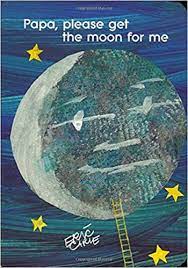
          Papa, please get the moon for me is a tale of great importance in my opinion. It shows us that imagination is wonderful, even if it is breaking something seen as impossible. Whoever told me that Father Christmas, the Tooth Fairy and the Easter Bunny weren’t real, or anybody for that matter, that breaks the dreams of a child, deserves a good long look at themselves. Reality and imagination can sit side by side, otherwise Neil Armstrong, or Elon Musk or Celine Dion would not be around. Ability and knowledge need the company of spark and dream – and that’s where imagination grows.

          “They are deceptively simple. I admit that. But for me, all my life I try to simplify things. As a child in school, things were very hard for me to understand often, and I developed a knack, I think. I developed a process to simplify things so I would understand them.” – Eric Carle

          As I sit typing words and reading about Eric Carle’s history, I recall flicking through glossy covers of his books, and the joy as my face beamed when I discovered a translated copy in Hengli, Dongguan. That beautiful familiar white cover with a caterpillar and a red apple missing a mouthful, all slightly imbalanced, as if to say, and to appeal, that things aren’t always neat and tidy. One day when COVID-19 passes and the world is a little more tidy, I dream to fly to Amherst, Massachusetts to see the Eric Carle Museum of Picture Book Art. That would be as good as finding another Uroballus carlei on a trip to Hong Kong. The Caterpillar Jumping Spider’s Latin name is testament to the reach and pull of a world class picture book writer.

          “My father used to take me for walks in the woods. He would peel back the bark of a tree and show me the creatures who lived there. I have very fond memories of these special times with my father and in a way I honor him with my books and my interest in animals and insects.” – Eric Carle

          ERIC CARLE June 25th 1929 – May 23rd 2021

          The Cafe Book

          The Cafe Book: Engaging All Students in Daily Literacy Assessment and Instruction, by self titled sisters Gail Boushey and Joan Moser, attracted me in library. Or because of the literacy element. Nor so that of instruction. The word cafe stood out. Its abstraction and my liking of coffee met perfectly.

          Hoisting the 204 paved softback down, I noticed the bump in the cover. A CD-ROM. I haven’t used a DVD or CD for so long. The Tungwah Wenze International School staff-issued iMac doesn’t come with a drive. I don’t have one on my personal laptop. The TVs at school, my TV at home and all the smart board systems at school don’t have a place for discs. Printed in 2009, I started to wonder if the contents would have dated as fast as the technology they employed. The longevity of books however remains stalwart.

          Seven sturdy chapters opened before me. I skim read the acknowledgements, unable to connect to the names on the page, but fully aware such matters as teaching and writing needs a cast of many. Last Friday, Grade 4 had a COLA (Celebration of Learning Achievement). Mr Jaime, Mr Richard and Miss Aria with support from Miss Keats and Miss Belinda set our class on a good course.

          Chapter one asks why and what are assessment systems. It refers heavily back to the authors and their previous book, Daily Five. The general idea being: students read to self, read to someone else, write something, use word work and then listen to reading. In an ideal and disciplined world, it makes a big difference. The appendix of the book I had in my hand though made more sense. I could see how CAFE system could be of use to the busiest of teachers. It is simple.

          Notebooks are often overlooked in these times of electronic record keeping. These can be filled by simple strategy forms. Students set their goals and post to a classroom chart. Small group work is encouraged, much like what I’m trying, time and time again. Whole group instructions and flip charts caught my attention. I’ve neglected flip chart paper for far too long.

          By the time I’d reached chapter two, the key details that came across were that teachers want to do more; the importance of scaffolding; and teachers take offence to be told to follow a set template. They want to find their own ways to adjust the scaffolding needs of individuals. Can’t say that I disagree.

          The evolution of a calendar from post it notes and scribbles on paper has certainly met all the best teachers. Our methods evolve and practices adapt. Reading literacy takes time for monitoring. Tabs, pages and menus of reading form. A bulletin board showing comprehension, fluency, accuracy and expanded vocabulary certainly feels like it should be at home in every classroom. Just like a daily ongoing story book. A chapter and day helps work, rest and play.

          To get students to know their target, classes often need exemplars. These set a clear visual goal for their work ahead. The CAFE book covers familiar grounds of observation, encouragement, tracking and how to push interest. It develops wall display ideas and recommends strategies to develop readers. There are bucket loads of suggested reading books, group activities and then reference forms. Before the evening expired, I had read the book cover to cover. Ideas will have sank in. But, first, just one chocolate Hobnob biscuit

          TESMC IV: The Quest for Peas

          Superman IV: The Quest for Peace was a British-American superhero fantasy released in 1987. Lead actor Christopher Reeve penned it alongside Lawrence Konner and Mark Rosenthal. It was bobbins. Proper crap. It was perhaps the reason the Superman franchise fell silent for 19 years. That and the unfortunate paralysis of handsome Christopher Reeve. The fifth movie followed Supergirl but slotted into the storyline arc after Superman III. The first four movies are good. Superman II: The Richard Donner Cut, remains one of my favourite pieces of cinema. Superman: the Movie has been regular viewing since I was a kid.

          “We were also hampered by budget constraints and cutbacks in all departments. Cannon Films had nearly thirty projects in the works at the time, and Superman IV received no special consideration. For example, Konner and Rosenthal wrote a scene in which Superman lands on 42nd Street and walks down the double yellow lines to the United Nations, where he gives a speech. If that had been a scene in Superman I, we would actually have shot it on 42nd Street Richard Donner would have choreographed hundreds of pedestrians and vehicles and cut to people gawking out of office windows at the sight of Superman walking down the street like the Pied Piper. Instead, we had to shoot at an industrial park in England in the rain with about a hundred extras, not a car in sight, and a dozen pigeons thrown in for atmosphere. Even if the story had been brilliant, I don’t think that we could ever have lived up to the audience’s expectations with this approach.” – Christopher Reeve, Still Me

          The final appearance of Christopher Reeve was ill-received by fans. Movie critics washed their hands of it. Plot holes gaped as large as life and special effects looked very much out of place. That’s exactly how my fourth instalment of TESMC will be. Read on to be convinced that I am right to state this early on. I make no apology. It is, what it is.

          Literacy and learning must be multi-dimensional. A topic can be talked about, in terms of content and theme. Talk serves as a bridge to writing. Talking about those written and supporting texts will only support the learning further. Our primary school years are crucial to allow us to develop literacy skills across the curriculum. A range and repertoire of skills can be born here. The key role of spoken language can furnish a student’s developmental progress. This is the path to critical literacy skills. New topics, new subjects, new teachers, new methods and the all round goodness of new experiences facilitate, under guidance, can bring meaning to it all. Talk is a tool for thinking and communicating. We’re helping students to make sense of the bigger (possibly daunting or exciting) world around them. In one blink of an eye we are seen as a facilitator, or in another flutter of the eyelids, we become the tour guide. Likewise we are an expert or a caregiver. We’re the U.N. Peacekeeper. We’re the negotiator. We’re a nurse. We’re an advisor. Then we’re a play figure. We shape our role in the classroom to the need of each or all students. Our interaction is important. We must be flexible and varied in our approach.

          The four stages of the teaching learning cycle (negotiating the field; deconstruction; joint construction; independent construction) are part of our arsenal to allow us to bridge the gap between oral and written language. We work tirelessly to integrate spoken and written language. We add clarity to muddy waters, interweaving the teaching learning cycle to give students a balanced understanding of concepts. We engage. We inform. We educate. We give opportunity. We task students to predict. We task students to evaluate. We check their prior knowledge. The students own their lessons. This becomes their own learning. It should shape their methods. Metalanguage builds up over time. These shared understandings about language and text allow students to look back on Superman IV: The Quest for Peace and agree it was crap.

          I can interact with classmates confidently. [I’m not afraid to try.]
          I can interact with my teachers confidently. [I’m Superman or Supergirl.]
          I can try to volunteer relevant information about the topic in class. [I can raise my hands.]
          I can express my personal opinion regarding a topic, when asked. [I have a view.]
          I can give feedback about the ongoing topic. [I can talk about something, over a few days.]
          I can talk and give relevant inputs in a group discussion. [I like teamwork.]
          I can try to use meaningful vocabulary / terminology for answering questions. [I can find big words that are useful.]
          Listening
          I can listen with sustained concentration and retell things. [You say it. I say it again.]
          I can listen to and follow teacher’s instructions/explanations attentively. [I know what you said I should do.]
          I can understand the different kinds of questions asked by the teacher. [I am clever.]
          I can respond appropriately to my peers and adults. [I am respectful.]
          I can listen and respond to audio tapes appropriately. [I understand more than music.]
          Useful rubric? From the fourth module of TESMC, I believe the above rubric to be of great value to my student’s self-assessment. I shall edit it further until it is of more use.

          Multiple activities can be effective in the process of learning. Students can use interests as a scope of discussion. They can use discussion as a scope of their interests. They can find common ground and talk openly. There will always be moments of excitement and times when familiar objects or foods generate a real buzz. One or two sentences by students beats no input and it is important to allow students a voice. Some may tend to hide. A teacher’s job is to encourage. Encourage. Stand tall. Perform. That’s the key to effectiveness. Tasks, however, must be relayed clearly, always based on the English as a Second Language (ESL) learner’s needs.

          I’m going to go away and find a downloadable copy of the Superman IV: The Quest for Peace script. Perhaps my grade four students can rewrite the script, and use a cast of garden peas. It can’t be any worse. Mark Pillow, A.K.A. Nuclear Man came from Leeds, Yorkshire (U.K.). Best forgotten.

          I guess the writing just says that the movie is bobbins.