Are there many novels that celebrate and champion persistence? Do all cops in novels ignore authority and tackle the weight of bureaucracy through ignorance? Early reviews pointed me to a challenge.
Inspector Imanishi Investigates by Seichō Matsumoto is a post-World War II novel originally penned in 1989. The lead protagonist, unsurprisingly, is Inspector Imanishi. He is a world apart from the rebellious bulldozing Harry Bosch found in Michael Connelly’s novel series. Instead, Imanishi is methodical, modest, and clinically human in his approach. He persists without need of a lightbulb moment or an act of genius. At every turn Inspector Imanishi displays empathy. He listens. He feels the victims’ lives. He endures whilst remaining ethical and responsible. The fog of guilt lurks. Grief and shame wallow. The good Inspector appears to put himself in others’ shoes.
What happens when guilt becomes unbearable? Drawing on a contrast of a post-war reshaping metropolitan Tokyo and that of rural provincial Japan, this book uses geography, culture, and traditional etiquette to deliver the truth. Themes of memory and recollection, urban alienation, interconnectedness, societal and historical tensions. The slow movement of justice’s machine underlines the need for structure and hierarchy but appears to comment on a lack of urgency. What secrets live between city lights and village shadows? Can you bury a crime in a country still healing?
How well can you really hide from who you were? The plot features new names, misdirection, reinvented pasts to escape guilt, shame, and consequences shows disguise as social-cultural adaptation. In an ambiguous world, the detective is a constant: deeply moral. Rarely does a slow-burn of a book stand out, yet from the opening chapter to the conclusion, I was hooked. The jigsaw was essentially a lesson in the importance of detail. Like a cold-poured Guinness, “Good things come to those who…. wait.” The novel’s ending seemed more reflective than triumphant yet left me wanting more. Was reluctant justice enough? Does empathy make the best detective?
Matsumoto’s Inspector Imanishi Investigates is a novel celebrating persistence and realism. It is the antidote to flashy books filled with spectacle and glamour. The notes of fading traditional values give hints at a nation’s people suffering an identity crisis – or at least instability causing a social flux. I found myself pondering, how much of our world’s remembered reality was misremembered? Can patience solve what brilliance cannot? Is closure enough when lives have already been lost?
novel
Kristen Perrin’s How to Solve Your Own Murder: Review + Light Up Lancaster
How to Solve Your Own Murder by Kristen Perrin is a page-turner with a unique premise that sets it apart from other mystery novels. At first, the genre and title didn’t attract me. Once I’d opened the cover, the protagonist’s posthumous investigation is intriguing, and Perrin’s plot is full of clever twists and turns. The novel’s fast-paced and suspenseful narrative keeps readers engaged from start to finish. Perrin’s innovative approach to the mystery genre makes this book a highly enjoyable and memorable read.
At times, I thought the book to be both gripping and inventive take on the classic murder mystery. However, I felt torn between changing a chosen book to read. At first, the story centres around the protagonist who, after her own untimely death, must piece together the clues to uncover her killer. It sounds cheesy and forced. Perrin’s writing is key to why I continued. The delivery is sharp and witty, with a plot that keeps readers guessing until the very end. That being said, it doesn’t leave too many imagined options.
The novel’s unique premise and well-developed characters make it a standout in the genre. Fans of mysteries and thrillers will appreciate the clever twists and the protagonist’s relentless pursuit of the truth. as it offers a fresh and intriguing spin on the traditional mystery narrative, Kristen Perrin‘s well crafted work stands out as a must-read for mystery enthusiasts looking for something different. A thought-provoking and compelling mystery told through the themes of identity, justice, and the afterlife. May contain deeper philosophical undertones.
If a soundtrack is needed for any future televised or silver screen production, then look no further than Rebekah Okpoti‘s haunting score for the Light Up Lancaster event installation in Lancaster Priory. Amongst the visuals by artists Jonathan Hogg and Nick Rawcliffe, a tone of menacing organ music filled the vast Lancaster Priory. The acoustics seemingly fit multiple genres of entertainment, and I reckon Kristen Perrin’s work deserves a soundtrack.
The Lancaster Priory’s Director of Music, Rebekah Okpoti, took inspiration from William Herschel, playing a tune overlaying an almost eye-lije triangle screen sinisterly reflecting kaleidoscopic journeys. The other town light installations varied in shape, sizes, and subtletkaleidoscopicy, much like the words of Kristin Perrin.
Katie Flynn’s A Mother’s Secret: Review
Katie Flynn’s A Mother’s Secret is a heartwarming tale that delves deep into the themes of love, resilience, and family bonds. Set against the backdrop of World War II, the novel follows the life of a young mother struggling to protect her family and safeguard her secrets. Flynn’s evocative writing and well-drawn characters make for a compelling read that is both touching and inspiring. This book is a testament to the enduring strength of maternal love and the sacrifices made during challenging times.
Interestingly, as I expected, the book’s author is a continuation of her work via her daughter. Katie Flynn’s enduring name lives through her daughter Holly. Holly rips into the work, delivering a glimpse of historical detail, life for the working classes, and the trials and triumphs of Wartime Britain. Katie Flynn, a pen-name of Norwich-born Judith Turner, passed away in 2019, after 82 years of life that threw a catalogue of books our way.
A Mother’s Secret draws tender attention to details, emotional struggles, and a secret with the odd unexpected twist. Love, loss, and redemption are portrayed in both a realistic and evocative way. Lessons about the strength required to confront and overcome past mistakes shine throughout the novel. The plot, however, lacks jeopardy in its delivery. That does no damage, as the focus of a mother’s love stands tall.
Katie Fforde’s Island In The Sun: Reviewed + Keane
Island in the Sun by Katie Fforde is a feel-good novel. I get why it’s popular. The age-old tried and tested niceties of its contents are visible from the cover to the blurb. It isn’t for me. That also applies to Keane, although this band does have some gorgeous tunes that are worthy of many playlists, including my own. If you like uplifting stories and music, pair up this novel with Keane’s Hopes and Fears.
“We’re spiraling; We’re tumbling down. We’re spiraling; Tied up to the ground.” – Keane lyrics, Spiralling
Usually, I would’t pick this kind of book up. Island in the Sun by Katie Fforde is a warm and enchanting story that transports readers to a beautiful, sun-drenched island. The book’s themes of love, self-discovery, and new beginnings are beautifully explored through the eyes of the protagonist, whose journey from uncertainty to confidence is both relatable and inspiring. The island setting serves as a perfect backdrop for the blossoming romance and the personal growth that occurs throughout the story. I also wouldn’t usually be found listening to Keane for too long.
Attending Keane’s 20th anniversary tour of their debut album, Hopes and Fears, was a pleasure. The tunes are melodic, the fans impassioned, and the band itself, divine. Tom Chapman, on lead vocals, alongside Tim Rice-Oxley and Jesse Quin, sit on the softer edge of rock, somewhere between indie and soul, and all the other gentle musical genres. Slow to mid-tempo rarely jump up beyond their distorted piano and instruments, but it works. Somewhere Only We Know is a gorgeous ballad. My sister Astrid was certainly enjoying the gig. She seemed to know every lyric instinctively. If ever Tom Chapman needs a break, Astrid is ready and waiting.
“I hold you in cupped hands; And shield you from a storm; Where only some dumb idiot; Would let you go.” – Keane, Sunshine lyrics
The Katie Fforde book is highly recommended for fans of feel-good romance novels, especially those who enjoy stories set in idyllic locations. It’s a perfect summer read for anyone looking to escape into a world of love and sunshine. I am not sure that I would pick this book up again. Much like the novel by Katie Fforde, the band Keane is sun-soaked, cheery, and filled to the brim with credible content. It is easy to imagine scenes of the book with the background music, This Is the Last Time. It doesn’t mean I won’t be revisiting the author’s or band’s works.
Katie Fforde’s Island in the Sun is a charming novel beautifully capturing both the themes of second chances and rediscovery. Richly drawn characters take a journey through a central landscape of warmth and magic. Dollops of personal growth land alongside love found at an older age. Expect whimsical blends of romance throughout vivid escapism. Much like the lyrics of Keane, satisfyingly atmospheric moments will occur. Perfect symmetry, indeed. Keane’s gig was postponed, much like the opening of Coop Live in Manchester. The wait was well worth it. An emotional Tom Chapman cut the stage-audience interactions perfectly, and on reflection, Keane delivered fantastically.
The new book
Opening the cover beyond the title and an author’s name, ignoring the blurb in the rear, smelling the pages, and anticipating what lies within. The smell of books decomposing ever so slowly, losing their cellulose and lignin is known as bibliosmia. A book shed that information to me once. A bibliophile needs to know that. Some folk say books smell and attract us. It could be. I’d have to read about that to understand it.
The peaty, earthy, and slightly musty smell is neither a grotesque or pleasant smell. It is a familiar one. So, today, on my 41st birthday, I open Vince Flynn’s American Assassin. I’m unsure if I have seen the movie by the same name. It’s insignificant. All I know is that I want to read the book and feel the author’s words. My Aunty Christine rehomed this book with me. She recommended it. That was some time ago. Good things come to those who wait?
The nostalgia of feeling a book in your hand has made me ignore my Kobo e-reader, almost immediately after Mum gave it to me years ago. I’ve used it for reading literacy documents and nonfiction. That’s all. The bibliochor fragrance is all too tempting. Tiny dust mites, squashed spiders lost in the pages, and the odd note by a predecessor of a reader make books a fair journey into timelines and places beyond the text. Each book, even the crap ones, packs potential for a new world or inspiration to read more, write better, or seek new nostalgic texts.
Some books are unpardonable and need discarding. Some can not be put down. Some demand full attention, and some will sit silently awaiting the caress of a gentle reader. A few books will get battered and lay tattered. Many will touch hearts, and others may heal, or hug, or wrap amongst the DNA of the eyes upon the pages. Emotions and feelings from junior texts to deeper heavier lexile demands may equally challenge or relax a reader. The duality of opening a book and opening a door to a new story awaits.
Simon & Schuster, the publishers sits on the spine. The New York Times Bestseller awaits. So, prelude, page one… off we go… over to you, Vince Flynn. I’m ready to read.
The End of Time.
Hello! How do! 你好~
The notion of time need to go. That’s how author Paulo Coelho answered Laura Sheahan for a Beliefnet.com interview. Everything is eternal and there is no time. He said that “time is another of these things that help us go through life”. Professor Stephen Hawking would have been proud. This was the closest I’d got to understanding anything written by the great professor, and it wasn’t through deep science.
Instead the vessel of discovering enlightenment came through a multifaceted faith-crossover text, The Alchemist. Since Qiezi (茄子) gifted me this novel, I’ve had to read it twice. Time on a hospital bed granted me a third visit to the pages. Actually, visiting this book again was like embracing an old friend. A welcome return to the familiar. And like all good friends, there’s always something new to encounter together.
Whoever is the Fatima of my Personal Legend and wherever the pyramids are that I seek, perhaps today in this hospital I’m encountering my own crystal glass shop. The cliche-heavy book is relatable in many senses and my biggest take home is change. We must always adapt and accept that very few things remain constant. If one day you can’t breathe easily, then the next you may improve (or not).
The simplicity of the book, through protagonist Santiago, tells a sweet take about keeping faith and discovering your destiny, despite the challenges set before you. Now Santiago’s visions set him on a journey that teaches more and gives plenty whilst indulging you and I as a reader in the do more, see more, be more mantra of life. If it was a Coldplay song it’d be about opening up your eyes.
The short read delves deep into fate and manifestations with a strong sense that the universe is pushing your path in front of you. Rich in symbolism, folklore and spirituality, Paulo Coelho has made me want to explore every other text he’s written since the Brazilian started publishing in 1974 (in his late twenties). His Portuguese books have spread globally and been aided by translation. Popularity has been earned. Now, which students can I put the Chinese and English editions into their hands? I’ve been gifted these words. It’s time to share this world.
Goodbye. Ta’ra! 再见~
Harry Farthing’s SUMMIT: A NOVEL.
你好/ Ní hǎo / Nín hǎo / Hello / How do / S’mae / Namaste
 What’s not to like about a novel that pits those wrapped in conflict against Nazis and Neo Nazis? I picked Summit up in a bookshop on the windy alleys of Kathmandu’s Thamel district. By the time I had picked up the book, I’d already read many travel and, or, climbing books themed around Nepal. The selling point was the capital letters reading as: A NOVEL. The blurb gave me an impression of a thriller tapered with reality and facts. The author Harry Farthing’s personal experiences flow amongst the words. It has heart and science.
The battle of man’s ability of mind and body against the elements – and in this case Mount Everest have thrilled generations for decades. This novel methodically and fastidiously details truth alongside fiction and slaps the reader with two warm characters, each with their own weaknesses and conflicts. The darkness of the early chapters builds upwards like a mound of cold and deathly snow ready to collapse in an avalanche of disaster. Just as I thought that I’d guessed the ending, something unexpected arrived. The central climbing characters of Josef Becker and Neil Quinn both tell the backdrop of Europe full of division in two very different eras. It revels in achievement and defeats equally, highlighting a telling cost for those who seek to go endlessly upwards. The coin is firmly flipped over to reveal a darker side of Everest, so infrequently spoken of, yet somehow there, always there in the shadows.
Beautifully written and meticulously researched, Summit follows two climbers across two continents as their stories and movements intertwine across history, culminating in one final push for the top of the world. This is the author Harry Farthing’s breath-taking debut novel and it certainly has been an ambitious and epic piece of compelling modern fiction. It isn’t hard to imagine a fast-paced stage play, a TV series on Netflix or a movie to follow the book. The novel itself may well be a challenge to adapt, but the pages flick over and over with ease. Those who like mystery, treachery and well-written characterisation should lift up Harry Farthing’s Summit: A NOVEL. There’s a place on my bookshelf now for Farthing alongside such well researched novelists as Michael Crichton et al. Not a bad investment of 500 Nepali rupees. My only regret is not reading this sooner!
再见/ Zài jiàn / Bài bài / Ta’ra / Goodbye / Hwyl Fawr / Dhanyabaad / Alavidā
Preview one.
你好/ Ní hǎo / Nín hǎo / Hello / How do / S’mae / Namaste
So, today I learnt that if you the below into Microsoft Word and hit enter, something happens. Try it. Not amazing, but certainly different.
Lorem =(5,5)
In fact, I could not type it easily, because everytime I hit enter, it happened. Why did I need it? I didn’t. It just came when I was watching a YouTube video on how to make word clouds. Common words like it, the, a, and so on are removed. I wanted to see common words from this blog of over 301,000 words to see what words stand out. I imagined City and Manchester to dominate. The result is as per below (2000 most common used words):
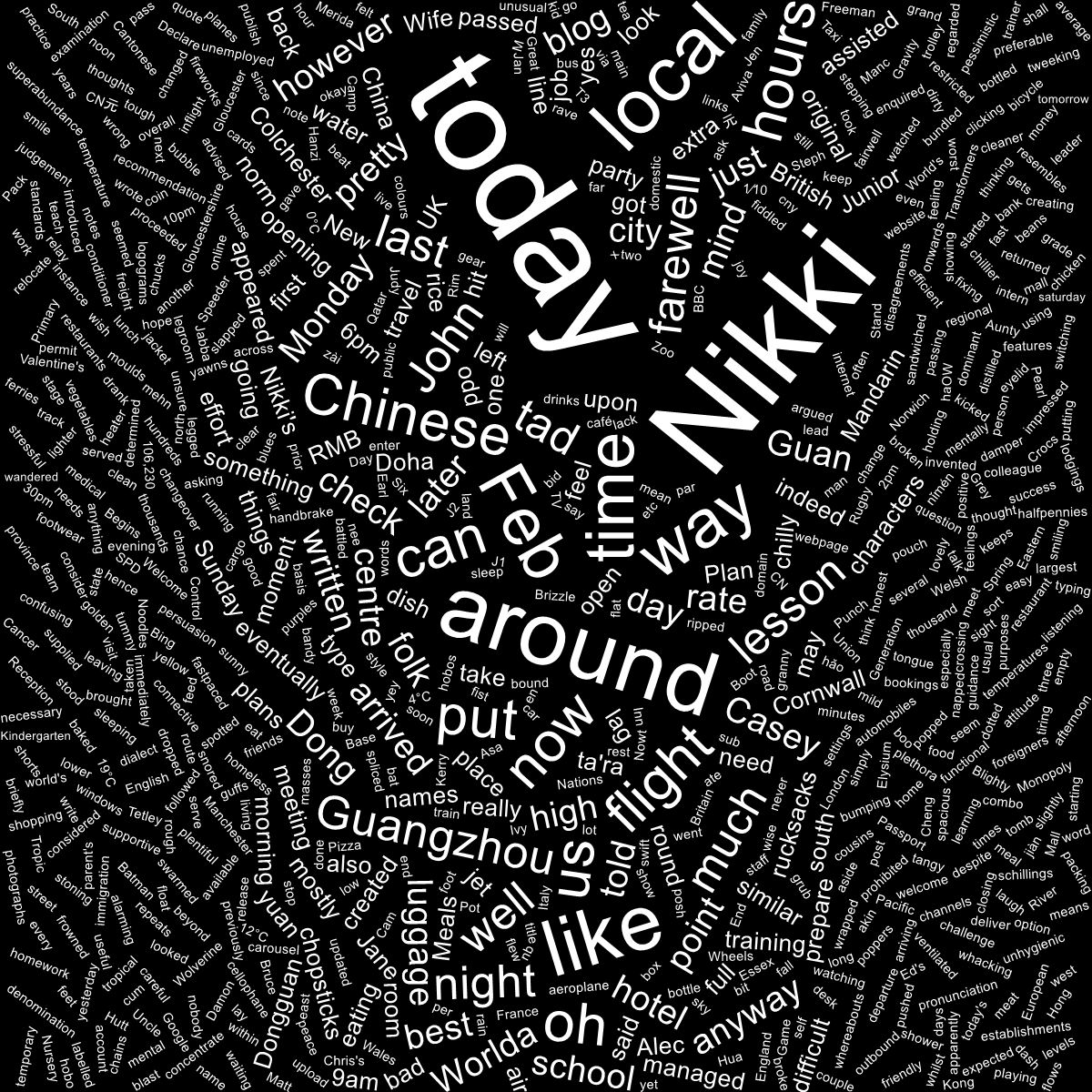
I did the same on the 120,000 word novel that I have written. Yet to be published. This is the first preview, in a way. Here is that result:

再见/ Zài jiàn / Bài bài / Ta’ra / Goodbye / Hwyl Fawr / Dhanyabaad / Alavidā
 AGAINST THE FLOW OF TRAFFIC - ACTON28.BLOG