I visited HuiDong, Guangdong (China) one January during the CoViD-19 pandemic, and it was quiet. On the August 2023 trip, it was the opposite of quiet. I no longer recommend the area. Too much litter, noise and far too many people. I just visited once at a much quieter time.
At 5.30am, on August 9th, a young kid was throwing sand at her pet duckling, and the duckling tried to escape. She put it in a carrier bag. One of her parents then stamped on it. To further this heinous crime against life, her parent tossed it into the sea. Plastic bag, dead duckling, and the shittest sea burial ever. That was a morning sunrise with Indigo spoilt by the grimness of an unwanted morning observation. I’d like to say that was all I witnessed during my time in Guangdong over the last decade. Similar crap happens on the U.K. I’m not naive enough to believe it doesn’t. The scale of bleakness and disposable life is grim: like painted turtles, flea-ridden kittens full of worms in small block cages and hamsters.
Beyond the disappointment, tree frogs, egrets, snails, and geckos made a change from legs being wrapped in sea plastic and watching bottles float out to sea. The sea could be seen as a glorious slumber of nature battling humanity’s demise. Our global oxygen provider and carbon dioxide sink act in a complex structure of processes so dependent on balance that any changes lead to stressed environmental twists. The tree frogs and egrets will know the difference. As will man. And woman. And LGBTQ+.
Henry VIII had his own purpose-made football boots, from Italian leather. That rough and ready game led to football and shirts being made and these days from recycled polyester materials. Not that the cost of recycled material ever shows in the cost of football shirts. Stood in a rock pool, looking at tiny crabs, anemones, and sea snails, I could feel the belting heat on my City shirt. The manufacturer Puma hadn’t accounted for Guangdong’s blistering humidity and heat, even in the shade of towering rocks. I pondered how the piles of plastic at the top of the beach could be used to produce future City kits. Or for team China. All it could take is a few lawmakers, employment of people to tidy and educate. Leave only footprints. Take only memories. Or not?
The wrong one may leave you in pieces. The right one will leave you in peace. The right one will find you in pieces but lead you to peace. Or not.
Possibly so: peace or pieces. It’s hard to tell. Much like a party of fools claiming to be a “strong stable government,” tiling floors and walls are not for the weaklings of the mind. Application of a three-dimensional wall covering with sharp bits can tear you apart. Much like a Conservative Party led by too many leaders over a 14-year period. Long may they fall off the walls like loosely grouted tiling! Hip hip hooray!
As one party flops out, the Labour Party moves in, with or without satellite television. Up steps a change that has been coming for years. Forget the British exit from the European Union, and countless money spent on distraction, the Tory government have left Labour up a creak with no paddle. Barely even a tea-stirrer. And then came riots. Far-right insights into their worry and panic. Flags unfurled. Bakeries and phone shops looted. Loose tiles of society.
And now to the prosecutors, the courts, and the overcrowded gaols: their work hindered by foolishness and hate. Their time set back. Meanwhile, social media, or X, or Twitter, sits quietly in the corner in total denial of its involvement. Telegram, and others wander and pander around. Their images on black screened tiles around the world. So, what now?
Some time ago, I tried to imagine a show similar to Father Ted, filmed within Asia. I genuinely came close to emailing script writers and asking for tips. Then the idea faded. The absurdity of Buddhists in China behaving awkwardly didn’t sit right. The Communist surroundings wouldn’t remotely support humour on television. Yesterday, the thought came back. I pondered more. What if it was set in Nepal? In the valleys and foothills of Everest?
Imagine the beloved British-Irish sitcom Father Ted, reimagined in the serene, mystical mountains of Nepal. Instead of a small Irish parish, the setting is a remote Buddhist monastery. Meet Beneath Everest (working title), a comedy series that captures the hilarity and absurdity of monastic life in the Himalayas.
Nestled high in the mountains of Nepal, the Namche Khenpo Monastery is a place of tranquillity, spiritual study, and unexpectedly, a hub of comedic chaos. The monastery, with its ancient stupas, prayer wheels, and stunning views, is home to a group of eccentric monks whose daily lives are anything but serene. The valleys around the Khenpo Monastery are mostly impassible.
Head Monk Tashi is a middle-aged monk who was exiled to the remote Khenpo Monastery after a series of misunderstandings and minor scandals at his previous, more prestigious monastery in Kathmandu. See also Father Ted. Clever, somewhat cynical, and often frustrated with his lot in life, Tashi tries to maintain a semblance of order and dignity, despite the antics of his fellow monks.
Monk Karma is a young, naive monk who came to the monastery with the purest of intentions but often gets confused about Buddhist teachings and the basic principles of monastic life. He is innocent, kind-hearted, and endlessly enthusiastic, Karma’s misunderstandings and childlike logic are a constant source of humour.
Monk Dorje is an elderly, cantankerous monk who spends most of his time meditating or napping in a secluded corner of the monastery. Despite his outward appearance of spiritual dedication, Dorje has a fondness for rice wine and often spouts incoherent mantras. Grumpy, unpredictable, and occasionally wise, Dorje’s outbursts and peculiar habits keep everyone on their toes.
Ani Pema is the monastery’s cook and caretaker, a devout nun who believes in the sanctity of hospitality and the importance of offering tea to everyone, at all times. Cheerful, persistent, and slightly overbearing, Pema’s relentless insistence on serving butter tea and her exaggerated sense of duty provide endless comic moments.
Throughout the series, the show explores the daily routines of the monks, from morning meditations and teachings to dealing with local villagers seeking advice or blessings. Each episode features Tashi’s efforts to maintain spiritual discipline amidst the chaos caused by Karma’s misunderstandings and Dorje’s eccentric behaviour. Karma’s literal interpretations of Buddhist teachings lead to humorous situations, such as trying to meditate under water to find enlightenment or misunderstanding the concept of detachment and giving away the monastery’s prized possessions.
Periodic visits from the head lama or dignitaries from other monasteries add to the comedy, as Tashi scrambles to present an image of a well-run and devout monastery while keeping Karma and Dorje out of trouble.
The monks’ interactions with the local community, including helping with festivals, resolving disputes, and participating in cultural ceremonies, provide a rich backdrop for exploring Nepalese traditions and customs with a comedic twist.
The show would retain the heart and humour of Father Ted while offering a fresh, culturally rich setting. The serene yet unpredictable world of the Khenpo Monastery serves as a perfect stage for exploring themes of faith, folly, and friendship. As the monks navigate their spiritual journey amidst a whirlwind of comedic misadventures, viewers are treated to a delightful blend of laughter and life lessons, all set against the breathtaking beauty of the Himalayas.
Of course, I wanted to contact Graham Linehan and others to see if the idea had traction, but Graham is too busy being nasty and divisive. So, this idea lands here, ready to be buried. That being said, I could contact Channel 4 for their view. All production and scripting should be worked with a local crew and thoroughly ensure respect for Nepal and their people. So, it’s probably a tough job to bash out. Arthur Mathews could do it, I’m sure. Does anyone have a contact at Hattrick?
Diane Charlemagne wasn’t Dido. She didn’t feature on Eminem’s Stan. She could have. Instead, her voice permeated a string of hits, club classics, and iconic songs. Sadly, discovering her name and back catalogue, I realised that I was too little, too late. And she’s a Manc. Why hadn’t I heard of her?
For many years, I had the song, “The key, the secret” bouncing around my head. Diane’s voice held that tune. Having sang alongside Moby and Elton John, having featured on Goldie’s Inner City Life amongst others, Diane Charlemagne deserves greater recognition – and she was Mancunian.
In the vibrant tapestry of Manchester’s music scene, where every note finds its rhythm and every song tells a story, one voice soared above the rest: Diane Charlemagne. With a name that echoes through the annals of music history like a perfectly pitched chorus, Diane was more than just a singer; she was a force of nature, a vocal virtuoso, and the beating heart of Manchester’s melodic soul. Oddly, few people know her name.
Born, February 2nd, 1964, in Manchester, Diane was destined for musical greatness from the heave-ho-get-go. Apparently, even as a child, she had a knick-knack for turning mundane moments into impromptu concerts, much to the bemusement of her family and neighbours. Her early years were a symphony of talent shows and local gigs, each performance adding a note to the masterpiece that would become her career.
Diane first strutted onto the big stage with the band 52nd Street, a group that effortlessly blended soul, funk, and jazz into a sound as smooth as silk and as infectious as a catchy jingle. Their single “Tell Me (How It Feels)” rocketed up the charts, and Diane’s voice, with its rich timbre and emotional depth, was the secret ingredient that left listeners hooked. Manchester’s very own diva with a voice that could melt butter and a stage presence that could ignite fireworks. Yet, only amongst a select audience.
Yet, Diane was no one-hit-wonder. She was seen as a musical chameleon, seamlessly transitioning from the sultry vibes of 52nd Street to the pulsating beats of dance music. Her collaboration with the band Urban Cookie Collective on the track “The Key, The Secret” became an anthem of the 90s rave scene, propelling her to international stardom. With her powerful vocals driving the song’s euphoric energy, Diane became the queen of the dance floor, commanding crowds with a single note. And that got her noticed.
Like any true artist, Diane was not content to rest on her laurels. She sought new challenges and found them in the world of drum and bass. Teaming up with Goldie, the genre’s godfather, Diane lent her voice to the iconic track “Inner City Life.” Her haunting, soulful delivery added a layer of poignancy to the song, transforming it into a timeless classic. Critics and fans alike hailed her as the undisputed siren of drum and bass, a title she wore with grace and humility.
“Inner city life; Inner city pressure; Inner city life; Inner city pressure taking over me (yeah, yeaaah); But I won’t let go” – Inner City Life, Goldie
Despite her impressive accolades and the glitz of the spotlight, Diane remained grounded. She was known for her generosity, her infectious laughter, and her unwavering dedication to her craft. Her collaborations with artists across genres (from jazz maestro Moby to pop sensation Beverley Knight) demonstrated her versatility and her boundless passion for music.
Tragically, Diane’s vibrant life was cut short in October 2015, when she passed away after a battle with cancer. However, her legacy endures, resonating through the speakers and headphones of music lovers around the world. Manchester lost a star, but the universe gained a voice that may echo through the ages. In the end, Diane Charlemagne was much more than a singer from Manchester. She was a musical luminary whose voice could paint emotions and conjure memories. Her journey from local talent shows to international stages is a testament to her extraordinary talent and indomitable spirit.
Is it possible to argue with some Conservatives? Or near-to-far right fascists? I can’t explain to them, without their true listening and understanding, about why they should care about people other than themselves. I can’t explain that people are people, and getting along is something a communal species should do.
I can’t explain that the “what-ho”, “pip-pip” and “down with this sort of thing” attitude of those who fought wars against oppressive regimes, invasive war machines, and Nazi overlords was for good purpose and to allow us as people to grow freely and fairly.
Stories from the bible, the Koran, and other holy books, alongside children’s tales, often educate and inform us about looking after one another. I don’t know how to tell someone that they should have learned how to be nice. Respect is given, not just earned. Britishness, national pride, and flag-waving has its place. There’s room for it. The problem is: are you proud to wave the Union Flag and St George’s cross when it’s claimed as a symbol of “us versus them”? I was brought up by parents, with input by grandparents, to accept people and respect all. It isn’t difficult. I can even respect Man Utd fans.
Yes, there are differences and clashes of belief. Hence, conflict. Conflicts by world powers playing Team America World Police have knock-on effects. The most visible being refugees. If you bomb for oil or to control an uncontrollable region, in an already divided place, creating a vacuum for absolute bastards to take over with unforgivable and inhumane laws, expect a few thousands of people to leg it.
Where do refugees go? The most appealing and tolerant places must appeal more. Off they pop. Through risks. Through high seas. In the back of trucks. Legal routes. Illegal routes. Whatever it takes. Along the way, lives are shed. Lost. Gone. Babies and children die. Ships sink. Boats fail. Lives are torn apart. And then the lucky ones arrive somewhere welcoming. The really lucky ones get support and they contribute.
Yet, a country that fought the Axis of Evil has its own right wing of hatred, xenophobic distrust, and insecurities. Fear spreads. The participants are sometimes unaware of their manipulation by power and money. And it hurts. It divides. It conquers people who want to get on with life – and live. Life is for living. Why can’t we understand that this way is not the way?
Seeking out and spelling out hatred of those with different sexuality? Check.
Refugee hosting state turning to refugee producing state? Work in progress, perhaps.
“An all but universally accepted definition of evil, a fixed point on our moral compass” – Professor Alec Ryrie (historian) on Nazism
These are difficult times. The landscape has gone to the dogs. Godwin’s Law is rife. And, why not? It feels like comparison of current troubles echo that of the 1930s Weimar Republic. Thankfully, by a minority, and not by a government (Israel, aside). But, can you speak your thoughts out loud? Yes, with the right audience. Heaven forbid you should write it down. Worse still, make a video and distribute it via social media. The Left are to blame, of course. Or the reigning government, even in their infancy. Modern-day Britain is a shitshow.
Everything is seemingly dumbing down. U.S. Presidents used to talk and have words that sounded both educated and reassuring, even as their fingers hovered over nuclear buttons. Nowadays, failed (thankfully) assassination attempts appear to inspire confidence and show defiance in a likely pathway to ruling. As Trump, Putin and other loony leaders play with our future, the world is truly heating up. Modern day Britain can’t even safeguard a Greggs bakery from looters. And the saddest part, the kids who lost their lives in Liverpool.
The victims: the kids should be remembered, and their stupendously-short, meaningful yet unfulfilled lives celebrated. It is criminal that they did not live longer. Evil swept them away. Their futures eradicated. More should be done to make their young friends and families safe. An open platform for debate could drive changes and give hope to all. That’d be a good memory rather than riots in Rotherham, London, and Manchester. Is this what life has become? Mourning under madness?
Let the authorities get on with resourcing the criminal actions of evil in hand and stop this cancerous social media disinformation that is treacherous to all who live on the green and pleasant lands of a supposed Great Britain. Or, burn it all down? Otherwise, history will repeat itself. We can’t go on this way.
One player I have read much about, seen flickers of videos, and met many years ago at the City of Manchester Stadium, has always fascinated me. Peter Barnes also signed my book, This Simple Game: The Footballing Life of Ken Barnes. Written by Ken Barnes woth Jimmy Wagg, the Manchester: Empire Publications book remains a proud piece of my City memorabilia. The name Ken Barnes sounded fresh from Coronation Street.
Throughout his playing days, Ken Barnes was known for his athletic build and agility on the field. Newspaper reports said he had a confident and determined demeanour, reflecting his leadership qualities as a midfielder. My grandfather said how as Barnes aged gracefully, his posture remained strong, and his eyes retained a glint of the competitive spirit that defined his career.
Dedicated and hardworking, Barnes was renowned for his relentless work ethic both on and off the field. His commitment to training and improving his skills was unwavering throughout his career. As a midfielder and captain for Manchester City, Barnes exhibited natural leadership qualities. He was vocal on the pitch, directing play, and motivating teammates. Featuring for City, Wrexham, and Stafford Rangers, he’d give his all for over 390 league and cup games.
Like many players, he faced setbacks and injuries with resilience, always bouncing back stronger and determined to contribute to his team’s success. Despite his achievements, Barnes remained humble and grounded, often crediting his teammates and coaches for his success. Beyond his playing career, Barnes transitioned into coaching and management roles, driven by a desire to impart his knowledge and passion for the game to future generations. Scoring 42 league and cup goals, alongside management at Wrexham, Bangor City and Witton Albion cemented his football experience.
Born and raised in Birmingham, Barnes showed talent for football from a young age. He honed his skills playing for local clubs before catching the eye of professional scouts. Barnes’s career peaked during his time at Manchester City in the 1950s and early 1960s. His £750 move helped him play a pivotal role in the team’s success, with City winning an FA Cup final at the second attempt in 1956. He never earned caps for the England national team or had a chance to represent his country with pride and distinction in international competitions.
“The best uncapped wing-half ever to have played in English football” – Denis Law, Scottish international footballer
Barnes is remembered as a legend of Manchester City, not only for his achievements on the field but also for his influence on subsequent generations of players and coaches. After retiring from playing, Barnes transitioned into coaching roles. He served as a coach at various clubs, including Manchester City, where he continued to contribute to the development of young talents. Barnes remained active in the football community, participating in charitable initiatives and mentoring young players. Barnes would be involved in the development of a number of young players, including Paul Lake, David White, and Steve Redmond.
He has been honoured with inductions into the Manchester City Hall of Fame and remained a beloved figure amongst senior fans for his dedication and contributions to the club.
Sometimes, it is easy to want to kick back. To give up. To give in. Buckle under pressure. To push it all away and walk off. Head away from everything. The problem is that it matters. And, when it matters, it really matters.
You can’t switch off from it. There is no miraculous light switch, with an option to plunge away that which matters. Nor would you want it to be that simple. Although, a spot of simplification may make a huge difference. Frustrating as it is, burying your head in the sand just wastes time and brings about a tumbling cascade of further frustration.
No plan ever survives first contact with the enemy, or a decorator, or a trip away. The only certainty in life is death. Everything else is hung on tiny, easily disturbed strings. These variables throw up challenges, barriers, and realisations. They shape expectations and twist the optimistic to the realistic. Deep down the cinders of pessimism, ebb, and flow, waiting for their time to shine. The advice is almost always: don’t let it.
That exclusive advice may seem out of reach. That’s the beauty of pain and the distorted view of solutions: we feel it. Frustration can be overcome. It may not seem that way. Finding your channel out of a stormy ocean is key. Believe. A spot of resilience goes a long way.
Have you ever worked hard on a problem to find more problems? When do you stop the “keep going” attitude? How far is too far? It seems like every step forward costs an arm and a leg, emotionally and financially.
I feel like a letdown. Rent is too high. Outgoings leave less than 20% for disposable income. Decorating frantically, problematic historic piping, wiring, and plastering are amongst the catalogue of challenges. The list goes on and on. Dividing rooms by to-do-lists, coupling with preparations, or bits here and there, seem to be cutting some grass, but then new grasses grow.
Focusing on the bathroom, that’s in hand. Some floor tiling and wall tiling are needed. A panel beneath the bar and a few minor bits. In hand. Heating and piping ca. Be resolved later. And a new shower cubicle. An okay shower and bath are available. Separate toilet room, okay – again a few tiling and flooring bits. Skirting boards all need doing.
The kitchen. Argh! New cabinets and sink, with tiles, all in boxes. Legacy sink, hanging by a thread. Oven fitted. Fridge-freezer standing tall. Walls are a disaster. Ceiling, patchy. Loads to do. A major hurdle. Skirting boards all need doing.
Box bedroom, boxed off, less carpet and heating. Back bedroom, boxed off, less carpet and wardrobe, and, yes, the skirting boards all need doing. Front bedroom: no go zone – not a task for now. Forbidden to entry. Upstairs landing and attic completed, save skirting and door frames that need a lock of paint.
Stairway to heaven-ish? Needs full painting. Lobby and front door/porch: full attention needed. Lounge: skirting and window frames, with carpets needed. Garden: for another day. Greenhouse: overgrown, and certainly work for later. Hedges: is it Eve dry enough to cut them?!
So, little by little, slowly, slowly, and painfully, the improvements turn to movements, but it all seems impossible. It isn’t. I know that. It just feels like pissing into the wind. It’ll get there. Seemingly impossible tasks always do, if you don’t give up.
The trouble with popular energy drinks, like Monster, is that you can no longer tell who the drunks are in the morning. Those 568ml (a pint) cans they use make the only visible sign of the drinker to be the rapid eye-movement and early signs of an incoming brain seizure. And so, we enter the season of General Election 2024.
“I have friends who are aristocrats, I have friends who are upper-class, I have friends who are, you know, working-class. Well, not working-class.” – Rishi Sunak, before he became Prime Minister
Mud is being slung, the Prime Minister has abandoned D-Day Commemorations, alongside global leaders. Perhaps the 81st Memorial next year is more important. That or he didn’t want to see his last one. Our pint-sized leader Sunak, the Wreck-it-Ralph of political debate, is floundering on the rocks as waves go down or up from a higher point. The debate itself was absolutely shambolic and an insult to viewers. Just like his recorded transgender jibes.
“They were 7.2 million, they’re now 7.5 million. He says they are coming down, and this is the guy who says he’s good at maths.” – Keir Starmer, Labour leader
Rishi “can’t use a bank card” Sunak has scandal in abundance. He loves numbers, and he lives for money. As he battled a debate like a schoolboy in a playground, refusing his challenger a stage to speak, it was clear, Sunak is like a rabbit in the headlights of an oncoming HGV. The former non-domicile tax-evader, holder of a US Green Card, occupant of Scottish Darlington doesn’t know people. His wife’s childcare firm does know his government’s budget, though.
An elitist that defecates on all beneath him is not fit to represent people. Sunak has boasted about taking from poorer regions to feed his more privileged regions. Those supporters may vote for him. Cash-strapped residents of once-okay towns and cities will explore other options. Or likely not abstain from voting. The mandatory identification provision before voting isn’t an ideal world. The Full Monty movie in 1997 tackled social issues that its sequel series in 2023 expanded upon. The latter of the two productions seemed to highlight the magnitude of education, health care, and employment problems faced by everyday people. It was human and touching. Unlike The Conservatives and their Terminator-style governments.
Truss: a woman in form but out-lasted by a lettuce; King of the CoViD epidemic Boris-wannabe-Churchill; Theresa bloody May; and David “where’s the pig?” Cameron have overseen the decline of the UK since 2016. We’ve exited Europe based on a hairline fracture of a public referendum. The Premier League football panel has higher voting standards. The House of Commons and House of Lords, relics of our times, equally need overhauling. People need people looking out for people. At least Rishi helped fill a supermarket employee’s car with fuel once. Once.
The opposition of Keir Starmer and Labour looks relatively bland. After years of ruin and increasingly-larger-than-reality doses of populism, many crave bland. A coalition of minor parties, making prooer decisions may be better. Remain UK and scrotal-face Nigel “Up the Rah” Farage can jerk their movements and jog on. Until July the 4th, U.S. Independence Day, we face weeks of faeces and detritus being tossed. Shithousery is guaranteed. Change is coming. I can feel it in the air.
Fresh air, not armchair, is one phrase banded around. Football is a highly subjective topic. The marmite of sports. Break it down further and tainted bias slaps views across faces and backs angry frustration in media, socially and professionally. Some fans can’t even agree to disagree.
A supporter, a fanatic, a loyalty customer whatever you identify as, as a footy fan, you’re bound to have a preference. Whether it’s the famous black and white of Grimsby Town or the traditional gold of Wolverhampton, football fans stick by their club. Loyalty is tribal. Some fans hide away when the going gets tough. Gates dip. Who wants to watch poor football on a weekly basis? Well, that’s where the diehards sit and stand and roar.
Manchester Utd fan Terry Christian posted the same photo of City’s trophy parade, clearly taken hours before the parade, and about a year two. He mentioned Deansgate. It’s a photo outside the Royal Exchange Theatre. The famous tramlines are a clue. To paraphrase Jim Royle, “Deansgate, my arse!” It’s okay. It’s in jest. Just someone fishing for laughs using social media as a tool. Other blinder to the obvious fans repost it. They claim it. They celebrate it. The parasitic nature of social media captures a perceived truth and turns a silly post into the next Baby Reindeer. It stalks its intended audiences and bugs a few City fans. It is what it is. We do it to them with our Poznans, our chants, and our attitude. Why shouldn’t they wind us up?
The match-going fan goes for friends, family, and feelings that sitting in a pub or at home cannot replicate. The rainbow of emotions at a game, the creeping emotion, and the waves of euphoria or disappointment keep us going. Win, lose, or draw, the fanatic donned in whatever-they-wish-to-wear goes to cheer their club on their way. Few anticipate or expect results to go their way, even if they believe a team capable “on paper.” That’s not cricket. Whether you’re a 100-year-old at Wrescam watching a win or a baby pitch-invading past stewards, football brings people together. It also tears us apart.
As Manchester Utd lifted the 2024 F.A. Cup, suddenly I found reconnection with a few old mates, who felt that day more appropriate to drop passive aggressive messages, jokes, or soft commiserations. It is what it is. City weren’t good enough. As painful as it is to lose to a bitter rival, you take it. We’ve had far worse days. Far worse. I’m more perturbed by price rises at both our club and many Premier League clubs. Tottenham Hotspur’s latest money-grab involves scrapping pensioner prices. That’s not on.
Football desperately needs to stop hiding in social media shadows, gripping well-earned cash from supporter bases that have been there for their clubs through thick-and-thin. The whole success of football lies in community. From grassroots teams like Wythenshawe A.F.C. to Girona F.C., clubs need fans. Their fans. Not just the new money and gloryseekers who latch to player or club. We need more fans like Haguey, Daz, the Oldham Groundhopper, and the West Ham lot.
For now, the posts are lifted up. Savour the past. Look forward to the season ahead. There’s always hope. You won’t catch me saying 5-in-a-row, even if it is “a dream in my heart.”
No joy lasts forever. Nor any pain. Everything is temporary. Football is the same. The joys of Manchester City winning the Premier League for the fourth time, or the highs of singing along to Black Keys at a rescheduled gig in the Coop Live arena. Just some examples of highs. Lows: losing the F.A. Cup final, especially to Manchester Utd. Feelings come and go.
The Liquor Station, not far from Wembley, was a pub with a bouncing atmosphere. Despite losing to Utd, our fanbase remained in good spirits. Win, lose, or draw, loyalty is a fine thing. Many of us chatted, sang, and memories shared. The spirit of football drives away pain through positivity. City had lost their 5th game of the 2023/24, two less than the Treble trophy win of 2022/23. We have been spoiled under manager Pep Guardiola. To feel wonderful one minute may lead to lower spells.
The news today and tomorrow note that Pep is on his way out. Social media hints City will be charged with 115 alleged infringements. The usual crap that has haunted City since the Premier League made their charges known. Whilst Everton, Nottingham Forest and others faced charges and punishment for different reasons, City have strenuously denied the allegations as being a matter of guilt. Frustration can be annoying. Things twist and turn.
Drinks with Kellie, her son Ben, Ian, and partner ‘Elton’ Gayle (from Watford) made good company. A good breakfast, a great evening, and company sandwiching a poor result. City will be City. Typical City. Following that great evening, a car drive back led to just me attending the City trophy parade with a few thousand Mancunians. F.A. Cup defeat and bad weather didn’t dampen the atmosphere. A day. A moment. Temporary.
Nothing is ever permanent. Everything is temporary.
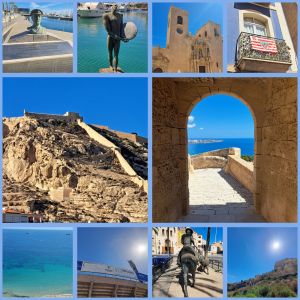
Alicante (or Alicant in Valencian) struck me as a surprisingly historic and quiet place for an April wander. Good food, great sights, and a spot of relaxation.
Arriving by train into Alicante port, I crossed the road and followed a few memorised simple directions. Ole Hostel wasn’t too far. Checking in was swift. Within a few minutes, I was back out and heading up to San Fernando Castle and wandering around the great structure. A good view of Alicante and North towards Benidorm gave me an idea of what to do the next day. The rustic sandy coloured castle wasn’t too impressive, but a free entrance wander into a former fortress filled time and provided a place to read a chapter or two of Kill Shot, my latest chapter in Vince Flynn’s Mitch Rapp series.
Following the first castle, I strolled down the town to the marina and followed the promenade northwards for an hour or so. A quick and simple dinner and a sit down by the marina helped power a good night’s sleep. The following morning, after a good breakfast of salmon and avocado omelette, I headed to Castell de Santa Barbara. The walk upwards wasn’t too exciting. Basilica de Santa Maria d’Alicant was a pleasant Gothic church built in the 1500s, but Parc de l’Etreta was closer to an ill-planned concrete monstrosity. It was the kind of park lacking character and constructed in the kind of speedy way that lacks an understanding of erosion and weather conditions.
Once the park made way for the Castell de Santa Barbara lower walls, a road and gated entrance became visible. Soon after that, the grandeur and dramatic fortress opened up. Hereon, the castle allowed for ample exploration, great galleries, fantastic sweeping views, and reading opportunities. The free entrance and the provision of water sales helped keep my attention in the Valencian stronghold. Standing atop Mount Benacantil (169m/554′), the castle has Muslim origins, from when they controlled the Iberian Peninsula, around 711AD to 1296AD. Roman, Iberian, and bronze age artefacts had also been found. Many inhabitants followed, and reinforcements were built.
Much like the Ole Hostel, the scene was warm, friendly, and international. Brazilian and Cuban tourists mixed with local people, and the historic battles of olden times were distant memories. Cosy places to rest your feet and community has long been the norm.
Beneath the castle, the golden sands, and clear waters of Postiguet Beach shone under bright sunlight. To the north, Sierra Grossa stood like a carved hill, edged by roads and tramlines. A ruined petroleum plant stood out amongst the dried lands of the tufted grass top of the hills. From the beach to the castle, the top can be done via an underground lift. I didn’t know that, and to be honest, the walk up and down was part of a casual exploration. On the way down, I strolled by Hércules Football Club’s concrete José Rico Pérez stadium and the historically cruel bullring. The twin of Brighton and Hove, England, U.K. and Wenzhou (China) is a relaxed place, but I couldn’t spend too long there. Two nights was enough. The flight back to England from the nearby Aeropuerto de Alicante-Elche Miguel Hernández arrived. Before long, I’d swapped 22°C sunshine for 12°C and cloud.
Sitting in shorts, on Friday, watching City Elite Development Squad beat West Bromwich Albion 2-0 as the temperature dropped wasn’t my wisest decision. Micah Hamilton‘s great strike following Kane Taylor’s opener concluded a good 2-0 win and a great week with 5 nights in Spain.
Icy morning, no wind blowing. Bright sunlight, calm delight. Dew under leaves, sparrows foraging. Sky pure blue, clouds ever so slight. Radiant colours, tall grasses. Young soft flowers, joy reflective. Branches reach out, squirrel passes. Spring to summer, natural selective.
Madrid, capital of Spain, longtime artistic city and short-term filmset of La casa de Papel. As much as I wanted to see the Spanish National Research Council (CSIC), I didn’t have time. Madrid was to be an in-and-out job, much like City’s thrilling three-all draw at the Estadi Santiago Bernabeu. Or, more appropriately, how my bank account is on pay day. In. Out. Done.
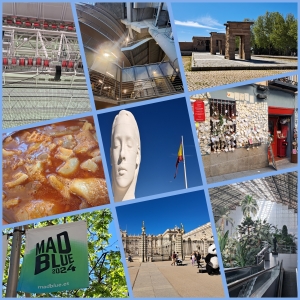
With that in mind, I met a few Blues for octopus on bread, alongside Callos a la Madrileña (a stewed tripe dish, cooked slowly for hours). With scrumptious food and a decent pint (or half litre) of Alhambra in the belly, I went for a wander. On the map, a temple had caught my eye.
Casa de Toledo isn’t in Toledo. It is in the Madrid area of Torrelodones. Sadly, a tad too far. The protected park by the Guadarrama River was too far out. Instead of planning a Bank robbery, I wandered to the Temple of Debod, which sounded quite mysterious. On arriving, with no information, I found a brick-by-brick relocated Egyptian tomb gifted by the Egyptian government to Madrid. Not a bad result of the Aswan Dam needing new space. This bizarre relocation overlooks the city of Madrid and a panoramic view of the majestic Palace area. Other bits are on view. On this occasion, the Simpsons, a panda, and a gorilla were nearby.
After this, a train from nearby sped towards Nuevos Ministerios metro station, followed by a stroll up to the football stadium. The Santiago Bernabeu is iconic and has been around since 1947. Maine Road, City’s mainstay for the 20th century, was built in 1923. Named after a former player and a benefactor, Santiago Bernabéu de Yeste once served under Francisco Franco’s Nationalists. The stadium had only a few years before bearing his name in 1955. Gone was the Nuevo Chamartín, and along came an iconic stadium. A recent refurbishment hadn’t been completed by the time Manchester City kicked off against Real Madrid in the 2023/24 quarter-finals of the UEFA Champions League.
The game itself was perilous at times, with moments of madness in defence for both teams sandwiching a handful of great goals. Phil Foden, J G, and Valvedare amongst the action. Bernardo Silva’s sublime freekick started the proceedings. The expected enclosure of the away stand was far from complete with a pre-match temporary power cut, taking the concourse lighting down. The alcohol-free offerings and limited snacks were overpriced and low in quality. Much like the tonnes of concrete dust around the “polished turd” of the Santiago Bernabeu stadium. The exterior is cased to look like an air-fryer or some such metallic pebble. Perhaps all the shopping trolley supply of Madrid was melted down for this external case. The steepness of the 4 (or 7 or 8) tiered away end allowed for a good view of pigeons landing below. Even their visit to the top two tiers needed supplementary oxygen.
The interior bowl of the Air Fryer Bernabeu looks impressive. It’s almost like a giant basketball-arena with a slightly bigger playing surface. The exterior lacks character and will no doubt reflect well under sunlight, but a metallic pebble broken by slats looks to me like a license to overheat. The dusty staircase, incomplete toilet and snack facilities, and decorations will no doubt look and feel better when complete. Until then, it’s a building site.
The four towers known as Paseo de la Castellana, near Madrid Chamartin railway station, does feature in the Spanish money heist series La casa de Papel. From here, I made my withdrawal. Bound for Alicante. Little did I know that City would be taken to extra time and eliminated from the Champions League in the following week. It is what it is.
“The wind is a gentle breeze Ooh, él me habló de ti, aah The bells are ringing…” – Freddie Mercury & Montserrat Caballé’s songBarcelona.
Ever since the Barcelona 1992 Olympic Games, Barcelona has gripped my soul with the words and haunting operatic sounds of Montserrat Caballé. The autumn before saw the death of its legendary singer and writer Freddie Mercury, which accentuated the voices of a stunning musical piece. The city is also famous for a football team and is synonymous with art and gastronomy. Whether it’s Gaudi or Messi, chances are most people on Earth have a Barcelona connection.
“In Barcelona, I learnt things I thought I knew when I actually knew nothing at all.” – Roberto Bolaño, writer
A snapshot of Barcelona.
Landed late at night, even the grimness of a late night subway and train journey didn’t gloss over the vibe of the city. Walking down from Plaça de Catalunya to the Sun and Moon hostel, the splendour and the darkness could easily be seen. Hand in hand. All the drugs in the world on offer, ladies of the night and classical theatre. La Rambla cuts a direct tree-lined route to the sea, Christopher Columbus on a column and Barcelona’s equivalent of the Liver Building. Before reaching there, I darted left to the fringe of the Gothic quarter. The mixture of Irish bars, tapas dealerships, and dated facades were mostly quiet. It was 1am. Checked in. Bed.
“The great book, always open and which we should make an effort to read, is that of Nature.” – Antonio Gaudi
Waking up, I wandered out. Turning left from Carrer de Ferran, I headed to the harbour and seaside. The smell of freshly warmed pastries, coffee, and dogshit came in wafts. Having got to the beach, the crap of the streets dissipated to a fresher sea air. A long wander to see El Petó de la Mort (“The Kiss of Death“) at Poblenou Cemetery also allowed sights such as a water tower, a converted gas-holder, and various beaches. Following this, the construction site of the new Nou Camp and various spires followed. The unfinished design of Basílica i Temple Expiatori de la Sagrada Família stands out across the city. It was rude not to visit Catalan architect Antoni Gaudí’s masterpiece. He died in 1926. It is due for completion in 2034. An incredible long-term commitment by the Catholic Church.
“There is no nightlife in Spain. They stay up late, but they get up late. That is not nightlife. That is delaying the day.” – Ernest Hemingway, Novelist
Throughout the city, the Catholic Church’s influence and presence are visible to the extent that it makes me feel England is a Godless nation. Not that I’m religious. I just feel the further a nation moves from a central belief, the deeper a lack of respect and manners shatter from society. Multiculturalism has the power to embed basic values, but let’s be fair, the U.K. is not fully integrated or interested in such a way. As can also be seen in parts of Barcelona, through homelessness, wandering refugees canvassing dodgy goods, and slum-like neighbourhoods far removed from equality. It could be a much prettier world.
“If we get up early and have a think, believe me, we are an unstoppable country. Thank you and Long Live Catalonia.” – Pep Guardiola’s speech at the Parliament of Catalonia after receiving its Medal of Honour in 2011.
The world comes to Barcelona, but not for long. Cruise ships stop. Ferries and shipping dock. Many come to see the sights and head elsewhere. The city is overcrowded. Like many cities. Visiting Castell de Montjuïc, I was presented with the opportunity to learn the word castle in Catalan. I can’t recall how to say it. Castell deMontjuïc castle has been central to the history of Barcelona since the 1600s. This infamous site was the last breathing place of Lluís Companys i Jover. Here, like thousands of others, executions awaited. The democratically-elected 123rd President of the Government of Catalonia was the first and only European leader to be executed. Nazi Germany’s Gestapo packed him off from exile in France to General Francisco Franco.
“We crossed spacious streets, with buildings resembling palaces, in La Rambla promenade; the shops were well illuminated, and there was movement and life…” – Hans Christian Andersen, author.
The former Francisco Franco and his legacy remain controversial and unpopular in Generalitat de Catalunya, an area of self-governance and autonomy. Barcelona, its capital city, sprawls across valleys and Serra de Collserola mountains. The Mediterranean coast and all the city could be seen from the fortified Castell de Montjuïc. A man fired an arrow from a bow along the moat of the in an area known for its executions. Leisure and pleasure have long replaced torture and death. Descending the 177.72m (583ft) Montjuïc hill, the winding roads swept over the Estadi Olímpic Lluís Companys, which is the home of F.C. Barcelona during their 2023/24 campaign. The La Liga ground is where İlkay Gündoğan plays football now. The former City player wasn’t available to be smuggled back to Manchester. João Cancelo wouldn’t be invited back.
“Tomorrow we will do beautiful things.” – Antonio Gaudi, artist, architect, and dreamer.
Wandering the Gothic Quarter of Barcelona, some quiet and relaxing spots made me think about why many people love Barcelona and why quite a few people dislike the city. It’s almost like Marmite. You either love it or hate it? I didn’t dislike it, but I wouldn’t call again. A day is enough. I found myself more swayed by the places within two hours. Girona looks gorgeous. That is a trip for another day. For now, next stop: Madrid.
As a kid, I was never given a top end bike. What I was given was a bike. That was enough. A pair of wheelers, after the stabilisers were removed, working horseshoe brakes. A seat. Handlebars and no gears. I’d be a teenager before I discovered gears and front suspension via our Asa’s Raleigh Activator mountain bike. In my secondary school days, Mum worked hard to give me a brand new Falcon mountain bike.
I don’t remember the Falcon’s model name, but I quickly nicknamed it the Millennium Falcon. This Star Wars-inspired nickname was apt as the year 2000 would soon be upon us. Not that I cared, Dan, Pete, and I were off riding our chicken chasers wherever they’d take us. We’d ride Stockport Town centre, rich for empty hills, Lyme Park for the mud and glory, or the High Peak Canal to Buxworth because it was all there.
Over time, a succession of bikes came and went. Gerry Sheilds in Failsworth, as a friend of Grandad, and later Gerry’s son helped regularly. I had long ago learned that Evans and Hal-frauds were not the impassioned maintenance experts needed to keep a bicycle on track. Chris Shields provided a lovely Speeder hybrid by Merida, and its £1500 price tag in 2008-ish was not particularly comforting on the pocket. It served me well, exploring Essex, Norfolk, and the North West of England. A good bike enables confidence and exploration.
Fast forward to China, and after trying a crap Giant bike, I switched to a Merida 500 Duke and then a Merida Challenger, number not recalled. The latter was too short, but in China, frames were rarely available in large. I needed extra large. It did a job. The two Merida shops in Changping and Dalingshan did their absolute best to make the Dongguan Express its greatest available cycling experience. So much so that I even exported the ill-fitting bike back to the U.K. in 2022. Yesterday, it was donated via a bike shop to a better home.
That bike shop is, Never Mind The Bike Shops, and to be honest at first, the dated website looked cack. Bright but framed in the hypertext equivalent of antiquity. The colour scheme was eye-catching. The name definitely had my attention. I read on. I decided to investigate further. Before long, in summer 2023, I’d replaced one rupture machine for an Orro grit bike with some customisation. Inevitably, the 100 miles of weekly commutes necessitated a full service. That and shearing a pedal off. Later, it was upgraded to feature Burgtec pedals, made in Macclesfield. The quirky bike shop ran by Martin Dallaghan and Hutch is one of the very best community and independent bike suppliers I’ve ever encountered.
I’d use this bike shop over others for their dedication, experience, and expertise. And still, the ride goes on. So, where to ride next?
Brian Horton wasn’t the glamour signing many wanted. One thing he was, and you can’t take that away from me, was the manager that caught my eye and attention. I was barely into double digits of age when this suited smart beaming smile of a man appeared on the Maine Road scene. The gravelly Scouse-voice of Peter Reid was suddenly replaced with an outsider from the familiar northern tones. An outsider he would not remain. Capturing fans’ hearts and imagination, he retained Steve Lomas, brought in the excitement of David Rocastle, Paul Walsh, Ian Beagrie, and the cult hero Herr signing Uwe Rösler. A relegation battle saw City go on a great run and excitement bubbled.
Niall Quinn, Richard Edghill, Garry Flitcroft, and others made for progressive football in 1994/95 with a weak league finish, keeping the threat of relegation in touching distance. As is Typical City, Chairman Swales made room for the great bogroll King Francis “One Pen” Lee. With that change, Brian Horton was sacked, and City would move for former England player Alan Ball. The rest is history, although many argue Manchester City has no history. We all know otherwise.
Over many years, I’ve bumped into former City players and current stars and gathered a collection of autographs. Having chances to speak a few words with one or two has been rare but worthwhile. Ian Brightwell signed my Manchester City v QPR programme on that fateful day in May 2012. I also nattered to the ever-approachable Tommy Booth. Mike Summerbee epitomises the fan-footballer relationship, stopping home and away, and all places between autographs and photos. These moments bring magic to Manchester City fans and others. Meeting Ken Barnes, Bert Trautmann, Peter Barnes, and Gerry Gow wouldn’t be a big thing to a Liverpool fan, nor a Manchester U****d fan, but for me anyone who has donned the legendary blue and white of Manchester, gets my attention. Even Ged Brennan.
Another star on the night at The Vale in Gorton was 6’4″ (193cm) goalkeeper Alex Williams. 125 appearances over 6 years, alongside England youth caps, and a prolific career at City In The Community has done Alex well. A well-spoken and welcoming individual who recognises the importance of social responsibility and equality has been deeply ingrained in City folklore since the 1980s. A fellow ex-resident of Levenshulme, Alex Williams, received an MBE in 2002. To his credit, he battled racism and it’s hard-to-believe-now that he was the first black goalkeeper in English professional football. Wayne Hennessey and Kasper Schmeichel were amongst his tutees during his coaching days. Like Brian Horton, Alex flogged his autobiography, You Saw Me Standing Alone. Both made it to my bookshelves that evening.
The evening of course featured 5 trophies, including the 2022/23 treble. The UEFA Champions League trophy sat next to the FA Cup and Premier League polished trophies. The UEFA Super Cup and FIFA Club World Cup were equally positioned on the evening. Gorton Official Supporters Club held a great night for its members and guests.
After questions and answers with Brian Horton and ex-City keeper Alex Williams, a warm feeling of connection to a club that has grown into a gargantuan behemoth remained. Keeping in touch with memories and pride is important. City ’til I die, indeed.