Doves have accompanied me for years. The band was mostly made up of Jimi Goodwin on guitar and often lead vocals, with drummer Andy Williams and his twin Jez on guitars. Martin Rebelski has for a long while provided keyboards and other bits and bobs. Yet, here we are, in 2024, with a new look lineup. How would they sound in Birkenhead’s Future Yards?
“Sure enough if you feel nothing You’re better off this way Gets to the point where you can’t breathe” – The Last Broadcast, Doves
Jimi is taking an extended hiatus as he “needs more time to recover.” Naturally, fans of Doves are there for Jimi and will be ready and waiting when Goodwin is ready. In light of this, the twin duo Williams’ brothers take central stage. Alongside Nathan Sudders on bass (who I’d seen in Nadine Shah’s band) and Jake Evans (Bad Lieutenant), the line-up started a pre-tour on Wednesday, November 27th in Stoke. The Friday would see Hebden Bridge, but the only ticket I managed was Birkenhead, sandwiched between those dates. No complaints at all!
“And as you make for the door this time you’re walking out …out forever” – Renegade, Doves
Swept up by Lost Souls in 2000, the dreamy soundtrack to college studies were plaued between CDs like Badly Drawn Boy’s The Hour of Bewilderbeast and all other available audio distractions. The wholesomeness of sounds that stood out and warmed my studies helped me reach university and apply to work for Greater Manchester Fire and Rescue Services. Listening to Doves helped my mind decode that university was the intended choice.
“In satellite towns There’s no color and no sound I’ll be ten feet underground Gotta get out of this satellite town” – Black &White Town, Doves
During my university years, The Last Broadcast helped me process my Grandad’s death. And then the death of my Gran’s partner Ernie, who I regard as my grandfather. Every hard moment had a song and some tracks were visited more than others. Words for comfort. Melodies for medicine. Even heading to see Manchester City would swiftly be showered by the foot-stamping Pounding. All the combined track energy and near-psychedelia sounds would transport you from a lonely student room in Aberystwyth to soundscapes far beyond the hills. Feeling like an imposter at university, lost in not belonging, the words hugged me and kept me grounded.
“Follow Your own path from here So don’t listen To what they say” – Words, Doves
Hearing Here It Comes, I’m spellbound by the genre-crossing ambience and the simplicity of the backing sounds. The lyrics are magical. It’s reminiscent and inspiring in equal measure. Just like the rays of hope from the latest album track release, Renegade. There’s an unmistakable warmth and tone, despite the Piccadilly garden rains. By the time I’d graduated at university, Some Cities had fired volcanic-proportions of indie rock at the world. The track Snowden, complete with rhythm and magic, alongside the drive of Black And White Town, amongst others, propel your ears. The lyrics range from frustration to joy to wonder. I’m sure other bits are covered in equal measures.
Playlist for the night:
Firesuite, Carousels, Words, Cold Dreaming, Black and White Towns, Snowden, Renegade, Rise, Circle of Hurt, Sea Song, Mother Silverlake, 10:03, Pounding, Caught by the River, The Cedar Room, Here It Comes, Kingdom of Rust, There Goes The Fear.
Future Yards is a class venue, with friendly staff, a great sound system, ample ales and beers, decent food, and warmth. Seeing Doves perform there, after many years of radio silence, was an absolute privilege. So, where’s the next Doves experience? Manchester Aviva. Can’t wait. The superb Doves Music blog website is firmly back on my homepage. The Doves family are back. This next broadcast is more than wanted.
“There goes the fear again, let it go There goes the fear, let it go” – There Goes The Fear, Doves
Thank you Doves, thank you so much, thank you for coming back. I truly feel energised after a tough few months and feel you’re with me, blessing my ears and touching my soul as the future unfolds. Thank you to Jez, Andy, Jimi, Martin, and the new beginnings.
How to Solve Your Own Murder by Kristen Perrin is a page-turner with a unique premise that sets it apart from other mystery novels. At first, the genre and title didn’t attract me. Once I’d opened the cover, the protagonist’s posthumous investigation is intriguing, and Perrin’s plot is full of clever twists and turns. The novel’s fast-paced and suspenseful narrative keeps readers engaged from start to finish. Perrin’s innovative approach to the mystery genre makes this book a highly enjoyable and memorable read.
At times, I thought the book to be both gripping and inventive take on the classic murder mystery. However, I felt torn between changing a chosen book to read. At first, the story centres around the protagonist who, after her own untimely death, must piece together the clues to uncover her killer. It sounds cheesy and forced. Perrin’s writing is key to why I continued. The delivery is sharp and witty, with a plot that keeps readers guessing until the very end. That being said, it doesn’t leave too many imagined options.
The novel’s unique premise and well-developed characters make it a standout in the genre. Fans of mysteries and thrillers will appreciate the clever twists and the protagonist’s relentless pursuit of the truth. as it offers a fresh and intriguing spin on the traditional mystery narrative, Kristen Perrin‘s well crafted work stands out as a must-read for mystery enthusiasts looking for something different. A thought-provoking and compelling mystery told through the themes of identity, justice, and the afterlife. May contain deeper philosophical undertones.
If a soundtrack is needed for any future televised or silver screen production, then look no further than Rebekah Okpoti‘s haunting score for the Light Up Lancaster event installation in Lancaster Priory. Amongst the visuals by artists Jonathan Hogg and Nick Rawcliffe, a tone of menacing organ music filled the vast Lancaster Priory. The acoustics seemingly fit multiple genres of entertainment, and I reckon Kristen Perrin’s work deserves a soundtrack.
The Lancaster Priory’s Director of Music, Rebekah Okpoti, took inspiration from William Herschel, playing a tune overlaying an almost eye-lije triangle screen sinisterly reflecting kaleidoscopic journeys. The other town light installations varied in shape, sizes, and subtletkaleidoscopicy, much like the words of Kristin Perrin.
The cover stood out. It had to read. I could not resist dipping beneath the cover of Under Cover of Darkness.
Amy Helen Bell’s Under Cover of Darkness slings the reader deep into wartime Britain. Loaded with intimate and authentic historical detail, the author’s power of research ploughs meticulously through an era of conflict plagued by rationing and air raids. Central to the storyline are compellingly genuine characters beating with a heartbeat of transformation, through loss and adaptability.
Inner conflicts hug danger like a hand grasping the wrong end of a knife-blade knowing that to let go would be disastrous. Turning over pages, a narrative of sacrifice, duty, and moral dilemmas emerge to test even the most devout in their resistance of desire and maintenance of responsibility. Are choices always clear?
Through a fusion of pacing, timing, and psychological tension, Amy Helen Bell’s world builds an edgy psychological tension. During our privileged era, the shifting roles of women during World War II created new opportunities for women. Bell capture’s a spirit and revolution in her story, exposing the complexity of newness and challenges faced by women, at that seismic time. For feminists and history buffs alike, this novel delves into the mean streets of London during a backdrop of fear and uncertainty.
This deeply human story sensitively connects the fragility of romance during conflict and the jeopardy of life’s end point seeming ever nearer. Nods to the psychological toll with trauma, resilience, and grief evident throughout the chapters. Ethical dilemmas integrate the human capacity for good and evil, without sounding preachy. That sense of resilience underlines community and togetherness offering hope amongst the doom and gloom.
Through skill and crafting, Bell’s writing style elevates the story beyond just another war story and showcases depth and range of storytelling through suspenseful character-driven narratives.
“Of the 120,000 Jews who lived in the Netherlands before the war, only 5,000 of us returned from either the camps or hiding.” – Hannah Pick-Goslar
Through reading My Friend Anne Frank, by Anne Frank’s reallife friend, Hannah Pick-Goslar, the text offered a unique perspective on Anne Frank’s legacy through the lens of their friendship. A slickly rich delivery in the form of memoir, loaded with heartfelt reflections that compliment Anne’s diary.
“I often feel Anne’s presence with me because I go around speaking about her very often.” – Hannah Pick-Goslar
Pick-Goslar uses her narrative as inspiration, layered in poignant heartbreak. The power of memory certainly ensures and in a world saturated by antisemitism and division, a fuller understanding of lost lives like Anne Frank, and the impact of absence wouldn’t go amiss. Touching anecdotes impart a close bond, evocative of a time of innocence swept up by severe tragedy. The deeper understanding of humanity lost in historical events crawls from the pages.
“I try to be compassionate, but I’m not sure it’s the result of war.” – Hannah Pick-Goslar
Several of my reading peers experienced the tales carried through Hannah Pick-Goslar’s My Friend Anne Frank. Upon feeding back to our book group, tears formed, and voices trembled. A more engaging and enlightened view of Anne Frank‘s legacy beyond her diary surely could not be found. Resilience and impact through shared memories that offer expansion to Anne Frank’s Het Achterhuis (republished later as The Diary of Anne Frank).
The author, Hannah Pick-Goslar, was one of several Verlorener Zug (“lost train”) passengers liberated by the Red Army. A broken railway bridge impeded the progress of the train to Theresienstadt ghetto for extermination. The luck led to survival. That survival allowed a story to live on.
“I approached the fence, but I could see through new gaps in the straw that the tents on the other side had been cleared out. Anne, Margot, Mrs van Pels, everyone was gone. Vanished. It was if they were never there.” – Hannah Pick-Goslar 12/11/1928 – 28/10/2022
Head of Zeus publishers release The Spy Across the Water by James Naughtie caught my eye through its cover. Between the covers unfurls an intricate web of intrigue via a fascinating yarn of espionage and loyalty. The backdrop of a familiar Cold War sees our protagonist’s pathways into a dangerous game of intelligence and counterintelligence. Trust is a rare commodity. However, through Naughtie’s evocative and gripping writing, tension rises and falls, maintaining a grip on the reader whilst bringing to life a Cold War era uncertainty.
Fans of Mitch Rapp (Vince Flynn), Jack Reacher (Lee Child), and James Bond (Ian Fleming) will find the characters make it a compelling read that will resonate with fans of spy fiction. Naughtie’s pace of plot plods along through intellectually stimulating layers of authentic tension and historical accuracy. This book, with lead Will Flemyng, is a must-read for anyone who enjoys sophisticated spy stories that challenge the mind and keep the reader engaged from start to finish.
James Naughtie is a BBC special correspondent deeply knowledgeable in democracy and respected throughout his field, except for on X (Twitter) because nobody is respected there. Not even the dead.
Now, it’s time to find the previous books in the series… The Madness of July and Paris Spring shall follow, even though they’re prequels to the book I’ve just read.
Katie Flynn’s A Mother’s Secret is a heartwarming tale that delves deep into the themes of love, resilience, and family bonds. Set against the backdrop of World War II, the novel follows the life of a young mother struggling to protect her family and safeguard her secrets. Flynn’s evocative writing and well-drawn characters make for a compelling read that is both touching and inspiring. This book is a testament to the enduring strength of maternal love and the sacrifices made during challenging times.
Interestingly, as I expected, the book’s author is a continuation of her work via her daughter. Katie Flynn’s enduring name lives through her daughter Holly. Holly rips into the work, delivering a glimpse of historical detail, life for the working classes, and the trials and triumphs of Wartime Britain. Katie Flynn, a pen-name of Norwich-born Judith Turner, passed away in 2019, after 82 years of life that threw a catalogue of books our way.
A Mother’s Secret draws tender attention to details, emotional struggles, and a secret with the odd unexpected twist. Love, loss, and redemption are portrayed in both a realistic and evocative way. Lessons about the strength required to confront and overcome past mistakes shine throughout the novel. The plot, however, lacks jeopardy in its delivery. That does no damage, as the focus of a mother’s love stands tall.
Island in the Sun by Katie Fforde is a feel-good novel. I get why it’s popular. The age-old tried and tested niceties of its contents are visible from the cover to the blurb. It isn’t for me. That also applies to Keane, although this band does have some gorgeous tunes that are worthy of many playlists, including my own. If you like uplifting stories and music, pair up this novel with Keane’s Hopes and Fears.
“We’re spiraling; We’re tumbling down. We’re spiraling; Tied up to the ground.” – Keane lyrics, Spiralling
Usually, I would’t pick this kind of book up. Island in the Sun by Katie Fforde is a warm and enchanting story that transports readers to a beautiful, sun-drenched island. The book’s themes of love, self-discovery, and new beginnings are beautifully explored through the eyes of the protagonist, whose journey from uncertainty to confidence is both relatable and inspiring. The island setting serves as a perfect backdrop for the blossoming romance and the personal growth that occurs throughout the story. I also wouldn’t usually be found listening to Keane for too long.
Attending Keane’s 20th anniversary tour of their debut album, Hopes and Fears, was a pleasure. The tunes are melodic, the fans impassioned, and the band itself, divine. Tom Chapman, on lead vocals, alongside Tim Rice-Oxley and Jesse Quin, sit on the softer edge of rock, somewhere between indie and soul, and all the other gentle musical genres. Slow to mid-tempo rarely jump up beyond their distorted piano and instruments, but it works. Somewhere Only We Know is a gorgeous ballad. My sister Astrid was certainly enjoying the gig. She seemed to know every lyric instinctively. If ever Tom Chapman needs a break, Astrid is ready and waiting.
“I hold you in cupped hands; And shield you from a storm; Where only some dumb idiot; Would let you go.” – Keane, Sunshine lyrics
The Katie Fforde book is highly recommended for fans of feel-good romance novels, especially those who enjoy stories set in idyllic locations. It’s a perfect summer read for anyone looking to escape into a world of love and sunshine. I am not sure that I would pick this book up again. Much like the novel by Katie Fforde, the band Keane is sun-soaked, cheery, and filled to the brim with credible content. It is easy to imagine scenes of the book with the background music, This Is the Last Time. It doesn’t mean I won’t be revisiting the author’s or band’s works.
Katie Fforde’s Island in the Sun is a charming novel beautifully capturing both the themes of second chances and rediscovery. Richly drawn characters take a journey through a central landscape of warmth and magic. Dollops of personal growth land alongside love found at an older age. Expect whimsical blends of romance throughout vivid escapism. Much like the lyrics of Keane, satisfyingly atmospheric moments will occur. Perfect symmetry, indeed. Keane’s gig was postponed, much like the opening of Coop Live in Manchester. The wait was well worth it. An emotional Tom Chapman cut the stage-audience interactions perfectly, and on reflection, Keane delivered fantastically.
The Death of Stalin is a black comedy that perfectly encapsulates Armando Iannucci’s signature style, blending absurdity with biting political satire in a screen adaption of a graphic novel. La Mort de Staline, by writer Fabien Nury and illustrator Thierry Robin, deserves more recognition. Set in the chaotic aftermath of Joseph Stalin’s death in 1953, the film offers a darkly humorous look at the power struggles among the then Soviet leadership. Iannucci’s other notable works, such as The Thick of It and In the Loop, each enjoy thematic similarities and differences.
In simple detail, The Death of Stalin follows the Soviet Union’s top officials as they scramble to fill the power vacuum left by Stalin’s sudden demise and death. The plot is infused with Iannucci’s sharp wit and keen eye for political absurdity, reminiscent of his previous stylish works. In The Thick of It and its film adaptation In the Loop, Iannucci dissects British and American politics with a similar ruthless humour, portraying politicians as self-serving and often inept. See also Boris Johnson et al. While Veep focuses on the American political system, it shares the same core of farcical incompetence and backstabbing, as seen in Real Life™.
Through an ensemble cast of The Death of Stalin features standout performances from Steve Buscemi as Nikita Khrushchev and Simon Russell Beale as the sinister Lavrentiy Beria. These characters are far greater morally ambiguous and menacing than the bumbling politicians of other works. While Malcolm Tucker (played by Peter Capaldi) is ruthless in his own right, his malevolence is played for comedic effect rather than genuine threat. The characters in The Death of Stalin are more multifaceted, with their comedic traits underscored by a palpable sense of danger. You wouldn’t invite any of them over for tea! Michael Palin and Paul Whitehouse blend in with a cast so strong that everyone and every moment could stand out, yet overall, the tapestry is enriched by presence in force.
Unlike the contemporary settings of Iannucci’s previous works, The Death of Stalin is rooted in a specific watershed historical period, which adds an educational layer to the satire. Iannucci balances historical accuracy with his comedic narrative, offering viewers a glimpse into a tumultuous time while maintaining his distinct style. This historical angle distinguishes the film from his other projects, providing a unique backdrop that enhances the absurdity of the characters’ actions.
The aesthetics and visual style of The Death of Stalin are more polished and cinematic compared to the handheld, almost documentary-like feel of The Thick of It. The production design authentically recreates 1950s Soviet Union, contributing to the film’s immersive quality. This attention to detail contrasts with the more contemporary and less stylized settings of Veep and The Thick of It, highlighting Iannucci’s versatility as a director.
Iannucci’s humor is dark and unflinching in The Death of Stalin, perhaps more so than in his earlier projects. The stakes are higher, with characters facing life-or-death consequences rather than just career setbacks. This adds a layer of tension absent amongst his television productions, where the political blunders are often played for laughs without such dire outcomes. The macabre humour in The Death of Stalin reflects the brutalised reality of Stalinist Russia yet still finds absurdity in the paranoia and sycophancy of its characters. As such this movie stands out.
This Armando Iannucci film grips through historical context, darker humour, and higher stakes. While it shares the sharp wit and satirical edge of his earlier works, the film delves far deeper into the sinister aspects of political power. Fans of his familiar comedic elements should also be prepared for a more intense and historically grounded experience. Iannucci successfully adapts his style to this new setting, slowly and carefully delivering a film that is harrowing and hilarious, solidifying his reputation as a master of political satire.
“And the past belongs to everyone.” – Professor Alice Roberts, Ancestors.
I must confess that this burgundy bestseller of a book sat on my shelf for far too long. Gifted by Mum and Paul, in Christmas 2022, it lay on a shelf devoted to books that I will read. Eventually.
Slowly and surely, like the remains of an ancient body arriving at the tip of an archaeological trowel, the book departed the shelf and found eyes upon it. Dusting down the top, it opened, unfurling mysteries, tales, and fables, alongside cutting edge sciences and graphic use of vocabulary.
Professor Alice Roberts first caught my attention on BBC’s Coast, and since then, a variety of television shows. I have a crush on her intellectual prowess and passion for her chosen field of expertise. I love how a bright spark seeks newness, raw knowledge, and extrapolates ideas, developing within a text or a show, or in the good Professor’s case, as a person.
Exploring neolithic, Iron Age, Bronze Ages, and a whole layer of timeliness, British history, human remains, personalities such as Pitt Rivers, and conflicting progressives explore our Before Common Era. Here, Roberts explains the dangers of assumption and the pitfalls of satisfying a narrative.
Final confession time. I spent time savouring this read over a few weeks, intertwining my reading amongst other books. Overall, essential reading is all about exploring a genre or topic of unfamiliar ideas. I am now neither expert nor amateur, but like an archaeologicalist digging ploughed Wiltshire soil, I have a sound glimpse into the past.
Praise is enough for some. Others need more motivation. Some distrust reward. Whether a student, a teaching mentor or a teacher, reward goes a long way. The buzz of recognition is empowering. In the past and present, behaviour management systems have often focused on punishments over recompense. Nowadays, education looks at ways to place guerdon over burden.
“central component of habit formation” (Wood and Neal, 2016, p.73)
If the stake of a decoration and honour is visible, students may be more motivated to perform, stay on task or give fuller focus to earn their winnings. Conformity by most students may follow. With that boot students may engage with a higher level of interest, get stuck in and participate more diligently. Most of us will understand that a tangible goal and deadlines add a sense of urgency to our responsibilities. Dangle a carrot and stick, and suddenly better work may be produced.
“Only rewards that promote the repetition of specific actions contribute to habit formation” (Wood and Neal, 2016, p.75)
Pride is a sin, yet humility can counteract such worries. To have pride is fine, just keep it beneath excessive. We all feel a warm tingle of joy when our efforts are appreciated by others, whether that’s in the classroom or a game of football or a pub quiz in Irene’s Bar (Houjie, Dongguan). Achievements matter. They boost morale and are powerful classroom tools of remuneration. Success can be tangibleand increase self-esteem, ideally leading to self-confidence and belief in raising a student’s game. Once-believed hard-targets suddenly become possibly achievable, and barriers can fall over like dominoes.
“He who wished to secure the good of others, has already secured his own.” – Kǒngzǐ (孔子 Confucius), Chinese philosopher
When persuading a student, every teacher must be critical of their own methods. Rewards, like learning should be exciting, engaging and appropriate. If you want your student to be the best version of themselves, then you must incite the best practice for yourself. Only then will you be able to induce the optimum classroom conditions for students to actuate improvements. To improve at home or in the classroom, a clear system of reward can drive students to squeeze out that extra bead of sweat in their efforts. Students who push themselves can see their final work improve and their efforts gain clearer progress.
“Carry out a random act of kindness, with no expectation of reward, safe in the knowledge that one day someone might do the same for you.” – Princess Diana
Of course, when prompting students, it must be a system that avoids greed. Dependence upon rewards can instil the wrong behaviours. Knowing when a scheme is prone to manipulation is important. Likewise, think about how the student may feel manipulated by something they may associate with as an early learning structure of rewarding. Does it appear like a bribe? The systems also need to consider the view of decreased value of the motivational bounty. The prize novelty cannot be over-stimulating and cause a student to shoot wide of the learning goal. Missing the point is counterproductive. Does the arrangement of reward also trigger further pressure? Is the pace, right? Is the task something a student’s working memory or ability will be capable of or incapable of completing? How can expectations be met if the task is too challenging? Whilst we look at advantages, we must be fully aware of disadvantages.
“…students could develop reward addiction.” – The Influence of School’s Reward Systems on Students’ Development, Zihan Chen, 2023
Effective rewards system need full consideration, weighing up pros and cons, to spur on, influence and activate student motivation. Each teacher or mentor reaches a class and gets the most out of students in differing ways. The fluidity of the teaching strategies and response by students will mean some methods work, some do not. Applyingadaptive teaching and strategies within reward schemes should bridge the gap to stimulate, propel and inspire students and bring them from their slumber into a world of active reading and attention. How will you provoke yours?
“Man gives you the award, but God gives you the reward.” – Denzel Washington, actor
Ideas to consider as reward options:
a visit to the library
achievement points towards a gift voucer
play a chosen music video to the class
earn a physical reward e.g. pens, pencil cases, etc.
play games
earn a snack or treat
choose an activity outside of the classroom
read quietly in a different space
change seats
watch movies
extra break time or outside walking time
choose a partner for a homework task
become a teacher’s helper for a set period
complete homework in class
share games
take home a postcard, reference book or game
choice of class chore or duty
custom-made bookmark, badge, school equipment
cancel homework for a class
share a story
a phone call home
teacher reads to the class
choose new books for the school to buy
school trips to the local library
school trips to a writing or literacy-related museum or tourist attraction
All the above were suggestions by our reading and writing club students.
Nota bene: allow students to be part of the process and choose their reward?
Before the 2023 summer holidays ended, I planned for the 2023/24 academic year, within the role and remit of the Literacy Mentor. A Padlet noticeboard started as out as a few scrappy ideas and a clutter of things to consider. As the year went on, I tracked the progress in many ways. Looking back is a way of looking forward. A good way to track changes, evaluate and expand ideas.
Hypothesis
Predictions for the outcome are dependent upon active engagement from students, applied alongside that of rigorous and well-compiled materials. To this end, it is predictable that an increase in reading engagement is forecastable.
Methods
Active Reading
That Reading Thing
In Class Support
Book Club
Writing Club
Inference and vocabulary-based tasks from an active reading booklet, tailored to the specific needs of the students.
Students work from sound to print using age-appropriate vocabulary and authentic reading material. The method is rooted in linguistic phonics but has grown its own way of working with older learners for the fastest possible results.
An instructional arrangement in which a paraprofessional provides education services in the general education setting, to allow students to access the materials and develop their ideas. Metacognitive techniques, Active Reading, etc. can be applied.
Reading For Pleasure’s masthead allows exploration of text and words for a small group, but is promoted to the entire school community, through modelling, displays and visibility.
Results
Active Reading results largely demonstrated an upward turn. Results were shared internally and to the school governors.
Reading For Pleasure has been researched and implemented in greater depth than the autumn-winter term. Below are some highlights:
Writing and reading competitions (multiple entries have been permissible in some cases). Winners roll of honour established with 12 books containing students’ works.
2 online video author meets (Tom Palmer/Joseph Coelho)
World Book Day voucher distribution, alongside sponsored Readathon event (in progress)
Over 140 books have been obtained from publishers, book groups and, online video events. A list is available.
In Class Support was provided across year 10 and 11 classes. All students completed entry assessments (YARC). Due to impending GCSEs and other assessments, no exit assessment was completed. This is something to amend for the future.
Form time reading groups Year 10 (Friday) and Year 11 (Wednesday) have completed their Active Reading booklets. Year 10 Tuesday has been affected by behaviour barriers, with the challenging students removed, allowing others to continue uninterrupted. Future provision for disruptive students and how to support them better would need to be considered.
That Reading Thing (TRT) allowed one student to be considered a model of success. Documented spelling, grammar and reading (with inference skills) have been logged. He has developed a great sense of reading for pleasure and is turning into a bookworm. That student had attempted writing book reviews, poetry and article writing, to deepen his TRT experience. It is arguable that he could leave the TRT sessions, however, to further good habits and create encouragement throughout this academic year, he will remain with the TRT programme.
One student joined TRT, and at first, was receptive and engaged. He eventually felt intimidated by one-to-one approach. Said student eventually scored highly in YARC, LAO assessments and NGRT – allowing him to exit TRT. He remains an at-risk student but was never truly in need of the TRT programme.
Another student resisted TRT from the offset. Again, this student was an at-risk student who likely would benefit from this programme. He was heavily influenced by a previous TRT student. As that TRT student left our school for another school, it may be feasible to reinstate that student into the TRT programme with less resistance.
Two further students joined TRT sessions on a Monday morning. Each made steady progression in efforts and output. Both require more sessions of TRT.
Conclusion
Due to reading comprehension being vitally important in secondary education, the active reading intervention is also important for educators to be mindful of because of the huge impact it can have on reading fluency as students transition from KS3 to KS4. The methods utilise a stacked approach of research-based methods, including reading aloud, assisted reading, and repeated reading in order to give students the chance to be active readers. In addition to this, it encourages reading habits for pleasure and curiosity by selecting appropriate and engaging materials.
Supplementing regular classroom instruction with Active Reading successfully accelerated the reading development of the vast majority of students. On the whole, the methods increased each student’s word recognition, automaticity, reading prosody, decoding skills, word knowledge, and reading comprehension. Focusing on phonemic awareness, phonics, fluency, vocabulary, and comprehension allows students to access a greater deal of text.
Evaluation
Strengths:
Ease of use of available materials for Active Reading.
Talented and enthusiastic staffing for literacy throughout the school community.
Knowledge and skill base of teachers and support staff allows for shared good practice.
Recognition that evidence-based and evidence-informed methods need to be partnered with challenging and suitable reading materials.
Opportunities:
Reluctant and ignored students can be caught and empowered.
Literacy partners are available via local libraries and bookshops.
Increased demand for well-read individual talent, with opportunities to perform, compete and be published.
In the future, a further noticeboard has been created to plan the Reading for Pleasure remit of our school in a deeper and broader look at possibilities, angles and ways to entice both the established and the most reluctant of readers.
Further opportunities to replicate the scheme to target a greater population of students.
Continued possibility to adapt materials and include a greater diversity of targeted reading texts.
Social and media promotion opportunities, e.g. blow our own trumpet.
Weaknesses:
Better Reading foundation and transition from this programme to Active Reading can clash with the Maths department’s intervention programmes.
Lack of graphic novels/comic books/recent publications.
Other schools have clearly set spaces for reading, library and micro-libraries; as well as tablet computers dedicated to reading.
Resource limitations (regionally and nationally).
Unclear visibility of long-term literacy goals?
Threats:
Numerous schools have established models for literacy or are re-evaluating literacy based on evidence-based and evidence-informed models. We should not be left standing.
Literacy censorship and availability of some texts?
Negative press of reading materials (e.g. The Secret Garden, etc.)
Changing social and behavioural habits towards reading.
Budgeting constraints, room availability, and student attendance.
Further Evidence
Further evidence has been kept securely and privately within school, as per GDPR.
Picking up a book, that usually I would never have picked up, one short story caught my eye. Then another. And another. Suddenly, I’d hit the halfway point of the annotated bilingual edition of the SelectedModernChinese Essays 1.
The book, whilst a little gentle, rendered into英语 (English) by Zhang Peiji features a bland cover with a bare tree. The flimsy pages and cover almost feel disposable. Shanghai Foreign Language Education Press didn’t even supply a blurb on the 38RMB book. Never judge a book by its cover? Well, this book has all the appeal of a Mancunian skyline during the peak industrial revolution during a grey wintery rain shower.
“His name has spread far and wide and become more and more celebrated with the passing of time. Innumerable people have come to follow his example so that everybody has become a Mr. Cha Buduo.” – Mr About-the-Same – Hu Shih.
Despite the outward appearance and an inside cover telling you about the translator, little is given away as to the themes of the essays nor the 377 pages. So, reading on is the only way to delve deeper. First published in 2007, this edition arrived a decade later.
Through writing by the likes of Li Dazhao, Lu Xun, Xu Dishan, Hu Shih, Xia Mianzum, Ye Shengtao, Zhu Ziqing, Ba Jin and 24 other authors, I found myself transported from modern life to various times within Chinese history and at varied points of culture. Mosquitoes featured every now and then. Phrases and parodies of tales that I had heard clung to pages like my sweaty underwear in a Guangdong summer.
“A fighter is perennially young. He is never irresolute or inactive. He plunges deep into teeming crowds in search of such vermin as flies and venomous mosquitoes.” – Be a Fighter, Ba Jin*
Plenty of themes feature throughout, including hope, faith, and the need for family and friends. The book itself is deep in meaning and easily interpreted in many different ways. Rereading a few pages, I quickly realised how the Bible, the gospels, and other religious texts could be manipulated under one light or another. Books are powerful things. We should read more to understand more and always adapt or change to whatever life needs, rather than desires. Equally, we should read for pleasure in a diverse way.
I enjoyed something different.
*See also: Carpenter Lao Chen and Dreams but the same author, Ba Jin.
Never take a bull to a china shop. Equally, a toddler in a Chinese china museum and tourist spot is of little recommendation. Said toddler tumbling a plant pot into a fish pond, whilst trying to rip a leaf off a plant is quite an embarrassing happening.
Munching on hakka dim sum and 番石榴 Fān shíliú (Guava) with the sound of running water is quite relaxing. Even if the temperature is 33°C, with 75% humidity, presenting a real feel temperature of 40°C. On top of that, your body melts, runs with sweat, and staying hydrated is a priority. Beyond these minor issues, the state of relaxation as birds tweet, red dragonflies fly past and and butterflies flutter between the bamboo tufts. Mosquitoes feast relentlessly. Relaxing.
Wandering around the extensive ceramic kilns, wood carving lodges, farm restaurants, and sculptured gardens was relaxing. The whole arena is fenced off and reasonably safe if you keep an eye on the deep water, fragile articles, and sharp bits all over the floors and walls. Complimentary kittens are provided in one of the toilets, and a local waterfall at temple XiHeGuMiao (西河古庙) is a pleasant stroll up a steep concrete road. Eagles and other wildlife like frogs, tree frogs, snakes, and mosquitoes can be seen.
The restaurant provides cabins, lodges, and open areas for a range of local food cooked well and enjoyed with the ambience of a dark evening. There are turtles, cats, and a happy dog. The centre and studios offer pottery experiences, fan making, and other activities for all. A few hours can be had away from city life.
Dongping Yao Ceramic Museum/ Dongping Kiln Cultural Scenic Spot, Huizhou City, Huiyang District, Huiyang District
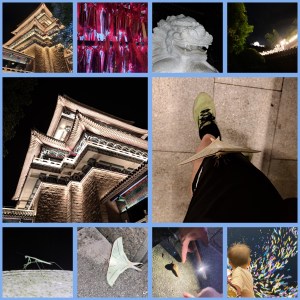
229.66m high isn’t much to an adult. But to a person of 83cm in height, it might as well be Mount Everest. That’s the gist of GaoBangShan mountain in Huizhou. A decent hill with a selection of pathways swoops around the summit. At the summit, a modern collection of Sinology, medicine experts, and important Chinese cultural architecture awaits.
Under moon and floodlights, it is highly recommended to blow bubbles like a fan of West Ham Utd. Expect to see bats, moths of various sizes, and shapes. The odd preying mantis amongst the night insects (mosquitoes included) can be found hunting alongside geckos and amphibians.
Smells range from dirty bins to humid dank dark paths lined with fragrant tropical flowers. At the summit and several points, the usual food outlets sell overpriced food and drinks. Beyond the hundreds of steps, lighting and piped music fill the air opening to the northern skyline of Huizhou and its surroundings. Your heightened awareness grows under tree canopies. Their umbrella canvas with limited lighting along the lower pathways shades out the light pollution beyond the treetops. It cakes those who walk beneath in humidity.
The steps up are a struggle. They’re uneven, yet modern. Each step appears slippery, and with damp patches of leaves and giant snails throughout, they’ll test the best sporting footwear. The knobbly-bits of pebbles on some footpath interludes are equally perilous. All part of the parcel in a dark park walk. The dense foliage, abundant with local species, although manicured at the path edge, gives an authentic taste of more wilder parkland.
For a few hours of wandering, the park features toilets at the foot of the main gate pathways, a few temple structures, and benches here and there. It is a short distance from Xihu (West Lake) in Huizhou. Xiao Crocodile Lake and Luoshan mountain are visible from the rear of the mountain. The name GaoBang means something to do with first and study, I’m told. When the Chinese Gaokao exams happen, many family people and students come and ask for good luck. The moon over the hill looks pretty, and a nightwalk is most recommended, even in the heat of summer.
Drip, drop, drip, rain begins to fall, A soggy blanket over us all. Pitter-patter, drop, drop, plop, it’s quite absurd, Each raindrop whispers a moistened quiet word.
Many flowers giggle, the trees all prance and dance, Worms pop up, taking their chance. A puddle forms, a tiny sparkling sea – A stranded haven for boats made of leaves, yippee, yippee!
Splash, splosh, splish, what a watery flowing treat, Raindrops tip-tap-dancing over the street. Forget not your brolly, dear old chap, Or just you might drown in your very own lap!
The rain it mocks, it rattles, it laughs, it jeers, Sneaking down necks, alongside strands of hair, tickling ears. But oh, dear rain, you do as you must, For without you, we’ll be dry and towels trust.
So drop, drip, drop, and have some fun, For when you’re gone and done, out comes the red hot sun. But until then, I’ll wear a joyful grin – And a very large bucket hat to keep you from getting in!