Kristen Perrin’s How to Solve Your Own Murder: Review + Light Up Lancaster

How to Solve Your Own Murder by Kristen Perrin is a page-turner with a unique premise that sets it apart from other mystery novels. At first, the genre and title didn’t attract me. Once I’d opened the cover, the protagonist’s posthumous investigation is intriguing, and Perrin’s plot is full of clever twists and turns. The novel’s fast-paced and suspenseful narrative keeps readers engaged from start to finish. Perrin’s innovative approach to the mystery genre makes this book a highly enjoyable and memorable read. 

At times, I thought the book to be both gripping and inventive take on the classic murder mystery. However, I felt torn between changing a chosen book to read. At first, the story centres around the protagonist who, after her own untimely death, must piece together the clues to uncover her killer. It sounds cheesy and forced. Perrin’s writing is key to why I continued. The delivery is sharp and witty, with a plot that keeps readers guessing until the very end. That being said, it doesn’t leave too many imagined options.

The novel’s unique premise and well-developed characters make it a standout in the genre. Fans of mysteries and thrillers will appreciate the clever twists and the protagonist’s relentless pursuit of the truth. as it offers a fresh and intriguing spin on the traditional mystery narrative, Kristen Perrin‘s well crafted work stands out as a must-read for mystery enthusiasts looking for something different. A thought-provoking and compelling mystery told through the themes of identity, justice, and the afterlife. May contain deeper philosophical undertones.

If a soundtrack is needed for any future televised or silver screen production, then look no further than Rebekah Okpoti‘s haunting score for the Light Up Lancaster event installation in Lancaster Priory. Amongst the visuals by artists Jonathan Hogg and Nick Rawcliffe, a tone of menacing organ music filled the vast Lancaster Priory. The acoustics seemingly fit multiple genres of entertainment, and I reckon Kristen Perrin’s work deserves a soundtrack.

The Lancaster Priory’s Director of Music, Rebekah Okpoti, took inspiration from William Herschel, playing a tune overlaying an almost eye-lije triangle screen sinisterly reflecting kaleidoscopic journeys. The other town light installations varied in shape, sizes, and subtletkaleidoscopicy, much like the words of Kristin Perrin.

Amy Helen Bell’s Under Cover of Darkness: Review

The cover stood out. It had to read. I could not resist dipping beneath the cover of Under Cover of Darkness.

Amy Helen Bell’s Under Cover of Darkness slings the reader deep into wartime Britain. Loaded with intimate and authentic historical detail, the author’s power of research ploughs meticulously through an era of conflict plagued by rationing and air raids. Central to the storyline are compellingly genuine characters beating with a heartbeat of transformation, through loss and adaptability.

Inner conflicts hug danger like a hand grasping the wrong end of a knife-blade knowing that to let go would be disastrous. Turning over pages, a narrative of sacrifice, duty, and moral dilemmas emerge to test even the most devout in their resistance of desire and maintenance of responsibility. Are choices always clear?

Through a fusion of pacing, timing, and psychological tension, Amy Helen Bell’s world builds an edgy psychological tension. During our privileged era, the shifting roles of women during World War II created new opportunities for women. Bell capture’s a spirit and revolution in her story, exposing the complexity of newness and challenges faced by women, at that seismic time. For feminists and history buffs alike, this novel delves into the mean streets of London during a backdrop of fear and uncertainty.

This deeply human story sensitively connects the fragility of romance during conflict and the jeopardy of life’s end point seeming ever nearer. Nods to the psychological toll with trauma, resilience, and grief evident throughout the chapters. Ethical dilemmas integrate the human capacity for good and evil, without sounding preachy. That sense of resilience underlines community and togetherness offering hope amongst the doom and gloom.

Through skill and crafting, Bell’s writing style elevates the story beyond just another war story and showcases depth and range of storytelling through suspenseful character-driven narratives.

Hannah Pick-Goslar’s My Friend Anne Frank: Review

“Of the 120,000 Jews who lived in the Netherlands before the war, only 5,000 of us returned from either the camps or hiding.” – Hannah Pick-Goslar

Through reading My Friend Anne Frank, by Anne Frank’s reallife friend, Hannah Pick-Goslar, the text offered a unique perspective on Anne Frank’s legacy through the lens of their friendship. A slickly rich delivery in the form of memoir, loaded with heartfelt reflections that compliment Anne’s diary.

“I often feel Anne’s presence with me because I go around speaking about her very often.” – Hannah Pick-Goslar

Pick-Goslar uses her narrative as inspiration, layered in poignant heartbreak. The power of memory certainly ensures and in a world saturated by antisemitism and division, a fuller understanding of lost lives like Anne Frank, and the impact of absence wouldn’t go amiss. Touching anecdotes impart a close bond, evocative of a time of innocence swept up by severe tragedy. The deeper understanding of humanity lost in historical events crawls from the pages.

“I try to be compassionate, but I’m not sure it’s the result of war.” – Hannah Pick-Goslar

Several of my reading peers experienced the tales carried through Hannah Pick-Goslar’s My Friend Anne Frank. Upon feeding back to our book group, tears formed, and voices trembled. A more engaging and enlightened view of Anne Frank‘s legacy beyond her diary surely could not be found. Resilience and impact through shared memories that offer expansion to Anne Frank’s Het Achterhuis (republished later as The Diary of Anne Frank).

The author, Hannah Pick-Goslar, was one of several Verlorener Zug (“lost train”) passengers liberated by the Red Army. A broken railway bridge impeded the progress of the train to Theresienstadt ghetto for extermination. The luck led to survival. That survival allowed a story to live on.

“I approached the fence, but I could see through new gaps in the straw that the tents on the other side had been cleared out. Anne, Margot, Mrs van Pels, everyone was gone. Vanished. It was if they were never there.” – Hannah Pick-Goslar 12/11/1928 – 28/10/2022

CN Lit.

Picking up a book, that usually I would never have picked up, one short story caught my eye. Then another. And another. Suddenly, I’d hit the halfway point of the annotated bilingual edition of the Selected Modern Chinese Essays 1.

The book, whilst a little gentle, rendered into英语 (English) by Zhang Peiji features a bland cover with a bare tree. The flimsy pages and cover almost feel disposable. Shanghai Foreign Language Education Press didn’t even supply a blurb on the 38RMB book. Never judge a book by its cover? Well, this book has all the appeal of a Mancunian skyline during the peak industrial revolution during a grey wintery rain shower.

“His name has spread far and wide and become more and more celebrated with the passing of time. Innumerable people have come to follow his example so that everybody has become a Mr. Cha Buduo.” – Mr About-the-Same – Hu Shih.

Despite the outward appearance and an inside cover telling you about the translator, little is given away as to the themes of the essays nor the 377 pages. So, reading on is the only way to delve deeper. First published in 2007, this edition arrived a decade later.

Through writing by the likes of Li Dazhao, Lu Xun, Xu Dishan, Hu Shih, Xia Mianzum, Ye Shengtao, Zhu Ziqing, Ba Jin and 24 other authors, I found myself transported from modern life to various times within Chinese history and at varied points of culture. Mosquitoes featured every now and then. Phrases and parodies of tales that I had heard clung to pages like my sweaty underwear in a Guangdong summer.

“A fighter is perennially young. He is never irresolute or inactive. He plunges deep into teeming crowds in search of such vermin as flies and venomous mosquitoes.” – Be a Fighter, Ba Jin*

Plenty of themes feature throughout, including hope, faith, and the need for family and friends. The book itself is deep in meaning and easily interpreted in many different ways. Rereading a few pages, I quickly realised how the Bible, the gospels, and other religious texts could be manipulated under one light or another. Books are powerful things. We should read more to understand more and always adapt or change to whatever life needs, rather than desires. Equally, we should read for pleasure in a diverse way.

I enjoyed something different.

*See also: Carpenter Lao Chen and Dreams but the same author, Ba Jin.

The Little Picture Book: Lost & Found

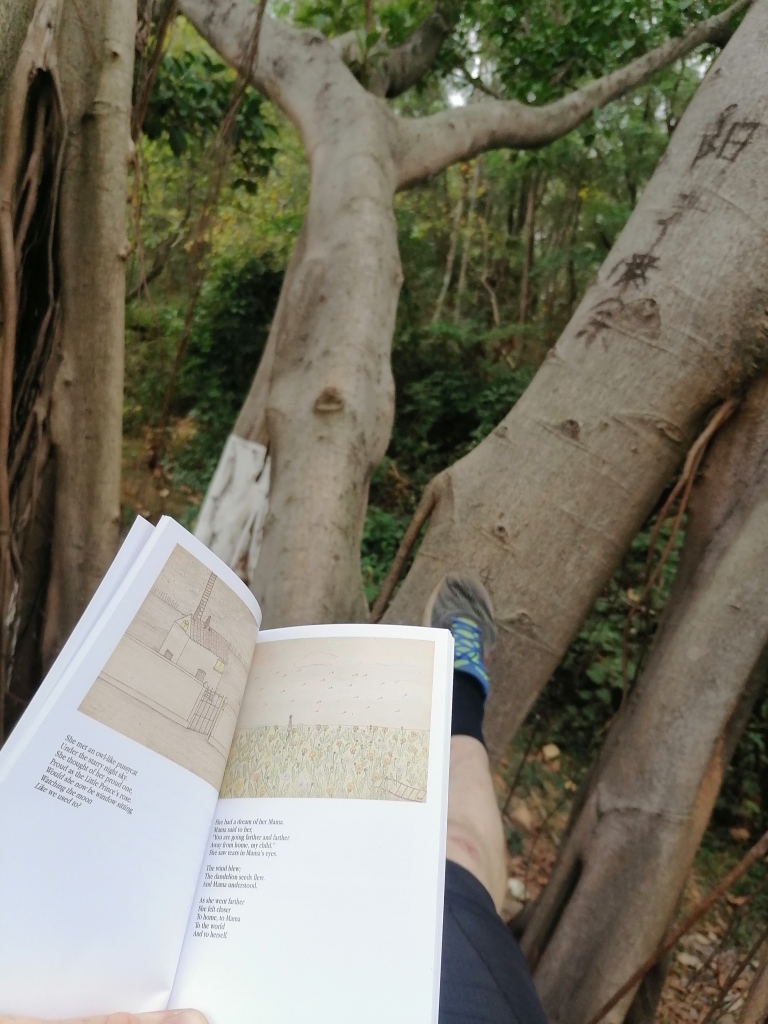
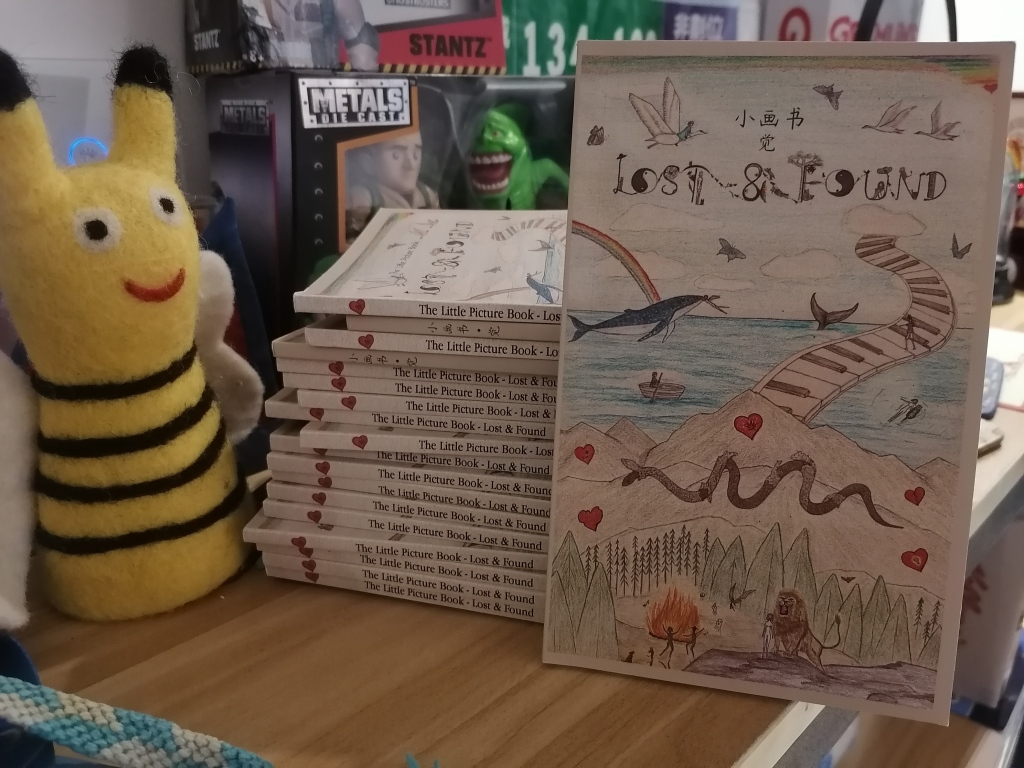
Eck and Timu, otherwise known as Echo and the late Tim Mileson, can be found in a book just shy of sixty glossy pages. The compact pocketbook is presented through poetry and story alike. It is conventional and yet unconventional. Interpretation is a skill you can choose to use, or just float on the muse.

Sandwiched between Tim’s personal writing, Eck explores emotions such as loss, belonging and echoes nature throughout. Cute eye-catching illustrations using a variety of sketching styles follow an imaginative route to deliver a peaceful and loving tribute in the form of a poetic manuscript.

There are lines throughout that transport the reader, catch them, hold them and bring them downward. There are uplifting words, moments of hope and flashes of light. It’s a sweet little book deserving of a wider audience. The book comes in both Chinese and English editions. My grade four students at Tungwah Wenze International School greeted that with joy. Next up they’ll interview the author…

In China? Further afield? Order directly from Eck by scanning the above on WeChat.

Lost for words.

A student stood up my class one day. She smiled as she asked a bold question. Her little voice was quivering but audible, “How many words can you write?” To my mind, I could not answer her. We began a class task, searching books, dictionaries (Cambridge and Oxford English), newspapers, everything and anything we could lay our hands on. The task followed each student and I from the classroom. It became an obsession. As time changed our research became simpler. Yet words expanded and multiplied. Eventually journals, magazines, compendiums and the internet came along, and how it grew and grew. We pooled our tasks together. The list for the student grew, even as she did not.

That first tough question was in the year 1948. I was a young teacher then. Just twenty five years of age. It’s now 2022. I’m still writing the list of words. I hope to be finished this decade. I fear our work will never be complete.

ALL CHANGE.

How do! / 你好 (nĭ hăo) / Namaste / Welcome!

August 2020 has seen a few new components to my life. A new apartment. A new place of work. A new kettle. A new model bridge in the balcony garden. And finally, like Star Wars, a new hope. Moving from Changping to Songshan Lake and Dàlǐngshān (大岭山) was relatively straight forwards.

The new apartment sits over the line of the township borders. I live in Dàlǐngshān but I work in Sōngshānhú district (piànqū / 松山湖片区). Dàlǐngshān Zhèn (大岭山镇) is part of Sōngshānhú but these days Sōngshānhú is a very high-tech centre within the 6 townships that surround Sōngshān lake itself. Shilong (石龙), Chashan (茶山), and Shipai (石排) aren’t really that close to the lake area but they’re part of the district. The lake area is mainly surrounded by Dàlǐngshān, Dàlǎng (大朗) and Liáobù (寮步). Sōngshānhú as a town has grown from 2003, from a simple high-tech park to the mammoth green living space around the lake that is now. Huawei and many other tech giants are here. It has a railway station on The Dongguan West to Huizhou railway and will soon join the subway with three stations in Dàlǐngshān on the line 1 route (东莞轨道交通1号线/Dōngguǎn Guǐdào Jiāotōng Yī Hào Xiàn), and one at Sōngshānhú itself. The new line opens in 2022, so I won’t get too excited right now. The subway Line 3 will also have 4 stations in Sōngshānhú but that hasn’t began construction.

The new job has been welcoming, well-paced and full of encouragement. I am confident that this is a new start with great potential. Two former students are following me from grade 3 at St Lorraine Anglo-Chinese School to the new Tungwah Wenzel International School (TWIS). I’m sure that they will enjoy their grade 4 class – and I will have to work hard as their Home Room Teacher to ensure that they do. Between various conference calls, meetings and introductions there has been good coffee and ample time to down tools to think of a plan of action. I am terribly excited about the coming semester. Even amongst these COVID-19 times there is a lighthouse and beacon when we look in the right places.

Dàlǐngshān town isn’t far away, and in the relatively short time since I first went to Dàlǐngshān, the place has grown and has modern districts, several branches of Lauren’s Pizza and even a Walmart. There are universities and amongst the Guangdong Medical University is just over the road from me and DG University of Technology (东莞理工学院) isn’t far off. The lake has one large section that is completely free of cycles and cars. There is a parallel cycle route below a highway and under a cooling tree canopy. Cycling around the rest of the lake is a must. It is a great spot for tourism with backdrops of Huawei’s impressive European-style town and numerous picturesque places along the way. Lotus leaves, lush green sprawls, flowers and bird call should be abundant. Around the many tranquil pathways, you can see Tai Chi, yoga, dates holding hands and families flying kites. I can’t wait to hang up my hammock sooner or later.

“I feel invigorated.” – Those were my words spoken to a new colleague on Friday. The evening was finished with a leaving day drink for Calum from Murray’s F.C. He’s only moving to Shenzhen but felt the need to arrange a leaving meal and drinks. I didn’t attend the meal as all new team members of Tungwah Wenzel International School were treated to a splendid buffet meal at the stylish Dongcheng International Hotel (owned by Tungwah/Donghua group). Even the coach journey was on a Tungwah group coach. They own factories, gardens, estates, hospitals and schools. They’re a sizable group and well-known in this region. Between the blooming peach and plum trees of Dongguan, the group’s assets aren’t far off. The ministry of optimism within my head is thankful for such a great opportunity. My only regret is not buying a crane from the car park exhibition at the Dongcheng International Hotel. Dahan Construction Machinery have some great pieces, ideal for placing hammocks within.

There are plenty of places within a short cycle ride now. Tongsha lake and the parks around it are just a stone’s throw away. Dalingshan Park is between here and Houjie. I’ve already cycled back to Irene’s Bar for a sandwich. There’s much to see and do in the area that I have yet to explore. On my doorstep, I will find the Tongji Bridge (通济桥 Song Dynasty, 920-1279) and cross that bridge soon. It will help me forget my worries. That’s the literal meaning, I believe.

“Quite apart from its meaty content, we believe we have found a real dramatist” – Gerry Raffles of Theatre Workshop speaking about Shelagh Delaney’s play A Taste of Honey.

Every story should have a beginning, an end, and some middle parts. There should be a plot, a setting with characters, some form of conflict (because something must happen), and a resolution (the smooth end). Some books carry the resolution or conflict over a series. That is life. Some things drag on. Others happen and fade away. There is no one-size-fits-all story to life. There will le a logical following and flow to a story because they must run smoothly to allow the follower to tag along. British dramatist and screenwriter Shelagh Delaney (who featured on album cover Louder Than Bombs, by The Smiths) intended A Taste of Honey to be a novel. It is a very famous play now. The drunken working-class single mum of Helen, and a daughter called Jo have spread from the monotonous 1958 skyline of a desolate Salford to London’s West End, Broadway, BBC Radio 3 and the Royal Exchange Theatre amongst other places. Peter, the wealthy southern lover of Jo’s mother Helen and a black sailor called Jimmy feature alongside a camp art student called Geoffrey. It is a complex and heavily questioning piece of drama. Class, gender, sexuality, and race are dissected which for mid-twentieth-century Britain was highly risky. The stars have followed the play with Stockport’s Sally Lindsay, a cluster of soap TV stars and Dr Who extras, Joan Ann Olivier, Baroness Olivier, DBE (born 28th October 1929) and notably Dame Angela Brigid Lansbury DBE joining the productions. A certain Billy Dee Williams (Lando Calrissian) has also featured on the stage for this production. From Salford to Home and Away to a Galaxy far, far away…

But, right here, right now my story at Dongguan’s Tungwah Wenzel International School has just began.