Mum.

你好/ Ní hǎo / Nín hǎo / Hello / How do / S’mae / Namaste

To quote Salford’s Jason Manford, his autobiography is called Brung Up Proper: My Autobiography. Without the words my autobiography, that’s how I feel. I feel ‘brung up proper”. My reasoning is simple. My mother did a great job. Now let’s drop the word mother and never use the American word mom. Mum, that’s what I call her. That’s who she is. Always will be. Dad and Mum in spring 1982 did something that my imagination will not entertain a single thought for. About 9 months later, out popped me. Dad’s second successful sperm. Asa won the race in Dad’s previous marriage. Good luck at winning a race now Asa, I’m faster and fitter! I think. Anyway, here I was and Mum, previously known as Elaine became a mam, not mom. We’re not American.

Mum and Dad divorced before I was old enough to dash Lego away. Although, I last bought a Ghostbusters Lego set three years ago, so that’s no barometer for my life. Anyway, somewhere in my infant years at New Moston Primary School, I found out life was not going to be all happy families. I suddenly had no father at home, and Mum was left to carry the burden: me.

Mum juggled hard and cooked reasonably well. I grew. New shoes always found my feet, even if I was a titleholder at breaking those shoes soon after. Some of those pairs of shoes managed a whole week without damage. Once? Weekend Dad was there as often as he could be, but Mum was always there to pick up the crying boy waiting at the window all day. Mum would ensure I could see wildlife in the park and chase around for me, when I stumbled over fences to look at dead birds on forbidden embankments. The dangers that I encountered only made Mum more of a great guide. With my endless energy, I’d launch myself over the sofa into the walls and no doubt give Mum occasion to talk with the Social Services. Those awkward moments probably followed Corn Flakes mixed with washing-up liquid in the toilet bowls and peaceful baths in the sink.

Mum, accompanied by my boyhood companion Pup the wonder dog and Basil the cat (until he ran away, probably through ear trauma) raised me. The many days getting me to focus at schoolwork gave me somewhere to channel my energy. In 1988, my sister Astrid arrived and we’d all share the affections of a great mum.

After Mum’s circumstances changed, we ended up moving from Warbeck Road in Moston to Range Street in Clayton. Here life became a little more tough and bumpy. I started at Clayton Brook Primary School and encountered some bullying. I can’t recall too much of life there, just a few summer sports day events and my first task writing a list of words beginning with the letters st. That and the maths books being too easy.

Almost as soon as my arrival at Clayton Brook, life moved us over to Levenshulme. Now with a younger brother in Paul. Mum completed studies via the Open University and enjoyed many tough years working for the Citizens Advice Bureau, initially on a voluntary basis before going fulltime. Mum’s social studies course has served her well ever since. Her love of cacti, succulents, and the garden is in full bloom. Sometimes some stitching is evident amongst her growing hobbies. Mum has travelled more and more, even going overseas to Cyprus and Malta. What’s next for Mum? The world is still her oyster. My Mum is brilliant – and she can go anywhere and do anything she likes, especially with her own powerful mind.

Mynah interruption

This writing was begun on the 20th of June. However, I am continuing now, a day later, due to writer’s block. The writer’s block in this situation being a mynah bird. It dropped into a class yesterday and following some commotion, ended up bunking at my place for the night. The playful bird nibbled my ear a few times and released its bowels on my shoulders more than a few times. We talked, we laughed, and we played but thankfully today I have been aware that the school gardener is the owner. Some pesky students let it out of its cage. All’s well that ends well, right?

“In the information society, nobody thinks. We expected to banish paper, but we actually banished thought.” ― Michael Crichton, Jurassic Park

Anyway I think considering I lived in there locations before I hit puberty and struggled at university, the fact that I am not a street cleaner or serving French Fries in the American eMbassy is testament to how Mum has always been a great friend for me – and put up with my teenage and youthful mishaps for far too long. She has listened to my problems, given great advice and acted as a great example. Also, Mum likes good music – and that has influenced me greatly. Without James, REM and Pulp, Led Zeppelin, Scottish-born Finley Quaye, and others my life would be less colourful. Mum let me watch London’s Burning on a Sunday night, passed my regular 9pm bedtime from an early age. Other comedy shows and a few great movies were permitted from time to time. Mum braved rains and flooding to see Ghostbusters 2 with me at The Roxy Cinema in 1989, took me and my mate Neil to Blackpool, and gave me Jurassic Park and Congo, to date my two favourite novels.

“It’s hard to decide who’s truly brilliant; it’s easier to see who’s driven, which in the long run may be more important.” ― Michael Crichton, Congo

Mum let me hang out with Peter and Dan. At times there was trouble and the odd broken thing or two, but throughout we formed unbreakable friendships despite testing their resilience from time to time. These friendships gave stability to my life. Mum encouraged us all. That’s how I ended up at university and ever since then I have been trying to be independent and pretending to grow up. If I ever crack this life, it will because Mum helped me to do it.


Meanwhile, after a great friendly tournament managed by Aaron and Murray’s F.C. last weekend, we had a game versus a Korean team midweek. Both dates were roasting. 90% humidity and mid-30s temperatures do that. Work has been going deep into injury time. By that, the last few kicks of the game of work will involve exams – and I need to prepare one final science paper and then mark it. Next week is my final student-facing week. Summer awaits soon after. Kind of. Well, after Friday the 12th of July.

Aaron, of Murray’s F.C. and general Dongcheng fame, mentioned his mate had some goods impounded on their way from Oman. The customs rules for importing or deliveries to China state: anything marked as ‘Made in China’ cannot be sent to China. Good look returning things to China. When I told Aaron the story of some of my unrecived parcels to China, he said how I’ve had some interesting and weird times. Spot on. It is an odd place. Especially, to send a parcel.

In closing, I want to wish everyone a happy Shaun Goater Day. FEED THE GOAT.


再见/ Zài jiàn / Bài bài / Ta’ra / Goodbye / Hwyl Fawr / Dhanyabaad / Alavidā

Round Our Way

你好/ Ní hǎo / Nín hǎo / Hello / How do / S’mae / Namaste


TOUR

Well, I’ve booked flights to return to Blighty on the 31st of July, with the return to China slotted in on the 15th of September. That follows four days in Yokohama (Japan) watching English Premier League Champions Manchester City, and a trip that takes in Nanjing, Shanghai and Hong Kong to see the City face West Ham Utd, Europa League-bound Wolves or Newcastle Utd and then Kitchee SC. It is expensive and beyond my bank balance, but you only live once, I think. Money isn’t all there is to life. If your nation is billions in debt and U.S.A. is trillions in debt, and you don’t fully agree with capitalism, then flip it, live for the moment and the future, at the expense of yesterday. We can always make more money, but we can’t make more days of living. Our species has had more warnings than we care fit. Godzilla: King of Monsters, even delivers this cheesy message. Just do thes best you can, and to quote Braveheart, every man dies, not every man really lives. Something like that.


IMG_5346.JPGI may die without offspring, and in debt but I’ll be damned if I will die unhappy. If I pass on a few smiles and some good advice along the way, then I am happy. Morbidly happy. I can’t wait to get back and enjoy summer with family and close friends. I miss so many good friends. I certainly miss my family. Homesickness seems to creep in as the football season ends, and my eyes firmly focus on a summer trip home. It has happened this way since 2015. This year my holiday is extended by a few weeks – and also, I will request Christmas off, to visit home. I need to see my family I owe it to them.


MANC AIRPORT ANNIVERSARY 2013 (25)Summer in the U.K. will probably see some football, London for the Community Shield, a few Premier League games, some Aberystwyth Town jaunts and whatever suits. I hope to see Bristol Balloon Festival when near our Ace’s. Chadderton Duck Race should be in there for Dr Kershaw’s Hospice. There has to be an airshow to visit. Perhaps some Tour of Britain cycling action, Vincent Kompany’s Testimonial game and a memorial tree planting. Everything is possible with your own powerful mind. Oh, and Doves near Acton town. That’s a must. Perhaps the Ramsbottom World Black Pudding Throwing Championships. Sadly, I fly back the week before Egremont Crabbing Fair & World Gurning Championships. Hopefully, I will find a way to see the great Lancaster Bomber fly, whether over Saddleworth, Southport or Blackpool, I don’t know!


I want to spend some of summer researching my family tree too. I know so little about my heritage.

gran and aunty sue

My Mother’s side:

Ivy Harrison was born on Densmore Street in Failsworth.  At the age of five Ivy attended Mathers Street Council School in 1930.  On April the 13th 1939 Ivy became a machinist making night clothes for Smith and Nephew (a Hollinwood based company).  In 1943 during the Second World War Avro Ltd. recruited Ivy to make munitions and aircraft pieces. Parachutes were also made. The war effort needed everything. In the wake of a recovering U.K. climate during 1949, Ivy married John Hitchin.  In May of that year, Carolyn Hitchin was born.  In 1955 John Hitchin died from a severe heart attack.  Ivy became a widow aged thirty.  And in 1956, Ivy’s mother died aged sixty-nine.

In late December 1956, Ivy remarried, to John Roberts.  John came from a long line of North-Wales’ Welsh men. Susan Ivy Roberts was born upon the 5th of October 1957. Soon after, Ivy’s third child Elaine June Roberts was born upon the 20th of June 1961. John Roberts died in my early years. My Gran remarried at the deathbed of her companion Ernest Freeman. She would pass away as a widow in February 2014 and leave behind family who miss her most dearly.

To be continued…

再见/ Zài jiàn / Bài bài / Ta’ra / Goodbye / Hwyl Fawr / Dhanyabaad / Alavidā

IMG_5346.JPG

To be determined.

你好/ Ní hǎo / Nín hǎo / Hello / How do / S’mae / Namaste,

https://sunyatsens.com/

I opted not to take headphones with me, or earphones for the trek around Nepal. The soundtrack would be life and nature. However, if I was to take one song on that journey, then I’d struggle. Today, I watched the video of Ting Bu Dong by Sun Yat Sens. The track opens with producer Ryan Chambers on the didgeridoo. Throughout the track he continues flitting between this instrument, an acoustic guitar and backing vocals. Sometimes he manages two of the three. Talented bugger! Some of us can’t even play the spoons. The vocals kick in from Chris Bradshaw, who puts a J between his names. It could mean juggernaut or John, as in Lennon, I don’t know. Rob Laughlin on base, alongside Eric Charette on drums and a session guitarist in Brandane Mullane form the band’s entirety. The reason that I namedrop these guys, because somehow, somewhere and someday these boys could reach high. They’ve evolved since I first watched them at Magic Island Music Festival back in December 2016. They’ve gone from a group capable of pub gigs, to a professional looking, well-marketed and confident outfit. They’re more A-Team than A-list still. That’s a good place to be. With videography by the talented Ryan and drone footage, alongside their graphic design they can do anything they want.

The dreamy didgeridoo-opening has a touch of This Garden by The Levellers, and I’m feeling a touch of Dido in there. It has the played down nature of early Oasis-acoustic tracks without the overpowering aggression of a cocksure Gallagher on board. I’m expecting, “Today is gonna be the day…” but instead the song smashes in some Chinese. Why not? The reggae-indie rap is dreamy. The chorus is clear and takes me back to Nepal on that last walk. Songs that unlock memories and emotion are powerful things. The video showcases life in China, a wandering figure and gives your imagination an opportunity to test itself. Sun Yat Sens and their previous song WeChat was more Feeder and jolliness in style. My students feature somewhere in there around the minute mark. I hope that we all see and hear more of this band soon.

#15 – PYRAMID – GORAK SHEP 1300 – EVEREST BASE CAMP – GORAK SHEP 1800 ~ 12km


8th February 2019

We set out from Pyramid (5050m / 16,568ft) to Gorakshep (5100m) and then onwards to EBC (5360m). On Earth’s lands there isn’t much surface area above us at this point. The upper points above 7,000ft (2133m) is only about 7% of the total of Earth’s surface. 29.2% of Earth has land above sea level or uncovered by lakes and rovers. Our oblate spheroid of a planet has bumpy bits. The Himalayas (China/Nepal/India)) with the Karakoram range (China and Pakistan) are the only places to see peaks over 8000m. Only Bhutan, Kyrgyzstan, Afghanistan and Tajikistan (a country I know nothing about) can be added to those countries for mountains over 7000m. Going to other countries and looking for big mountains is near pointless. Aconcagua (6962m) in the Andes (Argentina) is as close as you will get. Anyway I now found myself above 5164m for a night’s sleep. The highest that I have ever snoozed.

If Lobuche is bleak, then Gorakshep could have meant shithole in English. The smooth mountain top of Kalapatthar hovers over the lakebed that sits by Gorakshep. We arrived, ditched our things at the Buddha Lodge, ate a late lunch and then started the Everest Base Camp trek. The final leg towards a hidden shadow beneath Everest. The lodges are mostly supply drops and shelters. There is discarded waste in piles, banners and tents ripped to shreds scattered here and there. Armageddon refused to stop in Gorakshep on account of it being totally dilapidated and uninhabitable.

The worst night’s sleep ever followed. Firstly, the windows were rattling amd pccasionally flying open. Cracks in some panes threatened to explode. The roof was rattling. Each room had a temperature lower than -25°C. Snow slipped through the edges of the window frames. The lodge shook with each gust. Worse still – we were running out of yak shit. The main lounge room was starting to cool. As I lay my head down headaches came and went. Even if I wanted to descend downwards, this was not the weather to open any doors.

In the lodge a group of three from the U.K. with their The Baton flag slept, alongside Rhys, Al and Spanish Albert. Everyone seemed to endure a restless night of anti-sleep. Hope of making ot through a night without the roof blowing off was broken up by regular piss breaks to the toilet at the end of the cold corridor. The frozen stinking cesspit in the ceramic western toilet was perhaps the warmest thing for several kilometres.

The great thing about having a sleeping bag comfortable to -25°C is that when it finally teeters over that temperature limit, you’re still a little warm. An extra blanket on top helped. The noise of the howling winds did not. Gritty frozen grains pounded the windows outside. It seemed that the outside desperately wanted to be inside. Sporadically the dirt of the outside world slapped the windows like bullets being fired from a gun.


9th February 2019

Morning arrived. Breakfast was devoured. We set out.

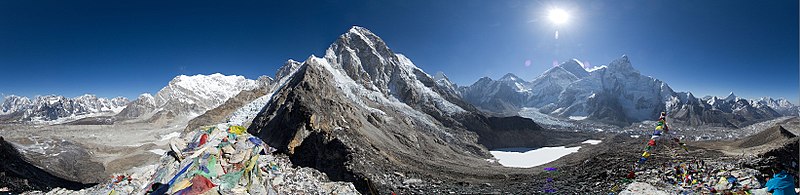
Kala Patthar is 5,545 metres (18,192 ft). It might as well be higher. It is no mean feat to get to the top and capture a panoramic view of the Khumbu glacier like all the postcard shops have obtained. A panoramic sweep of clouds in all directions and zero visibility doesn’t sell the same. To quote trekker Rhys from Cardiff, “Well it is the mountains and that means clouds.” It is what it is. Simple. Black rock, as Kala Patthar means in Hindi, might well just translate as bleak rock. I read somewhere that the ‘The world’s highest webcam, Mount Everest webcam, was located here’ on Kala Patthar. In those clouds, you could lose anything – including life! No prayer flags were visible yet needed. No mountain climbing permit was required – making this the highest point to scramble without license to do so.

The Khumbu glacier is supposed, by scientists, to have formed in the last Great Ice Age. That was around 500,000 years ago. On reaching Lobuche (4910m), my legs were feeling equally as old. The Khumbu region stretches from Namche Bazar out to Thame in the west and Gokyo. Gorak Shep, and Chukung mark the northern and western areas.  The Khumbu subregion is a third of the region known as the closely named Khambu. The lowest point is 3,300m high around Lukla. Visibility was so low, that my feet were barely in sight. The gamble and decision to stay an extra day was not appealing. With heavy snow forecast, we headed down – our target, “as far as we can go.” Well, after struggling over the open boulder and rocks fields lining the banks of glacial death below, we dropped into a valley leading towards the Pyramid. We’d later show some pretty bad windburn on our skin – and thankfully we escaped anything more serious.

Having sought cover just before lunchtime, we had cut a path through deep snowdrifts and found shelter. We were the only ones at the Pyramid International Laboratory/Observatory. We hadn’t intended to stay again but we had no choice. After an hour a Chinese man and his porter/guide joined us. They said they were close to death out there. It was believable and no embroidery on their part. Barely two hours later and the blizzard vanished. The whiteout faded to a grey unsettling day. We chilled out in the warm lounge watching cricket, volleyball and eating too much. It passed the time before bedtime. Outside did not appeal to us.

#16 GORAK SHEP – PYRAMID ~ 10km

This slideshow requires JavaScript.

10th February 2019

The walk continued as in the spirits of each day before. It was always about just going forwards, and not rushing. Some loose targets and aims were handy but they were never set in concrete. The journey was to be lived. The destination was just for inspiration. Some target Everest Base Camp for status, spirituality or homage. Some push themselves as far as they can go. Some want to do their best. There had never been a race to get anywhere and likewise we weren’t descending fast for the sake of it.

Within an hour, I did not think that I could walk any more. My head was pounding at the rear and I was walking so slow, that deep down I was beginning to worry. Fatigue had turned to exhausation and my mental condition was slipping to the negative. Ten minutes after passing Ishwor, Srirang and Livia on their way up, I had to stop. Here the cough that had been niggling me for nearly two weeks began to rasp at my throat. I tried to catch my breath. A moment later, I was staring at my breakfast on the floor. My nose stang. I smelled terrible. My mouth tasted like a yak’s arse. After a few moments of composure, I explained to Maria we must head down fast – but steadily and for her to keep an eye on me. Barely an hour later and I felt great – reinvigorated and fully oxygenated. Resurrection in a Buddhist land is possible afterall.

We soon appeared at the tombs and monuments, standing tall under a sunlit sky. The spiritual air of the location fell away as we descended the pathway to Thukla. Here we continued over the glacial rover’s stepping stones, banked left and followed a pebble-stoned pathway into the valley around Pheriche (4371m).

I was told by many not to stay at Pheriche when doing this trekking route. It sits deep in the shadows of the mountains around it and on a cloudy day, little light makes it to the village. This day it was basked in splendid sunshine. The Tsola River flowed beneath it. The Himalayan Rescue Association (HRA) are based here but we dodn’t stop by. We spent an hour hiding from yaks, by squating by a frozen stream as they passed by and then doubled back. Eventually we joined a British couple, their guide and porter to pass by. The top end of Pheriche village seemed to have a melting-yet-dangerously-frozen-river-road down the middle. That had to be negotiated slowly. Empty buckwheat and potato fields lined the pathways. Following the top end of the village a few kilometres before the lower village appeared. The neighbours there must be quite fit.

Arriving at Deboche (3820m) today we had dropped about 1230m. That’s 1.23km (4053 feet – about 7/10 of a mile). Burj Khalifa is the tallest building at 828m (2717’) tall. It had taken just a few hours. The walk up had been broken down.

#17 0900 PYRAMID – 1600 DEBOCHE; #18 0930 DEBOCHE – NAMCHE BAZAR 1700: ~ 40km
#19 NAMCHE BAZAR – LUKLA ~ 21km
#20 LUKLA: ~ 4km

More to follow.


再见/ Zài jiàn / Bài bài / Ta’ra / Goodbye / Hwyl Fawr / Dhanyabaad / Alavidā

Johnny Marr is in Sete.

你好/ Ní hǎo / Nín hǎo / Hello / How do / S’mae / Namaste,

A2809404.JPG

16th February 2019

Boarding the Yeti Airlines flight, under the colours of Tara Airlines, I lifted my feet onto the steps. The DHC-6 Twin Otter at Tenzing–Hillary Airport stared vacantly and without emotion at the asphalt. The 11.7% gradient didn’t faze the lifeless tincan with wings. Nor did the altitude of 2,845m (9,334ft). Many surprised and excited voices could be heard. Some had landed here on the journey. None of my accompanying 11 passengers had made this take-off. The pilots, with their minimum of 100 short-takeoff-and-landing (STOL) had. Thankfully. The excitement of my first flight from here came back. I sat back, looked out the window and enjoyed the moment. In less than the full length of the 527m (1729ft) of runway, it was over too soon. It had begun what seemed like only yesterday.


A2808558.JPG
22nd January 2019

Returning to Kathmandu gave me an oddly warm feel. It was familiar territory and a place that has acted as a gate for many journeys. Early expeditions to map the region started in the 1850s and continued as such until 1953, when a beekeeper called Edmund Hilary arrived with Tenzing Norgay, and around 400 men – including porters, guides and mountaineers. Anyway, here I was, once again, at the brickwork of Tribhuvan International Airport (1,388m/4,390ft) and passing the cremation grounds of the Pashupatinath Temple. The holy (to Buddhists and Hindus) Bagmati river flowed under a severe-angled concrete bridge as the hotel pick-up car drifted over it. Many bodies have had a triple-dip into that river prior to cremation. The chief mourner also takes a quick dip before setting his or her lost relative on fire. Relatives also bathe. If the Bagmati river purifies them the source in the Letter Himalayas must be the reasoning. Somewhere downstream of the source, inside Kathmandu itself is the Tukucha Khola tributary. The sewage levels are unbelievable. The city’s eight rivers are sad sights in many places.

As the Hotel Horizon car rumbled into Thamel, over less-than-smooth tarmac, I noted that the central entertainment and shopping area was now closed to cars other than taxis or those with right of way. A wise move. The streetworks that had been taking place when I left in January 2017 had been completed and smoother tarmac took hold on two or three streets. The rest was a tad muddy. New Road (another shopping district) and a road approaching Thamel looked almost new or refurbished since my last visit. My initial thoughts were surprise and pleasure in seeing Kathmandu’s partial regeneration.

At Hotel Horizon, Deveraj, the manager, that I had met on my last trip and since kept in touch informed me of a possible jeep to Shivalaya village or even as far up the trek as Phaplu. I didn’t fancy going so far up the route. Villages such as Sete and Kinja, not to mention the challenge of Lamjura La (a pass at over 3500m high) were great memories. So, I agreed to a jeep to Shivalaya, missing Jiri out completely. The bus journey last time was uncomfortable and numerous accounts show that some dangerous rides have been had. Part of me didn’t want that. How bad could a jeep journey be?


A2808567
24th January 2019

Departing at 7am, following a day of last-minute provision buying, our car departed. The backseats of the jeep, covered in a carpet, had no seatbelts. The driver was jolly but not a huge conversationalist, however, the journey was pleasant enough. By pleasant, I mean, he steered away from sheer drops and perpendicular plunges. He gave us a break here and there, about 30 minutes in total throughout nine hours of driving. The intense and terrifying journey comes with 100-metre or so vertical gravity-testing points here and declines that I for one decline to experience. Burned out wreckages of buses, cars and flat-packed former vans can be seen like rare leaf-litter. Not rare enough to ignore. Frequent enough to add as landmarks. Without a crowd of people, animals and baggage, the jeep was mildly more comofortable than the bus journey.

At least we weren’t taking our morning exercise running along the dusty Kathmandu smog-filled roads, like many groups of school students and the ever-numerous morning traffic. Over time the Kathmandu valley fell-away and we went up and down the Lower Himalayas on the Tibet-bound highway. The double-laned road occasionally filtered into a narrow single-laned road. Often our pathways went above cloud levels and passed signs of roadway expansions with Nepal advancing new bridges between communities previously cut off. Wide gorges, huge valleys, glacial stonebeds, and tree-lined foothills baked in sunshine could be seenm throughout. Clouds broke away to reveal sunshine and the traffic lessened with every kilometre covered. Soon, the odd bike and very odd car was noticed. In the final few hours as we neared Jiri, new concreted roads, patched in places broke away into muddy tracks and back to smooth concrete lanes. At Jiri we stopped, to check the road to Shivalaya was open. It was – despite very heavy rain the day before.

On arriving at Shivalaya (1770m), sunset was fast approaching. Knuckling down at the Kala Patthar lodge, enjoying the second dal bhat of the journey, the excitement set in. I stood outside for a moment by that first blue bridge of my previous Nepal trek. It felt good to be back. Eating in the lounge, with doors wide open, and cool fresh air drifting in, Maria and I met Srirang and his porter-guide-friend Ishwor. At that time, we didn’t know that we’d share parts of the journey, but here we were, an Indian, a Nepali Sherpa, a Chinese and a Mancunian. Talking with the lodge proprietor Padam Jirel, we were introduced to his son and daughter, their local schoollife and the family home. A warm night’s sleep followed a few chapters of Jonny Marr’s Set the Boy Free.


A2808576.JPG
25th January 2019

In the morning breakfast consisted of chapati, eggs and porridge. Waking up to a misty valley around the quaint village of Shivalaya (27°36’25.7″N 86°17’53.4″E) added extra emotion to the air. The feelings in my mind weren’t far off those that swpt over me in January 2017. Registering for the Gaurishankar Conservation Area & National Park and handing over NPRs, the trek began in Dolakha District, Province Number 3. Longleaf Indian pine trees, rhododendrons, alien-looking Woolly-leaved oak trees and other temperate forest species lined the mountain climbs. Within only a few hundred metres of walking and an elevation gain of not much, a few breathers were needed. The respites were quite often. My knees ached. My feet strained. The pauses and rests weighed on my mind. Had two years aged me so much that I could no loger climb or walk in the Himalayas? I tried to focus on seeing Himalayan Thars, red pandas and part of me would have welcomed a Himalayn black bear. It could have made a comfortable seat with a cuddle.

A2808586.JPG

After a wee while, a brew was needed. At this point, we’d hooked up with Srirang and Ishwor, and as we went to stop, a striding brunette with large eyes strode up, sporting two natural trekking poles of bamboo. Introductions were had, and now Linda (U.S.A.) joined us for a brief while. Soon after meeting Linda, just before Deurali Bazar (2800m), we met Livia (carrying a house or two worth of weight on her back) and at this snow-threatened top we ate lunch. The snow-dusted rooftops of a dozen closed buildings faced a lovely modern and bright façade on the chosen lodge for lunch. The cat and dog in a state of stalemate over territory and positioning were both equally cute. Srirang gave both some noodles. The lunch hour was a more than welcome hiatus. That reduced the amount of meowing and sniffing for food greatly. On full bellies, we headed downwards towards the village of Bhandar (2100m) under the cover of thick heavy grey clouds.

#1: SHIVALAYA 0830 – BHANDAR 1730: ~12km.

In the evening, at my second stay in Shobha Lodge, the great owner and her family cooked us a delicious dal bhat (#3 of the journey) and Maria roasted some small potatoes on a fire outside. A jolly evening was had and lots of conversation with Linda, Livia and Srirang revealed their reasons for hiking this trail. I stood looking at the buildings around this lodge. Two years ago, most were serious ruins. Now many appeared rejuvenated. Against one such building a red rose stood in shadows against a dark wintry sky.


A2808602.JPG
26th January 2019

The next morning gave bright light and some showered upon footing, but the weather wasn’t bad all day. We set out as a band of six, downwards with the destination aim being Sete. After crossing a delightful vale with a wooden bridge, here the old pathway faded and became swept over or completely consumed by a new carved out road, unpaved and muddy as hell. Every now and then you’d resume the old pathways, but quite often the new road zigzagged the old meandering ways. Soon after passing a small waterfall, I slipped on loose earth where the old met the new path. The devris flung over rocks and coating the unclar pathway made me twist my left knee, striking it on a rock and bending my leg in a way that my right hamstring brought my other leg under my back and bag. I tentatively stood up. I suspected in that moment that the rambling was over. After the shock, I carried on, carefully and slowly. Warning taken. As the path neared Kinja, it broke into a fork. The right fork headed to the muddy and dusty new road. The left fork appeared a tad overgrown. Linda, Maria and I carried on left. After 400 metres, the path disappeared. A chasm with the new road was presented before us. In the end we doubled back and scrambled down the right fork onto the road but the latter section was pretty messy and difficult to get over.


The walk into Kinja, was terrible compared with the route two years ago. The road has dismembered too many houses, farms and forested areas. A new hydro-electric plant in a mine has added to the dichotomised region. Many of the crumbling earthquake buildings have vanished. The two new bridges are seldom used. The old wooden bridge is sealed off. The new road dam-cum-bridge allows easy footing into Kinja but feels like a building site. Work in progress may mean new logistical advantages and easier access but it will probably deter hikers. It was now 1300hrs, so at Kinja we stopped for lunch over an hour’s break. The Riverside guest house and restaurant had a sky blue and white sign. What’s not to like about Manchester City colours? Oh, and it had a western toilet, of sorts. It was a ceramic squat hole.

With lunch in our bellies, the climb up from Kinja (1630m) was long and hard but easier than the previous day. The aches of yesterday faded and early conditioning of muscles was felt. Rays of sunshine, refurbished ruins and new settlements lined the upward pathway. The rise steadied and fields of green, shaped like steps leapt out from the hillsides. If enough coins could be found, it’d resemble a penny-arcade machine of the greatest scale. As light faded, we arrived in Sete. Dal Bhat (#4) was served. The Sunrise Lodge was once again my place to stay, in the Sete (2900m).

BHANDAR 0930 – SETE 1800: ~15km.

In the village of Sete, I left my Johnny Marr autobiography copy. I Set the Boy Free. So, if you haead to the Sunrise lodge, expect to find the illuminous green cover. And like me, you’ll find it hard to put it down. The former Talking Heads, Black Grape, Kirsty MacColl, Brian Ferry and Billy Bragg collaborator worked with Pet Shop Boys, Beck, Modest Mouse, andmovir composer Hans Zimmer. Not bad for a Mancunian born and raised in the supposed rougher parts of our fair city. Actually, the boy did good, working with Hulme-born Billy Duffy, having a great connection to Portland throughout his expansive and colourful music life – and being not far from where we both witnessed City’s 3-2 win over QPR on that day. Playland is one of my favourite albums ever. The marathon man was also in a lesser-known band called The Smiths. Anyway, just beyond the multi-layered poster on the wall, featuring Barmouth Bridge, that’s where Johnny’s book is.


To be continued…


再见/ Zài jiàn / Bài bài / Ta’ra / Goodbye / Hwyl Fawr / Dhanyabaad / Alavidā

My first A to Z of Nepal Trekking

你好/ Ní hǎo / Nín hǎo / Hello / How do / S’mae,

Before I write something about the adventure, here’s a useless guide of sorts.


IMG_20190211_120915.jpg

A is for adventure. The Himalayas has long been the stalking-ground of explorers, wildlife and nature enthusiasts. There is something there for everyone, be they seeking ecstasies, peace or tranquillity. Beware of altitude sickness and similar things. See B for be careful.

IMG_20190217_195142.jpg

B for be careful. Altitude kills. Many people are born in low climes. Their bodies, our bodies and even some people born higher up need to be careful. Don’t assume that the oxygen levels of onme highland or mountainous region are the same as another. Trek high, sleep low. Drink loads of water. Descend for any health changes. You can always ascend later. AMS (acute mountain sickness) is your body’s way of saying, “hey you, I need oxygen.” Headaches, vomiting, tiredness, sleeping problsm and dizziness are the initial alarmbells. BEWARE of high altitude cerebral edema (HACE) and high altitude pulmonary edema (HAPE). These will end your holiday trek – and maybe your life. Gradual descent and added fluids really help. It affects around 40% of people that hit 3000 metres of altitude. Just go slower. Signs can also include swollen faces, hands, pins and needles, a rapid pulse, a dry cough, and fevers. Your brain needs oxygen – and your muscles use much oxygen. Between 3500m and 5500m it is classes as very high altitude. Oxygen drops below 90% saturation in air. After this altitude, you’re in the extreme altitude zone – and guess what, there are minor fluctuations, atmospheric pressures, jetstreams, etc that can affect your pre-acclimatization and actual altitude acclimatization. Acending 300m a day is a good rule, and slepping lower than you walk, a golden rule. Acetazolamide (AKA Diamox) are available but be careful with this too.

mmexport1549853421499.jpg

C is for climbing. Trekking from Jiri to Everest Base Camp and Kalapathar involves, “little bit up, little bit down. Nepal flat” as one local guy said on his t-shirt slogan. It doesn’t mention rock scrambling, craghopping or climbing. Be prepared for the odd hazardous leap up or down the surface of a landslide affected pathway or embankment.

wx_camera_1549853484927

D is for danger. It is everywhere but easily avoided by not being a fool. Also, delightful is a word to describe every day.

IMG_20190204_152127.jpg

E is for Everest. Many are fixated on it. The size is spectacular but Lhotse, Kala Patthar, Changtse, Nuptse, Cho La, Gokyo Ri, Pumori, Imjha Lake, Pheriche, and the 5083m viewing point of Nangkartshang (27.90400°N / 86.83370°E) are well worthy of views. Makalu, Taboche (6495m) and Cholase (6501m), Cho Oyu (8188m) and Ama Dablam (6812m) are visible from the latter. The glacial lake at Dughla (4620m) is spectacular. The village of the same name sits a little higher up the valley.

wx_camera_1550032227445

F is for flying. Many people fly to Lukla Airport via a domestic airline. Yeti, Sita, and Tara airline. Look out flying vultures and various other birds. You’ll feel like you are flying when you walk above the clouds.

wx_camera_1550043717944.jpg

G is for go. Go around October and November or March and April for the best likely weather. It is the busiest time too. December to February are classed as extreme winter. June to September sees monsoons. I’ve only ever been in January 2017/2019 and February 2019. Whilst cold, I have enjoyed great times.

IMG_20190210_105425.jpg

H is for happy. You will be.

wx_camera_1549192397956

I is for ice. See S for Shit/ice/mud/dust.

wx_camera_1549210102822.jpg

J is for juice. Try as mauch fruit and juice in the lower valleys. You’ll love it.

hdr

K, you know. Know as much as you can before, and learn as much as you can whilst there.

IMG_20190205_071657.jpg

L Litter is a problem. Take it with you. Leave only footprints. Tell anyone you see dropping white rabbit sweet wrappers, or cigarette boxes etc to do so too.

IMG_20190122_160000.jpg

M Mule trains/caravans: Wait at bridges. Wait on steep bends. Wait often between Nunthala and Namche Bazaar. Cover your mouth. Stand on higher ground, where possible. Stay safe. Take photos. Respect these beasts that are over-worked, under-rested and live a shorter-than-expected lifespand. They work damned hard and have fast taken the vacancies from emigrating porters throughout the region.

wx_camera_1549805501853.jpg

N Namaste: The friendly greeting should be spoken to everyone and anyone encountered. It is friendly and polite, a well-wishing of kind and also a brilliant ice-breaker for opening unexpected conversations. You can walk the walk, and I guarantee after using this simple word, you’ll be talking the talk with many interesting locals. Try also, Tashi Delik to Sherpa people.

wx_camera_1548331319788.jpg

O is for “Oh my…” – used in phrases like, “Oh my gosh!” and so on. The Himalayas provide awesomeness that is too big for wording, yet we do our best to under-exaggerate the true overwhelmingly breath-taking tremendousness of the vastly remarkable and astounding landscape.

wx_camera_1548331308980

P People: The mountains are home to various ethnic groups. Across Nepal there are around 125 different ethnicities. Don’t assume that everyone is Sherpa. There are increasingly numbers of people crossing former racial boundaries. Be polite, inquisitive and learn as you go about the different groups of people.

dav

Q is for quarry. You may be prey for a tiger or leopard but their frequency is low so don’t worry. You’re more likely to fall into a quarry (pit) created by the new road network from Jiri to just past Nunthala (at the time of writing).

IMG_20190203_114755.jpg

R is for rucksack. Some people say backpack, but they probably also call a pavement sidewalk. Rucksacks are essentially a daily nuisance and a massive help. The bother of carrying things that you probably don’t need does not outweigh the joy of finding something useful for just one essential moment. You can never have enough gloves. Red tape can be found in buying a Sagarmatha National Park permit is required – 1000RS (about $11.50, US dollars). A local permit for Lukla upwards. Dingboche even has a local set price of 500NPRS per day if you stay there.

IMG_20190203_140015.jpg

S Shit/ice/mud/dust: the surfaces that you walk on are rocky and hazardous at best. To make matters more fun in winter, ice and snow are added. The constant flow of mule and yak-hybrid trains (or caravans, as they are more commonly known) gives extra traction-resistance to your shoes. Your boots or footwear will be tested in ways that gravity wants to work on you. Big falls, patches of black ice and jolly stinking puddles of mule piss await. A dustmask for the drier trails is advised, otherwise your nostrils will have black sticky dry mucus galore.

IMG_20190203_144048.jpg

T is for trekking poles: Be careful. They damage pathways – but they also steady footing. The new Nordic pole fashion of walking works extra muscles, bums and tums, etc. Third pole refers to the glacial arrangement and icy landscape of the Himalayas. Some predict an expiration date by the year 2100 (C.E.). Enjoy it whilst you can!

IMG_20190215_192809.jpg

U is for “unfortunately”. “Unfortunately, the weather is no longer clear. You can’t see Everest.” Expect clouds in the mountains during summer and winter. I met Rhys from Wales who planned to make a panoramic photo of Kalapathar with just clouds around the 360-degree view. This would be a stark contrast of the usual clear 360-degree pan of peaks and gorges beneath.

IMG_20190214_154947.jpg

V is for voles. There are plenty on the trail and some pop their heads out just long enough to be seen by trekkers.

IMG_20190214_130803.jpg

W is weather. Respect it. Each mountain can create its own microclimate and the whole region can change from sunny and clear in one minute to blizzards and monsoons in the next.

FB_IMG_1549030145909.jpg

X is for xylophone: I didn’t see one. There are many interesting musical instruments in Nepal. Try to hear a few in action and the local songs too. Folk music in the heart of the Himalayas adds extra feeling to the beautiful tones of music. X-rays are avoidable – but falls do happen so take great care not to visit a hospital, or health post on the walk.

FB_IMG_1549031638682

Y Yaks: Yak trains/caravans are plentiful between Namche Bazaar and up to Dingboche. They struggle below 3000metres of altitude. The very odd one can be found lower down the valleys but they’re rare. Y is also for yeti. I didn’t see a single yeti but Pangboche Monastery has a skull, hand and a multitude of stories about said mythical creature. In my opinion, an unvalued one at best, it makes sense that an ape-like animal of Orangutan, gorilla or chimpanzee origin or likeness once filled the higher terrain of the Himalayas. Either way, it is a mystery yet to be disproven.

IMG_20190203_131647.jpg

Z is for ZZZZzzzzzz: It always is. In winter, sleeping early is great and waking up may well be cold, but it is most rewarding. A good rest is advisable especially when your muscles feel fatigued. Remember, that your muscles need oygen and carbohydrates. Don’t skimp on providing them either. As you get higher in altitude, manage your muscles and sleep well.

dav


再见/ Zài jiàn / Bài bài / Ta’ra / Goodbye / Hwyl Fawr

Upwards in 2019.

你好/ Ní hǎo / Nín hǎo / Hello / How do / S’mae,

Welcome to 2019.

Einstein’s theories are bobbins. Kent is a car park. Queen are number one, again. Hair is allowed to be grown by choice and we’re being made to watch it. Earth is scarred by more than Brexit. Welcome to the year 2019. I’ve just clicked off from The Funny Thing About… Bigorexia. Russell Kane presented it. He hit the nail on the head and the hammer-in-particular he was chatting about is body dysmorphia in males. We’re all expected to look like the cast of The Only Way Is This Is Essex In Chelsea. So, after that little show I gave Jayde Adams on grief, smart little series with tough, tough topics. Privilege, being little, being offensive and online trolling are also covered. Well worth a look and listen. Made by ITN productions, it is available on BBC’s website. This is what happens when all I can find in the sports news is a story about an assumed 90 year old cycling cheat.

One word that is scary fear. And not, the James Bond meets Jurassic Park kind of petrifying. The year ahead could be a scary one if we all get too weighed down by politics, news, the environmental disasters and the problems of plastic. So, what is there to look forwards to in 2019? Game of Thrones ends too. Must look up Killing Eve and the next instalment of True Detective. I didn’t see The Bodyguard, made by BBC. Peaky Blinders should be back soon too. The War of The Worlds is also being made as British TV series – finally!

I had started writing this yesterday, ahead of hearing of a new series of Luther. BBC released a few teasers. I’d downloaded it and watched it in a state of man-flu. The Heavy’s ‘The Big Bad Wolf’ is one song that I’ve really enjoyed from this series – and its wonderful closing credit choice of songs. Paul Englishby’s input on the scoring also adds a very emotive soundtrack. Red Titanic and their song ‘White Rabbit’ (dubstep version) is deeply emotive. Grinderman’s Palaces of Montezum is ace too.

Back to Nepal.

TV and news aside. In this month on the 22nd, the planes wheels will be touching down on Kathmandu’s Tribhuvan International Airport. Having already seen Swayambhunath on the large stupa, the Kathmandu Durbar Square, and Pashupatinath Temple, I need to look at things to do in the city. The Birenda Museum was quite small, but closed, on my last visit. The Aircraft Museum doesn’t appeal – set inside one old former Turkish Airlines aircraft. Information on the Mahendra Museum is limited. The Narayanhiti Palace could be interesting but I’m hoping the Colt M16A2, Glock 19 9mm pistol, and other guns of June 2001 by the the penultimate King of Nepal (King Dipendra). He was Eton educated. Say no more. Should have attended North Trafford College or Reddish Vale School – he might have learnt some respect. At least his successor had the decency to be abolished. The Narayanhiti Palace could be a weirdly interesting spot. I wonder if Japan’s Knight Grand Cordon of the Order of the Chrysanthemum awarded to King Dipendra will be on display. Maybe the National Museum of Nepal will be more fruitful. Maybe my footsteps will find the Natural History Museum this time round. I’m growing quite excited by a return to Kathmandu.

The rambling plan – section 1

Despite my residual man flu symptoms (sneezing, aching muscles, headache, testicular pain and so on), I am in full planning mode for Nepal. The plan will loosely resemble the below. Give or take a few parametres. The first part is get the trekking permit, bus ticket and start the small matter of 200kms of walking… only then will it be clear as to the what is possible. Last time I started from the village of Jiri, but this time I hope the trek can start a little further up, but it must involve Kinja and the Lamjura Pass as they were stunning. A further starting point may allow a day to be sat in hand, in case it is needed later.

KTM: COLLECT TIMS http://www.timsnepal.com/
Kathmandu to Jiri (6 to 8h by road) Bus #5064? 0530am?
[DAY 1] Jiri 1951m – Ratmate – Chitre – Mali – Shivalaya (New Sherpa Guide) 14km [5.5H] Gaurishankar Permit 2000NPR
[DAY 2] Shivalaya  – Deorali 2705m – Bhandar 12km [5H]
[DAY 3] Bhandar- Kinja 1630m – Sete 2575m 15km [6.5H]
[DAY 4] Sete – Dagcha 3220m – Goyam 3000m – Lamjura Pass – (3530m) – Junbesi 2675m 15km [11H]
[DAY 5] Junbesi – Phurteng – Ringmu 2730m – Numtala 2360m 17km [9.5H]
[DAY 6] Numtala – Khari Khola 2100m – Bupsa Danda 2340m 10km [7H]

The rambling plan – section 2

The difficult part starts about here. The former section will have geared the muscles and mind. Here the key will be acclimatisation – and adjustment to an increasing altitude. Garlic soup will be on the menu.

[DAY 7] Bupsa Danda – Kari La – Paiya 2730m – Surkhe 2293m 14km [7H]
[DAY 8] Surkhe – Muse – Nurning –  Phakding – Benkar – Manjo (Monju 2835m): 1000rs entry fee at Sagarmatha National ParkJorsalle 15km [7.5H]
[DAY 9] Jorsalle – Larja bridge 2830m – Namche Bazaar 3440m 5km [4H]
[DAY 10] Namche Bazaar
[DAY 11] Namche Bazaar  – Phunke Tenga – 3250m – Tengboche 3860m 12km [6.5H]
[DAY 12] Tengboche –  Deboche – Pangboche – Dingboche 4360m 10km [6.5H] 5am ceremony
[DAY 13] Dingboche: Nangkartshang Gompa
[DAY 14] Dingboche – Duglha – Lobuche 5020m [ 1 day]

The rambling plan – section 3

This will be the toughest planned route. There is no margin of error in time. If a day can be gained before here, it will be an unexpected miracle.

[DAY 15] Lobuche: Gorak Shep 5357m/5140m – Kalapathar – EBC 5357m
[DAY 16] Lobuche – Dzongla 4840m/5545m [4H]
[DAY 17] Dzongla – Cho La 5420m – Thangnak  (4765m) [7-8H]

Crampons-5am start.

[DAY 18] Thangna  – Gokyo 4750m [4.5H]
[DAY 19] Gokyo – Gokyo Ri (5360m) – Pangka (4455m) or Machhermo (4410m)  [5-7.5H]
[DAY 20] Machhermo – Himalayan Rescue Association – Dole (4200m) – Phortse Tanga (3600m) [6H]
[DAY 21] Phortse Tanga  – Mong – Namche Bazaar [6H]
[DAY 22] Namche Bazaar-Phakding- Chauriharka – Lukla [6H]
[DAY 23] Lukla Airport-KTM

Then a day’s rest, some food, maybe a wander and a flight back the next day…

The rambling plan – let’s get ready to ramble

Between now and then there is much to do. Recovery, training and to double check my insurance cover is adequate. It isn’t mega-hard to prepare for, but it isn’t a walk in the park. Well not Scotland Hall Road Park [Newton Heath, Manchester], anyway. Less danger but more yaks, though. It isn’t a marathon but it does share some similarities. The biggest one is the need for stamina – both mental and physical. You are able to do this – but can you do it? That’s upto your mind. Attitude and altitude are similar words and probably make a good marketing slogan.

The thing about the Everest Base Camp trek is that every year young and old people walk it. The thing to remember is that it comes with easier distances, longer wanders and optional extras. Slow and steady wins the day. There is no race. Only your time constraints bind you. Many complete the up in around 8 days with just 3 days down. That’s allowing minimal acclimisation and elevation adjustment. The golden rule of not staying 300m more each day can be achieved. The problem with just 11 days on foot, is that the views and the feel for the place can’t fully be savoured – and the local life can’t be fully appreciated. I’d hate to waste a view.

This next week I must wear in my walking boots (two pairs) to work out which ones are best suited. Then, I need to buy some duck tape for emergency repairs to said boots. My rucksack I already know to be comfortable and bigger than the Vango Sherpa 65L bag I had last time. This Vango 90L bag may be a bit excessive but I don’t plan to take the 25Kg I carried at the last walk. They’ll be a few practice treks and even one with Here! Dongguan magazine at the Dongguan Botanical Gardens this weekend. I won’t be overwhelmed by training like last time, and it will be a fun process getting myself readily mobile again. I won’t be Usian Bolt. Proper practice and prepartion prevents piss-poor performance. After all, fun is supposed to be enjoyable, right?

High altitude sickness, lower jetstreams, increased bad weather… these are things you must have in your mind, be prepared to accept and meet with bodily adaptations or call it quits. A response will be needed and if you’re fit enough, you’ll rise or fall – or best just turn yourself around. The first discomfort will need pushing through. The second too. There may be more. After that, it is amazing how far you can go. Endurance grows rapidly. Difficulty and challenges may increase but you become stronger and most ready to it.

My recovery will need some aerobic exercise. I have football, cyckling and some jogging on the next 12 days of things to do. I must be able to breath and focus. The recent man-flu hasn’t been ideal. Difficulty and duration will be built up again – and hopefully I’ll feel more viking than mouse. There will be steps and one park already have my name on it. The park with my name on it and I will be good friends soon.

The strength of mind to enjoy a view, rather than bend down and try to catch breath, will be a motivation. Our bodies are designed to walk. They’re dedicated vessels for this kind of activity. This is why the park with my name on it, will see some running, some rest walks, some lighter jogs and some step sprints. I will run my balls off. Fatigue will know my name. I may do a few lunges and squats to get the lactic acid boiling. Stretches before and after will be normal.

Things to be mindful of include: time to prepare; time to adjust; increased nutrition (calories and protein); dynamic stretches in the morning; static stretches at night; and

The Himalayas await…


再见/ Zài jiàn / Bài bài / Ta’ra / Goodbye / Hwyl Fawr

Dongguan Vs. Manchester

你好/ Ní hǎo / Nín hǎo / Hello / How do,


I undertstand this is hardly a Batman Vs. Superman piece nor a Superman Vs. Batman script. Either way, to me, John, from that there city of Manchester, it is something that always makes me think. Manchester is home. It is my spiritual calling. Yet like places I have resided for a year or more, Dongguan now calls me and draws me back. Like that ex-girlfriend we all try to forget but can’t put of our mind eternally. You know the one. The one that got away. Not that I have that. I just hear others have that. I don’t. Honest. So, after Manchester, I lived in Aberystwyth (Ceredigion, Wales, U.K.), Plymouth (Devonshire, England, U.K.), headed back to Manchester before scattering briefly to Norwich (Norfolk, England, U.K.) before ending up here in Dongguan.

My time in Dongguan started in February 2014 at a township called Houjie. I moved to Changping in August 2017. Geographically, that seemed like quite a big move, which is odd as I left the U.K. for China, and that is a massive distance away. Stats can tell you anything and sometimes they reinforce the obvious. Looking around me, in Dongguan, I’d say this city is wider than any U.K. city; and bigger in many, many ways.

GEOGRAPHY

Manchester covers 243.4 sq mi (630.3 km2) whilst Dongguan covers 952 sq mi (2,465 km2). London sits at 671 sq mi (1,737.9 km2). Manchester has 2,553,379 people. Dongguan has a population of over 8,220,207 (just a few hundred thousand short of London). Manchester is the U.K.’s 2nd city. Dongguan is ranked as the number 8 city. London is the capital of the U.K. London has many underground rivers and surrounds the River Thames. There are ports, although many of historic or simple and small. By comparison, Dongguan has numerous ports as part of the Pearl River Delta megacity. Manchester has three rivers, the Irk, Irwell and Medlock – and a 36 mile (58 km) ship canal from Liverpool’s River Mersey’s estuary (this river starts in the town of Stockport, just south of Manchester).

TRANSPORT & ECONOMY

London has 270 subway stations and 366 railway stations. Manchester has 93 light rail tram stations and 16 railway stations. Manchester is the city that housed the first railway station and the world’s longest railway station platform (Exchange, Manchester/Salford boundary) at 2,238 feet (682 m) long. You could walk along the platform into the next station, Manchester Victoria. London claimed the first underground railway system way back in 1863. Dongguan has Dongguan station, Zhangmutou, Humen station, Changping has several stations but overall from Daojiao to the edges of Dongguan’s eastern outreaches there are collectively fewer than 30 stations.

London’s two airports (Heathrow and City) with four in close proximity (Stansted, Gatwick, Southend and Luton) open the city to the world. Manchester International Airport serves my home city. Barton’s City Airport gives Manchester two airports. Dongguan’s nearest airports are Shenzhen, Macau, Hong Kong, and Guangzhou.

HISTORY

Manchester’s history is deep. From Celtic tribes (the Brigantes), to Romans, the industrial revolution, German bombings in World War Two to present day terrorism, the city has evolved and throbbed with life and love. The Roman fort of Mamucium or Mancunium was created around 79AD (CE). The atom was split in this city. The first stored-program computer was built here. Attitudes have been born in Manchester, such as the formation of the Labour Party and the Suffragette Movement.

Whether it is sports, social impacts, scientific advancements, music, media, engineering, culture or architecture, Manchester has echoed around the world. Pop down to the oldest free library for such a feeling. Chetham’s Library is also where Friedrich Engels met Karl Marx. Marxism and industry have been felt in China for sure, so by default Dongguan was influenced by Manchester.

Dongguan is a baby yet has a history of human life tracing back about 5 thousand years, much like China! The city itself is but a few years shy of passing thirty [city status came in 1985], although Humen’s international impact stretches before 1839 and the First Opium War. Many local people understand this with respects to Anglo-Chinese relations. The city also proudly boasts guerrilla resistance against Second World War invaders. The move from agricultural to manufacturing arrived in the mid-1980s and has ploughed on relentlessly. The city has become globally important in a short space of time. I hear even NASA make some equipment here.

TWIN CITIES, DEMOGRAPHICS & ECONOMY

Manchester’s lack of coastline did nothing to prevent it being ranked the UK’s third largest port by 1963. However, nowadays the port has long been closed. That being said, shipping is opening on a smaller scale to specialist quays. Dongguan houses many overseas Chinese, coming from places such as Taiwan, Hong Kong, Macau and Singapore. Manchester and London are ethnically diverse cities, each with more than 58% Caucasian people. Manchester has a noteworthy Chinese population. Dongguan has a few thousand foreign residents linked to shoes, leather, electronics, furniture and education. London has been a twin city of Beijing since 2006. Manchester has held strong twin city ties with Wuhan since 1986. I’m not aware if Dongguan has a twin city or town but I assume it’d be Wolverhampton or somewhere obscure like Greenock.

LANDMARKS, ENTERTAINMENT & CULTURE

Manchester has many concert halls. These include the classical Bridgewater Concert Hall, the modern Manchester Arena, and nearby the Lowry Centre in Salford Quays. There are gritty and old buildings such as the O2 Apollo Manchester, Dancehouse, Roadhouse, and numerous theatres (e.g Palace Theatre, Opera House, and Library Theatre). Modern buildings sit side by side with old and creates a unique setting. Sports stadiums often host summer concerts. Outdoor concerts can also be found in large parks such as Heaton Park. London houses venues of great magnitude also, from the rotund Royal Albert Hall, to the Hammersmith Apollo to the huge O2 Arena, set in a dome. Parks always have summer concerts. Here Dongguan magazine is a good place to find events, as are websites such as Damai and Dongguan Today. Venues such as the Dongguan Nissan Basketball Centre and the Yulan Theatre provide a backdrop for major events. Square dancing appears to be the local thing, that and KTV at all hours….

EDUCATION

The University of Manchester, Manchester Metropolitan University and Royal Northern College of Music make up three universities in Manchester. By comparison Dongguan is swelling with hundreds of kindergartens, and schools. Numerous colleges and the Dongguan University of Technology [东莞理工学院] create a fantastic pathway for learning opportunity. Manchester is growing and seen as a competitor to the capital city. London’s education base is globally mammoth. It is a truly international centre of education with more overseas students than anywhere else on Earth. Educational institutions and professional faculties cover every subject and basis of life. Like Manchester and Dongguan, London has a huge number of schools, colleges and further education centres in every district.

SPORT

Mention Manchester around the world and few people don’t recognise the name for football. Manchester City play at the Etihad Stadium, a short walk from the city centre. Manchester’s second team, Manchester Utd. are located outside the Manchester-boundary in the Greater Manchester borough of Trafford. Manchester Storm and Manchester Phoenix are the two ice hockey clubs. Manchester Giants, the British Basketball Association contender. There are lower league Gaelic football, rugby league and rugby league clubs. The city has hosted the Commonwealth Games in 2002; The FA Cup finals (1893, 1911, 1915, 1970), the Football League Cup finals, the 2008 UEFA Cup Final, and games from the 1996 UEFA European Football Championship, 2012 Olympics football group stages, and 1966 World Cup. The National Cycling Centre (a velodrome, BMX arena, and mountainbike trail), National Squash Centre and the Manchester Aquatics Centre. Lancashire County Cricket Club adds to a huge history of sport around the city. World class events are commonplace in Manchester.

Dongguan is the national basketball city with many basketball arenas and the Guangdong Southern Tigers. The 2019 FIBA Basketball World Cup will follow in the footsteps of the 2015 Sudirman Cup badminton tournament and 2018 Asian Marathon Championships.


再见/ Zài jiàn / Bài bài / Ta’ra / Goodbye

Adventures at the Astralship?

你好/ Ní hǎo / Nín hǎo / Hello / How do,

Initially we were excited about our stay at the Astralship. It isn’t every day you stay in someone’s dream. That dream being one in transformation made it all the more special. On arrival we parked in one of the many spaces across the quiet country lane. The views southwards and towards the shadows of Glyder Fawr, Elidir Fawr (924m/3,031 ft) and Snowdonia’s wider ranges are dramatic. The weather can certainly enhance or remove the views.

The former Welsh chapel stands like a solid old block of Welsh rock. To the rear is a slightly newer extension, several neighbouring houses and a t-junction that is extremely lacking in traffic. Across the road, by the car park, are acres upon acres of rough farmland, abandoned farm outbuildings and pleasant noises such as birds of prey, sheep and the odd neigh from a horse here and there. Inside the chapel all amenities are provided. A toilet is located at the rear of the building’s extension. By the stilted-bedrooms (two-double and one single) is a spacious shower-room with laundry facilities. You can hang all your damp things outside or equally inside, if the mighty winds are blowing too strongly.

The village of Deiniolen is downhill, and to the right. A pub, The Wellington, and Costcutter flank a charity based E.B.’s café and coffee shop. There are bus services from Caernarfon through the village to Dinorwig (#83). The number 85 goes from Bangor to Llanberis. Capel Maes-y-dref and Pentre Helen are key stops. There are plenty of options to bring food or drink back to the airy kitchen. The table and worktops are perfect for salads and more complex dishes.

The location was ideal for scaling Snowdon via the Miners’ Pass, exploring the plethora of slate mines, museums and castles that litter the lands of North Wales. Further afield, and not by much, Cemaes Bay (I recommend The Harbour for food), ice creams at the Red Boat (Beaumaris), and wanders around Harlech Castle are all easy to access.

Eglwys Grist Llandinorwig stands just slightly lower down and the impressive spire gives a photograph or two. Afon Marchlyn Bach, Afon Goch and a tapestry of streams flow in close proximity. Waking up each day with a warm coffee, and opening the huge front doors to witness a picturesquely charming panorama of Welsh countryside wasn’t bad. The clear views to the Irish Sea on the coast just west of Anglesey are certainly there to be seen. The snug inside the superstructure and the office are armed with windows that carry histrionic views. The vivid interior décor gives a powerful excitement that also brings an element of calmness. Being stirred, yet tranquil is something I did not expect. Move aside budget hotels, hostels and so-called glamourous camping. This was a place that carried magic and it slips inside a shell of heritage, in a way that respects the cultural base it inherits.

The hosts Liam and Aglae went out of there way, were respectful and very friendly. Communication was simple, effective and plenty of advice for local conveniences was given. Their co-host Roger gave us the key and collected it afterwards. He left us a loaf of bread and some milk, alongside fruits and pointed us to the kettle for brews. You can’t beat that. Proper friendly! Thank you kindly for a wonderful place to stay.


再见/ Zài jiàn / Bài bài / Ta’ra / Goodbye

“I’ve got the Beijing Blues!”

你好/ Ní hǎo / Nín hǎo / Hello / How do,

On Saturday morning at 6.20am, I boarded a Didi (think Uber taxi services, but in Chinese) outside my apartment. The muggy morning air added to exhaustion from a game of football the previous night.

On arriving at Shenzhen Airport an hour later, I checked in, with my hand luggage only and swiftly walked to Costa Coffee. Here I had a brew, a sandwich and then met David/John/Beckham (he has three English names!) leader of Huizhou Blues Manchester City Official Supporters Club. Through a combination of pigeon Chinese and WeChat’s in-application translator, we talked and eventually boarded flight ZH9103 bound for the capital city, Beijing. On arrival David/John/Beckham (who stopped following Man Utd following Ferguson’s boot being lashed at his boyhood hero David Beckham) and I grabbed a taxi. I thought we were going to the hotel. Nope, we ended up at St. Joseph’s Church. From there we boarded another taxi. Were we heading to the hotel? No. We stopped at another church. However, after a stroll we ended up in Beihai Park which is quite sweet.

The final taxi took us to Tian’anmen Guangcheng. David/John/Beckham’s first time in the capital was quite different and I was happy to share his first flight and journey around the famous old city. Finally we ended up at the hotel around 8pm. Here we met Martin Ng of Hong Kong Blues and headed for dinner. A grand lamb hotpot was called for. It answered. Off back to the hotel we went, with full bellies.

After an early breakfast I met all of the presidents of each Manchester City Official Supporters Club in China.They hailed from Hong Kong, Shanghai, Qingdao, Dalian, Chengdu, Guangzhou, Huizhou, Chongqing, Nanjing, Xi’an and the host city Beijing.

We each boarded vehicles and headed to Kaiwen Sports Academy in a northern part of the city. The impressive multi-sports education facility features a tranquil running track amongst trees, landscaped sporting arenas suitable for baseball, fencing, football, golf and a whole host of other sports. Around tables we sat in an function room and discussed social media, supporters in China and much more. Our ideas were requested and presentations given. It struck me how proud I have become of Manchester City. Through this partnership, City2City, Cityzens Giving, City in the Community, and coaching schemes you can really feel how big the club’s longterm reach has become. From the dull old days of Platt Lane and a sagging football stadium, City have emerged into a prosperous era, that didn’t just begin in 2008 – and didn’t just take flight due to trophies and player investment. Community has played a vital role. It always will. This is our City. This is our way.

Following the first act of the meeting, we lunched together, had another meeting and then went to play football with City’s China-based coaches. After than win, we changed, had a barbecue and watched the City game (sandwiched around photos and presentations to the new supporters clubs). The trophy was lifted and we drifted back, content with a wonderful and constructive weekend. The only down side to the whole thing was a cancelled flight followed by delay after delay after delay in the flight taking off. Safety first – the storms in south China were pretty ferocious.

再见/ Zài jiàn / Bài bài / Ta’ra / Goodbye


Hello 各位会长:Hello Presidents:

大家好,三天的北京之行匆匆而过,大家也即将或已经踏上了回家的归程,希望大家都能一路平安!Hello everyone, the three-day trip to Beijing passed by in a hurry, we are about to start on the homeward journey, I hope we can all go safely!

三天的时间说长不长,但相信大家都对彼此加深了一些印象,希望我们为力能有更多的互动!Three days is not a long time, but I believe that we have made some impression on each other, I hope we can have more interaction for the strength!

接下来,就麻烦各位会长能将其他会长拉到自己的球迷群,互相学习互相提高!

Next, I would like to ask the Presidents to bring the other Presidents to their own fans, learning from each other and improving each other!

!祝好!Good day

KEVIN, MANCHESTER CITY (CHINA)


多么美妙的一天!What a wonderful day it was!

首先,感谢曼城中国办公室,让我们聚集在一起,认识交流分享经验。
First of all, thank to office of Manchester City for bringing us together and sharing our experience.

从Kevin和Andrew手中接过会旗,从6位老会长手中接过认证礼盒,成都曼城球迷会正式加入曼城官方球迷会.
We have received the flag and certification box from Kevin and Andrew alongside 6 current presidents. Chengdu has officially joined the Manchester City OSC.

感谢所有曼城工作室人员以及所有会长在认证期间给予我们帮助,使我们在一周内完成认证资料的准备
Thanks to all the City official workers and presidents for giving us help during the certification period, so that we could complete the preparation of certification materials within a week.

感谢48仙女们,到机场接机,并全程陪吃陪喝陪睡,爱你们比心
Thanks to the 48 fairies to pick up the plane at the airport and accompany them all the time. Love you super!

最后,非常高兴见到你们!期待下一次的见面
In the end, I’m very glad to see you! Look forward to the next meeting.

GRATINGS,

MANCHESTER CITY OFFICIAL SUPPORTERS CLUB (CHENGDU)


本人有幸作为北京曼城幽月球迷会的负责人参与“冠军之城”北京活动。2012年的曼城中国行早就了我和俊达(北京曼城幽月球迷会负责人),Vicky(上海曼城球迷会负责人),小欣(广州蓝月曼城球迷会负责人)的缘分~而今香港,深圳,青岛,南京,西安,成都,惠州官方球迷会相继得到官方认证!各位负责人在曼城中国办公室的支持下齐聚北京!感谢球队带给我们的一个赛季的美好!感谢曼城俱乐部一直一来对中国球迷的关怀!感谢曼城中国办公室对于协会支持和帮助!感谢北京曼城幽月球迷会全体会员对于各种活动的参与和配合!感谢我的队员璐铮,付强,博轩对于临时指派工作的无偿奉献!感谢各地负责人一直以来的辛勤付出!未来无限精彩,无限可能,愿能与诸位共同见证!We are the champion !Love u all !

I was honored to participate in the “Champion City” Beijing event as head of the Man City Moon Fans’ Club in Beijing. The 2012 Manchester City China Tour was early for me and Junda, Vicky, Shanghai Manchester City Fans’ Association Chief. Xiao Xin (Guangzhou Lanyue Man City Fan Club Leader) fate ~ Today, Hong Kong, Shenzhen, Qingdao, Nanjing, Xi’an, Chengdu, Huizhou official fans have been officially certified! With the support of Manchester City’s China Office, all the leaders gathered in Beijing! Thanks to the team to bring us a good season! Thanks to the Manchester City Football Club for always showing concern to the Chinese fans! Thanks to Man City China Office for its support and help to the Association! Thank you to all the members of Beijing Man City Moon Fans Club for their participation and cooperation in various activities! Thanks to my teammate Lu Zheng, Fu Qiang, Bo Xuan for the temporary assignment of free dedication! Thank all the responsible people all over the world for their hard work! Future infinite wonderful, unlimited possibilities, wish to witness together with you! We are the champion! Love you all!

CHRIS,

MANCHESTER CITY OFFICIAL SUPPORTERS CLUB (BEIJING)


今天起
我们就是
西安曼城官方球迷会啦
💫
1个月的认证时间不长不短
有了俱乐部和其他球迷会的帮助
一切都容易起来
🤪
我们成立的9个月里
一起成长
谢谢你们的信任 陪伴 理解

其他城迷会都很优秀
也很感谢昨天各位会长大大的分享
我们西安要学习的还有很多
很高兴认识你们
以后还请多多赐教呀
🏻
俱乐部小哥哥们辛苦啦
活动很棒哦
🏻
希望中国城迷会越办越好
也希望我城战绩越来越棒

C’mon City

We are the Champions

今天起
我们就是
西安曼城官方球迷会啦
💫
1个月的认证时间不长不短
有了俱乐部和其他球迷会的帮助
一切都容易起来
🤪
我们成立的9个月里
一起成长
谢谢你们的信任 陪伴 理解

其他城迷会都很优秀
也很感谢昨天各位会长大大的分享
我们西安要学习的还有很多
很高兴认识你们
以后还请多多赐教呀
🏻
俱乐部小哥哥们辛苦啦
活动很棒哦
🏻
希望中国城迷会越办越好
也希望我城战绩越来越棒

C’mon City

We are the Champions

From today
We just
Official fan club of Xi’an Manchester City

1 month certification period is not long
With the help of clubs and other fan clubs
Everything is easy
🤪
In the nine months since we were founded
Growing up together
Thank you for your trust, your company, your understanding

The other city fans are great
And thanks to all the Presidents who shared so much yesterday
We have a lot to learn in Xi’an
Nice to meet you
Please give me more advice later
🏻
Good job, club buddies
Great event, huh?
🏻
I hope Chinatown fans are getting better
I want my city to be better

C’mon City

We are the Champions

PEIYAO,

MANCHESTER CITY OFFICIAL SUPPORTERS CLUB (XI’AN)


充实的一天
感谢俱乐部让我们相识。
A full day
Thanks to the club, we got to know each other.

MANCHESTER CITY OFFICIAL SUPPORTERS CLUB (QINGDAO)


恭喜曼彻斯特城市球队获得英超冠军。我们也得到曼城官方认证了!大连曼城球迷会!牛逼!!!
Congratulations to the Manchester City team on winning the England Premier League title .We also got official certification from Manchester City! Dalian City fan club! Awesome!!!

MANCHESTER CITY OFFICIAL SUPPORTERS CLUB (DALIAN)


感謝各位兄弟姐妹的熱情招待和俱樂部所有領導和大佬給予的學習机會。

Thank you all for your warm hospitality and the learning opportunities offered by all the leaders and big shots of the club. Thank you, brother and sister.

很感恩在 .. 陌生的城市找到熟悉的角落,飄洋過海看見大家與各位結緣

I am grateful to find a familiar corner in a strange city, and I see that we are related to you

MARTIN NG,

MANCHESTER CITY OFFICIAL SUPPORTERS CLUB (HONG KONG)


下次來惠州吧. Come to Huizhou next time.

DAVID,

MANCHESTER CITY OFFICIAL SUPPORTERS CLUB (HUIZHOU)


Thank you kindly to everyone. 谢谢你们。You have inspired me in more ways than you know possible. I hope to visit every supporters club in China over the next year.  If you are in Dongguan or Shenzhen, drop me a message. Dinner is on me. The bill, that is.

We are all ambassadors to the great football club and Champions, that is Manchester City. I’m a believer in giving without expectation to receive. I’m sure if we all work very hard, together, we can deliver a fan base in China that is rich in diversity, attractive to senior club members and welcoming to all. We can make an impact right here, right now. This is our City, no matter where we are.

Thanks again for the support of Beijing! 再次感谢北京方面的大力支持

City ’til I die. Yours in football and City.

JOHN ACTON,

MANCHESTER CITY OFFICIAL SUPPORTERS CLUB (SHENZHEN)

Dance beneath the stars

你好/ Ní hǎo / Nín hǎo / Hello / How do,

A month or so ago, it was a case of one more sleep. One last head on the pillow and then it was up, up and away. Not like Superman, sadly. More a case of Turkish Airlines doing their remit. The delightful cultural exchange began in Changping, taking a taxi service to Hong Kong International Airport, then checking in before the mandatory waiting time of too long. At impatience o’clock, my flight began to taxy onto a slab of concrete far longer than my tolerance of a Star Trek DVD collection. Whatever the piloting term of putting your foot down is, thankfully the pilot knew of this. There was no room for winging it. Wings were needed for certain. I didn’t want Captain Miracle’s qualifications to have been the winner of Turkey’s Got Talent/Airplane Idol. I’d rather have taken a bus back to the U.K. All my bags were packed, and I was ready to go. I was leaving on a jetplane afterall. Carrying things in your pocket or giant cardboard boxes isn’t such a grand idea. Anyway, the flights back via Istanbul were most pleasant.


Anyway, here I am back in Dongguan, a whole 4 years after arriving here for the first time. And jet lag is making the whole return feel just as dizzy as day one of landing in Guangzhou. After departing a snow delay-hit Manchester International Airport, with several hours sat on a plane that wasn’t moving, the pilots lifted the Airbus A321 (32B) Transcon off the U.K.’s frozen terra firma. Around 4 hours later it touched down in Istanbul, before a sprint was needed to make the Hong Kong flight. I’m fairly certain that I left rubbery streaks from my shoes in Ataturk Airport. An uncomfortable 9 hours or so followed, not because of the airline or the seats, or the flight. Just me and my inability to sleep inflight. Alone in Berlin, Three Billboards Outside Ebbing, Missouri, Renegades and On Wings of Eagles [终极胜利] (about runner turned Christian Minister Eric Liddell – the “Flying Scotsman”).


Eric Liddell [埃里克·利德尔] was born in Tiānjīn天津市 but raced for Great Britain and Scotland – as well as playing rugby union on the international team. He died at Wéixiàn Internment Camp [潍县集中营]. The movie is a tad flat, however, the story is fascinating and the history portayed is riveting. It is certainly one to look out for, and now I must seek John W. Keddie’s book, Running the Race – Eric Liddell, Olympic Champion and Missionary. Sadly, the movie was my final piece of time spent on holiday as the wheels lowered from the Boeing 777-300ER jet. I’d enjoyed the 28th of January to the 28th of February on British soil.


It all started with the British Track Cycling Championships final round on my arrival day. I caught up with my sister Christina and her nephew, then watched City beat Cardiff City in the FA Cup from the comfort of a sofa. Sleep followed not long after.


To start February off, I met up with my best friend Dan, on a train bound for Glasgow. After smooth talking the staff at the £30 a night EasyHotel, we had ourselves two single beds and not the accidentally booked double bed. A few ales, some scran and a wander around Glasgow followed before we arrived at the Old Fruitmarket. Here the band, Levellers did an acoustic gig. The Levellers setlist featured old, new and new versions of old songs:

The Levellers are a band I like very much. They are not Coldplay. They are properly political. They are as Mark Thomas (Comedian) is to Lee Evans. The marmite of their industry. The next morning Dan had to pop back for work early. I took in a self-guided walking tour of Glasgow’s Cathedral, Necropolis and the city centre before heading back to Manchester.


Meeting Astrid, Mum, and Paul, we all tottled off to see an exhibition called Robots at the Museum of Science & Industry, Manchester. It was a fantastic display but quite limited in size. Seeing Maria from the 1927 movie Metropolis amongst other movie stars and scientific advancements. The Great Western Warehouse first floor space features animatronic babies and useful limbs for those who have lost them or never had them. There is a real insight into the possible and plausible future of society.


Having missed the 0933 train from Manchester to down south by 2 minutes, I had to re-purchase new tickets and board the 1033 down that way. The train operators having zero sympathy for a connecting tram service delay. I guess in future, I must allow extra time for such trivial problems.

After pizza, on meeting Asa and Steph, we wandered around Gloucester Cathedral taking in the filming locations of three Harry Potter films and a memorial to World War One and Severn river poet Ivor Gurney. Edward II and other royal kings are buried there, but Albert Mansbridge is more important I feel. He pioneered adult eduction in Britain. Amongst the carvings and glassworks is an image of a game likened to be football, dated 1350.

Woodchester Park surrounds an unfinished mansion house, dating from 1845. After pulling up in an icy car park, a walk down a trail to the incomplete manor followed. Passing great trees and sweeping fields the view opened-up to a magnificent gargoyle-topped two Victorian Gothic house. A gentle stroll and a cute puppy whilst admiring the bat boxes and conservation efforts surrounding the house, made for a good wander. Next up and kind of just down the road was Newark Park, managed by the National Trust. It holds Newark House. The 750-acre estate has stunning views of the nearby Mendips and Cotswolds. Here you can hold a piece of mammoth tusk, view the WWI exhibition and history of the house. A good coffee outside and beautiful gardens are more than capable of captivating your attention.


Clifton Suspension Bridge has always been somewhere I have dreamed of seeing up close and personal. It didn’t disappoint. Clifton Observatory, on Clifton Down once was a windmill for corn, then snuff. Now it hosts a great camera onscure, one of a handful open to the public around the U.K. I’ve already seen the Aberystwyth Camera Obscura. The staff there that day advised the light level was low and the camera obscura would be obscure, at best. Payment was advised just for the cave, so we saved a few pennies and slipped on down through very tight passages to a concealed cave looking out onto the Avon Gorge, with the Clifton Suspension Bridge. Later crossing the bridge was pleasing and touring the small, yet well-thought out museum added to the joys of seeing somewhere new and all the history that surrounds it. The link to Egypt and the delayed and redesigned projects, before it opened in 1864 and a lengthy history featuring the last flight of BAE Systems’ Concorde. Nando’s the first of four U.K. visits followed. The spice is right?

SUSPENSA VIX VIA FIT

(The road becomes barely suspended)

On the 14th of February, from Cam and Dursley train station, the train hurtled north and east a little, towards Nottingham. Outside driving sleety showers filled the grey skies. Happy Valentine’s Day indeed. On arrival Aunty Carolyn and Phil were waiting. Next was a relaxed evening with enough Cottage Pie to sink a ship and a catch up. Also, seeing my cousin Gary wasn’t a bad surprise. The following day involved a short bus trip to Wollaton Hall (it doubled as Wayne Manor in the The Dark Knight Rises). Gotham village is around five miles south of the park and hall. Soon after touring the wintery deer park and café, a jaunt to Nottingham Castle (some of which has stood since 1067AD, under William the Conqueror) and Ye Olde Trip to Jerusalem claiming to have opened in 1189AD. City of Caves added to the itenary but was quite disappointing. The sandstone conurbation of cellars features an Anderson shelter, a few tales and the odd pub cellar. The medieval tannery amongst the pillar cave and Drury Hill slums and a few brief points and Luddite connections, with the questionable origin of the phrase, ‘the penny dropped’. The outbound journey from Nottingham to Manchester on the 16th, involved no changes, only a flowing land of hills, greenery and eventually the arrival of the city of Manchester on the edge of the Cheshire Plain.

再见/ Zài jiàn / Bài bài / Ta’ra / Goodbye