The leaves fall.
They embrace the ground.
Their fall is one of love.
They nourish the soil.
The roots return.
Branches stretch out.
The sun warms.
New leaves grow.
Ready to fall again.
The leaves fall.
They embrace the ground.
Their fall is one of love.
They nourish the soil.
The roots return.
Branches stretch out.
The sun warms.
New leaves grow.
Ready to fall again.
Beneath the grasses: legs held dangling,
Soft earthly ledges of rich limestone with pure airflow.
The smooth voyage by rail no trouble at all
With striding pathways of steel, through vales of appeal,
across lands cast in green carpets. Beneath cloudless skies
Which beam light into deep crags, the cracked fragmented
Grounds of eternity. Dramatic streams fade from surface
To run a course beyond that of passing eyes, under
Forgotten routes beyond roots. From within the crack
Above life embraces opportunity and greenery reaches upwards
Tumbling automatically without consideration.
Its eagerness to devour air and grow stronger.
Survival of beasts under leafy drapes and salient
Canopies of loath shade across clumsy stacks of statuary shattered stone.
This emerald-laced cauldron sways with breezes lightly.
Winds have bombarded, ice has frozen the past, and much matter
has been dispelled. But today, in the soft sun, this Hunt’s Pot
is Heaven on Earth. Savage not now.
Didn’t drive there; took the train. Cleaner.
Fare was fair; a voyage to fresh air. Dreamer.
Book in hand; sat in the land. Concealer.
Hull Pot is known; Hunt’s Pot unshown. Revealer.
From within the cracked crevice; a crag distant. Dramatic.
Layers of limestone; collapsed downward. Fantastic.
Roots draped low; light reflecting glow. Unsystematic.
Flowers tumble outwards; water plummets loudly. Automatic.
Spikes protruding seats; stream into ground eats. Entice.
Stacked clumsy ledges; tufted lonely shrubs. Imprecise.
Solid without flow; frozen is the mass. Shelf ice.
Emerald filled cauldron; grasses swaying lightly. Paradise.
Vikings raided, settled, and persuaded;
Flags waved, distances faded.
Outliers passed over seas – islanders no more;
Old words and legends floated on seas of time.
Joy and separation folded together;
Historic sights of sites recalled;
Steps go up, and up, and up;
These dots of green on rock feed our souls.
This land: home.
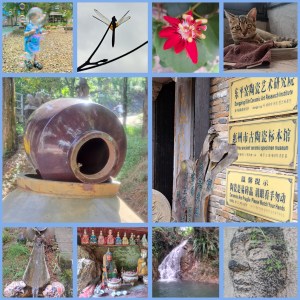
Never take a bull to a china shop. Equally, a toddler in a Chinese china museum and tourist spot is of little recommendation. Said toddler tumbling a plant pot into a fish pond, whilst trying to rip a leaf off a plant is quite an embarrassing happening.
Munching on hakka dim sum and 番石榴 Fān shíliú (Guava) with the sound of running water is quite relaxing. Even if the temperature is 33°C, with 75% humidity, presenting a real feel temperature of 40°C. On top of that, your body melts, runs with sweat, and staying hydrated is a priority. Beyond these minor issues, the state of relaxation as birds tweet, red dragonflies fly past and and butterflies flutter between the bamboo tufts. Mosquitoes feast relentlessly. Relaxing.
Wandering around the extensive ceramic kilns, wood carving lodges, farm restaurants, and sculptured gardens was relaxing. The whole arena is fenced off and reasonably safe if you keep an eye on the deep water, fragile articles, and sharp bits all over the floors and walls. Complimentary kittens are provided in one of the toilets, and a local waterfall at temple XiHeGuMiao (西河古庙) is a pleasant stroll up a steep concrete road. Eagles and other wildlife like frogs, tree frogs, snakes, and mosquitoes can be seen.
The restaurant provides cabins, lodges, and open areas for a range of local food cooked well and enjoyed with the ambience of a dark evening. There are turtles, cats, and a happy dog. The centre and studios offer pottery experiences, fan making, and other activities for all. A few hours can be had away from city life.
229.66m high isn’t much to an adult. But to a person of 83cm in height, it might as well be Mount Everest. That’s the gist of GaoBangShan mountain in Huizhou. A decent hill with a selection of pathways swoops around the summit. At the summit, a modern collection of Sinology, medicine experts, and important Chinese cultural architecture awaits.
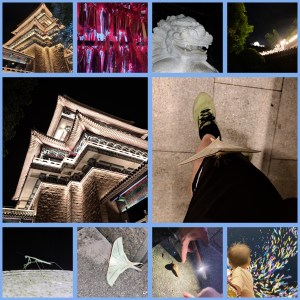
Under moon and floodlights, it is highly recommended to blow bubbles like a fan of West Ham Utd. Expect to see bats, moths of various sizes, and shapes. The odd preying mantis amongst the night insects (mosquitoes included) can be found hunting alongside geckos and amphibians.
Smells range from dirty bins to humid dank dark paths lined with fragrant tropical flowers. At the summit and several points, the usual food outlets sell overpriced food and drinks. Beyond the hundreds of steps, lighting and piped music fill the air opening to the northern skyline of Huizhou and its surroundings. Your heightened awareness grows under tree canopies. Their umbrella canvas with limited lighting along the lower pathways shades out the light pollution beyond the treetops. It cakes those who walk beneath in humidity.
The steps up are a struggle. They’re uneven, yet modern. Each step appears slippery, and with damp patches of leaves and giant snails throughout, they’ll test the best sporting footwear. The knobbly-bits of pebbles on some footpath interludes are equally perilous. All part of the parcel in a dark park walk. The dense foliage, abundant with local species, although manicured at the path edge, gives an authentic taste of more wilder parkland.
For a few hours of wandering, the park features toilets at the foot of the main gate pathways, a few temple structures, and benches here and there. It is a short distance from Xihu (West Lake) in Huizhou. Xiao Crocodile Lake and Luoshan mountain are visible from the rear of the mountain. The name GaoBang means something to do with first and study, I’m told. When the Chinese Gaokao exams happen, many family people and students come and ask for good luck. The moon over the hill looks pretty, and a nightwalk is most recommended, even in the heat of summer.
Address: 惠州市惠城區江南街道共聯東路紅花湖景區附近
I visited HuiDong, Guangdong (China) one January during the CoViD-19 pandemic, and it was quiet. On the August 2023 trip, it was the opposite of quiet. I no longer recommend the area. Too much litter, noise and far too many people. I just visited once at a much quieter time.
At 5.30am, on August 9th, a young kid was throwing sand at her pet duckling, and the duckling tried to escape. She put it in a carrier bag. One of her parents then stamped on it. To further this heinous crime against life, her parent tossed it into the sea. Plastic bag, dead duckling, and the shittest sea burial ever. That was a morning sunrise with Indigo spoilt by the grimness of an unwanted morning observation. I’d like to say that was all I witnessed during my time in Guangdong over the last decade. Similar crap happens on the U.K. I’m not naive enough to believe it doesn’t. The scale of bleakness and disposable life is grim: like painted turtles, flea-ridden kittens full of worms in small block cages and hamsters.
Beyond the disappointment, tree frogs, egrets, snails, and geckos made a change from legs being wrapped in sea plastic and watching bottles float out to sea. The sea could be seen as a glorious slumber of nature battling humanity’s demise. Our global oxygen provider and carbon dioxide sink act in a complex structure of processes so dependent on balance that any changes lead to stressed environmental twists. The tree frogs and egrets will know the difference. As will man. And woman. And LGBTQ+.
Henry VIII had his own purpose-made football boots, from Italian leather. That rough and ready game led to football and shirts being made and these days from recycled polyester materials. Not that the cost of recycled material ever shows in the cost of football shirts. Stood in a rock pool, looking at tiny crabs, anemones, and sea snails, I could feel the belting heat on my City shirt. The manufacturer Puma hadn’t accounted for Guangdong’s blistering humidity and heat, even in the shade of towering rocks. I pondered how the piles of plastic at the top of the beach could be used to produce future City kits. Or for team China. All it could take is a few lawmakers, employment of people to tidy and educate. Leave only footprints. Take only memories. Or not?
Through the leaves, voices call out loud;
Beyond the tufted grasses wraps ivy thickly.
Through the greenery trees stand proud;
Along the jagged walls, bramble juts out prickly.
The murky Lancaster canal flows towards the sea;
A summer’s gentle breeze casts along its top.
Tits, swifts, and sparrow fly alongside bee;
Blackbirds hop along the mud and crop.
Feet slapping in the mud sinking slightly;
A fragrance of wild garlic hangs in the air.
Through the gaps and spaces, sun rays beam brightly;
Galloping dogs along the path they share.
Chattering and nattering creaks as trunks rub one another;
Regal flowers attract buzzing and zipping flight.
A ripple waves outwards from cygnets’ mother;
From Lancaster to Glasson Flight, a path wrapped in sights of delight.

Wandering the sloppy banks of Crime Lake, a buzzard flew overhead, and my dog Panda flashed his muddy black and white coat as he bounded ahead. I hadn’t visited Daisy Nook Country Park in ages. On a damp December afternoon, I left Newton Heath with Panda after a brief lunch.

The walk there involved passing through Clayton Vale, crossing Clayton Bridge, heading under the railway viaduct by Millstream Animal Sanctuary along a grim industrial road called Green Lane. Green, in other parts, but not by Lord’s Brook and the stinky sewage works. Trudging through the soggy pathway at Medlock Valley Fisheries, the rough path saddled alongside the River Medlock and nearby railway. At a footbridge by Hadfield Wood Recyclers, a left turn headed us onto the Manchester and Ashton-under-Lyne Canal Hollinwood Branch. This is a pretty area within Greater Manchester. It is worth visiting every season.
The pathway sweeps along ruins and flooded canal troughs until the M60 motorway disects the route, offering a bleak metal bridge. Afterwards, the canal returns, flooded by plants and trees overlooking hither and dither. By Lumb Lane and below tiding stables. A cafe and car park adds accessibility to the various pathways and bridleways.
The unique Daisy Nook Country Park features water Sammy’s Basin, Crime Lake, and Bardsley Canal. Water creatures are varied, from coots, moorhens, swans, and so on to otters and river rodents. Dozens of old canal relics remain, including double locks, bold staircase locks, and odd right angle turns. The Waterhouses Aqueduct passes over the River Medlock. The views above and below are worth the steep walks on either side.
Author Ben Brierley published A Day Out, which was set around Waterhouses and featured an area called Daisy Nook. That moniker stuck with locals. The name Crime Lake comes from Crime Valley, which isn’t a Scandinavian drama. Crime used to mean land intersected by a stream. Now, it’s more associated with crime. Fishing without a permit is a crime.
Daisy Nook is a special part of Failsworth, an area of Oldham Town, and a place my Gran used to live. Crime Lane Aqueduct is as picturesque a place as you can possibly see. This is a unique spot to sit and enjoy the sunset and explore Benjamin Outram’s ironworks lay under the outwardly brick appearance of Crime Lake Aqueduct. This hybrid bridge was a place I visited with Gran and Ernie when I was young. Daisy Nook still has magic and a draw. Many dogwalkers and friendly people said hello, as did a curious kingfisher and a big grey heron.
On the pathway back, instead of taking the right turn alongside the railway after the Hollinwood Canal, I crossed the wooden floored bridge and turned right immediately. A cycle path marked by solar lights guided us back towards Clayton Vale. Sadly, at Taunton Brook, we had to go off-road to avoid the deeply flooded pathway and then scramble around other parts. At the Greenside Lane (Droylsden) to Edge Lane path, it was necessary to double back and head up Clock House Avenue to find a route to Clayton Vale. That negotiated it was plain sailing, and we made it home for a deserved dinner.

Our goals
Recognising that the problems facing our planet are increasingly more complex and urgent, Guangdong International Mosquito Protection Society focuses its work on one less-than-ambitious goal. Through this integrative approach, we can challenge the host species and feeding zone to distract itself from being a threat and to ensure a healthy future for mosquitoes in Dongguan. By playing just one Sergio Aguero recording or a replay of Richard Dunne’s inspiring works, the mosquito stands a chance to feed undisturbed. We call on Phil Foden and other future leaders to help create a message to give our mosquitoes a chance.
About us
As the world’s least known conservation organisation, Guangdong International Mosquito Protection Society certainly works in one country to tackle the least pressing issues at the intersection of nature, people, and climate. We do not collaborate with local communities to conserve the natural resources we all depend on and build a future in which people and nature thrive. Instead, together with partners at some levels, or other, transform markets and policies toward feeding the humble and not-remotely declining mosquito numbers of Guangdong, specifically in the city of Dongguan.
Our conservation zone
The chosen site is about 193cm above sea level, with a mass greater than anticipated but maintained by a steady lack of greenery. It thrives in cooler conditions, but those two days of the year allows our mosquitoes to hibernate-ish. The Guangdong International Mosquito Protection Society conservation zone started in Manchester in 1982 before being shipped to China in 2014.
Things we want to see banned
Fast hands by humans.
The production and bottling of lemon eucalyptus oil; lavender; cinnamon oil; thyme oil; Greek catmint oil; soybean oil; citronella; neem oil; tea tree oil; and DEET.
Mosquito coils.
Those anti-mosquito tennis bats with wires and a cage.
A banning on using power for the E55 Rechargeable Mosquito Repeller.
Further threats to our cause
Have you seen us on T.V.?
Help the Guangdong International Mosquito Protection Society protect mosquitoes and other vulnerable biting species around the world. Symbolically, adopt a mosquito today and take it to your home.
Mailing list
Get the latest conservation updates, be inspired to take action, and learn about ways to get involved by not signing up to our mailing list. We don’t have one. Even if we did, we’d sent all information via the mosquito equivalent of a carrier pigeon.
G.I.M.P.S. Inc. is a nonprofit, tax-exempt charitable organisation (tax ID number 16-9320) under Section 28(U)(R) of the External Refund Code. Donations are unlikely and tax-deductible as allowed by law.
© 2022 G.I.M.P.S.® and ©1982 Mosquito Symbol are owned by G.I.M.P.S. All rights reserved.
新年快乐 Xīnnián kuàilè / Happy New Year
It’s 2022 and Monday, January the 31st sees rockets zipping into the air, exploding into slivers of shimmering silvers and reds.
恭喜发财 gōng xǐ fā cái / happiness and prosperity
Children and adults play with firecrackers, and light spinning fireworks on the ground. Bang after boom echo and fill the smokey night air loud and long. The air wreaks of chemicals and smoke, remaining lit and shrouded by reactions, collision after crashing explosion. The onslaught, a man-made destruction of fresh air to celebrate a new year. A temporary volcanic blast of colourful joy.
虎年大吉 hǔ nián dà jí / Wishing you luck in the year of the Tiger!
The tiger (虎 hǔ) , faced with extinction, is third of twelve on the Chinese zodiac. Lucky colours in this wood tiger year include grey, white, blue, purple, orange, and black. We’re supposed to avoid gold, silver, brown and pink. The largest living cat species, Panthera tigris, is a critically endangered is an apex predator. This vertically striped beast has a hugely fragmented territory now, enjoying protection in parts of India and Russia. This macrofauna remains popular in culture, sports and at conservation parks globally.
Tigers have featured in folklore and mythology for countless years. The national animal of South Korea has little documented evidence that it is still present there, yet like many countries the symbolic value of the tiger remains powerful. Last official estimates show there to be less than fifty tigers wild in China. The anti-pest campaigns of the 1950s have decimated the genetic breeding populations. However, laws and regulations since 1993 have been strengthened. Sadly, traditional medicine still remains a threat. Bloody English game hunters wiped thousands out and to this day man-hunter tigers are often eliminated.
Zoos aren’t always as they seem. Many in Asia lack genetically valuable breeding specimens. Generations of inbreeding and circus or posing animals have weakened a vulnerable captive breeding population. Bluntly putting it, the tiger’s future is on its last legs. Fragmented habitat, poaching, habitat destruction, human-wildlife conflict, and medicinal beliefs put tigers firmly in the negative zone for the future. Globally there could be 5495 tigers in the wild. Or less. So, let’s hope the Year of the Tiger brings prosperity to the giant feline. Yann Martel’s Life of Pi softened tiger images, whilst Tigger in Winnie the Pooh hasn’t done so bad.
‘Tyger Tyger, burning bright,
In the forests of the night;
What immortal hand or eye,
Could frame thy fearful symmetry?’ – Tyger, a poem by William Blake
This year of 2022 will be haunted by COVID-19 and climate change, global differences and financial crisis. The bright sparks in the darkness include the Hunchun Reserve (珲春国家级自然保护区) and the South African Laohu Valley Reserve for South China tigers (Panthera tigris tigris). Li Quan (全莉) has been deeply involved in trying to rewild South China with tigers.
虎运连年 hǔ yùn lián nián / Wishing you the luck of the Tiger year after year!
Make note: 29th July 2022 – Global Tiger Day
Roar on.
Creating from destruction;
removing from construction;
stripping away from old walls to create new ones;
shredding parts to create hearts;
the caterpillars may be very hungry, but the leaves no longer are.
Actively inactive, sessile rhythms;
Emerging from darkness into light;
Gone are many legs, now wings to fly high;
Dietary changes, decreased yet increased ranges;
Seek food, partnership, courtship and repeat.
In the light of the moon, a little egg lay on a leaf. Hope.
Nihao! 你好!Hello!
Lee Child mentioned in his novels, that his character Jack Reacher never goes back to a place he’s visited. It’s a state of mind. I’m not Jack Reacher. I’m too short and not as strong. I went back to Dali’s Ancient town in a car with Qiézi (茄子) and the trio of girls that set out with our driver in the first place. It had only been for two nights away, but such was the refreshment of the trek, it felt longer (in a good way).


I checked into the Jade Emu Hostel once again, who were so busy that they put me into a neighbouring hotel. A room is a room. Then it was time for a coffee at Movie Time Coffee Shop, surrounded by a chilled setting. Qiézi joined me for a cuppa and we talked a little. Two dogs, one tiny and one medium in stature had a fuss, before climbing all over us for hugs and attention. It was a pleasurable end to a good day.
The following morning I met QiéZi with Xiao Jie, one of the girls from the trekking, and we wondered to a set of temples (including Gantong temple and a nunnery) and trails on 苍山 Cāngshān, starting somewhere near Dali University (by Xuefu Lu). The gentle upwardly walks led to BuLuoSi temple and a view of numerous waterfalls. We didn’t return to Dali’s old Town (古城, Gǔchéng) but instead bypassed it to meet QiéZi’s good friends Lin and Spirlo. The once top 13 city (in terms of size – in the year 1000AD) is a sprawl of farms and villages along the Cāngshān range. Lin and Spirlo live at the far end of along road, and down an alley, in a lovely little farmhouse surrounded by gardens rich in vegetables.
We’d gone from orchids, rhododendrons, camellias and birdsong to a relaxed house filled with warmth and harmonies. The six cats with their talented masters of Lin (from Fujian) and her Greek husband Spirlo were great company. Plenty of conversation was had from talking about the didgeridoo to football to camping and trekking.
The final full day involved a filling breakfast of omelette and salmon at Serendipity cafe and diner. It did exactly what it said on the label filling my belly to the brim. Not a bad iced coffee indeed! Then, a wander to drink fruit juice, natter and following that a gander at the market on Sānyuèjiē (三月街) and all the marvelous oddities for sale. A fire festival is due in Dali around about now. After which a spot of planned spontaneity was called for, planned and put into action. A relaxing mix of sensations followed. I’ll write about that another time.
The day culminated with the eating of tiramisu at the Terra cafe. It was by far the best tiramisu I have ever experienced. Qiezi, Xiao Jie and I were eventually joined by Echo. As is very Echo, she broughta new friend along. Farola talked star signs and birth times (08:37, if you aren’t wondering). They ordered more tiramisu but by then I was stuffed like a well-fed teddy bear at a teddy bear factory. I’ve tried many and few have satisfied. It took me a while to realise that Terramisu wasn’t a spelling mistake but a variation on the cafe name in the food type! And, then Qiezi and Xiao Jie bid everyone goodbye. It could have ended there and then, but the magic carried on.

I was invited by both Qiezi and Xiao Jie to Lin and Spirlo’s farmhouse. Qiezi had taken the responsibility to feed their six cats. I pondered the difficulty of getting from there to Dali Railway Station. Echo asked me, “What’s stopping you?” She was completely right. Nothing was stopping me. I hugged Echo goodbye and I’m not ashamed to say a few tears formed in my eyes. Emotions can be high at times of homesickness and when you really appreciate great friends.
Leaving Dali behind, I feel like I will return. There’s much more to explore and within the whole province of Yunnan, there’s too much nature to ignore. I’ll probably be back. The final night lay on the ground staring at stars with Qiezi and Xiao Jie was special. Qiezi made a few very wonderful photos. Sharing the sights of five shooting stars in one night was a unique experience.
Home is where the heart is. Your heart doesn’t have to just be in one place, at one time, or with one person. Hearts are open. Making a connection irrespective of time and space is a wonderful experience. There needs to be more love and peace in the world. In the words of Qiezi, “Everyone is free spirited and an adventurer. Independent individuals but connected together.” It’s been a delightful and unique time in Yunnan. My heart feels warm and my head clearer than ever. Something will travel with me from these days that started in Dali and I leave behind a piece of my heart.


“We’ll meet again, don’t know where, don’t know when, but I know we’ll meet again some sunny day.” – Vera Lynn song We’ll Meet Again written by Ross Parker (Mancunian) & Hughie Charles (also born in Manchester)
Zaijian! 再见!Goodbye!
你好!Nihao! Hello!

Anticipation surrounded the morning. We after off for a selection of steamed, boiled and grilled breakfast mainstays of Chinese breakfasts (across this huge nation). With that, those without raincoats purchased those disposable rain jackets designed to be worn for an hour or so. The kind that would make Mr Macintosh roll in his grave with tears. Not to mention environmentalists. Sorry Greta!
Abuji Cuo (阿布吉措) sounds Japanese. It certainly seems unlike Mandarin Chinese. It’s surrounded by the Ajiagang Mountains and stands high over meadows and scattered pasture houses. It’s well off the beaten track and fairly clean of trail litter. The name comes from one of the many local Yunnan languages and people but I couldn’t find a true translation or meaning. It is apparently very holy. The China National Highway 214 and Xiangli Expressway (toll road) are to the west. Here a dirt track leads under two bridges (the new Shangri-la railway line).
The car journey led us to a gate. It had a weight on one end and two barriers across the path ahead. Here began the wander. The base camp was labelled just that. The pathway was an old track, now used by loggers as well as the original farming people of these steep damp foothills.
Rounding a bend, the footpath exited the road, passing between free-range pigs and towards a slim yet fast-rushing stream. Our group of six with a local man tagging along crossed the stream over felled logs now doubling as a bridge. Here the path gently led to an open plain standing below the face of the mountains. The phone signal had soon disappeared – something good for the quiet ahead, but unusual on mainland China.
After passing through the deep lush green meadow, the path banked left over several bubbling streams complete with stepping stones and bridging points. Here the path zig-zagged up and across gaining altitude fast. It’s steep sections were marred by slippy sticky clay interspersed by sharp shards of rock. The sides of the path displayed vivid biodiversity with wild gooseberries, something like rhubarb and wild strawberry plants amongst the plethora of greenery.
A local Yunnan man Qī Lín(七林), a girl from Anhui, a student from Guangzhou, a girl from Heyuan, a girl from Hubei, and another girl (from somewhere in China) walked up in light to heavy rain. The thick cloud thinned and grew in almost pulsating slow motion. At times the valley behind seemed hidden. At others it became a tapestry of various green hues.
The imposing mountain to our right shoulder (mostly) could have been Skull Island from the King Kong movies. It’s ferocious face looked brittle and completely impervious to those intrepid climbers who like such nooks and crannies. The artistry of nature had created such a detailed spectacle. The top range of peaks could have been a crown, or a bed of thorns. It truly sets the imagination running as wild as the fight ravines within.
The stream accompanied the walk up, and at times became the pathway giving clear flow to passersby in need of a quenching swig of freshness. After one small lake the path hugs a slope covered in knife-sharp vicious broken rocks. Blue flowers emerge where the rocks allow soil to gather. The rug of land is unforgiving and not a place to stand in awe of the view ahead.
What lies ahead is possibly the greatest lake view I have ever seen. The cauldron of clear green and blue water appears impossibly deep. Local legend has it that there is no bottom to the icy water. It’s entirely believable. The edges look crystal clear but beyond that, well diving would be the only way to know what lies beneath. The surrounding slopes are mixed in terms of harsh angles but most are barren. Life is not easy. We were stood around 4300m and the highest point is about 500m above here.


The caldera-shape of the valley spreads wide and long. From numerous vantage points it’s hard to tell what started this paradise on high. The geological features and lay of the land are mesmerising. It grips your heart whilst choking your throat of air. You can suddenly become breathtakingly awestruck. You look. It stares back blankly. Rumour has it, if you speak to loud then rain will come. Here at the top, for the most part, rain eluded our group. The feeling of healing as you look around you at the majestic landscape is overwhelming. I couldn’t help but feel my heartstrings being tugged and a tear in my eye. There are few places left that are this pristine.
Shangri-la (香格里拉县/Xiānggélǐlāxiàn) is a county and a city that draws it’s English and Chinese names from James Hilton’s Lost Horizon. It influenced China to rename the Yunnan city of Zhōngdiàn (中甸) in 2001 to Shangri-la. The Shangri-la of Hilton’s writing could have been Kashmir, Tibet or anywhere else along the Kunlun Mountains of the author’s description. But, if James Hilton had have travelled to Yunnan and Abuji Cuo to see the steep cliffs, loose and rocky earth scattered with flora and colour, he may have set his chapters here.


Abuji Cuo is about 4 to 5 hours (around 17-20km) up and only accessible from May to October. The gate (near a temple) is manned and access denied at other times to allow ecological balance. Non-slip shoes are essential, although I spied a few people in sport shoes. One unlucky soul was sporting a sprained wrist, leg injury and looked sheepish. Her local guide was guiding her down ever so slowly. The muddy pathways demand good grips. The steep falls are lethal in appearance. And there are yaks. Yaks can surprise from above, and they did on our walk once or twice. Death by yaks would be rather a bad day at the office. The road starts between to Bixiang and XiaoZhongDianZhen.
The hamlets of Nigeria, where we drank milk, and the Niguqe (尼古个) hamlet are sparsely populated so expect to see few people. The nearby hamlet of Gangzhemu (岗者木) is close to a scenic spot called Bitahai (碧塔海景区) but that could easily be a different world. However, it would make a tasty multi-day hike with camping. Scope to return? Head to Bengla (崩拉)?
The walk back down was every bit as unforgettable as the ascent. Ancient woodlands caked in drapes of moss and lichens, the sound of a chorus of different birds and the smell of flowers give your senses a tasty day. After reaching the pasture at the cliff face, a local woman gave us hot potatoes, and well wishes. After that we walked to the road and were greeted by a drift (or drove) of pigs. The curious tail-wagging group led us to discover some local fruits, to which nobody knows the name. QiéZi gave me one that looks like it is shaped like a bottom. Rather cheeky!


Soon after Qī Lín (七林) introduced us to an elderly farming couple. Here we had hot milk, sour homemade yogurt and delicious cheese. The wooden cabin was a good end to a day’s hike and we bid the farmers goodbye before jumping in a car back to Shangri-la. The unique and diverse holy Abuji pasture would occupy our minds for the evening and I’m sure that visiting there, we gained something more.


Grid reference: 27.666254378118495, 99.90886934422305 (Abuji Cuo) to Bixiang village (27.604282621386876, 99.78759058373961). 14km distance as a local chough would fly.
再见!Zai Jian! Goodbye!
你好!Nihao! Hello!
Salvador Dali has nothing to do with the Yunnan city of Dàlǐ (大理). The draw to Dali has been the art district, cycling, the coffee and cafe culture and my friend Echo. Also, wherever I’ve been in China, everyone mentions the comfortable weather of Yunnan.
Echo or Eck published a poetry little picture book recently. She’s made her nomadic home in Dali. Here she’s honing her artistic talent, existing comfortably and living happily. I dropped by (via Guiyang and Kunming) from Chengdu, Sichuan province to say hello. I told Echo I’d arrive on Sunday but Saturday afternoon, walking by the Terra coffee shop seemed as good a time as any. Yunnan is great for growing coffee and Dali has no shortage of coffee shops.
A good old chinwag and catch up preceded a walk through the ginnels of Dali’s ancient old town to a door in a wall. The door was open and smooth tempting beats were gently rolling out. Ducking below the low entrance, an Old-styled yard with greenery and tables greeted us. Echo’s friend (or should I say complication?) Yali and his brother were serving up delicious pizzas. The pomegranate tree nodded towards the range of locally-produced liquors. Here Echo introduced me to Myrtle Bee, a girl named QiéZi (茄子 or eggplant/aubergine). There were several others but my recollection for names had by now been overwhelmed.
Meanwhile my mouth had been delighted by a cream cheese and tomato pizza, followed by a further shared pizza with zucchini and deliciousness on top. The pesto dip was a smart move. A side salad featured a baked cheese and rocket lettuce. It was a bit too salty for my pallet, but overall very tasty. The funky beats faded and a disappointing bar called King Cat followed. The music wasn’t my cup of tea, but it saved wading through deep puddles and high-bouncing rain. After a later than expected hour, I arrived back to the Jade Emu China Australia International Youth Hostel, only to find my swipe card to enter didn’t work. The matter resolved itself and I slipped off into dreamland.
I didn’t need a sign for Cāngshān (苍山). The imposing green and cloud-kissed range of peaks. The Didi taxi driver from Dali railway station to the hostel had given ample chance to view the waving weaving green peaks. So, with a late rise and a belly full of good food, I set out for a waterfall recommended by a friend. On passing a set of small waterfalls, I headed up a track made by goats or sheep or possibly very narrow humans. The steep track disappeared and I soon found myself jutting between soft earth, trees and huge fluffy plants. By which stage I’d reached a ridge, with a very confuddled water turbine worker, who then directed me up a hidden pathway towards the top ridge. It was a tough but pleasant trail.


The undergrowth swept away to reveal a near-hidden valley tucked between two mountain ridge lines. I wandered down, dipped my feet, watched the butterflies and listened to the idyllic birdsong. One can definitely relax when clouds cuddle the mountains above, and gentle breezes softly drift around your chest whilst your feet are in chilly flowing waters.
Once again Busa called for dinner. Their second opening night led me to catch up once again with Echo, her Yali and other friends. The waitress Hazel, from Changde, took an interest in the book I was reading. A few days later, the tatty and soggy paper back was left for her to read. Echo’s friend QiéZi invited herself to my next walk the following day. Cāngshān (苍山) once again would be the wandering space.
With little barefooted QiéZi (who is no taller than 155cm), we set out towards the Cloud Jade pathway of Cāngshān. Passing the chair lift to our left, then our right, then left again we ascended. Stopping for Pu’er tea, a coffee and a snack at a park Police point seemed reasonably normal. The local boss had her grandson playing with leaves as she served a refreshing brew to us both. We left behind the options of hospitality and wandered paths here, there and everywhere. My pigeon Chinese and a relaxed mood made the afternoon to evening a satisfying and contented ramble.


By about 8pm, after almost eight hours of moving forwards, we descended through dark shadows and paths more at home in the deepest darkest parts of JRR Tolkien novels. Emerging from utter darkness, with only the company of fireflies, seemed to take a while but the adventure was nevertheless a great day out!
The next day (which is today, now) I decided this town needs a little more of my presence. I decided for the remainder of the holiday that I’d be here or there, but not so far from Dali. Why not? A place that puts a smile on your face and opens you to the nature around it, isn’t all bad! Ian Fleming penned some of his books in his Jamaican home of Goldeneye. Perhaps a few days in Dali and I may have found my Goldeneye.
However, a few hours later, I changed my mind. Have shoes, will walk. I will keep looking for answers and smiles.


Zai Jian! 再见!Goodbye!


你好! Nihao! Hello!
The first train from Chaka Lake station left on time. I’d spent an hour or so prior talking to a young your guide called Ethan. His tour group were busy exploring Chaka Lake. He kindly shown me the mine workers’ village and a nondescript shed that doubled up as a shop. Inside it was crammed with fresh vegetables, beers, spirits, dry foods and all the things life needs to survive. The dark shop had a big bottle of water and a bottle of lemon tea. That’s exactly what I wanted for the four hour train ride ahead.
As I went to pay, Ethan, born in Qinghai and a graduate of philosophy, beat me to it. He insisted. It’s hard to fight warmth and kindness from people at times. We sat on his your coach, complete with snoring driver, and talked about Buddhism, Confucius (孔夫子 Kǒngfūzǐ), Muslims (Hui), and harmonious people. He mentioned how one grandfather had fled persecution during the Cultural Revolution, on the advice of fellow villagers and how another had ridden his horse away from the late-World War II battlefield with Japan.
I changed at Xining for the second train. A sleeper carriage all the way to Chengdu (成都). I awoke, still with three hours to kill, flipped open Word By Word: The Secret Life of Dictionaries and half-read, half-day-dreamed. Alighting the train at Chengdu Railway Station, I emerged into a world of grey. Concrete and aged. My first impressions lacked enthusiastic joy. I headed down to the subway for a tube train to the Chengdu South Railway Station.


I departed the station’s subway via exit C, emerging into a barren building site. I turned right, trying to find a way to the other side of the surface railway. After about a kilometre of walking, I arrived at the Skytel hotel. I checked in without trouble, then headed out for an exploration of the city’s relics.
My initial impression of the city softened. Littered with monasteries, relics and life, the city of Chengdu became a green established city with limited construction (unlike many other cities) but sadly one that has far too many flyovers and cars. I visited a monument to Zhūgě Liàng (诸葛亮), the one time legendary military leader and prime minister of Shu Han (蜀汉) during the Three Kingdoms period. From there I tasted black ice cream from a black cone. No apparent explanation could be given. The Wuhouci (武侯祠) temple was okay but the modern Jinlin Ancient Street (锦里古街) around it was heavily commercial, in a way resembling so many other cities that have tourism at their hearts. The new version of an old style street is very much a photogenic tourist trap.


The biggest draw for tourists lies to the city’s northeast. The city of Chengdu is famous for the Chengdu Panda Research Base of Giant Panda Breeding Centre. It’s a kind of zoo limited to red pandas (the original panda) and a handful of aquatic birds… and Giant Pandas. The 58RMB ticket seemed a little harsh at first. Every enclosure had a sign saying that Giant Pandas can’t go outside in warm weather. For me it was no problem. For many other fare paying customers, they were angry on the border of irate.
On entering several internal enclosures, I managed to see a few scruffy Giant Pandas. Their housing having turned their white to grey and black to dirty. Usually Giant Pandas sit with their arse to the windows. Maybe to drowned out the think it on the glass by adults and kids alike. Tired looking security staff didn’t seem interested in keeping the noise down. Some opted for megaphone to make sure you didn’t stay still too long and enjoy the majestic mountain beasts.
Cameras and selfie sticks are all fair and good, but waving them around carelessly striking a Mancunian in the face will only result in an ouch and a tut. Said person then asked me to “小心” (xiǎoxin) which means be careful. It was entirely my fault to be stood still and swiped by a careless metal pole with an iPhone begging to be stamped on. But, instead I tutted. Tut!
I observed Sichuan Opera (四川歌剧院) on the way to meet a good friend Momo and also caught up with an organiser of the Dongguan World Cup for beers, a natter and midnight snacks. His former student friends were all policemen and lawyers. It was an interesting insight into Sichuanese language and culture. They were all so very friendly. Just like the Taoist people at Qingyanggong Temple (青羊宫) and Du Fu’s cottage (think Chinese Shakespeare). Most of the food I ate was not too spicy (微辣; wēilà) but often it was too oily and spicy. The midnight snack hotpot from a Chongqing boss (老板 lǎobǎn) was delicious, even though I’d ate earlier!
Sichuan pepper (花椒; huājiāo) isn’t too hot compared to Thai and Indian foods. It’s just a little more drying with a kind of mouth numbing effect. Although for one meal, passing a Scotts Fish & Chip shop I had to try it. For 110RMB, the large cod and chips with a drink didn’t disappoint at all! A huge Tibetan area by the Wuhouci temple also had my belly full far too much. Meeting Momo in Comfort Cafe (British-style) meant my two days in Chengdu featured a balanced diet of hot and bland. A good Ploughman’s is hard to find. Sorry, Comfort Cafe, I didn’t find it. The piccalilli wasn’t bad though.
Meeting a student who was travelling alone, I ended up exploring the Panda Museum at the Chengdu Panda Research Base of Giant Panda Breeding Centre with Jason. He explained how he was studying to be a soldier. I didn’t ask questions. Anyway, we tagged along together and ended up going to the immersive Jurassic World exhibition. The 168RMB allowed a wander through some animatronics and simulations. It wasn’t bad and took me back to the first Jurassic Park movie and book. A highly enjoyable contrast to other cultural parts of the days in Chengdu. Chengdu is truly a modern old city with a futuristic outlook.
Next stop: Dali (after a bloody noisy train journey… or three). It’d be nice if the obese woman and her young child that is full on slobbery would stop screaming down their phones. The phone calls are not really helped by the in-out, in-out nature of tunnels and mountains. Almost everyone around them is going on mad. I’ll just tut. Tut!
再见!Zai Jian! Goodbye!
Nihao! Hello!
The train rolled into Xīníng (西宁) and I skipped immediately down the stairs, found a wee man’s room and had a piddle. As exciting as the journey was, I could not go to the toilet. The views and valleys were something else. The tunnels were also rather long, and I didn’t want to gamble on missing any scenery whilst urinating. Hence, the urgency at Xining’s plush railway station.
Xining is the provincial capital of Qinghai (青海). It is home to Mongols, Tibetans, Han Chinese, and Muslims (Hui). It has a mixture of vibrant cultures. Walking around Lotus Lake (Mayigou Reservoir), I witnessed Tibetan music, Muslims walking and relaxing and Han Chinese carrying umbrellas in the afternoon sun. The train journey into Qinghai crossed huge expanses of grasslands, tight valleys and mountains beyond mountains. There’s nature in and around the area. The WWF (not the wrestling lot) have an office here.
The language around here is different, it’s Mandarin but Qinghaihua dialect. Like the language the cultures and food are quite diverse too. Almost as diverse as the routes of water within this province. The three great rivers of China have their sources in Qinghai. The Mekong, Yellow (黃河) and Yangtze rivers all begin here. Xining’s Huángshuǐ hé (river/湟水河) is a tributary of the Yellow River.
I started Monday by moving hotels. My first choice hotel had no vacancies for two nights so I moved to the Xinsu 1357 Inn. I should have stayed here sooner. The wooden and brick lodge was cosy with lovely lighting and Tibetan decor throughout. Even the room key card came in a hand-carved wooden block. Immediately after checking-in, I set out for the Tǎ’ěr Sì (also known as Kumbum Monastery 塔爾寺). Near to Xining, the 14th Dalai Lama was born and he later spent time at Kumbum. As did Peter Fleming, journalist brother of James Bond creator Ian Fleming.
The monastery was dazzling and wrapped in the blanket of history. There were some buildings rebuilt after a fire in 1912 but mostly the temples and shrines dated to the 17th century. The number of monks is residence is close to 300, a tenth of its peak population. The odd cat and umpteen pigeons scattered between the natural bird population seen on the green fringes of the site.


Whilst wandering a passageway, a pretty young girl stopped me. I’d seen her distinctive glow in a courtyard just moments before. Her curious eyes and manner stopped me and asked me a few questions. My favourite question was, “It’s all in Chinese, how can you understand?” I replied that I’d visited many Buddhist places in Nepal and then we talked about travels. Stacey, as she introduced herself, was a recent Masters graduate and worked with the internet. Smart kid. She’d been to France to study and had a bubbly personality. I bid her goodbye and she scuttled off back towards her native Beijing.
The cultural day featured The Great Lama’s Residence, Yak Butter Scripture Temple (a huge butter sculpture in a refrigerator of a modern temple), then the Huangzhong Huanghe Cultural Museum. From there I wandered to Huangzhong County Museum, and a Tibetan Museum by the Mayigou lake/reservoir. I’d already walked the pleasant area around the reservoir the day before. Today I aimed for the food festival site at it’s far end.
I joined a Tibetan family’s stall and ate a kind if bread with lamb inside. This came with a spicy coleslaw-like salad and some rolled dough noodles (擀面皮 gǎnmiànpí). It was all delicious and a fantastic way to feel full on a walk back. That and an ice cream.
Frustrating things happen. That’s life. Some conversations lack progression or clarity. That’s the way of life. The important thing is to be polite and patient.
“When did you enter China?”
“March 2020.”
*pause*
“When did you enter China?”
“March 2020.”
*thinking*
“When did you enter China?”
“March 2020.”
*puzzlement*
“When did you enter China?”
“March 2020.”
*does not compute*
“Show me your vaccine certificate.”
I complied.
“Did you leave China since coming to China?”
“No.”
“Please wait a moment.”
Minutes pass.
“When did you enter China?”
I repeatedly point at my passport entry date stamp.
Questions about where I was yesterday, the day before, last week follow.
“So, you have no job?”
“I’m a teacher. I am on holidays.”
Guess the next question.
I ignore the train conductor. Until the next visit. This time she has an array of questions…
I was asked why I was on holidays; how I have worked in China since the pandemic; why I have no wife; why I didn’t go back to the UK; why I didn’t stay at home; which school I worked at; do the school allow travel; do the school know where I am; why am I travelling alone. I had an audience around me. One person insisted on translating for me. A kind stranger. One passerby stood an recorded it on his phone. I imagine I’ll be on TikTok/Douyin soon enough. After all of that I was none the wiser as to what I’d done wrong. Perhaps I’d stolen some hotel soap. I didn’t want to leave the bar of soap to be wasted. Perhaps, I didn’t give my first pet’s name?
Tuesday’s 8am train from Xining railway station arrives at Chaka Lake by 12:10. The hard sleeper service cost 275RMB return, but it meant sprawling out with a book would be possible, and not a hard seat for the bottom. The Gaoyuanhong Inn would provide a night’s sleep before returning at 17:10 on Wednesday for a 21:30 arrival in Xining. That should fit in a trip to the Dongguan Mosque (东关清真大寺; Dōngguān Qīngzhēndàsì) before departing Xining…
Chaka Lake and Chaka Khan are two very different things. The latter is a Singer-song writer, born in 1953, famed for I’m Every Woman and Ain’t Nobody. Chaka Salt Lake is often known as the ‘Mirror of the sky.’
Zai jian! Goodbye!
How do!
Here we go again…
A little later than expected the Z6207 train rolled into Zhāngyè (张掖) Railway Station. The Lanzhou to Xinjiang Railway (兰新铁路/Lánxīn Tiělù) Service was not expected to terminate there. It would carry on to somewhere along the 1904km (1183 miles) line, perhaps even Ürümqi itself. The train Oliver and I had arrived on was not the train we were supposed to arrive on. We were supposed to have arrived on the 12th by 12:51. Here we were, in Zhangye, on the 13th, at 16:40. Our replacement train had been six hours late leaving Yinchuan in Ningxia, so that had long missed the connection at Lanzhou West in Gansu. We’d looked at countless alternative routes, alternative plans, flights and in the end, just waited. No simple solution presented itself. Many dull hours in Yinchuan station led to us boarding a train and waking in Lanzhou, to then tackle 12306 Chinese Railway customer services, with a handful of crap Chinese and a bucketful of determination. With regret, we opted for a 5 hour train journey in standing room only. By room, there was little room, although for the last hour of the journey, we managed to sit down. The train was cooler than the outside 38°C.
After arriving the local security and medical team at the station made us supply dates of travel, PCR (COVID-19) test results, green codes, phone numbers, places we intended to stay and our pet dog’s mother’s maiden-name. It was just a small hiccup in an otherwise wonderful travel. COVID-19 had seen many people pull their masks up as we approached. A very thoughtful act! Their saliva and spray from breathing could no longer get in our pathway. Some even jumped out of our way. Being vaccinated and the current pandemic has made many question our arrival dates into China. My standard response is, “Wǒ cóng 2020 nián 3 yuè 26 rì kāishǐ zài zhōngguó, wǒ yǐjīng liǎng nián méiyǒu chūguò guóle.” I may get that on a T-shirt: 我从2020年3月26日开始在中国,我已经两年没有出过国了。I have been in China since March 26th, 2020. I have not left the country in two years. Maybe on the back of my new Manchester City shirt?


The first thing we did was say hello to Waits and then go for dinner, an early one, a local dish of chicken in thick noodles and plenty of sauce. Waits had recommended it. We devoured it. Little remained. Following that we enjoyed a walk around the Zhangye Wetland Reserves (a Ramsar site: Ramsar is in Iran and happens to be where the 1971 Convention on Wetlands was held). The Hēihé (Black River or Weak Water/弱水/黑河) banks give this fragile temperate desert environment a surreal edge. It is a set of oases – some small oasis, some huge. I spied a Baer’s pochard (Aythya baeri), some gulls and a stork flying over. The water, in the evening, had cool fresh feel, lowering the temperature of the air around. It gives life in a tough place to live. We talked a little before all retiring to our hotel, leaving Waits to drive the short road home.
On the recommendation of Waits, the Zhangye Pingshan Grand Canyon (平山湖大峡谷; Pingshanhu Daxiagu) became our destination for our first morning in Zhangye. We hired a taxi to the destination for 229RMB. With access, via tickets costing RMB, and paths spanning out to the 1040 square kilometres filled with red-layer Mesozoic Jurassic rocks and sands. Gullies, stacks, sandstone mountains and years of erosion capped with grasses, small shrubs and few signs of trees as the near-sterile mountain swept over an almost-infertile great distance to the barren desert below. Here, Oliver and I wandered and explored the desert area, where it was spitting and cloudy. The toasting desert temperature of 35°C dropped to a pleasantly mild 22°C. After our wanderings we headed to the car park, and the Didi app failed us. We tried in vain to get a taxi. No joy. Not until Oliver managed to ask a hotel to help us. A kind woman taxi driver offered to get us to our next port of call for 258RMB (including an 18RMB toll charge).
Looking back as the taxi car pulled onto the new highway, the towering mountain-scape beyond the canyons looked dark green. The aspens, spruces and cypresses soon disappeared and the bleak desert surrounded the highway for some time. Soon after passing through the tollroad, the car slid into a long tunnel appearing beyond a range of mountains closer to Zhangye’s city. The car slowed and the driver explained something, and that her friend would carry on the journey. Her friend drew alongside our car and we were delivered on the roadside like contraband. Her friend was a talker, and never shut up yapping, even after Oliver and I fell asleep. We awoke as the car skidded to a halt at another of Zhangye’s Danxia landforms. The driver took my Wechat for contacting later and pushed for us to use her taxi on the way back. I declined, because we didn’t want to be rushed. I said I’d order her taxi later and pay. She agreed but still persisted. I said to her, “Do not wait.”


The colourful mountains of 张掖七彩丹霞旅游景区 (Zhāngyè Guójiā Dìzhìgōngyuán/Zhangye Qicai Danxia Scenic Spot) rise and fall like towering sea waves. They are devoid of life. Few plants grow. This is the driest area of the desert. The strata of rocks displays multitudes of colour over an area of around 510 square kilometres (200 square miles). The public access to the park is limited to a handful of areas to prevent erosion. The organic sediments make for a rainbow effect with colours often hard to describe. I went with blue-yellow, but Oliver said it was green. We couldn’t agree. Iron, trace minerals, sands, salts, uplifted sediments and silicilastic rocks make for a vivid and overwhelming landscape. Hematite (a kind or iron oxide), Danxia formations, yellowing metallic sulfurous rock, green chlorite rich clays and purple slithers give the eyes a challenge to decipher the blend of colours. Cameras do not do the region justice. Watching sunset here was a treat, just like the superb market Waits recommended for dinner afterwards! Gansu knows how to do beef noodles!
The shuttle buses, walkways and guided routes of the Zhangye National Geopark are a must. Long may people witness the glory of nature’s Qilian foothills. At first Oliver and I were disgruntled at being corraled along a pre-designated route, but the volume of people (easily tens of thousands) merited the passing of numerous gift shops, cafes and hot air balloon ride areas. The millions of years that have seen dinosaurs and their terrain smashed to smithereens gives us the impressive ‘Rainbow Mountains’. Tourism is under regulation to allow for that to continue. The 74RMB ticket includes the shuttle bus journey. Walking solo is now banned. Walking out of the exit gate after our wander, and checking my phone, I spied I had 8 missed calls from the taxi driver who had got us there. Just as I looked up, Oliver said, “Here’s the driver!” And, she tried to push us to move faster. I purchased some delicious apricots and Oliver browsed the souvenirs casually. Eventually we boarded her car. She had gained another customer who was sat waiting. We went back to the city. She dropped off the man, and he paid 200RMB. At which stage, we were famished, and decided to find food there. We told the pleasant but pushy taxi driver. She then demanded 450RMB! We agreed at 100RMB. She had tried to rip us off.
At 东大街 (Dond DaJie) we found 甘州市场 (Ganzhou food market; Ganzhou is the old provincial name) and ate twisted dish noodles (without fish). Cuōyúmiàn 搓鱼面 looks like fish, beef noodles and a crispy crunchy 洋芋擦擦 (potato wipe?). It was so good, that we went there the next day for lunch and ate like pigs, drank lemon water like it was going out of fashion and chilled in the heat. The day had taken us around Zhangye’s city centre to see the old wooden pagoda (西来寺; 50RMB not well spent), Great Buddha Temple (大佛寺: to see a lay down 34.5m long Buddha; 40RMB well spent) and the Bell & Drum Tower (rebuilt 1668, which now doubles up as a traffic roundabout; 10RMB entry). The city of Zhangye has much to offer, but sadly time was limited. With Waits being busy, I decided, over a cold Dayao (大窑: an Inner Mongolian soft drink that tastes like bubblegum), to depart the day after Oliver.
Oliver departed, on Thursday, by Didi taxi car to the Lanxin Second Railway/Lánxīn tiělù dìèr shuāngxiàn (兰新铁路第二双线) Zhangye West Station (张掖西站) and I turned right from the food market area. His connecting flight in Shenzhen being a week or so away, and my need to carry on wandering led to the shaking of hands and goodwill words. Now solo, I wandered around the city’s many parks and then went for a late afternoon nap. Afterwards, I met Waits for dinner and nattered until late.


Departure for myself came the next morning (Friday), again from Zhāngyē Xī Zhàn. Here I caught the D4011 to Jiayuguan. As it was available, I grabbed a first class train ticket for 125RMB. I wouldn’t usually do that, but as Chester-born comedian Jeff Green used to say, “F**k it, I’m on holiday!” So, I sat comfortably and enjoyed the plains, mountains, and rolling parallel railway.
Ta’ra for now!
Dear curious folk and readers,
I am writing from near the seat of the West Xia Kingdom (1038-1227). The city of Yinchuan is about 25 kilometers (15.5 miles) away from the tombs and mausoleum. The bone dry eastern face of the Helan mountain range towers over the mausoleum site. The site spans around 50 square kilometers (19.3 square miles) and approximately 9 imperial tombs, with a huge 253 lesser tombs. They’re still making discoveries to this day.
The tombs are incredible to witness. The museum at the entrance has six very modern galleries full of relics discovered across the site. The lighting, style and interactive nature of the artefacts is we’ll organised. There are plenty of opportunities to visit the a 3D cinema, gifts shops and grab plenty of water for the outdoor experience that follows. From the museum you can walk to a bus transfer. Here we opted to walk to the mausoleums and experience the desert ambiance.
The mausoleum site is spread out, striking and feature-rich. Steles, towers, sacrifice palaces, earth walls, and natural damage by winter floodwater alongside cracks in the earth covered the whole region. Using three-wheeled scooters after plenty of walking, we managed to see huge distances of the area. Sunblock was applied almost hourly, as grasshoppers flew by with clicking sounds and cute Gerbil-like rodents scampered around. With two litres of water, the day was comfortable, but more is advisable in 38 degrees heat! The sun is not your friend.
The day was a great investment in exploring the state’s deep history and culture. A taxi from Yinchuan cost 60RMB and a return Didi taxi car cost 85RMB with entrance fee being about a 100RMB. Just over two hours on the scooters cost 130RMB (but we certainly went off the beaten track).
The following day, Mr Oliver and I set out for the Great Wall. I’d suggested the Ming Great Wall stretch by a place called Sanguankou (三关口明长城). The three passes are about 2.5km apart. We didn’t go there. Mr Oliver found a section using Baidu maps and an overhead satellite photo near to the G307 highway (Ningxia to Inner Mongolia). So, after a Didi taxi car journey we hopped out in searing heat in the mountainous Alxa desert. Having left Yinchuan’s continental arid climate we were now at the mercy of the sun.


We scrambled up a mound of earth to see a watchtower, wandered down the road and looked at the adjacent wall sections. Here we respected every fence and sign. Then we went under the highway and followed a section of wall through fields and over hills. Horses, hares and hawks were frequent witnesses to our hiking. The enigmatic landscape surrounding the wall had so much to offer the eyes.
Fences came and went, so we walked close and far at times. We started trekking at about 10:30am and ended around 19:00hrs. Some sections had the backdrop of a Jeep safari driving range, whilst others had civilian roads with a handful of tourists driving by and saying hello. At some stage though we had to get back to Yinchuan. The map shown a road to the nearby Wuwa Highway and G110 highway. We avoided the military warning signs on a path seemingly headed into the mountains, passing some civilian contractors and wandered (now without any water left) along a bleak ever-expanding straight line slab of concrete. The road was intensely energy-consuming.


Towards the last 3km, just past the tanks, a car with two men gave us a lift to the highway. That journey was curtailed and after three hours of explaining our day’s walking route, photograph inspection and travel document verification we were driven to the village of Minning. The People’s Liberation Army were extremely hospitable. They seemed to understand that we’d strayed into their tank range unintentionally. They appreciated our desire to see the Ming Dynasty Great Wall.
The gate guardsmen gave us hot noodles, a cake and some fruit. And frequent, much needed water. The chief who came with at least three officers and the Public Security Bureau policemen kept apologising for taking our time. It was all rather surreal. We were able to cancel our onward train journey, and hotel for the next night. We also apologised politely and shown our sorrow at wandering into a restricted military zone.
The Public Security Bureau policemen waited with us whilst we tried to get a taxi or Didi car. As it was midnight, nothing was coming, so we spoke with a nearby hotel receptionist. He ordered a car for us. We got in, whilst being watched by the three policemen. They approached then checked the driver knew where we were going. Finally, they checked his credentials and found he was an illegal taxi driver. So, we stepped from the car, “for your safety” and the Police dealt with him. Annoyed by that inconvenience, we started to hike and try to get back. The Police gave up and headed back. Eventually we flagged down a van.
Nestled between chicken feet in buckets, flies on the roof and 400RMB lighter for it, we made it back to the hotel we’d checked out of that day. We retrieved our left luggage and checked-in. All is well that ends well. Our next journey is the 1842 train to Gansu’s Lanzhou city to meet a connection to Zhangye. What waits for us there?
Until next time, goodbye…
晚上好 Good evening (or whatever time it is),
The Great Wall (长城) is massive. It’s length exceeds the distance around the U.K.’s total coastline (I believe). Fact check that at your heart’s content. Heading from Xi’an involved a night train on a soft sleeper bed. The room had old yellowing lights, grim grey walls and no power sockets. It was cost-effective to travel and bunk, than to bunk at a hotel then travel. The selected option had no shower and barely a place to brush your teeth in comfort. The on board restaurant car involved a selection of noodles, room temperature water or baijiu (rice wine).
Having finished Lee Child and Andrew Child’s The Sentinel, sleep was an easy choice. My former colleague Mr Oliver occupied the attention of an enthusiasm kid trying to charge his phone at a busted power point outside our bunker of a room. The lack of ventilation wasn’t so bad because our closest window slid down from time to time. Waking up at 01:30hrs due to a slammer of a man thumping down his suitcase, thrashing his shoes off and generally bumping everything with loudness wasn’t so bad. Until his eruptive snoring. Still, I fell asleep well.
From Taiyuan station we wandered to a bus station, Jiannan Bus Station, bagged tickets and sat down to eat in a Chinese equivalent of a greasy-spoon cafe nearby. The Shanxi pickles were good alongside egg pancakes and eggs. After an uneventful journey with a dab of xenophobia, we arrived at the mining region of Yangquan (coincidentally where I’m writing this now). Immediately a Didi taxi was booked to Niangziguan and the village of ShuiShangRenJia. The water village has multiple bubbling springs feeding babbling brooks and streams. Some pass through and under buildings. Our homestay had such a variety of flowing water over the roof and in the restaurant area.
The above was written yesterday evening and since then there has been an overnight train journey on hard seats. Think little old ladies spitting into metal pans, snoring and general discomfort. On the positive side, some fellow passengers made space for my rucksack and moved from my first seat. Mr Oliver and I drank a few McDonald’s-based beers, pretending to be customers at the American Embassy branch of Taiyuan. It passed some of the three-hour transfer time.
We have wandered through Guguan Pass and Ningzi Pass in recent days. Seeing the old stonework and some newer sections has allowed us to explore a few off the beaten track avenues. Some knee-deep in thorns and prickly bushes, with wasps the size of fighter jets buzzing by our heads. Some horsefly species surely must take their name from that of them being the size of a horse. Scorpions and centipedes have whipped by and so far been avoided. Although mites and spider bites have likely been experienced.
The jagged snaking Great Wall sections at Guguan are far more dramatic than that of Ningzi Pass. The protrusion at the latter have been remade in recent years but sit atop a splendid village and river landscape. At our lodge of choosing, the owners have decorated the walls with photos and artworks of the locality. The waterfall these days is hidden around a river-side theme park and tacky attractions. However, the Great Wall lines an ancient village.
Guguan is an oddity. The wall towers over a fantastic entrance gate. The ground is lined with centuries of horse and cart worn stones. Around the entrance, a highway slides through (under a section of bridge connecting The Great Wall). The scars of industry, mining and the Revolution periods of China’s new era shroud and strangle the Great Wall before releasing it’s higher levels to a combination of wild scrubland and farmlands.
The short stay in Shanxi was a pleasant one with local people gifting us refreshing cucumbers, crunchy crisp pancakes and an abundance of pleasantries. The food was excellent and varied. The people were generally warm and welcoming. The whole visit was delightful, despite the heat! However, I won’t miss the relentless thorn bushes (or the snarling dogs)!
Good night (or whatever time it is)!


224 words shaped so many bedtime reading sessions. Bedrooms around the world were greeted with a heart-warming tale of growth, albeit through humour and a spot of seemingly obesity. The story has radiated like the light from the moon, from pages in over 60 languages to beaming eyes looking at the colourful intricate nature of the tale.
“That’s something I learned in art school. I studied graphic design in Germany, and my professor emphasized the responsibility that designers and illustrators have towards the people they create things for.” – Eric Carle
Eric Carle didn’t just write that one book of course. His designs, illustrations and words have appeared in numerous texts. Having dropped his first drawings in 1965, Aesop’s Fables for Modern Readers (Peter Pauper Press), the new-to-the-scene and relatively young illustrator was spotted by educator and author Bill Martin Jr. One red lobster in an advertisement led to a lifetime of colour and creation.
“We have eyes, and we’re looking at stuff all the time, all day long. And I just think that whatever our eyes touch should be beautiful, tasteful, appealing, and important.” – Eric Carle
Brown Bear, Brown Bear, What Do You See? was an award-winning book collaboration with the late author Bill Martin Jr. Thereafter cardboard editions, die-cut holes, inflatables, plastic pockets and multiple versions of artwork with words began to grow and filter from Eric Carle to the world. Countless children have lived and learned through rhyming picture books and used string in one of his many creations.
“One day I think it’s the greatest idea ever that I’m working on. The next day I think it’s the worst that I’ve ever worked on – and I swing between that a lot. Some days I’m very happy with what I’m doing, and the next day I am desperate – it’s not working out!” – Eric Carle
The story of the story-teller is ever more remarkable. This was a man, who his wife Barbara Morrison, strongly believed had held a form of post traumatic stress disorder. He’d dug trenches on the dreaded Siegfried Line of a World War II battlefield. He’d seen death at first hand, aged only around 15 years of age. But then, darkness turned to light over the years: “One Sunday morning the warm sun came up and – pop! – out of the egg came a tiny and very hungry caterpillar.” Okay, it wouldn’t have been that simple, but Eric Carle refused to bow down and give in. Years of toil brought his mind to a place where writing was permitted. An audience was earned. From Germany in World War II, he returned to his country of birth, the U.S.A. and found his way from Syracuse to the New York Times as a graphic artist.
“Let’s put it this way: if you are a novelist, I think you start out with a 20 word idea, and you work at it and you wind up with a 200,000 word novel. We, picture-book people, or at least I, start out with 200,000 words and I reduce it to 20.” – Eric Carle
Via stints back in Germany, for the U.S. Army (during the Korean War) he went on to be an art director at an advertising agency. His collage techniques, rich in hand-painted paper, featured layers and slices of vivid imagination set out as tiny pieces of artwork. Nature and wonder have set tones throughout his simple stories. These stories have been warm and inviting, and give hope to children, especially those new to schooling and education.
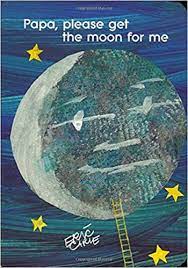
Papa, please get the moon for me is a tale of great importance in my opinion. It shows us that imagination is wonderful, even if it is breaking something seen as impossible. Whoever told me that Father Christmas, the Tooth Fairy and the Easter Bunny weren’t real, or anybody for that matter, that breaks the dreams of a child, deserves a good long look at themselves. Reality and imagination can sit side by side, otherwise Neil Armstrong, or Elon Musk or Celine Dion would not be around. Ability and knowledge need the company of spark and dream – and that’s where imagination grows.
“They are deceptively simple. I admit that. But for me, all my life I try to simplify things. As a child in school, things were very hard for me to understand often, and I developed a knack, I think. I developed a process to simplify things so I would understand them.” – Eric Carle
As I sit typing words and reading about Eric Carle’s history, I recall flicking through glossy covers of his books, and the joy as my face beamed when I discovered a translated copy in Hengli, Dongguan. That beautiful familiar white cover with a caterpillar and a red apple missing a mouthful, all slightly imbalanced, as if to say, and to appeal, that things aren’t always neat and tidy. One day when COVID-19 passes and the world is a little more tidy, I dream to fly to Amherst, Massachusetts to see the Eric Carle Museum of Picture Book Art. That would be as good as finding another Uroballus carlei on a trip to Hong Kong. The Caterpillar Jumping Spider’s Latin name is testament to the reach and pull of a world class picture book writer.
“My father used to take me for walks in the woods. He would peel back the bark of a tree and show me the creatures who lived there. I have very fond memories of these special times with my father and in a way I honor him with my books and my interest in animals and insects.” – Eric Carle
ERIC CARLE June 25th 1929 – May 23rd 2021
Good evening, day, night, morning or afternoon.
Walking from Dongchong village to Nao’an or something like that, I passed a scene of struggle at the roadside. I didn’t call the police. I began to intervene but stopped myself as the majestic Under-sieged victim lifted itself up. It landed on a perch of twigs and then in some high grasses. Beating its wings with all its mighty energy
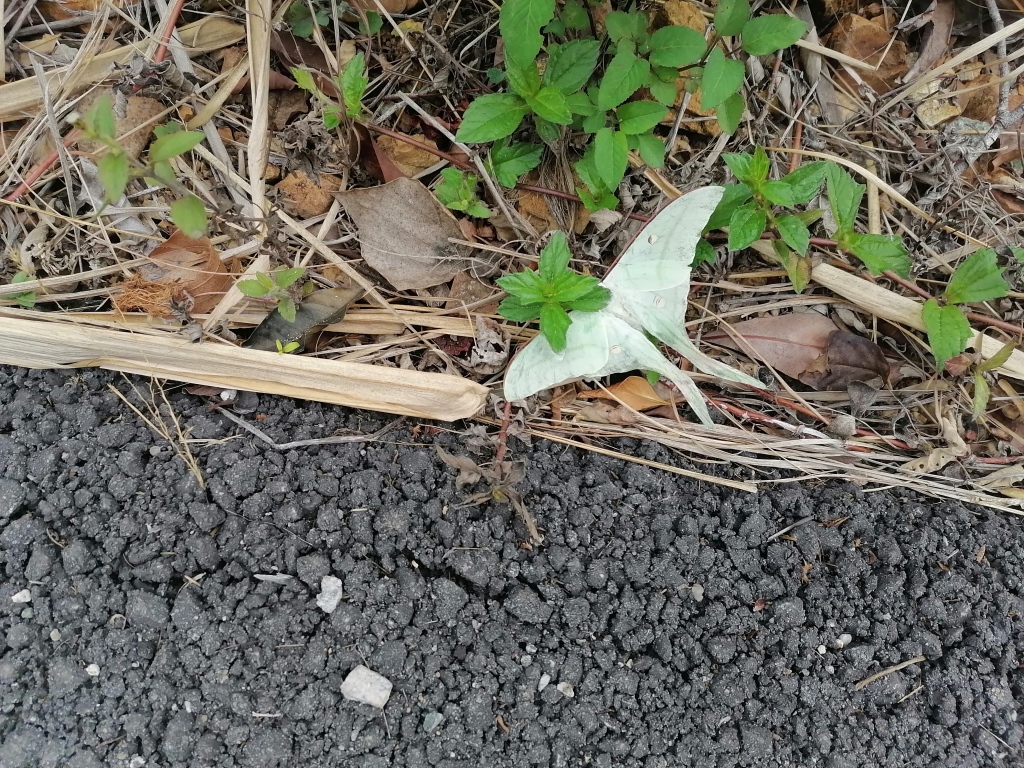
This may seem like a dead butterfly. It was battling to fly away against many ants. Eventually it made a tree but once I looked closer I could see the ants had mortally wounded it. It never seemed to give up trying to fly. Using every part of its fading energy. It twisted. It turned. It pulled itself away. Until the ants entered its body through their gaping infliction of a sound.
The magnificent coloration of its wings, a fluffy white underbody and shiny black to red legs made it look unearthly. The ants didn’t see beauty. They computed it as a meal and opportunity to support their queen and nest. Life is brutal.
Until the next battle.
你好Hello
The voice came from the ground. It was a single loud clunk. Clunk! It sounded like localised thunder. It’s waves shot upwards towards my ears. A metre away in any direction it would be inaudible. Almost imperceptible that a large rock could move and create such a loud static sound. The eagle spotted a kilometre overhead may have spotted it. The black kite perched nearby definitely did.


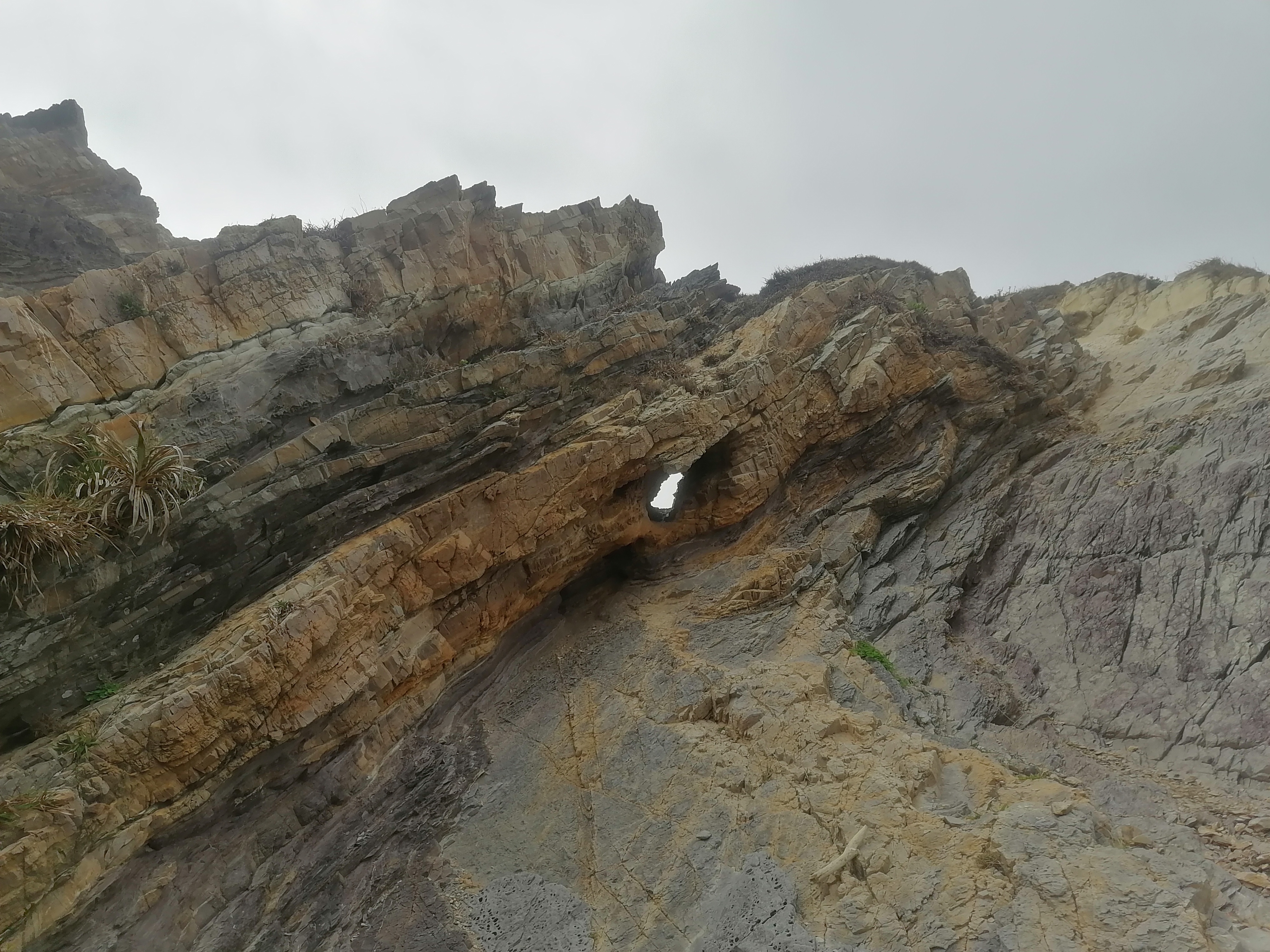

Distracted by a pretty and handsome young couple saying, “Hello tall man”, I slipped on the loose near-horizontal dusted ground and hit my armpit on a pointy-up blunt branch. After all the near-vertical declines and sharp jagged spines of rocks, it made sense to slip on an easy area of walking. The now vanished chains of support weren’t there. Drops of suicidal angles had scattered behind me. Plain and simple became my hazard. Complacency in action. Or inaction in complacency. Anyway they looked a happy and cute couple. They witnessed a size-fifty shoe slide and a tall man wearing a Dal Bhat power 24 hour T-shirt ram a tree branch by armpit. The girl spoke, “Xiaoxin”. That means careful. So, I stumbled past them, 小心 indeed.
Today, marked a walk starting at 07:30 from Dongchong to XiChong and back, on the DongXiChong trail. I started with Dong (east 东) and ended west at Xi (西) but liked it so much I returned for a second helping of Dong. Like you do. This classic coastal pathway was at times stunning, at other times saddening. The mountains meeting the sea formed a terrific seascape. Clear blue seas and grey skies that eventually turned blue made trekking easier than being under baking sun rays all day.
The nearby Pingshan mountain and a view of Sanmen island did little harm to my vivid impressions of DaPeng peninsula. Cliffs and rock scrambling have long been my thing since experiencing it with Grylls Head outdoor adventure centre and Chapel Street Primary School in year 5. Rocks, holes, tiny islands, bridges, stacks, columns and landforms made by sea erosion towering over sea reefs and the omnipresent imposing tides of an angry sea can’t be a bad day out. It certainly perks your ears up for the cry of seabirds and the crash of countless waves. I wondered, as I wandered, how many stories can each shell tell?
Between the coastal villages of Dongchong and XiChong it is mostly undeveloped, save for the XiChong observatory and three small beach shacks. A few steps and chains have been fitted but nature mostly rules the route. There’s litter, at shameless quantities and annoying spray painted signs pointing out numbers for boats, lodges and so on. I’ve heard it compared and listed as one of the top ten routes in China. Perhaps that needs confirming. Also, that’s a worrying statement about the state of coastal routes. Yes, there are beautiful near golden sands at either village and some great pebble beaches between, but surely there’s more?!
The potential for ecotourism is high provided the litter mountain can be contained. If you can’t carry it back, why carry it there? Discarded wrappers, bags, drinks bottles, beach mats, hats, parasols, gazebos, barbecues and more were seen. Almost all was made in China, so no blame can be sent across the South China Sea. The blowing sea breezes and tides can only be responsible for so much. Humans as a disgrace for the rest. The National Geographic Magazine may need to review their write-ups. Although this walking route is not far from Shenzhen bustling centre, it feels remote and relaxing. Just about two hours from Futian via Yantian port!
16km of up, down, sideways, forwards and back ruined my Altra walking trainers. They’ll need replacing. They’re good for rough wear but not for smartness. This highly scenic route is dusty and tough at times. I enjoyed the 8km walk there and around XiChong so much that coming back made sense. Meeting nobody for three hours on my outbound journey was rewarded with meeting many friendly faces on the return journey, even if I was turned away Mary and Joseph-style by two coffee places in XiChong. On returning to Dongchong a kind shopkeeper pointed me to a shop selling Nespresso coffee. Not a bad end to a walk.
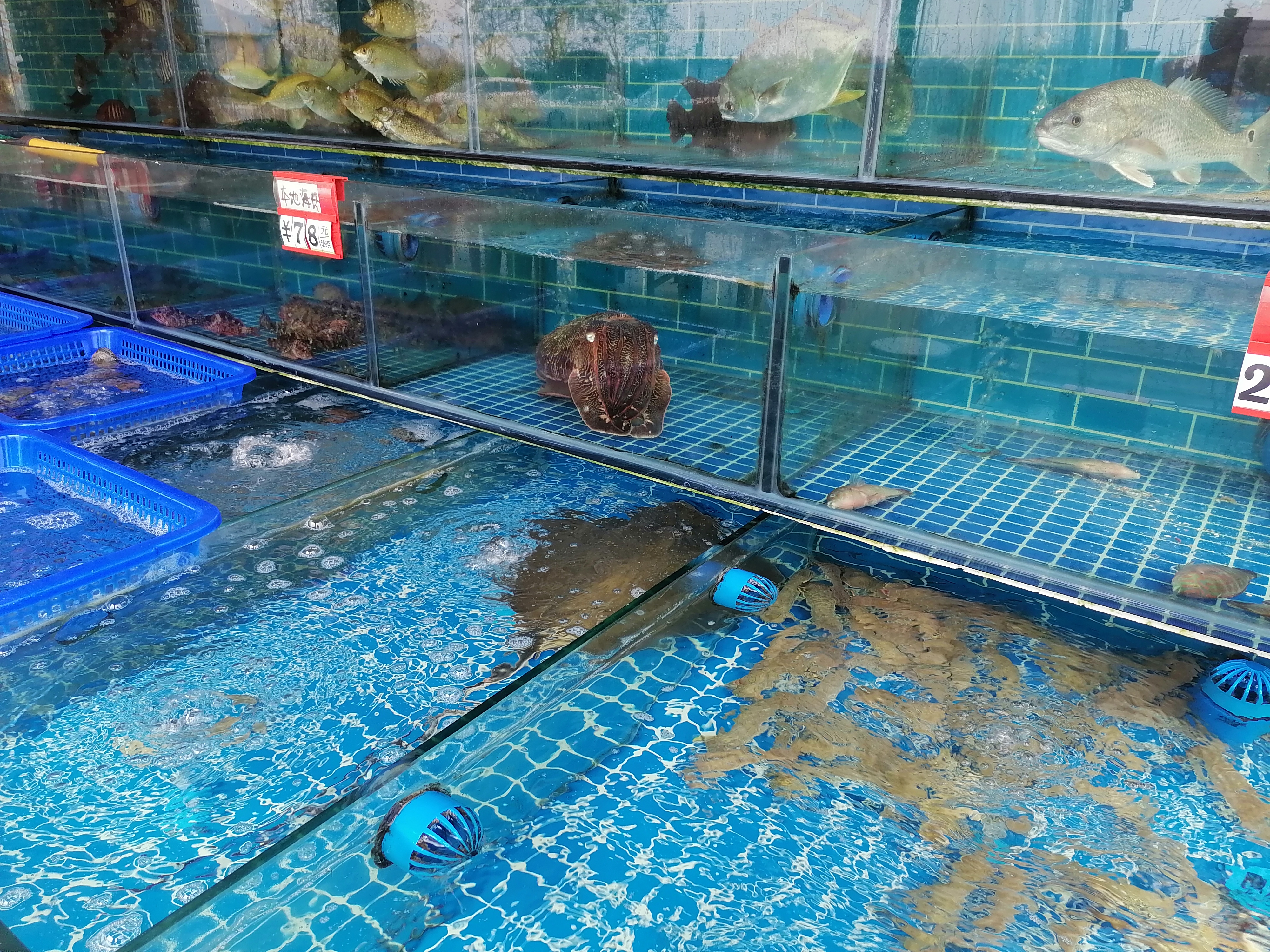
Finishing the day following a video call could only be done one way. Seafood. The local barbecue restaurant was perfect. There’s a few places to choose from. Most feature the animal kingdom, well the aquatic part, anyway. Reflecting on a day well spent, I thanked the trekking gods that I didn’t encounter whatever or whoever left behind all the crap that local village volunteers were bagging up.
再寄 goodbye
Good evening.
The sequel to yesterday’s post involves the sudden deaths of five winged attackers. Slain at my hand on entering the apartment. As I squeezed through my open door, in a heartbeat, and closed quicker still, these terrors followed me in. The ones spotted are gone. At least one more remains.
Beware the lone gun. They blend in. They lurk in shadows. Mosquitoes aren’t like you and I. They’re equally not all bad. Sorry to say that.
Mother mosquito is doing a good deed. She’s genetically-programmed to hunt you and I down. We’re targets stuffed full of proteins and nutrients that give her a child-bearing body. Our amino acids are like the prenatal supplement human beings buy at a pharmacy. They’re good for eggs. Daddy mosquito is busy eating fruit and watching the football.
Whilst his mouth parts are shoved into juicy fruits, she’s probing you and I with her elongated snout. Her segmented body is often so light that we seldom notice the deed until the girl has left. Her wings rarely touch their target. She uses organs called halteres to gather intelligence before dipping in on her target. The original bouncing bomb over a dam. And they have separately formed compound eyes which may explain why swatting them can often prove difficult. Olfactory systems are fine tuned to smelling our perspiration or nonanal, also called nonanaldehyde, pelargonaldehyde or Aldehyde C-9. By the time you read them, chances are you were bitten.
For the girly mosquitoes, they start as eggs (thousands clutched together like a raft of doom), turn to larva then a pupa before becoming fully grown irritations of adults. Their male counterparts do the same steps but don’t directly irritate by biting people. From floating on water, they hatch into algae feeding juveniles before turning into proboscis hammering adults. Some live up to a week. Some species can live for several months. Splattered specimens don’t live as long. The adults breed and lay eggs in cupped leaves, ponds, lakes, disused waste containing water, cracks with water, and all shape and form of water containing objects or places. Just when you thought it was safe to pour out the water…
Mosquitoes are actually about 112 different genera. That makes up several thousand species. Not all feed on man (or woman, or child, or LGBTQ+). Other arthropods are on the menu. They’re on most corners of the Earth, provided a meal ticket is available, invited or not. It seems at times like every species is having a crack at me, and thankfully they’re not.
They’ve got bad reputation because of their irritating bites, and other small matters like malaria, yellow fever, Chikungunya, Dengue fever and so on. The list is longer than the average serial killer’s whoopsy points. They’re adapted to their watery breeding grounds and that’s where a vector can bring a long a nasty friend. The circle of life in inglorious action.
Transmission of disease kills. Pangolins and bats can take a deep breath, knowing they’ve possibly spread less harm to the COVER-19 world than an ill-timed Celine Dion world tour or mosquitoes. In fact, it’s said that of over half of the people that walked the Earth, mosquitoes carried the vector that helped caused their demise.* They’re the UPS of death. Much like, as the WHO are indicating, perhaps COVID-19 started life from a delivery system. Or perhaps mosquitoes are not responsible for that many deaths?**
Tonight’s ideal human menu: a starter of O type blood, with a side of human prone to abundant skin bacteria. For the main course, a heavy breathing type (to test that legendary mosquito detection skillset), alongside high body heat release. Dessert will comprise the blood of a pregnant woman. The ideal menu will then be inherited as a genetically-controlled component, meaning that mummy mosquitoes daughter will love your taste too!**** Our crepuscular (or otherwise) feeders don’t like to be disturbed in the day, however the ferocious Asian Tiger Mosquito hunts during daylight. And its spread from Southeast Asia to the globe has been rapid. Thanks to international travel and freight, it finds itself feeding overseas. Its distinct striped appearance is best noticed as you squish its central nervous system outwards.
Many cultures say mosquitoes evolved from the ashes of giants and their mortal remains being incinerated. Punegusse may well be the cause or that if a 79-million year old piece of Canadian amber containing Paleoculicis minutus*** would be a good evolutionary story. Whatever was stomping around when old P. minutus was buzzing about, I hope it was equally as bugged as I am by one lone wolf fly zipping around my apartment right now.
Did you know that before Walt Disney even dreamed of Mickey Mouse, Windsor McCay animated the mosquito in 1912? How a Mosquito Operates was state of the art for? its time. An animation about a man being tormented by mosquitoes. Almost a hundred and ten years have passed. Who can’t relate?
Citations:
*Timothy C. Winegard (31 Mar 2021). The Mosquito: A Human History of Our Deadliest Predator. Text Publishing. p. 2. ISBN TBC
**“More or Less – Have Mosquitoes Killed Half the World? – BBC Sounds”. http://www.bbc.co.uk. Retrieved 2021-03-31.
***G. O. Poinar; et al. (2000). “Paleoculicis minutus (Diptera: Culicidae) n. gen., n. sp., from Cretaceous Canadian amber with a summary of described fossil mosquitoes” (PDF). Acta Geologica Hispanica. 35: 119–128. Archived from the original (PDF) on 2013-10-29. Retrieved tonight.
****Fernández-Grandon GM, Gezan SA, Armour JA, Pickett JA, Logan JG (22 April 2015). “Heritability of attractiveness to mosquitoes”. PLOS ONE. 10 (4): e0122716. Bibcode:2015PLoSO..1022716F. doi:10.1371/journal.pone.0122716. PMC4406498. PMID25901606.
Wasted energy just fizzled away. Wasted thoughts upped, up and away. Gone. Entropy, all said and done? Faded light in the thick darkness, a laser pen without power. No battery cell to zap outwards. Protons and neutrons inactive.
Plastic shreds, humanity on meds, ducks strangled by packaging. Gone. Waste management, and no fun? Carrier bags drifting in murky waters, a container without a rubbish bin. No recycling scheme to expand areas. Wrappers and sheaths defective.
Rubber tyres, telephone wires, headaches caused by noise. Gone. Bikes of thunder, and not one gun? Airplanes thunder overhead in shrouded skies, a siren without an emergency call. No laws to control the sounds. Banging fireworks completely reactive.
Grimy air, murky vision, stuffy noses full of dust. Gone. Smells of flowers, not by the sun? Machines clatter earth on stripped land, skies fill with ashes. No rule visited this land. This is all productive.
Do you remember trees?
What happened to the bees?
Rainbows and clouds vanished. Elephants and rhinos banished. Trees and grass diminished. Lakes and rivers finished.
Do you recall the smells of spring?
When did the birds last sing?
Dust filled the sky with pain. To see the horizon is a strain. No animals left with a mane. People struggling to stay sane.
How often did it snow back then?
Seasons. When?
The Human race. Who’ll be the winner?
How do! / 你好 (nĭ hăo) / Namaste / Welcome!
Before I write any more, firstly, I need to clarify that I hate the idea of animals suffering. Actually, it forms one of the reasons why right now I do not have a pet. If I cannot be certain where I will live within twelve months, how can I look after a cat, dog or hamster? I’ve been lucky enough in my life to be raised around animals. My Dad and Mum gave me Pup, who was with me for about 17 years of my life as man’s best friend, a wonderful dog. There were cats along the way, Basil (think of a detective that was a rodent), Sparky and Tigger (original, right?). I had umpteen hamsters: Bright Eyes, Stripe, Gizmo and Gremlin to name but a few. Astrid, my sister, will tell you of her hamster Doris, and how she selected it on the basis that it bit her bigger brother (me) in the pet store. There were mice, bred and rehoused, with responsible intentions. I had fleeting dreams of being a vet – but for a huge dislike of blood. Then, it was time to study a BTEC National Diploma at North Trafford College and eventually study a BSc Behavioural Biology. Since then, my wildlife and animal passion has evolved into a pastime, set of interests and hobbies. The professional world was oversubscribed, underpaid and hard to escape clicks. It wasn’t for me. Instead I find myself softly influencing future generations and making people think twice.
Stumbling into education with transferable skills just meant I swapped elephant dung in the morning for a whole raft of new pooh. I’m in China, their gaff their rules. But I can talk freely about some topical issues. What is a wet market? Well, it’s just a marketplace that sells fish, meats, vegetables, and fruits. The produce is not dry (like fabric or electronics). The goods at wet markets are perishable. Not all wet markets slaughter animals or have a fishmongers. Across the Indian subcontinent (e.g. Thailand), China, Japan, Korea and the island countries northwest of Australia, wet markets can be found and are a common feature of daily life. Foods can be fresh, cheaper than supermarkets, and going to these markets themselves can be a huge part of your social life. It is tantamount to culture and traditions for many people. To close many wet markets may be seen as xenophobic and cause more problems. But, will these same wet markets yield the next outbreak?
Wang Mengyun’s video of a bat being eaten in Palau has become infamous. It is disgusting in my opinion. What adds further disgust is that RT and the Daily Mail, amongst many, posted this via news outlets and social media claiming it was from Wuhan. I was even sent it on the Chinese app Wechat. I’m not justifying or defending her, or any other fools eating weird crap. Data and images can easily fit any story, without, erm, actual information. Of course, if China is involved, then there’s always an element of menace and worry from a social point of view. What exactly are they up to over there?
The wet market here hasn’t reopened (and many will never reopen, as many are rumpured as marked for demolition, to be replaced by more sanitized versions) which is great. I’m actually excited for when it does because they have limited the list of edible species right down. You wouldn’t believe the list before. There was no list. It could have been likened to taking a walk in a zoo. Except, that zoo was closer to The Green Mile, and all the inmates were destined for the grimmest of chops. Owls, giant salamanders and frogs may not appear on the menu in Beijing, but across this large nation of China, there are huge differences in diets. Here in Guangdong, it is said that the Cantonese eat everything with four legs, excluding chairs and desks.
Afterall the list isn’t far off what is approved as meat in the U.K. The most exotic things are to be found all over Britain such as ostrich, deer, reindeer, alpaca etc. Sadly, the list still includes fur species: mink, foxes and raccoons. BUT activism and conservation are growing here. Thoughts are changing. Many influential and middle-class people really believe that bigger changes are coming. Conservation and animal welfare are some of the few things people can protest here. The WHO advised China to “sell safe food with better hygiene”. That seems to be triggering a huge revolution in hygiene. There’s revulsion at the rich who can afford palm civet soup, braised bear paws and deep-fried cobra. These rarities are not farmed or caught for everyone. There’s status and face to show off, and keeping up with the Joneses is on the menu. Rebecca Wong explains in her book about the illegal wildlife trade that things are far from simple.
The China Biodiversity Conservation and Green Development Foundation is pushing for an end to meats from wild sources. Many cities such as Shenzhen and several provinces are banning the sale of wild-sourced meats – yet China only has a temporary ban in place (and that excludes use for Traditional Chinese Medicines – T.C.M.). Is the ban effective? Well, The Daily Mail, managed to get images and a journalist into Guilin, Guangxi province and show dogs alongside cats, with T.C.M. posters showing bats. The W.H.O., the U.N.’s Convention on Biological Diversity, have called on China to do more.
China’s Wildlife Protection Law to permanently make catching and eating wildlife as a food into a criminal law will follow. The decision’s first real steps had been made on February 24th 2020. It is expected the list of 54 wild species bred on farms will be further reduced. Do people really need to eat hamsters and bird of prey? Do these horrific farms need abolishing? Does the farm license from The State Forestry and Grassland Administration conflict with their interest in wildlife protection? Places like Guangzhou and this province of Guangdong will need to seriously rearrange their eating habits. Chinese news sources, backed and owned by the state, have decried the practice of eating wildlife. One such piece, China Daily, went further than most with an English opinion piece by author Wu Yong. He correctly pointed to the Institute of Virology of the Chinese Academy of Sciences (home base: Wuhan) and their publications warning of the next big outbreak, following SARS in 2012. There are voices from within China banging a drum to the same beat: stop eating wildlife (50% of people surveyed in 2014 said wild animals should not be eaten). And should the laws come how vague will they be? How will provinces, cities and local areas enforce the laws? Who will steady the balance books of those who need the income?
It is easy to say that wild animals carry viruses, and should they not be eaten by people, then there is little to no chance of these zoonotic viruses affecting human lives. If we do, then the viruses are with us. But, how many viruses start on farms from long-term domestic animals? Think Pandemic H1N1/09 virus and its outbreak from Mexico/U.S.A. in 2009 that killed about 151,700-575,400 people globally, according to the CDC. The problem is that for some their eyes are bigger than their bellies. They don’t want you and I, or others telling them what is right or wrong. For some status and entitlement is paramount. Why can a rich U.S. hunter go and shoot a lion in Africa, when a poor villager can’t catch pangolin in Vietnam to support their family? Will bans work? Will the trade go from loosely regulated to completely underground shady dealings? “Psst, wanna but a civet?” What is a civet anyway? I imagine many having seen a pangolin too. Look them both up. They’re wonderful little critters. Just don’t grill them!
China has endured food safety scandals, unusual additives being included in food, a distrust of food regulation, corruption and countless public health appeals and campaigns seeking to improve standards. If you live here long enough, you’ll know having diarrhea tablets to be most useful. Food poisoning happens and at public ad even private restaurants, finding hand soap can be a miracle. Everyone carries hand sanitiser and tissues, but few look forwards to visiting an outside toilet. To get to the modern regulation systems of the U.K. standards, the U.K. under the name of Great Britain and its Empire had many flaws and faults. Many want change but it will take time. Not every country is perfect, some wash their chicken in chlorine, don’t you America? Tradition and odd ingredients need talking about, at least. Without conversation and debate, how can we as people strike a balance between nature and need?
This pandemic is always going to throw up many questions. Should all wet markets adapt and abandon tradition in favour of hygiene and high standards? Yes, for the sake of humanity, surely! Should we be searching for the next big pandemic? Should we be vaccinating our pets and our zoo animals when the cure to COVID-19 arrives? Will the virus replicate and mutate in other domestic animals? Have we ignored the warnings (2017 and so on) for too long? Will wildlife poaching rise in the shadow of little eco-tourism? How many more lies will the internet spread about handwashing?
Keep talking. It’s the only way to progress.
The cover image: chicken anus on a stick. From a Taiwanese takeaway store, in China.
How do! / 你好 (nĭ hăo) / Namaste / Welcome!
So, my trek in Nepal was over. I’d passed through up to 28 ethnic groups of people, notably Thakali, Gurung, Magar, Chhetri, Bhotia and some Tibetans. I’d seen Annapurna II, Manaslu, my favourite haunt of this trek, Pagunda Danda and other great mountains. I’d passed through areas housing maybe just 45,000 or so people in a short distance and across great swathes of area. The river Marshyangdi had been by my side from beginning to the end, and never more than a few kilometres away from my wanderings. I’d tread along a world-renowned trekking destination that needs great care, for peril lurks at every ridge. Remarkable waterfalls, dense forests, and other climatic wonders had lined the sub-tropical, temperate, sub-alpine and alpine bio-climatic zones. These imposing regions offered diversity in both mammal and bird species, and plants that I’ve never seen anywhere else before, and no doubt will never see somewhere else. The barks of musk deer, the swoosh of vultures, the tweets of life from tree to tree, and flashes of Himalayan Langur will stay in my memories.
I’ve met people connected with agriculture, animal husbandry, tourism, the military, conservation, Buddhist monks and other labouring forces. These stirring moments reminded me why I love to visit Nepal. There have been moments when I’ve looked in shame at crumbling mountain sides, ripped open by new roads, and power lines draping over great scenery. The price of a modern world has cut open a blend of people in need of the new age, with as many in fear of what will arrive. Can these ethnic groups survive the new ways in, and the new exposure to the outside world? Will everything change too fast for some to understand? Will education and investment bring new opportunity? Can the high pressure on natural resources be reduced? Will an unequal distribution of tourism wealth and benefits leave some people behind? Poverty is there, but can it seriously be eradicated? Will Chinese hydroelectric dam projects benefit anyone if they have mostly Chinese workforces? Will Indian investment be reduced as Nepal juggles the money of China over India?
With hunting, poaching, pollution, loss of habitat and humans getting ever closer to wildlife, can the Annapurna or Manaslu parks be improved to reduce these problems? Will climate change, flooding and increased tourism add greater strain to the region? I read that 18% of the world’s plant species can be found in the Annapurna Conservation Area. The project there highlights that 58% of Earth’s birds are present. A staggering 33% of Earth’s reptiles have refuge in the region. Amphibians (20%), butterflies (53%), and flowering plants (18%) represent significant proportions of Earth’s species too. There’s much more to Annapurna than snow leopards and possible yeti sightings…
To have walked through the largest protected park of Nepal was a privilege. I sat down to a cold coffee in Pokhara and stroked my sore head. I decided I would fly from Pokhara to Kathmandu. My friend Jodie was to visit Kathmandu a day or so later. I decided the long arduous coach journey was too much for me. Besides I like to fly and the price wasn’t too bad (732RMB) – and bookable via my Wechat money and Trip.com application. After a few wanders from the now ghostly quiet Pokhara, I was ready to fly.
Before doing so I took in the sights of Pokhara, a bat cave and the Gurkha Memorial Trust. Since joining the British Army in 1815, after showing valour in the battlefield against the British, the Gurkhas have enjoyed great connection with Britain and India. The museum itself was alike almost every museum and trust collection, with cabinets of medals, regalia and factsheets. Photos of hundreds of faces, stories and campaign information could be found throughout the large building. I was welcomed by two former Gurkha soldiers in full uniform and shown to the ticket desk, then set free to enjoy the words of regimental life, the sounds and read about Victoria Cross winners. A history sheet was handed to me and I spent a good couple of hours perusing the displays. I had passed the museum by chance, and prior to walking to Bat Cave in the direction of Mahendra Cave not even know there to be such a museum. I did not expect to be so detailed and well-constructed. The passion of many had created their space to inform, educate and celebrate. Here I learned the name Gurkha comes from the hill of Gorkha, and not from a specific race of people. Better to die than be a coward, is the Gurkha motto. Their history attains to that. Long may they have the welfare and care of those who respect them.
Now, Bat Cave is called that on every sign. I could see signs for the religious Mahendra Cave frequently. Those signs had Nepali Sanskrit and English on. The Bat Cave just had English. Bruce Wayne had no chance of hiding a Batmobile and Batwing in there. Green foothills surround the cave, but before you get there, a gate, with a kind of turnstile not out of place at a 1980’s football ground and a pay booth await. Here they try talking you into hiring a guide. I resisted that. I wanted tranquillity. He handed me a large lamp. I handed that back and shown him my simpler headtorch set. In I went. After a few steep steps, a dip and a ducked head I was in the main cavern. Alongside me were around 70-100,000 horseshoe bats. I dipped my torch and gazed on enjoying the cold humid chamber underground. The floor is slippery, the air is whiffy (it is a home to nature, after all), and my good footwear helped me a great deal. I reminded one small group to stay quiet, and they respected my wishes – and that of the bloody great big sign saying to be silent. There was a tiny passage for an exit, but I doubled back without trouble. I wanted to avoid a bump on the head.
After the 20km round-trip walk, I headed back to Obey Guest House. The family were really very nice. Sushil’s place had been recommended to Srirang and I by Livia on our first brief stop in Pokhara. Each time I’d stayed, I ended up the same room: up the stairs, first right turn, first room. The big clean room had a double bed, coffee table, hat stand, two small chairs, a bathroom with a steaming hot shower and a sink for a proper scrub down. There was a tiny balcony and the door would open to allow me to put my stinking walking boots outside. On the top floor, there are several levels to appreciate the panoramic views and a place to sit with a garden table. The family were really welcoming, warm and friendly. They check on you and make you feel at home. Sushil had washed some of my laundry before the trek, and it was waiting in a bag for me, alongside some trainers I’d left behind. The lodge is a tall pink building up a road from Lakeside. It’s easy to find. There’s Wi-Fi and the family pointed us to a simple and tasty breakfast place at the top of the road. Every morning I awoke to beautiful bird call, and at night I enjoyed peaceful ambience. I had several good sleeps there. Sushil pointed us to the nearby TIMS office, other amenities and gave great advice throughout. If you want to stay somewhere peaceful without hassle and worry, then obey me and look up Obey Guest House.
I do have to apologise to Obey Guest House because I stupidly left my smelly walking boots on the balcony when I left… I hope that they turned them into a plant pot! They probably couldn’t be repaired, and they certainly won’t be now! Sorry Sushil and family!
So, with the wheels lifting off the Pokhara runway, flight YT676, operated by Yeti Airlines departed, I assume. I’d been shuffled onto an earlier departure that eventually departed later. Not to worry. It was a good flight. The flight comfortably descended into the Kathmandu valley and once again I was in the cradle of rapid urbanisation. Here I enjoyed more days at Northfield Café and hotel, met a good man to embroider my travelling shirt, and enjoyed a haircut. With room in my bag, eight Lee Child novels filled my bag and that was that. I was ready to go. Goodbye Nepal. Thanks to Srirang and Livia for great company. Thank you to all of those people I met. See you again.
Almost 54 days later, I am writing this piece. I should have been in Hong Kong and heading over to Dongguan, China on the 15th of April. Here, I am in Dongguan, preparing to end my time in quarantine. If my PCR (Polymerase Chain Reaction) test comes back as negative tomorrow, I will be allowed to go to Dongguan’s Changping town, to fill in more forms and scan a QR code to show that I am virus-free. I’ve penned a letter to the management and local government officials here. Maria and Waits translated it for me. It’s as per below:
给相关人士 To whom it may concern.
我从心底里感谢你。谢谢你对我的帮助。就像一名优秀的曼城足球运动员一样,我会敞开心扉。我在这里的日子很艰难,但你们更加辛苦。Thank you from the bottom of my heart. Thank you kindly for helping me. Like a good Manchester City football player, I wear my heart on my sleeve. My time here has been tough, but you have been tougher.
当你路过西湖的时候,不管是东莞的这家酒店,还是那片著名的杭州的湖,还是惠州的那座城市,你都一定能够感受到你所做的这一切带给你的荣耀,是你肩负起了这份重任。When you pass West Lake, whether the hotel in Dongguan, the famous lakes of Hangzhou or the city of Huizhou, you’ll be able to think of the pride that you made a difference. You answered the call.
是你让所有人一起团聚;是你给予了爱人、朋友和亲人们一起纵享新时刻的机会;是你,在保护我们,你在照看我们,是你放弃了你们自己的时间,而把精力全部投入到了我们身上。You brought people back together. You gave loved ones, friend and family the chance to enjoy new moments together. You protected us. You looked after us. You gave up your time and gave us all your energy.
你为我打扫卫生,检查我的健康,为我尽心尽力。你让我的肚子饱饱的,并激发了我不知道我能做的锻炼。每当我口渴的时候,你就在那里。You have cleaned up after me, checked my health and waited on hand and foot for me. You have kept my belly full, and inspired exercises I didn’t know I was capable of. Every time I have been thirsty, you have been there.
我是东莞的客人。广东的客人。来中国的客人。你让我很受欢迎。我非常喜欢东莞。这是一座充满希望、想象力和雄心的城市。就像我的家乡曼彻斯特一样,这里也有工业路线,但这里的工业路线也越来越多。I’m a guest in Dongguan. A guest of Guangdong. A guest to China. You’ve made me welcome. I like Dongguan greatly. It is a city of hope, imagination and ambition. Like my hometown of Manchester, it has industrial routes but here too has grown to be so much more.
我们是如此的幸运,生活虽有不便但我们还是在这儿。那些倒下的人、那些逝去的人和那些殉职的人——正是因为他们,我们才能好好地活着。让我们一起为他们默哀片刻吧。We are the lucky ones. We are inconvenienced but we are here. Those who fell, those who died, those who died – it is because of them, we can live well. Let’s observe a moment of silence for them.
Mr John R. Acton
To the NHS staff in the U.K.; and to those health workers, care assistants, doctors, nurses, specialists and all going about in essential jobs right now. I salute you. Keep fighting on. Never give in. You are true heroes. The world needs you. I wish you well. Good luck! This is your hour to shine. Inspire the next generation and those who can and should support you. Look after your neighbours and we’ll find a brighter day. Peace and love!
Sawasdeekhap / Namaste / Welcome!
Before the climb, we’d stopped in Danagyu, at a lodge on the right-hand side. It was busy. A family were playing cards. Kids were running around and one managed to hit both Livia and I with first her walking stick and second a snotty finger. I was fully aware of the coronavirus outbreak by now. It was by now February. Hygiene was on my conscience but this terrible toddler was not sharing my concern. Bogies smeared down my leg. I used soap and water to clean it away. Eventually a teenage girl came over and shuffled the toddler away. We’d already ordered pumpkin soup and momos now. Having seen the soon to be altogether contour lines on the map, our engines for walking needed some much needed fuel. One trekker’s bar wasn’t going to be adequate.
After reaching a waterfall tucked in a tight ravine, Livia went right along the road, and I went left up some steep steps. Srirang was just behind Livia, with his sore leg, yet he soldiered on and never gave in. Tough lad. After only a few steps, I started to see speedy little Himalayan squirrels and the view backwards of the peaks nearby to Manaslu was marvellous. Upwards was very much that. Up, up and away. After some crumbly steps, that could have been made of Lancashire cheese of apple crumble topping, I managed to reach the road, and cross straight over back onto the pathway. Here the green trees folded outwards ever so slightly, to show stacks of natural compost on the forest floor. The air had a damp natural earthy smell and occasional felled logs rotted alongside the trail. The track would mostly rise and do little of a fall. Soon enough the mud and dirt track became covered in frozen snow. Not the fluffy soft and easy to trudge through kind, but the solid mostly with a metre drop inwards should I find the bit unable to tolerate my weight, kind. And it seemed I was in for many steps up, and a few deep into the partially frozen snow. Heave. Heave. Heave.
The snow pretty much didn’t want to convey me and with every drop my boots, and the best part of my legs disappeared. Out came the crampons. Out came the determination. Onwards I went. My imagination enjoyed the peculiar eerie silence. I imagined packs of wolves, snow leopards and bears watching me go by. Not your ideal range of animals to picture you pass by, especially if one of them was very hungry, but here I was in the territory of nature, and damned if I was going to imagine Minecraft or a rock concert.
The pine trees shed patches of snow and melt water dripped all around me. Glorious rays of sunshine broke the canopy and occasionally I caught glimpses of mountain tops here and there. Then, a sudden crashing sound in the trees ahead, had me at full alertness. I froze solid as the iced floor around me. Silence resumed. Then a larger and louder thump and crunch. Something was in the trees ahead. I heard a racket and a commotion. Voices yelled from the canopy to my immediate left. The thuds and thumps were accompanied by a disturbance in the snow maybe a few hundred metres away. Then I spotted a monkey, Himalayan langur, springing up and down in the snow, swiftly from tree to tree across a small clearing. They didn’t seem too perturbed by the snow, but didn’t hang around either way. I tried to shoot them. My camera wasn’t quick enough though.
Throughout this journey, I had seen many mammals. These included Himalayan langurs, Assam macaques, Rhesus macaques, Irrawaddy squirrels, orange-bellied Himalayan squirrels, Himalayan striped squirrels, voles, Himalayan field mice, Himalayan pika, shrews, a variety of bats, and some wild boar, I’d never seen many animals in the snow. It was a privilege to enjoy the monkeys and hear them move over the forest. It was a welcome break from the constant in and out walking motions of the snow. I also had chance to reflect about the fall onto my walking stick which had gave the stick a slight bend, or three.
After crossing many streams carefully, over tiny little snow-covered bridges, and occasionally playing find the rock over the odd crossing point, I reached a stretched out chain bridge. Snowfall and heavy damage had ripped one end of the supports from its foundations. The two guard rails fanned out, practically useless. It wasn’t quite and Indiana Jones movie, but it looked far more precarious than comfort. The river flow was about five metres wide, pummeling steeply down to the River Marsyangdi many metres below in altiiude. I decided to chance my luck at a bridge further upstream. After 200 metres, I realised that this was the only bridge. I hadn’t seen one downstream either. Whilst I could hear the river nearby, I couldn’t see it and no alternative route evident. The flayed and flawed bridge was to be my point of movement. A way like no other.
So, off came the crampons, and then I positioned my rucksack tighter to my back. I stowed my walking sticks. I pulled out my thin winter gloves with extra grips (thanks Black Diamond) and I stepped through the first pocket of snow on the bridge. I tested the bridge for movement. First with a little weight and then applying all slowly, readied to dive into the snow to the side of the bridge. Then, I did a kind of half-hop. The bridge was surprisingly sturdy – a real testament to the Gurkha builders who had provided so many bridges across the country. From that, I leant and tested the sideways cable to my left, uphill and in appearance the least damage of the handrails. I turned square onto it. I placed my left hand over my right hand and never left any motion rightwards without one very firm hand on the rail. By the time I’d reached the centre of the bridge, the rail tilted upwards, almost as it should have been and all the snow had melted in the sunlight. I gently walked up to the other side and looked backwards. Stepping off the bridge was a relief. Then I peered left at the small landslips dotted along the river bank.

The fallen ground and occasional uprooted tree didn’t prove too much of a challenge. The trail banked left and into an open field, which led onto a rock-cobbled road. Each rock was jagged and unwelcoming. It had a Lord of The Rings feel to it. Wild, and otherworldly. Onwards, I plugged until reaching the Hotel Royal Garden, where I met Livia aftera few minutes. Here, I also met Shadow. Shadow wasn’t his name but for that day he would be my little shadow and follow us throughout the village of Timang. After a great lunch, Srirang joined us, and we checked in for the night, just 100 metres down the road. Ahead of us the weather looked bleak and unsettled. So, a Sherpa family welcomed us, and we dropped our bags into a room each. The Hotel Manaslu View Point had a view of Manalsu in the distance and the panoramic view in all directions was a clear sign that we were now in the Himalayas, proper. Timang (2630m) was about 400 metres higher than Danagyu (2200m). The air temperature was much more-icy here. Clouds floated over the mountains behind us, disguising hidden peaks and over the River Marsyangdi to the opposite side, occasional matchstick-looking pine trees, empty of leaves and needles, stood like wooden stakes in a cemetery. There looked to have been a nuclear blast over the valley. Even the ground appeared clear of life.
This village was both sinister and beautiful. Firstly, the crows, those often billed in horror movie birds, were everywhere. They made themselves known with sharp piercing cries and occasionally softer sounds. The Kāga (काग Nepali for crow or craven) here were not Carrion crows. These were bigger ravens, Corvus corax tibetanus, with long grey neck feathers. Light on their feathers gave a beautiful purple-blue iridescence. Amongst the pairs of ravens, Carrion crows moved and foraging by jackdaws, and other smaller birds like sparrows could be seen through the village. Now, the sinister, I described wasn’t too much about the crows…
One single storey building with a shop front on the right of the road gave me new heebie-jeebies. Outside the front a man swapped tyres on a jeep. At the side of this passengers from the jeep waited patiently. At the rear of the building in the garden, an animal pelt hung from a washing line. From a distance I couldn’t work out if it was red panda, a dog or something of similar size. I know that the rules in Nepal are extremely strict regarding hunting, but I could not for the life of me understand what it was. It was, in all probability, a goat – and certainly unwelcoming. And, not far from that pelt on the washing line, a dead crow was tied up by its neck, flying in the wind like a grim version of a child’s kite. I expected haunted hillbilly music and a narrative from an Alfred Hitchcock movie.
After a great dal baht, in front of a warm fireplace, we all departed for bed. The matchstick looking cluster of spiders in the toilets gave an appearance of buffalo pubic hair [you know what I mean!] – and they seemed to detect the cold too, nestling together like brush hair in the corners of the long cold toilet room.
After a good night’s sleep, a great omelette and some defrosted ice-water, we three departed, bidding our farewell to Shadow the dog and a variety of goat kids in the nursery nearby. The road headed out, skirting around the brow of the hills beside us, never quite leaving the river below. At Tanchok village it doubled back inwards, crossing a frozen stream before lurching back into the river valley below. It slid gently up to the crossroads at Koto before nestling its way into Chame (2700m), complete with signs for yet more hot springs. Monkeys had been sighted in the forest’s brow by the village of Tanchok, by Livia and I stood watching them for some time. Here the valley started to tighten up and appear much steeper than previous days.
Chame is a colourful place, but in February, the sun sets early, shrouded by mountainous ridges to the west. Here a dozen municipal buildings and hospitals can be found. Derelict military barracks stand to the village’s north. It is a town of about 1200 people. In winter it is quiet with many people heading to Kathmandu and Pokhara. There are signs of the April 2015 earthquake having struck here. There were also some very good small supply shops and chances to get some much needed fruit into our diet. We checked into the cosy New Tibet Hotel and Restaurant sandwiched between a brittle looking cliff face and the river’s east bank. We then had a wander around the village which seemed to be many scattered lodges along a kilometre of two. An upper level village to the west looked more modern and functional, but less touristic. There were the usual array of schools and public facilities with prayer flags visible all across the high points.
After the walk Livia tucked into her billionth bowl of rice pudding, and probably ordered one for the morning too. Seeing Livia eat rice pudding in a wolf/koala/bear hat was quite a frequent sight on the journey. I often had scrambled eggs, porridge and buckwheat bread of chapatti. Always with a milky coffee or tea. Several bank machines were available in the village but there was no internet and sporadic power cuts for the two nights that we stayed. There was even a roadblock on alert for any walkers from China! By now fear and panic about COVID-19 had spread up the road. I kept news that I had left China over two weeks before arriving there to myself. I’d heard Chame described as an often crowded place. We met only two other trekkers, both French and both walking solo (with a guide).
Our lodge was less than two minutes of walking from a lovely spot. The hot springs doubled up as an open air launderette. Livia and I washed our clothing in the warm flow of water, as local soldiers soaked up the minerals in the neighbouring swimming pool. The spring itself was a dull green bubbling hole with pipes jutting from it. Nothing exciting to the naked eye. The miracle of life and fresh water was surrounded by man-made concrete and exploitation. Still, it was a good place to wash my underpants. Bloody warm too. Later I scattered my clothes on the balcony and added some socks to a warm chimney to speed dry them in the fading sunshine. Night was soon rolling in, complete with starry skies and ice-inducing temperatures. To be continued…
On the I’d booked a flight between Bangkok Don Mueang International Airport and Shenzhen for April the 1st. April Fool’s Day. Appropriately Thai Air Asia cancelled it yesterday. As I had used Trip.com to book it, I have to use Trip’s customer services. Flight FD596 is no more. On top of that, my visa expires here on April the 14th. I have been told that to stay here, I need to have a letter from the UK Embassy to say that travel to my country of residence is not possible. The UK Embassy won’t give such a letter for British citizens traveling to China. Thailand’s Immigration won’t allow me to stay because I can currently fly to the U.K. There are flights to Guangzhou at drastically hyper-inflated prices but even they could be pulled. Trip.com’s phone numbers ring a little and then hang up, all three of them! Their email reply reads as follows:
I get that we’re in a global catastrophe and the world is going mad buying excessive amount of bog rolls and shutting borders, but when you haven’t got much cash, or hope to get around, and your head feels like it is going to explode if it doesn’t release the bubbling rage and worry inside. I even paid for new cycle lights to allow me to break out of my body, and fly away, like a bat out of hell… or at least peddle fast from stray dogs and monkeys now coming out from the temples and sanctuaries in search of food. Next I expect to see chameleons on sun loungers, well maybe not see them, but at least know they’re there when the fly numbers drop down. That’d be more amazing because as I am aware, there aren’t chameleons in Thailand, but with current world problems, maybe they’ll bounce back like other wildlife – especially now people are talking more about wildlife trade ending. Or, will this COVID-19 world hide a debate about climate change?
Still, worries aside, it could be worse. It could be much, much worse. I worry for others. I’ll survive and money I haven’t got will add to other money that I never had. You can’t repossess from a hobo, right? Especially one trapped in Thailand… trapped, with just two bottles of Vimto and two frozen portions of black pudding. Nope, it ain’t all that bad! Stay strong. Survive. Beyonce and her mates told you to.
 AGAINST THE FLOW OF TRAFFIC - ACTON28.BLOG