Plastic or Fantastic #1 Jumping Ahead

你好/ Ní hǎo / Nín hǎo / Hello / How do / S’mae / Namaste

Plastic fans or overseas fantastic fans?

When it first happened, we were a little jealous. No. In fact, we were bitterly jealous. As the likes of Liverpool, Manchester Utd and Arsenal gathered overseas fans, City had no hope in hell of travelling beyond Greater Manchester. Together with other so called big 4 club Chelsea, they often dominated the pathways into European football’s top competition and commercial cash card. Terms likes ‘plastic fans’ or phrases based on the geography of where a fan came from, ‘Kent reds’, ‘Singapore reds’, or ‘Here’s another ferry from Ireland’ could be heard. Ignorant fans labelled the new followers as glory seeking lightweight supporters in a heartbeat. I know, because I used to say it and still do from time to time.

Before the Premier League was formed, history served Man Utd well, they’d won it in ’68 – as the first English club to do so. Liverpool did better beating the rest of the pack in 1977, 1978, 1981, and 1984. Nottingham Forest were a founder club of the Premier League – and have the European Cup in 1979 and 1980. Of the 22 founder clubs that season, only 12 are in the 2019/20 season of the Premier League. Like Nottingham, the other 9 clubs have had a topsy-turvy recent history. Where are Wimbledon?

The Champions League followed the European Cup. For the former, Aston Villa won it in my birth year. However, only Chelsea, Man Utd (twice) and Liverpool (twice) have managed to win it in 25 years of the Premier League. Man Utd received global acclaim on how they rebuilt a club following the Munich air disaster and capitalised on a social liberation and liberalisation in the 1960s. They cashed in on the surrounding pop culture with “Fifth Beatle” George Best and so on. Football fans and even the neutral fan could join in or follow a team beyond their own turf. They wouldn’t be begrudged their second club from time to time. It was the norm.

Real Madrid and Barcelona have appeared in the Champions League since cavemen bashed clubs over dodos. They’re almost ever presents having qualified for seemingly every edition. Barca have managed 15 straight seasons of last-16 knock-out games. Their 16 domestic league titles since 1990 has featured just four finishing standing outside La Liga’s top three. Since 2008-09 they have finished twice, three times. They won the other seasons. Real Madrid last finished 4th in La Liga’s 2003-04 season and also clinched a Champions League Place. In 1996-97 they didn’t join the Champions League –  having qualified in the edition of the season before. The Champions League rebrand of the top European Cup started in 1992, at about the same time as the Premier League in England. The global branding of Spanish football has been clear – and one rarely unbroken for Real and Barca. They bucked the trend in terms of fans following top clubs from Asia. Neither team sported red, like the flags of Singapore, China or Hong Kong’s sponsors Sharp name. But, their following was few and far between until Ronaldo and Messi arrived. Then, they banked on superstars.

In the years leading up to the Premier League, floating on the stock exchange wasn’t a bad move. Man Utd did that. City just floated – with no direction. As branding clung to fashionable stars like Beckham and Giggs, football entered a new era for City too. Financial ruin caused by off the field mismanagement and on the field turmoil. Freefall entered the blue half of Manchester with little sign of abating as one club would march to a historic treble (that people seldom hear about these days). Even City signing Chinese player Sun Jihai in the early 2000s did little to stem the flow of international fanbases looking from the east towards somewhere west of Manchester.

Liverpool have won zero of the 27 Premier League titles on offer yet have fared well in Europe during the Champions League era. They like Man Utd, have been in Europe, to the FIFA World Club Championships and European Super Cups. The International Champions Cup has featured them plenty. Exposure beyond the Pennines, Irish Sea and the Lancashire boundary has been kind to them. Man Utd have been described as a global brand – long before City lifted a Premier League trophy. Overseas tours followed the money as City spewed out close to home European numbers like Hamburg’s HSV and Oldham Atheltic away. Even Stockport County and Sheffield Utd had a crack at China – although West Brom came first, long before the Eastlands was a term.

Manchester City’s first foray into the Champions League came from a third-placed league finish in 2010/11. City have featured 8 times in UEFA’s top competition since reaching the semi-final twice, hardly enough to make a dedicated Wikipedia page on City in the Champions League. Higher league places mean higher Premier League revenue and City gave won half of the Premier League titles on offer since their first on 2011/12. Since the takeover in 2008 they’ve shot from ‘marketable lovable team seeks caring partner’ to ‘dominatrix of the year’. Back to back titles, especially considering the strengthening and determination to dethrone City’s centurion of point getters has justified some clever marketing deals.

City and Utd having a derby in Beijing could have been a big thing. It was a farce and never happened. USA had that first privilege at a later preseason. As thousands of red shirts outside the Bird’s Nest Stadium cried, shouted and shown general anger, pockets and handfuls of City fans skipped around Beijing bars, experiencing the City fan culture. A few days later, similar happiness happened in Shenzhen and the culture of Manchester – and football spewed outwardly. Shenzhen Blues and Hong Kong Blues were soon joined by 11 more groups – recognised as official supporters clubs by Manchester City. The OSC formed in 1949 and now has around 250 clubs globally, with around 20,000 registered members. It provides a direct and sometimes challenging link to Manchester City. It is officially recognised and backed by the club but remains independent. Kevin Parker has been voted as General Secretary for 20 or so years running now. He does wonders for the club in a demanding voluntary role. Alan Potter, Howard Burr, Mike Young, Christine Wardle, Karen McCormack are names that help run this ever-expanding organisation, but I don’t know their exact roles. They get mentions in matchday programmes and online from time to time but maintain quite a modest presence.

The annual membership for Manchester City’s Official Supporters Club goes far. A percentage goes to City in the Community. Another amount is made available for charitable applications by the Official Supporters Club membership. Shenzhen Blues donated around £500 to a children’s charity, A Heart For China. The membership gives a card, often a gift and the chance to apply for tickets by each branch. There are many other benefits and event support is one. One thing that as a supporter travelling from nation to nation, or town to village in the UK, means that knowing where your nearest OSC is, you can say hello. So, if you’re in Addis Ababa or Newton Heath, you’ll not be far from one. When I first moved to Dongguan my closest branch was Hong Kong Blues. I met up with that lovely branch until Shenzhen Blues became mainland China’s first branch. From then, I have met so many mainland fans and expats here on work, or just visiting and that is exactly what an OSC should be for: to bring people together.

The Premier League Asia Trophy featured in Nanjing and Shanghai and we’re not really here… we never thought we’d see this many blue shirts or this level of enthusiasm overseas. To continue this writing, I will explain why fans of English clubs overseas are fantastic – and not just plastic unlike the Leeds fan who shouted, “Our fans are from Leeds, your fans are Chinese” at someone not even born in Asia… in Perth this week. Man Utd’s 4-0 win over their bitter Pennine rivals shouldn’t have come into his thinking. Anyone the video us out there.

To be continued.

再见/ Zài jiàn / Bài bài / Ta’ra / Goodbye / Hwyl Fawr / Dhanyabaad / Alavidā

Next stop: Nanjing

你好/ Ní hǎo / Nín hǎo / Hello / How do / S’mae / Namaste,

34 years ago, Richard Skinner mentioned, “It’s 12 noon in London, 7am in Philadelphia. And around the world it’s time for Live Aid!” That’s the legendary concert that plays ever so well time and time again. But, whilst Twitter is trending, did the concert have an actual reason for showing? Seems to be of little note in all the flashbacks across the interweb. Whatever the problem was, it must have been fixed.


“All we hear is 👏Radio Ga Ga 👏…”


CITY OF SHANGHAI

SHANGHAI PIN BADGE IDEA 1My checklist from 2016, of things I must do in China has been reduced. I ticked off visiting Qingdao, flying a kite, and in five days, Shanghai, a city my grandfather visited will be marked off. I triefd Chinese art, caligraphy and kung fu. All were insults to their heritage. At least I tried once or twice.

Changning, Baoshan and Pudong districts of Shanghai once had Marks & Spencers. The city has a French concession region and the Bund is world famous. So, will I be in China or a European city? I’ve been reading up on things to do, places to see etc. Aside from City’s game versus Newcastle Utd or Wolves, I’ll get cultured in five days when I visit Shanghai.

#1 Shanghai Museum #2 China Art Museum (Line 8) #3 M50 for urban art & Jade Temple (玉佛寺/Line 13, Jiangning Road) #4 Xuhui Riverside Park wander. #5 Jewish Refugees Museum – and the ghetto in Hongkou #6 YuYuan Park #7 Sculpture Park #8 Wusongkou Paotaiwan (Line 3: Shuichen Road) #9 The 1933 Old Millfun #10 Zhujiajiao water village (Pine 17) #11 Huangpu’s Garden Bridge #12 Chuansha park #13 复兴公园 Fùxīng gōngyuán

I’m still trying my best to understand customs and Chinese culture. I’ll mark it as done. It will go on forever. I’m still trying to learn Mandarin (slowly).

The things remaining from that list of 33 now stand at just 5:

1. Visit Kunming and Yunnan.

2. See the Terracotta Warriors.

3. Visit Hangzhou, “Paradise on Earth”

4. Check out Jiuzhaigou.

5. Visit Chengdu.


CITY OF NANJING

NANJING PIN BADGE IDEAFirst up, tomorrow I travel to the 2008 Habitat Scroll of Honor of China city that is Nanjing. I’m looking forwards to seeing the City Wall of Nanjing (南京城墙 Nánjīng chéngqiáng), a wall that heavily influenced the Forbidden City of Beijing. The Jùbăo gate (聚宝门 Jùbăo Mén) looks atmospheric. I may start my wall walk from Zhonghuamen Station. Keeping with the word city, there is Shítóu Chéng [石頭城] or Stone City by Hanzhongmen Station. Maybe I can look up Purple Mountain (紫金山 Zĭjīn Shān) because of City’s new purple trim. It has UNESCO status of some kind and many places to view that you wouldn’t see every day (the Imperial Tombs of the Ming and Qing Dynasties: 明孝陵/Míng Xiào Líng). The Ming Palace [明故宫Míng Gùgōng] located by Minggugong Station will be a good place to explore too. Most call it the ‘Forbidden City of Nanjing’. Or, for ceramc value, I can check out the Great Bao’en Temple [大报恩寺].

Nanjing seems to be a city famed for mausoleums and the massacre during China’s bitter war with Japan. The museum of the massacre [Nanjing Massacre Memorial Hall 侵华日军南京大屠杀遇难同胞纪念馆 – Yunjinlu station, line 2] will be an emotionally addition to seeing the Nanjing Museum. Then there is a museum dedicated to Nazi Party member John Heinrich Detlef Rabe who saved sheltered approximately 200,000-450,000 Chinese people from slaughter by the Japanese. Rabe was the Nazi party’s local head, as a Deputy Group Leader in China. On one hand, he saved, on the other hand, he supported the Nazi cause. However, he did something monumental and saved many, many lives. Following his return to Germany, the Gestapo prevented Rabe from reaching Hitler. In his hand letters and documentation. His desire to influence Adolf Hitler and pass a message to the Japanese to cease their activity never was heard.

“It is not until we tour the city that we learn the extent of destruction. We come across corpses every 100 to 200 yards. The bodies of civilians that I examined had bullet holes in their backs.” – Rabe’s diary notes: December 13, 1937.

Soviet NKVD agents for Russia and then the British Army interrogated John Rabe following the war. He had a miserable few years following de-Nazifying. However, The Good German of Nanking (his wartime diary title), received food, aid and cash packages from the grateful people of Nanking. This continued until the Communists took over the city of Nanking. In 2009 a Chinese and a western movie portrayed John Rabe’s wartime experiences.

In 1948, the citizens of Nanking learned of the very dire situation of the Rabe family in occupied Germany and they quickly raised a very large sum of money, equivalent to US$ 2 000 ($ 21,000 in 2019). The city mayor himself went to Germany, via Switzerland where he bought a large amount of food for the Rabe family. From mid-1948 until the communist takeover the people of Nanking also sent a food package each month, for which Rabe in many letters expressed deep gratitude.[18]

The south bank city of Nanjing sits in the Yangtze Basin. It was historically known as Nanking, which I believe was purely to confuse me. China’s Three Furnaces are Wuhan, Chongqing and Nanjing so I won’t be expecting to see any snow. The average July temperature is 28.1°C (82.6°F) and I’ll be using the subway’s Jinlingtong (also known as IC-tong) to escape the heat between places.

On matchday, I’ll have a gander at My Town Bar around 3pm with fellow City fans. I wonder which City Legend will be alongside City mascots Moonchester and Moonbeam. Then it will be over to the Nanjing Olympic Sports Centre Stadium – and I must get a quite unique photo opportunity with the Premier League trophy, FA Cup, Carabao Cup and Community Shield.


After Shanghai, I fly back to Shenzhen, whiz up to Dongguan and then zip over to Hong Kong the next day…

CITY OF HONG KONG


再见/ Zài jiàn / Bài bài / Ta’ra / Goodbye / Hwyl Fawr / Dhanyabaad / Alavidā

East is West (Food, glorious food)

你好/ Ní hǎo / Nín hǎo / Hello / How do / S’mae / Namaste


Our favourite home comfort dishes can be still be found in Chinese restaurants. Just a little…different.


Every now and then I fancy a taste of back home. China has a wealth of cuisine. Local, regional and national dishes, sit hand in hand. Steamed, fried and Chinese-style stewing is common throughout the provinces, autonomous regions, municipalities and special administrative regions. Gastronomy is so diverse in China, yet every now and then, I long for a Manchester Tart and a glass of warm Vimto. Neither is readily available or even for that matter, imported.


There are plenty of well-stocked western restaurants in Dongguan – and every other city, for that matter, in almost every district. Some like One For The Road cater proper Fish and Chips, Ziggy’s DG does a mean steak burger, or Irene’s Bar throws a wonderful barbecue. For variety, there are options all over the city and suburbs. For some, like myself, sometimes these places involve a trek or a wander out of the way. Or, we’re not always as free to stumble upon these alternatives. What do we do when rice and noodles have little appeal?


Pasty Or Patty Anyone?

In the U.K., there is a bakery-chain called Greggs. It has spread from its north-eastern stronghold of Newcastle faster than a dropped sausage and bean melt. There are no such joys here. Or so it seemed. Until I discovered the Kǎobaozi (烤包子), also known as the Uyghur Samsa. This often contains mutton, beef or poultry (and I hear Bactrian camels in some regions). Carrots, onions, tomatoes, peppers and other shrubbery can be packed in too. Sometimes even fruit finds its way inside.


For an alternative to the delectable Cornish-recipe pasties found in many western joints (e.g. Alan’s World in Dongguan) delightful bakery products, these Uyghur Samsa know how to deliver. They fit perfectly between the chopsticks and fill a hole. Traditionally, this baked bun concept is cooked in a brick oven. For me, it has never failed to be appetising. A great way to feel satisfyingly full after a hard day’s work.


Fancy Sausage And Chips?

Pushing aside innuendo, I hate sweet, tasteless fatty sausages. Give me a meaty number [quit it!] with great flavour. Battered sausages are a common chip shop favourite in Blighty (another way to say Britain). Harbin Red Sausage 哈尔滨红肠 (Harbin hóngcháng) is one of a number of sausages around the Middle Kingdom that is worth chomping on. It is less sweet and much more smoked like Germanic and Russian sausages. It arrived from Lithuanians working at a Russian factory in Harbin and has yet to leave the city.


Price per sausage is reasonable with some restaurants selling cold varieties sliced for more. It costs much less for a hot sausage on a stick. If only a bread roll was handy. I also recommend you look up Yizhou blood sausage (宜州血肠) for around 2RMB a try. Think English Black Pudding…


Now for the chips, I recommend Dongbei’s Suānlà Tǔdòu Sī (酸辣土豆丝). They are traditional to Northern China. Spuds are versatile, whether mashed, boiled or roasted, but everyone loves the fried chipped variety (in American English, they say French fries, oddly christened by this name in Belgium). This dish translates as ‘sour hot earth bean thread’ dish. Tǔ (earth) dòu (bean) is Chinese for spud. I always thought it was a phonetic sounding version of potato, how wrong was I!?


Sometimes the potato dish can be found sporting other names, clad in spring onions,shredded carrots or other extra peppery greeneries. Most are there to flavour the dish and not be eaten. Usually the chillies are dry and extra hard to digest.


Improvised Fish and Chips?

Sometimes, just sometimes, the Sōngshǔyú [松鼠鱼] or Squirrel Fish delivers. It lacks the tiny little bones that niggle and hurt the throat. Of the six or seven times, I had eaten this, I experienced little to no bones. As I sat with friends, looking to gnaw on this dish in one restaurant, I was pre-warned, “It will contain many, many small bones.” I backed down. My appetite was on the brim of chockfull. The next night, I set out again for a different restaurant. Lady luck was on my side.


The fish looks attractive. It has a texture of appealing nature, with an endearing smell. Often garnished with lime or vegetables, and always accompanied by sweet and sour sauce. Tartare sauce may be absent, but don’t be deterred. The scored blocks of flesh hang out like the branches of a Christmas tree. It is surprisingly easy to eat. It is not just golden brown, but crispy and crunchy. This is a go to fish for introducing visiting friends who seldom give fish a second glance. They always ask for a second helping.


This delightful dish may not be Atlantic cod, but the deep-fried strands of white flesh pulled away, encased in a sweet and sour batter. Alongside stacks of shredded potatoes, it made for an enchantingly appealing alternative to fish and chips. I must confess, I have since longed for fish and chips… ending up at Murray’s Irish Pub in Dongguan, again. Always, again. Atlantic Cod takes some beating. I tried. It can punch back. Big buggers! Between the genuine article though, Squirrel Fish certainly delivers for taste and value.


Just like Quesadillas?

Firstly, take one bag of grated cheese with you. It is necessary to convert this food from a streamlined automobile to a sleek open-top sports car. Xianbing (馅饼) resemble English muffins (an unsweetened bread). Is it a stuffed pancake? Is it a pie? Is it an encased sandwich? Either way, when roasting hot and spliced open, cheese can be inserted. Some even resemble pasties in shape and size.


The crispy case opens to reveal a luscious savoury filling. I have had a few of these in my time. My figure is testament to that statement. The fillings have covered all spectrums of meat fillings, pork, lamb, beef and even one that was entirely onion and mushroom-filled. That’s the last time I eat with vegetarians… Expect to find it on street food stalls, in Dongbei restaurants and in freezer sections of supermarkets.

The Emperor Of Burgers?

I spent a year in China before I discovered Ròujīamó (肉夹馍). Then I immediately read up on them. It could easily be said this dish is the grandfather of sandwiches and modern hamburgers. Without this conception, there would be no McDonald’s or Burger King. Many a food review in the local press would instead need to focus on salad. It’d be a far sadder world indeed. Steak prices could have been far different.


Instead, the exotic-sounding Ròujīamó saved the day. It appears in street food locations from Guang Ming Market to places all over the country, and beyond. Some contain spices, roots, clove essences, varieties of meat, potato shredding, and others are all about the meat. If you have the odd slice of cheese in your refrigerator, order one of these sandwiches hot and slap it on. Think of it as an instant and modern form of hedonism. You will thank me later for this suggestion.


Chicken Ròujīamó is also great with sweet chilli sauce. For me, it gives it a kind of bread-based fajita feel. Shaanxi’s flatbread, the mó, dates back to Qin Dynasty (221 BC – 206 BC) but the meat was around in the Zhou Dynasty (1045 BC to 256BC). It makes you wonder how they held the meat together. Surely it was not sat in a salad?! Old texts do mention gravy as a side course. I approve.

Where To Try: (Jianggujia) and  秦关面道(Qinguan miandao – a national chain)


Late Night Kebab?

Kebabs in the U.K. are often the staple food of those who have drank one too many. The rich oils and meats soak up the booze and fill in fat reserves, albeit too well. Over here in China, Xinjiang and Uygur Kebabs are the Bing to Google. Dipped in salts, peppers, spices, lathered in yoghurt or stuck sweltering with heat on a stick, they are scrumptious. They are not greasy and have no unpleasant smell – and are highly nutritious compared with many other meats. The mutton is often slaughtered that same day. It is skewered and roasted over hot charcoals or firewood. It is cheap too – a skewer of tender chunks is often as little as 3RMB. Xinjiang mutton is often free-range and far healthier than farmed sheep variants. Xinjiang people are often skilled experts at cooking this meat. Serve with Nang – a crispy yellow wheat and cornflour bread.


Room For Dessert?

I love a good dessert. Hand me a Manchester Tart and watch it vanish in seconds. Not an ounce of coconut topping will remain or the inkling that a cherry was on top. Bakewell Tart? Devoured in the blink of an eye. Treacle toffee pudding? A vanishing act. Cheesecake? Cheese? Cake? Cheesecake? Oh, go on, it will dematerialise. Voomph! Rhubarb crumble? Ooh, you are naughty…


As good as the light Guangdong Coconut Bar or Almond Jelly (A.K.A. Annin Tofu 杏仁豆腐xìngréndòufǔ) is, it doesn’t quite fill my belly. However, a few Chinese desserts have won me over. They are practically western in style. Uyghur region restaurants have a meanBaklava style dessert full of dates, raisins, walnuts, and syrups. It is nutty goodness. Then Churro-like doughnuts can be found in the Yóutiáo (油条). Whilst it means oil strip, it is a fluffy yet crispy snack for dessert. In Guangdong, the Canton-speakers call it yàuhjagwái (油炸鬼, gwái is ghost or devil!). There are stumped variations of the dish, Tánggāo (糖糕) is much shorter and is far sweeter. But for me, the daddy of all desserts in Dongguan, is a go to staple food for comfort. Ladies and gentlemen, I give you the humble Egg Custard Tart (蛋挞dàn tǎ). Unlike the English egg custard, set at room to chilled temperatures, the Cantonese brother from another mother (born around the 1920s in Guangzhou) is set in an oven. Since then Hong Kong, Macau and many more lands have taken the offspring away. It can be found in Dim Sum restaurants – and even conventional fast food joints. The love child of east meets west is globally known.


Remember, it isn’t decadence to jazz up and add fusion to local dishes. This way home comforts can embrace more conventional forms of grub. There was once a period of time before pork became pulled and ice cream sorbet had been dreamt of. Innovation in food, especially in China, is coming all the time. Maybe your creation will bless a menu one day. Until then, why not invest some time and effort into sampling local dishes and trying to add a flicker of your palate into the recipe…

再见/ Zài jiàn / Bài bài / Ta’ra / Goodbye / Hwyl Fawr / Dhanyabaad / Alavidā


Originally published by Dongguan’s now defunct HubHao magazine. Permission granted. Not for profit.

Robots in disguise.

你好/ Ní hǎo / Nín hǎo / Hello / How do / S’mae / Namaste

For every minute that passes, a football pitch is lost in the Amazon. Tick. Tock. Tick. Well, rather an area of trees that could cover a football pitch. Is that why Brazil are so good at football? Are they chopping and sawing away trees in order to beat Argentina and co? Of course, the environment and conservation in general are taking epic beatings. It isn’t all doom and gloom.

Britain has flowery roads, replacing lost meadows; Sir David Attenborough is reaching the youth of today at music festivals; Sky are aiming to plant 3 billion trees before the year 2050; farmland is being explored as potential new forests; farms diversification for a public benefit; Shanghai is dividing litter and rubbish into four types with view to recycling more (although education is needed); Yangtze rehabilitation schemes are in place; actually, beyond the gloom there are some pretty selfless and amazing projects happening.

#QuicklyDividingRubbishSendsShanghaiCitizensCrazy (#快被垃圾分类逼疯的上海居民)

Yet dead whales are being found with 40kg of plastic in their bellies; Japan is whaling again; the Antarctic ice is falling faster then ever before; life is changing for many, it is getting warmer; poisoned farmlands; farms that need actions now; famine; or the Australian condemnation of threatened species over farmland necessity. Jakarta’s residents will sue their government due to bad air pollution. Surely, knowing a little how taxes work, they will realise that they will sue themselves. And, didn’t they cause the air pollution too? #SetorFotoPolusi – oops.

Stable ice may be shrinking fast globally. Israel may be ready to start a war with Iran. China may be ignoring sanctions and buying a few fighter jets from Russia. Radioactive magma may erupt from the Yellowstone national park in USA. The Ring of Fire may trigger a huge earthquake and the Phillipines is on high alert.

Conservation and envioronmental protection needs more. The world needs to pull together. Many great projects need government and world body backing. That’s the hard part. Some governments are petrol-backed and busy building walls, or destroying cultures using cultural genocide…


Meanwhile in China, many characters with their flyers have collared me this week. It is normal. Most cannot speak English as they thrust their gym advertisement leaflet into my chubby hands. This week, an exception, a man with clear English and knowledge about the U.K., “London is a big city” he shouted. He slammed his body in front of my pathway. It impeded me crossing at the green for pedestrian dancing man. The red man appeared. More solid. Less inviting. Cars quickly prevented me dashing over the wall. “You could move into an investment opportunity tomorrow,” he smiled through words that barely left his immobile jaw. His eyes beamed expecting an instant commitment to his probably well-tested sales pitch. He caught my apprehension and carried on, “You can move in tomorrow.” He then delivered many words in English, too fast for me to understand. I interrupted him, and said, “I’ll take two.” His face lit up. He seemed over the moon, and then a thought triggered across his eyes manifesting in one word, “Really?” So, here I stated, “No, thank you. I need to go across the road and have a coffee. Goodbye. Enjoy your day.” Did he lose face? Only to me – his pack of colleagues didn’t understand. He asked for this. The green man flashed after 90 seconds and off I went. Straight to the sanctuary of Starbucks. Well, it was Independence Day.


66346153_10158668691255760_6510162903012737024_n

This weekend I went to Shenzhen (44.5RMB train ticket each way), jumped on the subway (7RMB) and went to watch football at the Xixiang Stadium. Shēnzhèn Péngchéng (深圳鹏城) faced Sìchuān Jiǔniú (四川九牛), City Football Group’s Chinese partnership club. On the day, it appears, UBTECH of Shenzhen have changed the club’s name to Sichuan UBTECH. City’s partnership club had no away tickets available. They had to be ordered in advance, so I went to the home end. On passing through a metal detector security gate, I was handed a ticket for free. Not bad. The stadium was built around a running track, with only one stand in the east (I believe). The southern end displayed the China flag. The north faced onto a hill. The park around the stadium was entirely devoted to sports (basketball, racket sports and swimming) easy to see. A huge netting cast over the western end of the park. Presumably a golf driving range housed the emitting clinks of balls on clubs. There could have been pterodactyls there.

With the sun strong, and the temperature around 32°C, the game kicked off. Sporting a Puma kit in white, the Sichuan team soon turned the shirt translucent with sweat. A water break after 22 minutes gave the visiting team a kind of nudist look. The bench dressed in all-black gave stark contrast. All looked soaked with sweat, as was in the unwelcoming concrete stand. The 3,000 faded seat stadium could have been called the Bird’s Nest, due to all the dried crap on the floor from the birds’ nests overhead. I was trying to figure out if the team had changed name and abandoned their traditional yellow kit for this game, or forever. No-one that I spoke with had a clue. The board displayed the name Sichuan UBTECH in Chinese. The new away shirt was all white with a sky blue sponsor.

66508354_10158668659195760_4743651817764683776_n

Half-time refreshments involved water, or water. The only option was free and served from a hand-pump over a 20L water bottle. In the heat the water was certainly needed. With this I talked with a fan called Luke who was very familiar with Manchester City goalkeeper history. Hart was mentioned, Ederson too, and which was best, which was a Given, according to him. The fans mulled around, smoked a few cigarettes and talked. The teams reemerged and out came the orchestrated beats of a drum and megaphone induced Olé, Olé, Olés – from bullfighting to south China. I sat back and reflected on seeing a goal scored by the Shenzhen team, where the striker went through the defender… and then the net itself gave him a lovely Spider-Man promotion feel.

66132647_10158668656820760_8347157738777739264_n

Before the game there had been red scarfs held up in the home end, to no tune and certainly no hymns like “You’ll never walk alone.” They did have some songs and chants but I couldn’t follow most. Apart from when they were 1-0 up, they’d sing “Èr bǐ líng” [二比零] which means 2 against 0. That is a weird thing to say. Ttally unlike “C’mon City” or “We want seven!” The away end had a fair bit of noise, with the rat-a-tat of inflatable cheering sticks being quite visible. I love going to a football game, and I’ll happily watch the likes of Rhayader Town, Hyde Utd or in this case Sichuan UBTECH. My friend Chris Howells, a super photographer back in Aberystwyth enjoys the passion of the players and the crowd atmosphere. I’ve learnt from him to spend some time watching the people in the stands. It is a wonderful and quite relaxing experience. As summer swallows swooped over the field during yet another waterbreak, I thought to myself, a regular thought that I have, I need to watch more football from the stands.

66461712_10158668657620760_1806568827878637568_n

The Chinese Football Association Division Two League (Simplified Chinese: 中国足球协会乙级联赛) is the third tier of domestic football. It is split into a northern and a southern group. The top 4 clubs from each segment play off for promotion to the Chinese Football Association Division One League. Bottom of the league means play-offs or automatic relegation to the confusingly named 2019中国足球协会会员协会冠军联赛 which translates as the Chinese Champions League. These two teams reflected mid and upper table, with the Sichuan club bidding for promotion at the first chance following their takeover.

65991027_10158668659655760_2649611427081355264_n

Their new signing, number 32 came on in the 32nd minute and Yang Jun Jie seemed like a kind of Jamie Pollock player. The team were 1-0 down – after 26 minutes, and playing calm football, against the opposition and the late-afternoon heat. They soon went 2-0 down before a spirited second half, which sadly for the visitors didn’t result in an equaliser. An official report can be found here. Of the 600 fans in the stadium 200 had entered the away end. 2000km away games, in the third tier demand a bit of respect.

65959728_10158668663230760_2962556737271365632_n

再见/ Zài jiàn / Bài bài / Ta’ra / Goodbye / Hwyl Fawr / Dhanyabaad / Alavidā

66401820_10158668656810760_3569770232803229696_n

School reports.

你好/ Ní hǎo / Nín hǎo / Hello / How do / S’mae / Namaste,

So, last Friday was the last of the days with 2F. They are now on holiday. After sharing some post-exam lemon teas, they floated away on the wind – or school busses and more regular forms of motion. Here’s a little review of the 26 students that make my day delightful… sometimes. I’ve used some of the text for their school reports.


Bright-eyed Aaron needs to improve his focus. His enthusiasm is at times wonderful. At other times he is a little bit of a daydreamer. Aaron is extremely polite and has a great character. He is shaping up to be a well-rounded student. Just a little more effort please, Aaron! You need to be yourself, you can be no one else.

Able
Active
Responsible
Observant
Neighbourly / awake / reliable / unhampered

Smiley Alice is patient, often mature in her responses and thinks hard before delivering great English. Her pronunciation is improving. She is creative and greatly respected by her peers. To improve, Alice just needs to carry on. As you were!

Adaptive
Laudable
Inclusive
Curious
Effective / civilised / clever / methodical

Bubbly Allen is dedicated to speaking. His spoken ability is confident and he grabs every opportunity to talk in English. Allen clearly likes to lead teams. With just a little more control he will be an outstanding student. Allen, Allen, Allen… slow down and work together! I think you’re the same as me. We see things that they’ll never see.

Accountable
Leading
Liked
Easy to talk to
No dummy / fearless / outspoken / confident

Smart Angela is imaginative. Miss Rabbit or Lucy are stage names and the world is her stage. She is smart as can be. At times she can be distracted and needs focus, but I suspect that unchallenged, Angela seeks something to switch her mind on. Let’s keep finding ways to unlock that big brain of yours, Angela! All you dreams are made…

Able
Natural
Gleaming
Extraordinary
Laid-back
Advanced / highly-intelligent / quick on the draw

Brainy Billy is capable of much more. His attitude in class can be quite relaxed and he understands English greatly. Billy just needs a kick up the bottom at times. With gentle persuasion our Billy can be everyone’s Billy. He is a great team player. Billy, please keep trying hard! Your class loves you. Give yourself a dream. Live it!

Bold
Interested
Leisurely
Leading
Young-at-heart / observant / reliable / unhampered

Careful Candy is well-respected. The jolly smiles and soft-spoken sentences that Candy delivers are welcomed by all. Candy’s ever so patient and curious outlook are clearly the great shaping by her family. What a star you are Candy! You’ll go far by being who you are! Trust your classmates. Believe in one another.

Confident
Alert
Neat
Dependable
Youthful / wide-awake / zestful / quaint

Diligent Dongyee has jumped ahead in these recent months. She has gone from being hardworking to using her voice louder. Dongyee can climb, she can talk about nature, she can discuss things confidently and she understands much. Stay curious Dongyee and show everyone your ability! YOU CAN DO IT!

Dainty
Outstanding
Never-failing
Great
Yare*
Easy to talk to
Empathetic / agile*

Delightful Doris can be wonderful. Impatient Doris can be challenging. The two sides of Doris are now becoming less frequent. Delightful Doris is learning patience and working harder. She approaches with questions and seems relaxed with making mistakes. She learns from these small errors. Rome wasn’t built in a day, Doris. Some day you’ll find a brighter day!

Daring
Outspoken
Radiant
Independent
Stimulated / warm-hearted / fearless / witty

Excited Evan is fast becoming a walking thesaurus. Students who love language can do anything. With more focus, Evan can excel. Evan, how do you fancy showing off your spoken English a little more? C’mon Evan! You’re free to be whatever you choose.

Excellent
Vigilant
Awesome
Nimble-witted / understandable / observant / reliable / unhampered

Bold Henry used to be rude and noisy, without reason. He has changed greatly. Henry shows solid teamwork, is much more patient and has developed a sense if humour for both adults and children to enjoy. Stay positive, Henry! These last few months have been brilliant! You can have it all but how much do you want it?

Humorous
Eager
Nimble
Resourceful
Young-at-heart
helpful / agile / confident

Polite Jimmy is at times witty, creative and kind. At other times he challenges me to think of new positive adjectives. He is adaptable and considerate. You’re going to make it happen, Jimmy! Take the time to make some sense of what you want to say. We’ll be hearing you more, Jimmy!

Jazzy
Incorrupt
Measured
Most excellent
Yare* / agile* / serious / happy

Vibrant Kim is a pleasure to have in our class. Class 2F loves Kim. Her fizzing and sparkling attitude is a testament to great parenting. There isn’t a more lively or animated student in our class. Take the time to make some sense of what you want to say, Kim. You can have it all. Stay cheerful.

Keen
Interested
Mindful / adaptable / courteous / frank / rational / reliable

Improving Kitty is on a relentless run of progress. This year has seen Kitty rocket. Her little voice is fading away. A new bold Kitty is emerging. Kitty, keep going! Live your life for the stars that shine!

Kind
Inspiring
Talented
Triumphant
Yare* / agile* / exemplary / friendly

Skilled Kristy is a pleasure for our classroom. She can be witty, clever and determined. Demonstrating her growing knowledge and ability, Kristy is rising fast. Step outside, the summertime’s in bloom.

Keen
Rapid
Initiative
Sparkling
Talented
Yern* / eager* / integrated

Talented Lewson will not let the brains he has go to his head. A more-grounded student there is not. Whether it is demonstrating magic, showing his reading skills or singing with a smile, Lewson is modest. He works well with others and is fast learning to control his emotions. Lewson, you can go far.

Level-headed
Easy to approach
Wide-awake
Sweet natured
On hand
Noteworthy / popular / methodical

Cheerful Leon, I am sure you’ve heard it all before. You need to focus. Now is the time to see Leon pay attention more and more. We know that you can do it. You’re improving and showing us signs. Do me a favour, work harder and play harder. To play in a castle, you need to build the walls and towers. Only then can you enjoy the green grasses in the castle square.

Leading
Eager
On target
Now / helpful / agile / confident / bustling

Mighty Marcus stands tall. There are many things that I’d like to say to you, but I don’t know how. So, let’s keep it simple. A lion runs fastest when it is hungry. Show us your hunger to learn and you will stand far taller. Stay calm, stay positive.

Mighty
Active
Radiant
Caring
Unafraid
Stimulated / warm-hearted / fearless

Curious Marline probably has a scientist trapped inside her mind. All your dreams are made, when you focus from time to time. This semester has seen less day-dreaming, and more curiosity. Keep finding your way into the classroom and teamwork. You are making big progress, Marline! Please stop bringing ants into our classroom!

Magnetic
Artistic
Relaxed
Laid-back
Individual
Neighbourly
Enjoyable / quaint

Pleasant Natalie may need a little time to wake up. Once her arms are stretched out and her mind is awake, Natalie is wonderful. A veritable little bucket of knowledge!  Stay true, Natalie, we need your mind working harder and harder…

Nimble
Adaptive
Thorough
All systems go
Laudable
Inclusive
Effective / civilised

Quiet Roselle is not always quiet. Roselle, when you’re happy and you’re feeling fine, then you’ll know it’s the right time to talk. You are raising your hand more and joining in teamwork without hesitation. This is a wonderful and huge improvement. Your reading voice can be heard. At last. More of the same, please!

Regal
Objective
Settled
Earnest
Lionhearted
Lovable
Eager / perfect

Energetic Sabrina is oddly shy at times. Her capable mind and thoughtful manners don’t sit with her somewhat shy nature. Build something. Build a better place. You can do anything, Sabrina! Is Siri still helping with your maths?

Surprising
Adaptable
Big-hearted
Rational
Informative
Neat
Ace / courteous

Silent Sharon has gone. All your life you will try to make a better day. Now, with your voice louder and your ability, you’re very much ready to step in front of an audience. We believe in you. Do you believe in you, Sharon? Go and make some noise!

Self-disciplined
Hard-working
Adaptable
Responsible
Objective
Nobody’s fool / quaint / considerate

Friendly Soffy is working harder. You’ve been lost. You’ve been found. I am happy to see that your quiet days have gone. You’re a very confident girl. Keep working hard. You’ll find lights to lead you there. They’ll be blinding, You can do anything but it takes some hard work. Go on, Soffy!

Smiley
Orderly
Fluent
Freethinking
Youthful / quaint / considerate / adaptable

Tremendous is a big word, Tony. It is similar to great, wonderful and fantastic. Get on the rollercoaster. The fair is in town today. You can take any ride for your future, Tony. I should just write, “Mr John, Mr John, Mr John…” Few students will have the chances that you can make. Go ahead, make a bright tomorrow.

True
Original
Nobody’s fool
Youthful / warm-hearted / fearless / outspoken / energetic

Talented Tyler. There’s lots and lots for us to see. There’s lots and lots for us to do. Stay curious and keep reading as much as you do. Don’t fear any books. You have an eye for art, let’s see your mind’s eye. Show it all. Keep talking. You’re a credit to your parents. Keep teaching us too! Keep talking about spiders too.

Tough
Yare
Leisurely
Omnipresent
Ready / eager / easy-going / true

Steady now Victoire. Keep this pace up. You’re learning fast and improving in your behaviour. Keep your emotions under control and you’ll go far. Tonight, you can be a rock and roll star. You’ve got to take your time. You’ve got to say what you say. Don’t let anybody get in your way but be respectful and fair. Here’s to a wonderful term at school, Victoire. V for victory!

Volcanic
Initiative
Cordial
Teachable
Observant
Inventive
Reliable
Effervescent


That’s that. Done. The final reports of the year. A few Oasis lyrics slotted in. I was listening to Bugzy Malone at Glastonbury then Johnny Marr, so I can’t explain why I chose the Gallagher brothers. In August, the students will return. In September, I will return to…

St Lorraine Anglo-Chinese School/Kindergarten is in Changping, Dongguan. It is owned by a Hong Kong parent group. They have branches throughout China, notably in Guangzhou, Shenzhen and Dongguan. The main primary school was founded in 1999. It is a full-time Chinese-English-language school. The education aim is to provide “quality international and pluralistic education for children in different countries.” The school provides Cambridge International Primary and Junior High School Curriculum (Cambridge International Primary and Lower Secondary Programmes). Students can apply for Cambridge Examination (certificate awarded by the University of Cambridge Examination Authority) and this assists with progression to the Cambridge IGCSE or Cambridge International O Levels Local or equivilents. Many students attend from the mainland of China, Hong Kong and Chinese Taipei.

There are 8 classes for the first grade of primary school (approximately 30 students per class). There are 2 classes in the first year of junior high school. Around 240 students join each academic year to create the new grade one classes. Some kindergarten students face one-on-one interviews or interviews. In fact across China placement of written tests and English assessments are common for international school entry.

The school is located at: Bauhinia Garden of Changping Town Changhuang Highway, Dongguan City, Guangdong Province.

The school has a website here and here, with my own mugshot being found here and there. Like all education establishments in China it is regulated by the education authority for China, Dongguan city and the province of Guangdong.


再见/ Zài jiàn / Bài bài / Ta’ra / Goodbye / Hwyl Fawr / Dhanyabaad / Alavidā

The £80 season ticket.

你好/ Ní hǎo / Nín hǎo / Hello / How do / S’mae / Namaste


“Mr John, what’s your favourite season?”, Billy asked. His tiny frame jiggled around with excitement as he happily danced the question from his chirpy mouth. He looked in anticipation of my answer. In his eyes, I think I sensed he wanted me to answer winter. He could see that I was sweating from the 35°C heat. I have been quite vocal about my dislike of summer and heat since around March when the mercury hit 30°C for the first time this year.

To his surprise, I could see it in his eyes, I did not reply spring, summer nor autumn. The expected word of winter did not disembark my mouth. “Billy, I like the football season best.”

The response was quite international, “Huh?!” One simple sound of confusion with calculators flashing in his young eyes. And smoke billowing from his ears. His thought processes however surprised me. He understood, “You like the start and end of football games in the year but not no games.” Spot on. Grab your A-stars now and go directly to university. How perceptive of you Billy.

Now, flash forwards a day to older-than-eight-year-olds. During a conversation, I was asked which season I like best. I gave the same reply. Nothing. Not a single question or notaion of understanding. The boy in grade 8/junior school 2 was flummoxed. Uterrly mystified and totally foxed. So, rather than let him avoid the subject, I asked if he understood. He replied, “of course.” Very confident. So, I said, “please explain.” I didn’t expect much more information to come. The body language of the boy shown he had been thrown, possibly flabbergasted and bewildered. There was a rabbit in the headlights. He opened his mouth, “In winter it snows, so there is no football. In summer, it is too hot, so there is no football. In spring, it is too wet, so there is no football. In autumn it is windy a dry, so this is when the football season is.” I liked his answer, it had a kind of mathematican’s logic to it. I explained the traditional football seasons of Europe run from August to May. There are variations of course. I said summer football is a huge outlier and probably because the weather is too hot, the fields (pitches) too firm. His reply was, “Well, why is the World Cup in summer?” I said it probably boils down to availability and less interruption to less leagues. I said the winter World Cup of 2022 in Qatar will be an outlier.

My years have never been measured by lunar calendars, Gregorian dates, academic planners or such. No, I opted for cards handed out with the Manchester Evening News’s The Pink years ago, and other wonderful football season date lists.  That first date tunnels utter anticipation until the close season becomes pre-season. Pre-season dates are foreplay to the full activity of the football season proper. Waiting for the football season is a time in itself. Here shirts are released, players exchanged, cold, bought and loaned in or out. Words of war are spoke and expectations set, high or low. The battle is far from underway. The Community Shield is looked at as a friendly, unless you’re in and then it is a trophy, unless you lose. There are contradictions in the making from supporters everywhere. Prices of season tickets, games, and all the accessories of the devout football fan are bickered over. “I won’t buy that” becomes an impulse buy. Quarells placed on pause since May (or June) slide to on. Fantasy football teams are prepped. Bookies collect their bets and forms.

TV subscriptions and schedules are juggled around bills and holiday plans. The ripple of every change is mirrored by the frantic actions of a football fan cancelling a wedding in Benidorm in favour of a weekend wedding at Bolton’s Travelodge. Well, Bolton host your team that weekend. Aberystwyth Town’s last season kit is folded away, and you’re pestering Steve Moore at the clubshop on a daily basis. You’re pinging off text message after twitter message after Whatsapp group query, “When is the new Aber Town top out?” You know that by the time your £80 season ticket is printed, you’ll have the famous black and green on your chest but can’t be sure you’ll be wearing it before Gresford Athletic or Llanidloes Town visit. You’ll dig out your oldest kit and call it retro those days. When is the Nathaniel MG Cup Round Two draw? You overlook the first batch of round dates. It matters not to you.

This pre-season I will travel further than before for City’s four preparation games. Taking in the Premier League Trophy in Nanjing and Shanghai,  a game at Hong Kong Stadium versus Kitchee SC and then the EuroJapan Cup game in Yokohama against F. Marinos. Taking in a trip to Japan excites me. Time to do some planning.

Former City Manager Manuel Pellegrini returns to China having coached Hebei Fortune. Former sky blue hero, Pablo Zabaleta could face City. I’ve paid 288RMB ticket for each game on mainland China. Not a tenner in the sterling world, but not too expensive considering the tickets can equate to the below:

£71/£122 via ManCity.com. Newcastle Utd or Wolves v Manchester City. Fri, 19 Jul 00:00. Shanghai’s Hongkou Stadium.

£43/£65. West Ham United v Manchester City. Tue, 16 Jul 00:00.Nanjing Olympic Sports Centre.

I’m told my ticket in Yokohama was for a similar price to the 288RMB, although I’ve seen some weird four-figure numbers banded about too. This all makes Aberystwyth Town’s £80 season ticket look good value.


再见/ Zài jiàn / Bài bài / Ta’ra / Goodbye / Hwyl Fawr / Dhanyabaad / Alavidā

Snow White & The Huntsman (2019 Edition)

你好/ Ní hǎo / Nín hǎo / Hello / How do / S’mae / Namaste


This week has mostly been spent preparing for and running examinations. I’ve recorded six listening tests. I’ve assessed 76 students in their oral English examinations. I’ve also ran 26 mathematics and English papers for my class. Yes, we’re firmly into the final furlong of the school’s academic year. Next week will be spent writing 26 student reports and seeing their parents. In some ways it is a pleasure to feed back how good many of the students are behaving and how well they are achieving. My class’s students will have reports based on a school report I had at a similar age. The sections will include:

  1. Attitude
very talented / demonstrates a great capability / increasing in ability / consistent / vocabulary impressive / grammar improving / understanding of work clear / thoughtful / focused / cooperative / enthusiastic /often overzealous / observant / strong / very creative / daydreamer / seeks information independently / good organisational skills / positively curious / passionate / great listening skills / energetic / often a model student / great eye contact and rapport
  1. Interests
  2. Handwriting
excellent / very clear / very good / good / satisfactory / improving
/ needs improvement / poor at times / poor
  1. Effort
Almost the same options as per handwriting.
  1. Recommendations
  1. Read English books or comic books. e.g. Roald Dahl, Dr Seuss, Judith Kerr, Michael Bond, Judy Blume.
  2. Watch productive English videos. e.g. Blue Planet II, Our Planet, Life on Earth, ManCity.com
  3. Listen to English music. e.g. BBC Radio 6 Music, Doves, Arcade Fire, Cherry Ghost, David Byrne
  4. Keep building up their confidence. This is the beginning and we can only get better!
  5. They need more self-belief! YOU CAN DO IT! We can do this together. We need you!
  6. Try to speak English more often. Raise their hand more often. If you don’t try, you don’t do. Practice phonetics/phonics/sounds/reading aloud often.
  7. Practice and improve handwriting. Copy words and sentences from difficult storybooks. Improve accuracy.
  8. Improve teamwork skills. Be more patient. Stop shouting out! Share more. Use manners often. Follow the class rules more closely.
  9. Keep learning! Make mistakes without fear! Talk English as often as possible. Stay curious. Ask questions and look at new things.
  10. Find an interest in cultures, history, wildlife, music, entertainment, etc. What? Who? When? Why? Where? Which? Do? How? Which?
  1. General comments
WORK/CHILDREN/ADULTS excellent / very good / satisfactory / poor at times / poor
OVERALL considerate / well-mannered / positive attitude / would benefit from a little more care and attention / sometimes distracted by others / sometimes needs help controlling emotions / needs further encouragement / expresses ideas clearly / bubbly / dependable

From this, the conversation with each student’s parents will last around 15 minutes. My colleague Cici will provide a great translation service for some but not all the parents.


The raging battle for Number 10 Downing Street’s hot seat goes on. Jeremy Hunt, Tory MP said, the next Prime Minister “must be trustworthy to avoid no Brexit”. He them went on to say he is trustworthy. Is he oblivious to why people call him an obscenity that rhymes with his name? A year as Secretary of State for Foreign and Commonwealth Affairs, followed around 6 years as Secretary of State for Health and Social Care. Before that he was the Secretary of State for Culture, Media and Sport during a time when London held the 2012 Olympics. He was the Minister for the Olympics, having been Shadow Minister for the Olympics and Shadow Minister for Disabled People. Since 2005 he has represented the poor region of South West Surrey as their Member of Parliament. So what is wrong with 52 year old Jeremy Richard Streynsham Hunt?

Some would argue he is a cunt. Others just slip it into news broadcasts and interviews. As a son of a senior officer in the Royal Navy (Admiral Sir Nicholas Hunt), Mr Hunt hasn’t done bad for himself. His rise from impoverished Lambeth to the Houses of Parliament has been meteoric. It hasn’t been helped by him being a distant relation of Elizabeth II and Sir Oswald Mosley. Mr Hunt was educated at a school for the needy, Charterhouse. Here, as headboy, he read Philosophy, Politics, and Economics before attending Magdalen College – a kind of inner-city comprehensive blighted by gun and knife crime. Mr Hunt has been an English language teacher in Japan, on a TEFL-scheme but couldn’t sell marmalade to the Japanese. He needed to explore the Peruvian market.

Mr Hunt has never had trouble with expenses, rules, and has never had a topsy-turvy attitude to exiting the European Union. Nepotism and privilege are word unfamiliar to him. The News Corporation takeover bid for BskyB went well. Nor did he need to apologise over anything relating to the Hillsborough football disaster and national scandal by governments since. If he did, he could use his tax savings from his Hot Course project.

Throughout it all Mr Hunt has supported the NHS – even at the Olympics, via the proven science of homoeopathy, abortion control, chasing foreigners for lost money, hammering back any payrises for medical staff (the greedy undeserving bastards), and managed 231,136 followers on a UK Government website. He has dispensed helpful advice, championed experts, assisted Accident and Emergency departments, and backed extra weekend work. He has truly understood junior doctors, expanded medical care, followed peer reviews closely, without a worry about his own interests. After the NHS he backed the bombers and our bombs and has since battered the EU for being like the former USSR. How his Chinese wife Lucia Guo finds time to see Mr Hunt is beyond me? His political heroes are Hull-born William Wilberforce and Maggie Fucking Thatcher. Mr Hunt cannot be mixed up with the retired cyclist Jeremy Hunt because that 2001 and 1997 British national road race champion wasn’t a cunt. The now director sportif of Azerbaijani Continental team Synergy Baku Cycling Project. The cycling Jeremy Hunt would never refer to his Chinese wife as being “Japanese”. Bad stereotypes, talking about your own wife, and difficult rival nations aside, political Jeremy Hunt is a [INSERT EXPLETIVE HERE].

On the 24th of July, either The Right Honourable Jeremy Hunt or Boris Johnson will enter Number 10 as Prime Minister. The comedian and pub landlord sang. “If we’re going to go down, we’re going to go down together.” Knuckle down and strap yourself in, welcome to the new Blitz,. Snow White or The Huntsman?


再见/ Zài jiàn / Bài bài / Ta’ra / Goodbye / Hwyl Fawr / Dhanyabaad / Alavidā

Mum.

你好/ Ní hǎo / Nín hǎo / Hello / How do / S’mae / Namaste

To quote Salford’s Jason Manford, his autobiography is called Brung Up Proper: My Autobiography. Without the words my autobiography, that’s how I feel. I feel ‘brung up proper”. My reasoning is simple. My mother did a great job. Now let’s drop the word mother and never use the American word mom. Mum, that’s what I call her. That’s who she is. Always will be. Dad and Mum in spring 1982 did something that my imagination will not entertain a single thought for. About 9 months later, out popped me. Dad’s second successful sperm. Asa won the race in Dad’s previous marriage. Good luck at winning a race now Asa, I’m faster and fitter! I think. Anyway, here I was and Mum, previously known as Elaine became a mam, not mom. We’re not American.

Mum and Dad divorced before I was old enough to dash Lego away. Although, I last bought a Ghostbusters Lego set three years ago, so that’s no barometer for my life. Anyway, somewhere in my infant years at New Moston Primary School, I found out life was not going to be all happy families. I suddenly had no father at home, and Mum was left to carry the burden: me.

Mum juggled hard and cooked reasonably well. I grew. New shoes always found my feet, even if I was a titleholder at breaking those shoes soon after. Some of those pairs of shoes managed a whole week without damage. Once? Weekend Dad was there as often as he could be, but Mum was always there to pick up the crying boy waiting at the window all day. Mum would ensure I could see wildlife in the park and chase around for me, when I stumbled over fences to look at dead birds on forbidden embankments. The dangers that I encountered only made Mum more of a great guide. With my endless energy, I’d launch myself over the sofa into the walls and no doubt give Mum occasion to talk with the Social Services. Those awkward moments probably followed Corn Flakes mixed with washing-up liquid in the toilet bowls and peaceful baths in the sink.

Mum, accompanied by my boyhood companion Pup the wonder dog and Basil the cat (until he ran away, probably through ear trauma) raised me. The many days getting me to focus at schoolwork gave me somewhere to channel my energy. In 1988, my sister Astrid arrived and we’d all share the affections of a great mum.

After Mum’s circumstances changed, we ended up moving from Warbeck Road in Moston to Range Street in Clayton. Here life became a little more tough and bumpy. I started at Clayton Brook Primary School and encountered some bullying. I can’t recall too much of life there, just a few summer sports day events and my first task writing a list of words beginning with the letters st. That and the maths books being too easy.

Almost as soon as my arrival at Clayton Brook, life moved us over to Levenshulme. Now with a younger brother in Paul. Mum completed studies via the Open University and enjoyed many tough years working for the Citizens Advice Bureau, initially on a voluntary basis before going fulltime. Mum’s social studies course has served her well ever since. Her love of cacti, succulents, and the garden is in full bloom. Sometimes some stitching is evident amongst her growing hobbies. Mum has travelled more and more, even going overseas to Cyprus and Malta. What’s next for Mum? The world is still her oyster. My Mum is brilliant – and she can go anywhere and do anything she likes, especially with her own powerful mind.

Mynah interruption

This writing was begun on the 20th of June. However, I am continuing now, a day later, due to writer’s block. The writer’s block in this situation being a mynah bird. It dropped into a class yesterday and following some commotion, ended up bunking at my place for the night. The playful bird nibbled my ear a few times and released its bowels on my shoulders more than a few times. We talked, we laughed, and we played but thankfully today I have been aware that the school gardener is the owner. Some pesky students let it out of its cage. All’s well that ends well, right?

“In the information society, nobody thinks. We expected to banish paper, but we actually banished thought.” ― Michael Crichton, Jurassic Park

Anyway I think considering I lived in there locations before I hit puberty and struggled at university, the fact that I am not a street cleaner or serving French Fries in the American eMbassy is testament to how Mum has always been a great friend for me – and put up with my teenage and youthful mishaps for far too long. She has listened to my problems, given great advice and acted as a great example. Also, Mum likes good music – and that has influenced me greatly. Without James, REM and Pulp, Led Zeppelin, Scottish-born Finley Quaye, and others my life would be less colourful. Mum let me watch London’s Burning on a Sunday night, passed my regular 9pm bedtime from an early age. Other comedy shows and a few great movies were permitted from time to time. Mum braved rains and flooding to see Ghostbusters 2 with me at The Roxy Cinema in 1989, took me and my mate Neil to Blackpool, and gave me Jurassic Park and Congo, to date my two favourite novels.

“It’s hard to decide who’s truly brilliant; it’s easier to see who’s driven, which in the long run may be more important.” ― Michael Crichton, Congo

Mum let me hang out with Peter and Dan. At times there was trouble and the odd broken thing or two, but throughout we formed unbreakable friendships despite testing their resilience from time to time. These friendships gave stability to my life. Mum encouraged us all. That’s how I ended up at university and ever since then I have been trying to be independent and pretending to grow up. If I ever crack this life, it will because Mum helped me to do it.


Meanwhile, after a great friendly tournament managed by Aaron and Murray’s F.C. last weekend, we had a game versus a Korean team midweek. Both dates were roasting. 90% humidity and mid-30s temperatures do that. Work has been going deep into injury time. By that, the last few kicks of the game of work will involve exams – and I need to prepare one final science paper and then mark it. Next week is my final student-facing week. Summer awaits soon after. Kind of. Well, after Friday the 12th of July.

Aaron, of Murray’s F.C. and general Dongcheng fame, mentioned his mate had some goods impounded on their way from Oman. The customs rules for importing or deliveries to China state: anything marked as ‘Made in China’ cannot be sent to China. Good look returning things to China. When I told Aaron the story of some of my unrecived parcels to China, he said how I’ve had some interesting and weird times. Spot on. It is an odd place. Especially, to send a parcel.

In closing, I want to wish everyone a happy Shaun Goater Day. FEED THE GOAT.


再见/ Zài jiàn / Bài bài / Ta’ra / Goodbye / Hwyl Fawr / Dhanyabaad / Alavidā

Roy Keane: City Manager 2.0

你好/ Ní hǎo / Nín hǎo / Hello / How do / S’mae / Namaste

We should talk more.

Fresh from the las few weekends is a wee bit of world coverage of Hong Kong’s protests. This follows The Guardian, Washington Post, NBC, refinitiv.com and HuffPost, facing exclusion in China. Wikipedia died a death in China a few weeks back. The 4th of June events at Tiananmen Square and around the country in 1989 may be the reasoning. Even the British embassy posted things on social media around that time and found that they were deleted. Other news websuites such as Bloomberg etc tone down their news. The state of play between China and the world is always so delicate. Between the parent state and the special administrative zone of Hong Kong, it is tedious and difficult. To Hong Kong residents protesting is “in their DNA”. Still, that beats releasing a charity single by a bunch of overrated talentless popstars.

Don’t misread my message or think wrong of me, music has power to change. Without the battle of Liam and Noel Gallagher, we’d have a dull world. Noel Gallagher supported by Johnny Marr was ace at the Castlefield Bowl a few years back. Even Liam Gallagher was a great night at Old Trafford Cricket Ground in 2018. Both reminded me of great Oasis gigs at the City of Manchester Stadium and Maine Road. Heaton Park’s homecoming giog just before Oasis disbanded had support from Kasabian. But for me, music has lacked something in the years that have followed Live Aid and Band Aid etc. U2 and Arcade Fire support their causes and you can find evidence if you look closely at their event programmes of website. You won’t see the kind of brilliance in political digs that The Levellers and Johnny Marr master. Seeing the mesmeric Cherry Ghost in Manchester Cathedral should have come with a message. It was the house of God, after all. Music has power but like sport, and other forms of entertainment, it plays to the popular and the masses. We need the Super Furry Animals, SFA and Doves to kick off people’s thoughts more. The world would be better if the Foo Fighters held a political revolver every now and then. If Ariana Grande or Celine Dion sang about a cause, or backed the flag of Taiwan, it would be controversial but it’d get people talking.

Alexander Boris de Pfeffel Johnson & co.

The Right Dishonourable Boris Johnson MP is one and every reason why everyone should be careful of politics. If Donald Trump can succeed, so can this blubbering buffoon. The good people of Uxbridge and South Ruislip voted him in as an MP. The people of Henley had got rid of him before. Ken Livingstone and Sadiq Khan sandwiched him as Mayors of London. He was Secretary of State for Foreign and Commonwealth Affairs for almost two years. Boris, born of Manhattan, New York City is the child of an artist. His mother, Charlotte Maria Offlow Johnson Wahl has suffered from Parkinson’s Disease for over 37 years. She has also suffered from her son for around 54 years. Boris Johnson’s father Stanley is a banker. A proper banker. The world’s World Bank banker of bankers. Surprisingly he comes from the modest Cornish town of Penzance. There is a history of Turkish and Germanic blood. Boris has a journalistic sister and a brother who is also the MP for Orpington. Boris Johnson married Marina Wheeler, QC in 2016 and has since divorced his second wife. I’m unsure if it was to do with her stance on public law, including human rights or infidelity. Boris is known to be a bit of a player. The powers of politics are everywhere to be seen in the Johnson clan.

Boris Johnson is dangerous. He is not just controversial. He is inflammatory and he is well-supported. He is the Man Utd of parliament. His humour is clear. It gives him an endearing quality. But, behind his blonde hair and his cold shark eyes stands more than entertainment. Elitism, cronyism, dishonesty, sexism, laziness, racism, homophobia and more follow this stray dog of a political jouster around. He is a smart monster but a shit version of Winston Churchill, at best.

The environmental and conservation-supporting Stanley Johnson said his son Boris Johnson’s burka comments did not go far enough. Nor do Boris bikes, written columns, sharing your lovechild, saving a filmmaker, or being a great spearhead of London 2012. Perhaps his defence of arms sales is okay? Or his love of poetry? Or was it the spy that loved him? Boris does not fear China as a superpower though.

The incestuous adventures of parliament continues…

The candidates of the Tory Party include a one-time reformed cokehead Mikey Gove (probably in force with Rory Stewart), probably Paul Scholes, Jeremy Hunt, Sajid David, and frontrunner/mop-head Boris. I wouldn’t be surprised if Pep Guardiola’s cardigan is in the running. The final two standing get to run their Conservative Party – and be temporary Prime Minister until the next one (whether voted in using democracy or filling in the boots of someone legging it).

Former Secretary of State for Exiting the European Union Dominic Raab is out. His past at Jesus College served him well in his role as that minister for a staggering 4 months. Now he “can rediscover and reward the lost virtue of hard-work” as he now re-joins a “a fairer society”. One down, too many more to go.

Based on all this crap going on, I reckon come December Roy Keane will be Manchester City’s new manager assisted by Sir Alex Ferguson and his pet dog Wayne Rooney. Stranger things have happened. And that is, why Boris Johnson will be the next Prime Minister. Let’s get it out of the way. Let’s do something as a nation that may in the end mess us up so much, that we switch it off at the power socket, do a system reboot and crack in with a long-needed upgrade. We can always call customer support at the White House, or wherever and be back up running just after the Apocalypse that brings us to the Armageddon.

Other signs of the impending doom of mankind include: Lightning versus Seaside Resorts; footwear holidays; cats loving dogs; golf becoming a combat sport; UFC becoming the only means to gain a job in the banking sector; Marmite to be the national dish of Uganda; retro-modern-futura-fashion to be the new name of nudity; and the release of James Bond – Episode 25: The Phantom Menace…


再见/ Zài jiàn / Bài bài / Ta’ra / Goodbye / Hwyl Fawr / Dhanyabaad / Alavidā

Preview one.

你好/ Ní hǎo / Nín hǎo / Hello / How do / S’mae / Namaste

So, today I learnt that if you the below into Microsoft Word and hit enter, something happens. Try it. Not amazing, but certainly different.

Lorem =(5,5)

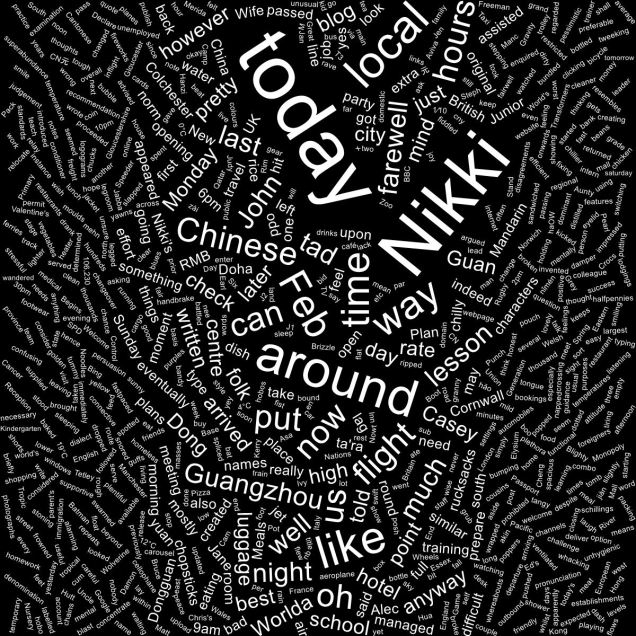
In fact, I could not type it easily, because everytime I hit enter, it happened. Why did I need it? I didn’t. It just came when I was watching a YouTube video on how to make word clouds. Common words like it, the, a, and so on are removed. I wanted to see common words from this blog of over 301,000 words to see what words stand out. I imagined City and Manchester to dominate. The result is as per below (2000 most common used words):

word cloud blog 3rd June 2019 b

I did the same on the 120,000 word novel that I have written. Yet to be published. This is the first preview, in a way. Here is that result:

NOVEL WORD CLOUD

再见/ Zài jiàn / Bài bài / Ta’ra / Goodbye / Hwyl Fawr / Dhanyabaad / Alavidā

Round Our Way

你好/ Ní hǎo / Nín hǎo / Hello / How do / S’mae / Namaste


TOUR

Well, I’ve booked flights to return to Blighty on the 31st of July, with the return to China slotted in on the 15th of September. That follows four days in Yokohama (Japan) watching English Premier League Champions Manchester City, and a trip that takes in Nanjing, Shanghai and Hong Kong to see the City face West Ham Utd, Europa League-bound Wolves or Newcastle Utd and then Kitchee SC. It is expensive and beyond my bank balance, but you only live once, I think. Money isn’t all there is to life. If your nation is billions in debt and U.S.A. is trillions in debt, and you don’t fully agree with capitalism, then flip it, live for the moment and the future, at the expense of yesterday. We can always make more money, but we can’t make more days of living. Our species has had more warnings than we care fit. Godzilla: King of Monsters, even delivers this cheesy message. Just do thes best you can, and to quote Braveheart, every man dies, not every man really lives. Something like that.


IMG_5346.JPGI may die without offspring, and in debt but I’ll be damned if I will die unhappy. If I pass on a few smiles and some good advice along the way, then I am happy. Morbidly happy. I can’t wait to get back and enjoy summer with family and close friends. I miss so many good friends. I certainly miss my family. Homesickness seems to creep in as the football season ends, and my eyes firmly focus on a summer trip home. It has happened this way since 2015. This year my holiday is extended by a few weeks – and also, I will request Christmas off, to visit home. I need to see my family I owe it to them.


MANC AIRPORT ANNIVERSARY 2013 (25)Summer in the U.K. will probably see some football, London for the Community Shield, a few Premier League games, some Aberystwyth Town jaunts and whatever suits. I hope to see Bristol Balloon Festival when near our Ace’s. Chadderton Duck Race should be in there for Dr Kershaw’s Hospice. There has to be an airshow to visit. Perhaps some Tour of Britain cycling action, Vincent Kompany’s Testimonial game and a memorial tree planting. Everything is possible with your own powerful mind. Oh, and Doves near Acton town. That’s a must. Perhaps the Ramsbottom World Black Pudding Throwing Championships. Sadly, I fly back the week before Egremont Crabbing Fair & World Gurning Championships. Hopefully, I will find a way to see the great Lancaster Bomber fly, whether over Saddleworth, Southport or Blackpool, I don’t know!


I want to spend some of summer researching my family tree too. I know so little about my heritage.

gran and aunty sue

My Mother’s side:

Ivy Harrison was born on Densmore Street in Failsworth.  At the age of five Ivy attended Mathers Street Council School in 1930.  On April the 13th 1939 Ivy became a machinist making night clothes for Smith and Nephew (a Hollinwood based company).  In 1943 during the Second World War Avro Ltd. recruited Ivy to make munitions and aircraft pieces. Parachutes were also made. The war effort needed everything. In the wake of a recovering U.K. climate during 1949, Ivy married John Hitchin.  In May of that year, Carolyn Hitchin was born.  In 1955 John Hitchin died from a severe heart attack.  Ivy became a widow aged thirty.  And in 1956, Ivy’s mother died aged sixty-nine.

In late December 1956, Ivy remarried, to John Roberts.  John came from a long line of North-Wales’ Welsh men. Susan Ivy Roberts was born upon the 5th of October 1957. Soon after, Ivy’s third child Elaine June Roberts was born upon the 20th of June 1961. John Roberts died in my early years. My Gran remarried at the deathbed of her companion Ernest Freeman. She would pass away as a widow in February 2014 and leave behind family who miss her most dearly.

To be continued…

再见/ Zài jiàn / Bài bài / Ta’ra / Goodbye / Hwyl Fawr / Dhanyabaad / Alavidā

IMG_5346.JPG

Contemptible. Ridiculous.

“A woman in what is still a man’s world” – Right Honourable Harriet Harman QC, Labour MP

Prime Minister Theresa May cried! Grenfell? No. Windrush deportation? No. Foodbank uses? No. NHS cuts? Deaths of homeless sleepers? No. Childhood poverty levels? No. Self-sympathy tears? Yes. And they wonder why some believe those in power are lizards!? Her legacy is, at best, contemptible. No place for her on the positive walls of history are likely. She has until the 7th of June to fix the unfixable.

“She has, just for a moment, allowed her emotions to show” – Ken Clarke CH QC

Party politics is fallin apart, left right, and centre-right. Instead of two huge party rivals with the odd group picking off the spoils of war, we have the most divided United Kingdom ever. Okay, well maybe less than before actual unification in 1284 (Wales annexed by England), 1536 (Wales, legally part of England), 1603 (Scotland joined and Great Britain was born), 1707 (all parliaments acting as one Kingdom of G.B.), 1801 (U.K. of Britain & Ireland) or 1922 (Ireland set free, less the Northern bit) dependent on your view of when we actually came together. And ever since then, we’ve been together-ish. Alienation and independence, devolved assemblies – and the odd campaign for Free Scotland aside. Completely unified. Like Manchester Utd under David Moyes/Louis Van Gaal/Jose Mourinho and possibly Ole Gunnar Solskjær in the months to come (if my bet pays off).

“Tories ‘have nothing to offer the country'” – Nick Boles MP, former Conservative Party member


It is sad to see Everest and Nepal grabbing negative headlines too. Two deaths on the south side and one on the Tibet side make for a strong argument for lottery-style permits – or at least a longterm permit scheme, whereby those who climb enter a waiting list or something to avoid congestion towards the peak. If you’re in a queue, it isn’t a challenge worth doing. My condolences to those sho succumbed to the challenge, but they should never be risking their lives in a queue. That’s ridiculous!


Sunday, will see the E.U. election results for our local elections. I didn’t vote. It isn’t easy to vote if you are overseas. Also, the E.U. elections to me has always seemed like a waste of time. Doubling up for the sake of it.

Farting Fair Play & Harry Hole

你好/ Ní hǎo / Nín hǎo / Hello / How do / S’mae / Namaste


wx_camera_1547690585098

CHAMPIONS – AGAIN (& Financial fair play)

This season has seen one of the tightest title competitions ever. I won’t write too much. I won’t laugh at Liverpool F.C. Whilst some of their fans irk me, I respect their club set-up. They abolished their connection to a bottled water supplier with alleged possible and dubious human right connections. They paid off huge debts during their takeover with no fuss from the media. Their recruitment has been wise and fitting in recent years. Not since Andy Carroll, have they had a dud player. City were regular buyers of the over-priced until recent years. The prejudism towards City’s new money and new ability to compete may have been reported by Liverpool F.C. stakeholder New York Times (NYT) all too often, but this is life. Just like the Manchester Guardian, the NYT was set up to voice opinion and create conversation, whilst seeking truths. And in true form, Manchester City responded directly with a statement. Unlike the official website of the football club, the newspaper cites sources without revealing the sources. Essentially the same as most postings of crap on Twitter. The papers ambitions of adding to over 127 Pulitzer Prizes is based on speculation – not bias.

Anyway enough about that, Liverpool F.C. have assembled a fantastic squad with their lovely Warrior kits (owned by New Balance, a Saudi Royal family investment).

The current reported UEFA investigation may be into the past, or present. Either way it doesn’t make too much sense in terms of fair play. Some clubs and national FAs have been funded by Bosch, Mercedes, Deutsche Bank and VW. How can they claim the high ground? Although some have battled bitter history and have defeated enemies time and time again.

Top versus Runners-Up Trophy winners on the money front makes me laugh. The numbers across the board are huge – and the money is as transparent as mud. Throw in them lot over the Manchester border for comparison too. Footballs backer will always have grey and possibly rainbow-shaded areas with colour coded charts of uncertainty. Who are we to judge the rights and wrongs of a sport that creates social evils, media unjust and headlines? It’s entertainment like every other industry of ‘things people watch to escape real life’. Surely, through talking an debating we’ll realise that at the end of the day, you can buy more players, buy more seats, buy more everything to get that margin of fine gains that has been in every sport since the dawn of time. The clean as a whistle UEFA and FIFA know how it goes. They must be careful not to bite the hand that feeds them. Instead of banning, or retrospective action, tidy the bloody rules up and make things more transparent. Then, us, the hard-working paying masses can get on and enjoy the bloody game every Saturday afternoon, I mean, whenever TV dictates.

State-aided funding of airlines etc, could be a weird one. How many sponsorship companies have been bailed out by governments? How many have acted as official agents of governments and done a spot of dirty work? The US Open Skies case had Etihad, Qatar-Airways and Emirates show that they were not state-aided. Also, City have previously shown evidence on paper that their Etihad sponsorship of City was directly funded by the Abu Dhabi Executive Council. So, why didn’t UEFA act?


Manchester City
Kit supplier:
Nike, UK£72 million (US$108 million) signed 2013, expires 2019 [£12 million a season] speculation that these numbers may be fabricated
Main sponsor: Etihad Airways, UK£400 million (US$652 million) signed 2011, expires 2021 [£40 million a season] speculation that these numbers may be fabricated
Sleeve sponsor: Nexen Tire, UK£10 million (US$12.9 million) per season, length unreported [£10 million a season] speculation that these numbers may be fabricated
Deals since 2017/18: Turtle Beach, Xylem, PAK Lighting, Marathonbet, AvaTrade, SeatGeek, Nexon, Tinder [loose morales?], Barclays [questionable], Amazon [bye, bye local traders], Gatorade, Khmer Beverages , Mundipharma, Rexona [sure?] and a whole host more. speculation that these numbers may be fabricated


Liverpool F.C.
Kit supplier
: New Balance (Trump supporter and owned by club owner John Henry’s close friend], UK£300 million (US$390 million), signed 2012, expires 2019 [£42.8 million a season* *once a record figure holder in 2012/13]
Main sponsor: Standard Chartered, UK£160 million (US$236.1 million), renewal signed 2018, expires 2023 [£32 million a season]
Sleeve sponsor: Western Union, UK£25 million (US$32.1 million), signed 2017, expires 2022 [£5 million a season]
Major deals since 2017/18: Standard Chartered [squeaky clean with no state backing in the middle east at all and certainly no cartel money in any accounts], Wireless Infrastructure Group, Petro-Canada Lubricants,
Tibet Water (Chinese-owned) actually ended.


Manchester Utd.
Kit supplier: Adidas, UK £750 million (US$$1.3 billion), signed 2016, expires 2026 [£75 million a season]
Main sponsor: General Motors, UK£371 million (US$559 million), signed 2012, expires 2021 [£41 million a season]
Sleeve sponsor: Kohler, UK£20 million (US$27.5 million) per season, length unreported [£20 million a season]
Major deals since start of 2017/18: Chivas, MoPlay, Melitta, Kohler, Belgium FA [an actual country’s association], MLILY, PingAn Bank, Cho-A Pharm, Science in Sport, General Sports Authority of Saudi Arabi


Fair Play.

And if you want to see fairness, then compare the other 17 Premier League clubs, the multitude of top level European clubs and see where we’re at. Is better marketing allowed too?

Then compare full gates, trophies since the Premier League’s inception, a twenty year sponsorship portfolio, global shirts sales, domestic TV coverage and overseas coverage, global marketing, ambition to grow the foreign market, invitations to high-value friendly competitions, added TV sales etc, pioneering eSports etc, TV documentaries… domestic and overseas investment potential.

Another thing is how do these sponsorship deals come about, bidding, tendering, slipping your mate at a good brand some plum deal and probably a spot of tax evasion.

Think about where that club invests, how their profits are used and whether they have passed the FA’s due diligence test of new club owners. Perhaps, UEFA could up the ante and set higher standards. FIFA could be involved too. It might affect them. Fit and proper ownership could then be extended to all sponsorship deals – with clubs declaring their fully visible statements to a neutral panel, or one that accounts for UEFA member associations. Tome to end the witch hunts and go on about setting a model example. Because every piece of crap that enters a paper, with “a source said this” and “an un-named official said that” ruins certain fans and gives them a weak and annoying response. Where we you when we were s4!t?

Also, how do fans of Liverpool or ManUre view FFP and how do their club frameworks see the knock on effect? Live every news article, we can all find a source here and there, but it doesn’t mean much.

“Sorry John,yes you want to make money,and want us to be an attractive catch for when the people you are slating at citeh and Chavski comes a knocking to buy your investment from you….or would you decline such offers because your such a staunch supporter of FFP?”

And, to read further Colin Savage (Prestwich OSC) at Bolts From The Blue has it spot on. It is my understanding that right now, one board, kind of preparation court has to prepare a case with recommendations. It must have solid evidence. There is also the fact that the financial fair play cases being pushed by Belgian lawyer Jean-Louis Dupont has yet to be concluded. UEFA’s slippery net is at full risk of crashing and burning. The E.U. and Belgian courts may kick it over to a court in Switzerland. Would you trust a place that hoarded gold from dubious piles of ruins arund the late 1940’s. Oh, and they only let women race and vote as late as the ’70’s. Look up the Swiss Verdingkinder and you’ll probably understand that fairness is far from a national trait. Switzerland is ranked one of the top 5 nations to export weaponry. Now look up how few factories they have capable of such a thing, and how few soldiers that they have. Don’t count the noble Swiss Army Knife. Saudi Arabia and the Ukrainian armed forces are up as much to benefit from Switzerland as UEFA is. The battle for fair play could equally take place in another nation.

If a case ever gets presented, who will it affect? The fans. Of course, the fans that nobody cares less about these days. The agents will still find ways to make money. The clubs will lose some trade and opportunity. The clubs and their hostories may be tainted. Juventus came out of their demotion smelling of rose. Ronaldo’s rape allegations weren’t treated seriously. Wayne Rooney was destroyed by papers following an affair, or visit to an elder lady of the night. The Heysel disaster saw 14 Liverpool F.C. fans convicted of manslaughter, and many more labeled as thugs. It tainted UEFA’s history in international competitions and promptly banned English clubs for five years (six years for Liverpool F.C.). Around 39 people died that day. UEFA, the Belgian police force and Liverpool F.C. continued on.

UEFA and any external independent legal team will have to consider the impact and consequences of any punishment. Just like disasters and the investigations that follow them, this will drag on. It will ruin football for the fans. It will be bitter and painful, but at least no lives have been lost – and no ruthlessly banded phrases used. Even of that club’s fans chuck potential death-causing smoke bombs at an enclosed coach full of people, or other such facial damaging glass bottles.


anfield may 2008 (6)

You’ll never walk alone.

I disagree with any fans using the “always a victim” tagline when referring to Liverpool F.C. It is dishonest and stupid to say so. The Hillsborough disaster was a low point in football history. 96 people died. Justice has yet to be found, despite 30 years of court actions. Just like the Bradford City stadium fire that claimed 56 people, these were disasters brought about by those above and those in control of stadia and their management. It is too easy to blame fans. It is tasteless to associate the death of many in this way. I urge anyone crying the words “always a victim” to play the shocking videos on YouTube on to reach their inner humanity. Don’t be a knobhead.


wx_camera_1547690585098

What is fair market value?

Surely, if you restrict Forest Green Rovers from buying multiple players and building a 60,000 seater stadium to allow them to grow and one day compete with the Premier League clubs, then you restrict the evolution of football. Where are the original football league clubs now? Are they all equal? Can new clubs like M.K. Dons form? Isn’t it more important to back ambition and make clubs more self-sufficient. If a club can develop a pool of 200 players in a decade, it is unlikely they will all make it. They need places to go. Partnerships and deals need to be done. Just like marketing. Sheikh Mansour and Etihad are unrelated yet it would be foolish to think the two don’t have indirect influence over one or the other. If I was Queen Elizabeth II and I owned Reading F.C., whilst I owned Weetabix, but did not manage or influence them, I’d be pleased if Weetabix wanted to sponsor my Reading F.C. club. In City’s case UEFA have already accepted fair market value for all the sponsorship by Etihad but Aabar and Etisalat remain under question.

Don’t panic. Don’t worry. As Colin Savage mentions:

“It also could be that a journalist has completely misrepresented and sensationalised what they’ve been told. That wouldn’t be the first time that has happened.”

07 AUG 2004 CITY 3 LAZIO 1 (10)

Record Matched & Unbroken

A record could have been broken recently – for the least goals scored at home. I didn’t want our record to go. 2006/07 was a bleak season but a necessary one. It produced an end of season highlights video devoid of content. Simple boredom. I remember a few good memories that season. We got to the 1/4 finals of the FA Cup and that felt pretty good at the time. We stuffed Fulham 3-1 that season, and beat Arsenal at home too. Vassell’s derby day pen was annoying. How Ball managed to stay on the field that game was beyond me. To get to May without a home league goal since New Year’s Day was underwhelming. Vassell, Samaras, Corradi, Mills, Dabo, Hamann, Ball and Thatcher were never going to produce great football. Dickov, Miller and Reyna failed to score, surprisingly but that squad had no creativity at all. Even Mark Hughes backed Pearce after the FA Cup exit.

Hudderfield Town had the chance to set a record for the lowest goals scored at home in the season. They failed. By scoring a goal through Mbenza against Ole’s Man Utd, they simply matched the 2006/07 season of Stuart Pearce’s Manchester City.

The pre-season transfer market was dull. Joe Hart would go on to be a fine signing though. Nobody came in of great note. We loaned and sold many for brass buttons and a Gregg’s pasty of two. Reebok churned out a crap set of kits. Off the field John Wardle and co were obviousy working hard but City were about as exciting as winning the Thomas Cook Trophy (which we lost that season to Porto).


index

Jo Nesbo

‘I’m a stranger here, I’m a stranger everywhere’, sang Jarvis Cocker on his ballad I’m a stranger. Well, the words of that song reminded me of my most recent book in hand. The 11th novel that I have read so far, by Jo Nesbo has been gripping. It is called Police. The central character is Harry Hole. He is flawed, gritty and as far from perfect as can be. Fate has dealt him some shitty card hands. Jo Nesbø’s stories have featured in two movies, the standalone tale of Headhunters and Harry Hole’s serial killer epic The Snowman. Michael Fassbender portrayed the tall blonde in movie form, despite not being blonde. His sister suffers from a ‘mild dose of down’s syndrome’ – and every aspect of the character play is multi-layered and deep. There is black humour galore and some depth to the stories, in factual basis and an imagination, that didn’t do bad after the author left a career playing football for Molde FK. Anyway, the first book I lifted up was Headhunters, when I was staying at my Aunty Christine’s house. Then, I started with Harry Hole in The Redbreast. Since then I read the books in order, with the exception of The Bat & Cockroaches (which I picked up in Kathmandu at the poorly named United Book Shop in Thamel). Michael Connelly first published a novel in 1992, aged 36. His character Harry Bosch influenced Harry Hole, written by Jo Nesbo, and released by the then 37-year-old Nebo in 1997. Michael Crichton published a novel under the name John Lange by the age of 23. Roadl Dahl had released a book before his thirties too. He would be 45 before his well-known titles reached the bookshops. Obviousy not science but the thirties is a good time to release a book. The greats vary in age at their main publications, so I am not worried. Inspiration can be found everywhere. Fleming was 45 and he dodn’t do too bad.


mmexport1555249975866.jpg

A peak too far.

Yínpíngshan and the park around it [东莞银瓶山森林公园] mark Dongguan’s highest point. It is in the eastern township of Xiegang. The mountain peak is shy of the Welsh 3000s (914.4 m) by a little way (18m, or 59 feet). The hill is sometimes referred to as Yinpingzui, just to confuse those looking for it. It is a city boundary from Huizhou’s Baiyunzhang – or under 5km from one another. The name Yínpíngshan translates to silver bottle mountain, because it kind of has a summit that has a vase or bottle-like funnel on top.

On this journey the top was immersed in clouds. The forecasted storm didn’t arrive but walking through cloud a drizzle ensured all at the summit were drenched. On the walk up peaks and summits all around the region dipped in and out of clouds, like Gods and Goddesses surveying their mortals below. An evergreen band coated the mountains with rare breaks accommodating streams and patches of open rocks. Beyond that trees covered all.

The summit of Yínpíngshan is bare and exposed. A cliff face on one side and on another a concrete pathway much like the Hilary Step on Everest, but far lower down in altitude and much more travelled. I can’t imagine the drink and snack sellers climbing so high to sell their double-priced goods. The granite looking rocks to each side of the enclosed pathway jutted out like generals on a battlefield.

On the descent we encountered a waterfall, and some dipped their feet in the rockpools beneath. What the fish in the pool made of it, I’ll not know. I’m told ancient species of Rhodoleia championii [Hong Kong Rose] and the fern brainea insignis.

To get there, there are buses from ZhangMuTou town (2&5 to XieGang Square, then 4 to NanMian village); or a a train to YinPing station; or as we opted a Didi car journey from Changping. Here! Dongguan magazine laid on a coach from Dongcheng that day too.

Going from 180m up to a height of 896m shouldn’t have troubled me. The elevation gains total around 796m and the 11.18km distance are not things that should trouble me. They did. The aches and pains of a healing foot and ankle injury and there to be seen. Battling humidity and my own discomfort were things that I expected. Almost every walk of a few kilometres these last two weeks has been uncomfortable. My flatfooted feet can be hellishly awkward at times. Living in China, where most things are made, doesn’t mean I have access to orthopaedic supports or footwear suitable for recovery. I donned my walking boots, last worn in Nepal. They fitted like an Aston Martin in a James Bond movie. As I placed them on, I even had the famous James Bond single hornpiece playing in my head.


“Got it.”

“Got it.” That seems to be a standard emotionless reply to many things. Whereas, in the U.K., I’d expect to hear thank you, ta, or wilco (will comply), in China it is usually just “okay”, or, “got it.” I don’t know why ot bothers me. Perhaps it is because it is a non-commital form of later or an evasive response at the best of times. If I had a finger for everytime somebody used “got it” after I put the effort in, and then later found they’d “got it” but clearly done naff all with it, I would have too many fingers to play the entire global supplies of finger-based musical instruments.


The world is full of bullshit.

The holidays have passed, and many “got it” messages have been received. Part of me wanted to reply, I’ve “got it” too.  For four days of the holiday, I did somewhere between nothing and miniscule activity levels. My infinitesimal adventures made Ant-Man and co look impossibly large. I did sweet F.A. because I wanted to rest my ankle and joints. The diminutive break involved watching Avengers Endgame and regretting doing so. It was okay. Just okay. A bit long. Binge-watching Who Is America with Sacha Baron-Cohen was a pleasure. Two episodes of Game of Thrones and some walking locally wrapped up an otherwise eventfree escape from work. Some planning for summer, some editing of photos, and some writing filled in the gaps. I did some paperwork too. The kind of things that are semi-important and without a deadline so that you procrastinate over them time and time again. Why complete tomorrow’s work today if it can wait until the next day? What didn’t happen yesterday, doesn’t necessarily need to be completed tomorrow either. These are the unavoidably essential and ineludibly methods used by U.S.A. with regards to climate change. The U.S.’s approach is actually too certain to be a British government model of applocation. Anyway Bond 25 was launched. No title, no plot, no song, no commitment. Proof that Brexit uncertainty and gloom is exiting and entering all walks of life. Trump would say fake news, but he does/does not buy into WikiLeaks and all that. He never used it on his campaign trail, so he would surely not now of it afterwards.


How does one measure a fart?

Do we measure the volume of obnoxious gas produced? Do we check its density? How long does a fart last? Do we measure it metres, yards or time? How smelly was it? Is there a scale like the Scolville scale for chilli peppers? Do we measure the volume of sound? How much pressure was released? How far does the fart blanket over a surface area? Is the fart warmer than previous farts? How fast does it rise upwards? Is there any coloration to the gas?

All the right questions concerning Brexit and Trump are to be found in the previous content of course.


再见/ Zài jiàn / Bài bài / Ta’ra / Goodbye / Hwyl Fawr / Dhanyabaad / Alavidā

Thoughts on courage.

你好/ Ní hǎo / Nín hǎo / Hello / How do / S’mae / Namaste,

Bravery and tragedy seem to sit hand in hand, side by side. Wherever the former is, we’re usually shown the latter in the news. Tragedy sells. Courage, valour or bravery is not always frontpage news on its own. Superman’s cape draped over a chair sells better than him saving a kitten from a burning oil-tanker out in the worst waves imaginable. Some tragic news brings apathy – because let’s face it, much of the news we see is grim – and often, as is the way of the multimedia age and global connectivity. Sometimes we need to turn a blind eye. There can’t always be happiness and suffering are a worry many carry. The news does not shy away from such tales. It reports in all manners about lust, jealousy, hatred and hostility in equal-ish measures. What we choose to empathise in is up to us, as an individual.

On Monday, in Sìchuān [四川], a region renowned for spice, pandas and Kung Pao chicken, around thirty firefighters were killed. A huge forest fire engulfed them – and none could escape the path of the fireball. 700 brave firefighters had been trying to control the fire for several days. Sichuan is home to Manchester City’s new partnerclub Sìchuān Jiǔniú [四川九牛] who play in the provincial capital of Chengdu. I’ve grown up on a diet of London’s Burning, the TV show, famous for portraying the hardwork and lifestyles of firefighters. I almost became a firefighter myself, but instead, opted to go to university instead. I have firefighter friends. Around 343 fatalities from the 2,996 deaths on ro around September 11th, 2001 were those of the New York Fire & Rescue Services. Firefighters occupy a community of selflessness and put themselves between dangers and the everyday soul trying to survive. Some pay that ultimate sacrifice. On top of that, their mental health is affected and levels of suicide is higher amongst them than the general populous. Firefighters who faced the Grenfell disaster or other such tragic emergencies will surely lose a piece of themselves.

SICHUAN MESSAGE

Humans have always worshiped heroes. They may be Gods, they may be comic book figures, or they may have been very much real. Religions have plentiful heroes and examples of bravery. Some, like Islam, show control as a huge auxiliary to courage, in tackling the devils of life and spirituality.

Some religions and governments push embarrassment and disgust through their guidelines, wording and morals. That’s how stones become a weapon of execution in Brunei, right? Don’t worry, they need witnesses or a confession. Sorry, Brunei but your rules are cuntish at best. How do the private actions of individuals that cause no damage to those around you, affect your leadership or government or religion? It is utter bullshit. The Sultan of Brunei is cunt. I challenge him to a public conversation, face to face. A debate. Let’s get his problems out in the air – and his government’s worries. Come on Mr Sultan Haji Hassanal Bolkiah Mu’izzaddin Waddaulah ibni Al-Marhum Sultan Haji Omar Ali Saifuddien Sa’adul Khairi Waddien Sultan and Yang di-Pertuan of Brunei Darussalam, let’s talk. If you want to experience sedition, I’ll fight for another (woman’s or) man’s cause, with words. Give me my chance to show courage. I’m not writing from boredom but from contentment to your new laws. I hold these law in contempt of humanity. I’ll feel disappointment if you do not reply. I won’t be surprised as anywhere that amputates hands for thefts, brutally punishes minors for petty crimes and completely fails to prevent human trafficking. Their intrays must be overflowing with requests.

I always wonder if such laws are caused by boredom and loneliness or perversed arousal from power over the people. Do they grip panic at allowing too much freedom? Well at least we have Amnesty International, Human Rights campaigners and others to renew our faith in humanity. Again, they are all courageous. All too often they’re fighting for voices in former British protectorates, colonies and places rich in resource. The 159th member of the U.N. are a case in point. Perhaps the U.K. could withdraw the Nepali Gurkha battalion and other military personnel stationed within Seria. But U.K. interests in Brunei probably only stretch as far as having a stopover airport on the way to Oz and New Zealand.

慈故能勇 cí gù néng yǒng loving causes ability brave

 Socrates said a hero is, “a man willing to remain at his post and to defend himself against the enemy without running away” but back then gender inequality was rife. There has been an acceptance and anticipation throughout history of multiple religious saviours and possibly an end to suffering by a higher being, or two. I prefer to think that we alone can save ourselves. Many individuals work in conservation and humanitarian aid. There’re more heroes than we see in movies. They just don’t attract the same desire or curiosity. On a heroic front, Brunei were the first Asian nation to ban shark finning. So, every cloud can have a silver lining – it is all a matter of perspective. Some British Indians hate our new five pounds notes, because Sir Winston Churchill is on there. His willingness to let courageous Ghandi die on a hungerstrike and his general lordly attitude over the “foul race” of Indians and their own fault for “breeding like rabbits”. He wasn’t at all nice to Indians or Bengalis, or Hitler and co (but Adolf certainly deserved it up ‘im). His legacy can be hugely criticised. For me, the Royal family are the same – and Queen Lizzy the 2nd is on one side of the note. That’s history. It is more grey, than black and white. At least with busts, notes, books, documentaries, and more. Otherwise we’d not learn that King of the Belgians, Leopold II of Belgium was a bit of a bastard. Think millions of deaths.

Sir Winston Churchill said of courage many things, but he as both the hero and antihero, cannot be denied his power to compose and express. Courage over risk needs a personal fear to be conquered or managed. There may be deliberation but eventually an intention to act will be made. The courage could be as a perceived good act – or one that is believed to be noble. As noble as a lion or as strong as myself resisting a box of fresh raspberries. Okay, the rapsberries are gone. Not a fine example of strength, but moreone of my own humiliation at not enduring a test. The rage I have in not allowing a punnet of raspberries making it from the fruit shop to my apartment door. Okay, I show no remorse. Just resentment. Okay, not that. Sorrow that the raspberries have gone.

“Courage is rightly esteemed the first of human qualities because it is the quality that guarantees all others.” – Sir Winston Churchill

Emotions are strong things. I have an affection for those who are brave – and selfless. It gives me angst that maybe I’ll be called upon to do my bit. How will I react? I am in awe of thise capable of freezing their minds and cutting away from anger, anguish, annoyance, anxiety, despair, disgust, fear, frustration, grief, horror and shock in order to save other people – especially when they are unfamiliar with such strangers. That curiosity of my mind wonders how their self-confidence dominates pride and creates a social connection that rejects self-interest. The ecstasy of saving life must further create an anticipation of joyful hope. They never seem to panic or show over confidence, these superhero firefighters. They’re like you and me but made of stronger stuff, at the same time. They’re courage in a bottle. The bottle cannt be procured at a cornershop. It is ingrained in years of enthusiastic service. Our gratitude may be given from time to time, but these service people don’t look for merits and commendations. They get their heads down and do their jobs. Euphoria one day. Sadness the next. Depression waiting around every corner. I don’t envy firefighters. For they have a rainbow of emotions to contend with. It’d give me anxiety! I don’t pity their choice of occupation, but I do pity their salaries. Some risks deserve more surprise and trust. I feel guilty that the U.K.’s elected government is too busy wasting money on things that could fund those who put themselves in truly adverse situations. It is an outrage that the masses have such a little voice to show pleasure and show little passion in looking after our own heroes. Just like the environment, we’ll miss it all when it’s gone.


再见/ Zài jiàn / Bài bài / Ta’ra / Goodbye / Hwyl Fawr / Dhanyabaad / Alavidā

Ruptured Earth.

你好/ Ní hǎo / Nín hǎo / Hello / How do / S’mae / Namaste

Climate change is a phrase we hear all too often, but do we really listen?

“Our planet, the Earth, is, as far as we know, unique in the universe. It contains life.” David Attenborough –The Living Planet (1984)

Sir David Attenborough is the gentle voice of BBC Wildlife’s successful department. Soon he will present what he terms as an urgent documentary. In spring, BBC will air Climate Change – The Facts. Now facts are often questionable and open to interpretation or accusation of being fake news. I vehemently hate that term: fake news. Bullshit is bullshit and fake news is a tosser denying criticism. The world’s population more than doubled since 1950. Prove me otherwise.

“If we [humans] disappeared overnight, the world would probably be better off.” David Attenborough – The Daily Telegraph (12/11/2005)

Sir David Attenborough is 92 years of age. He could retire. He could kick back and count the letters that follow his name (OM CH CVO CBE FRS FLS FZS FSA FRSGS). He could reflect on his two brothers John and Richard, or sit down and listen to his relative Tom in The Tigger Movie. The Attenborough clan permeate the world of stage and theatre. Sir David’s father had once been the principal of the University College, Leicester. It could be said that his family haven’t done bad. They don’t need to work at Primark or Spar to earn a living. Yet no, Sir David, cracks on. He opens debate, he fuels fires which need dousing. The young Sir David would carry his passion to this day for wildlife and nature. However, in recent years he has become a leading voice for global concern. An unqualified expert. The people’s champion for change.

SAM_1903.JPG

“This is the loneliest and coldest place on Earth, the place that is most hostile to life.” David Attenborough – Life in the Freezer (1993)

As a primary school student in the 1980s and warly 1990s, I would always hear about the Greenhouse Effect and Acid Rain. Spray deodorant and cans suddenly became friendlier. Keep Britain Tidy campaigns swept through classrooms and eventually the streets of Manchester. Trees were planted, like what Peter, Dan and I planted with BTCV in Highfield Country Park, Levenshulme. To this day, I take pride in seeing that little difference, everytime I walk there. There was talk of a future with mysterious windpower and cars would all be electricy-powered. As time went on, we’d attend seal clubbing classes, where we learnt that seals had no interest in dance music and nor did we get a technique on how to bash the cute creature’s skulls in, essentially we heard of the horrors people go to to make a jacket and a steak. Almost Everyday Shit™ seemed to be up against things not necessarily in our own paved backywards but effecting man (or woman… or other) around the corner, or further afield. Even as far as Hyde or Belgrade. Suddenly, I found myself in secondary school discussing Not Really Quite Everyday Shit™. Teenage boys had to stop grabbing their flacid cocks and the girls had to stop doing whatever it is that girls do. We were the future generation and hope. It was our responsibility. But, evidentally, we fucked up. Not Really Quite Everyday Shit™ didn’t go away. Now the next generation could be the last generation with a chance to fix it. Sir David Attenborough said so.

IMG_2854.JPG

“Ever since we arrived on this planet as a species, we’ve cut them down, dug them up, burnt them and poisoned them.” Sir David Attenborough – The Private Life of Plants (1995)

On present day Earth, we can probably divide people into three camps. Within those camps, there can be further division. Division is important. Camp one is classed as the deniers. They’re useless as a voice and obstructive. They possibly have vested interests in wealth. Camp two are the changers. They need to be heard. They seek to make a difference. Competively they can make a lot of noise against camp one. Camp three are too busy, simply looking after number one, or their families or feel unable to make a different. Camp two often feel that they are too selfish and ignorant. Camp one enjoys their silence. Camp three probably recycle but couldn’t be depended on to ask for recycling bins to be installed. The camps are unclear and people fluctuate from camp to camp, mostly due to discomfort, lack of clarity and by way of reaction to Almost Everyday Shit™ changing to something outlying and worrying.

“It seems sad that on the one hand such exquisite creatures should live out their lives and exhibit their charms only in these wild inhospitable regions. This consideration must surely tell us that all living things were not made for man, many of them have no relation to him, their happiness and enjoyment’s, their loves and hates, their struggles for existence, their vigorous life and early death, would seem to be immediately related to their own well-being and perpetuation alone.” The Malay Archipelago (1869) – Alfred Russel Wallace

We’re aware of plastic bottles as a problem. Everyone is. The bloody things are everywhere. I am guilty too. Sometimes, they’re unavoidable for hygiene reasons. I try my best to deposit them in recycling bins or places that I know someone will take them for recycling. But what if say Theresa May [Insert Prime Minister here], Donald Trump (unlikely) or Xí Jingping [习近平] banned disposable plastic bottles at source. The factories. That’d be the place. Keep them away from people. Permit reusable, and deposit-based larger bottles that must be returned, cleaned and recycled by any means. Take away anything below a certain capacity. Plastic must exit the ecosystem. It needs us to remove it. There are many ways to do so.

P60227-123059.jpg

“we can ensure that there is still a place on Earth for birds in all their beauty and variety – if we want to … and surely, we should” The Life of Birds (1998) – Sir David Attenborough

History has led us from the past to the present. It was a simple linear transition, unless you are Tom Cruise and his associates. Is Scientology a religion or cult? [Let’s discuss that one day, hopefully without fear of cyber-attack reprisal] Well, we’re here in the Anthropocene. The age of the human. Homo sapiens. Latin meaning wise man. We’re the only living human species. Things change and species often have a limited time on Earth. One thing we know, is that supersizing a meal at the American Embassy isn’t good for us. But, has that prevented overconsumption and stopped deforestation, because we no longer need a bigger paper bag? Have we learnt that overexploitation of lands leads to deserts and not desserts. How much weight does every fish in the sea have compared with that of the plastic in the seas?

“Instead of controlling the environment for the benefit of the population, perhaps it’s time we control the population to allow the survival of the environment.” The Life of Mammals (2002) – Sir David Attenborough

Opinion matters. I’m with Sir David Attenborough. Individual action is not enough, “real success can only come if there’s a change in our societies and our economics and in our politics”. The world’s temperatures (ask the Mongolians) may be soaring, and we are the likely cause. Planes, cow farts and all that are the debated and often argued origin. We need to think of ways to cut this crap down. Get on Three Seconds by National Geographic. A video with a message that we should think about. It has 287,319 views compared to The Crazy Nastyass Honey Badger’s 90 million plus views. The same honey badger, or one of the 12 subspecies, may be of least concern now on the conservation status but few are seen in Guangdong, and this used to be their ‘hood. Or will we all be another fossilised-brick in the wall, soon enough?

sailing Tenerife 2009 (20).JPG

“The fact that they are solar-powered means that their bodies require only 10% of the energy that mammals of a similar size require.” Life in Cold Blood (2008) – Sir David Attenborough

Perceptions of place matter. If a road is dirty, people and especially lesser-educated people will chuck their crap on it. There’s no snoberry in saying lesser-educated people intended. Some people have never had access to education in the ways that I have – and I for one was never going to go to Harvard or Oxford University, unless they needed a cleaner. This is the way of the world: the haves and have-nots. But, if Billy Billionnaire at Taxbucks Willing Avoidance Trade Specialists Ltd wishes to fund a litter awareness and education programme with the money they denied the state(s) that their Monopoly Conglomerate department sublet, then feel free to do so. Ultimately, your man (woman, transgender or other) on the street will be unaware of that plastic bottle’s effect on the river downstream or the air that they burn it into. We are capable of educating each other.

“If we and the rest of the backboned animals were to disappear overnight, the rest of the world would get on pretty well. But if they were to disappear, the land’s ecosystems would collapse.” Life in the Undergrowth (2005) – Sir David Attenborough

Politics is something we’re told to embrace. The complexity of an electorate and their representatives messing up and not knowing where to go, is seen globally. See, Brexit and the Trump administration’s political circus. So, how do we get those in power to focus on saving us as a species and those other species around the world that we could do with saving? As a British person, I know that writing a strongly worded letter to the Intergovernmental Panel on Climate Change (IPCC), down at the U.N. isn’t a bad idea. But, if we all did that, we’d need a lot of recycled paper or energy to power those emails. Would they mark the emails as junk? Possibly. Do they deserve the Nobel Peace Prize for 2007? No. Okay, they did, but having to share it with Al Gore, hasn’t changed much, or anything. The inconvenient truth is that we need mass action on a global scale. We need laws and directives to stop bad things and create things of use. Taking inspiration from conferences and internal flights etc doesn’t help. Bringing a duster and a shovel to an earthquake doesn’t work. We need the masses for the masses. We need actions.

Hamburg July 2008 (119).JPG

“Every one of these global problems, environmental as well as social becomes more difficult – and ultimately impossible – to solve with ever more people.” How Many People Can Live on Planet Earth? (BBC Horizon, 2009) – Sir David Attenborough

Issues will always be a problem. There aren’t rooms for the 14th Dalai Lama to sit in with the Chinese Administration, or Northern Ireland to talk to the Republic sensibly. Turkey and Syria have beef. Israel needs to open up more. The U.S.A. needs to bring home a few fighter planes. The Church of Croydon may have similar problems with death worshipers from Norway. There’s a can of worms out there when two opposition parties have two ideals or beliefs that can’t flex. For us as a planet, we need to shed our differences and share technologies and ideas. Life is finite or infinite in some religions. I ask, does reincarnation, make you less worried or more? If reincarnation were true, there’d be X amount of total individual lifeforms on Earth, continually coming back as X amount of total individual lifeforms. So, in one generation there may be 6 billion people, but many centuries later there may be 6 billion cockroaches because 6 billion people can no longer inhabit the Earth. Does reincarnation stretch beyond Earth too? Does it include every microbateria or virus?

“I never never want to go home; Because I haven’t got one; Anymore” – There Is a Light That Never Goes Out – The Smiths

Proposed adaptations for humanity cling onto some Buddhist thinkings. We must be fully endowed with higher knowledge and ideal conduct. In other words, stay off Twitter. Get over to Bhutan and let’s learn a thing or two. Would controlling our ever-growing population be a good thing? We humans leapt from needing 200,000 years to hit the 2 billion mark as a species, to 200 years nearly touching 7 billion. Surely, that is far from sustainable. The current growth rate of 1.18% per year is expected to drop. Disease, lack of biodiversity, natural resource exhaustion, ecosystem imbalnces, environmental degradation, ocean acidification, global warming, and ecological crisis are terms that we will hear mre often. Overpopulation will test our mettle. Our resolve will lead to conflicts on a more regular basis as we battle the increasing heat and try our best to survive. If we act now, we can reduce that risk.


British scholar Thomas Malthus scribbled down in 1798 that we’d exhaust Earth’s resources for food by the mid-19th century. He was wrong. How wrong? Well he could have been out by a few centuries. Since then, expert after expert have delivered messages and issued warnings. Now with meta-analytics, computer models and sound studies based on huge banks of data, we’re creaking on the abyss. The U.N.’s Food and Agriculture Organisation carry the Latin, fiat panis (“let there be bread”) but there are more Fiat cars being turned off a production line than strategies to ensure bread can be produced sustainably. They say that in the next 30 years we need to produce 70% more food.

“Sometimes when this place gets kind of empty, Sound of their breath fades with the light. I think about the loveless fascination,” Under The Milky Way – The Church

Catastrophies are in motion. Pollen distribution is changing. Glaciers are receding faster than my hairline. The beetles are dying. Bees, the great pollinator of all life, are declining in numbers. The buzz is lessening. Fish are filled with plastic parts and we eat them. The fish are also ingesting our drugs and decanted chemicals into the sea. We’re making them infertile or causing gender imbalances. Every continent is under ATTACK. Every sea and ocean are under ATTACK. Even red crabs get attacked by crazy yellow ants introduced by us. ATTACK. We stamp and kick every stone on Earth and leave our mark, whether intentional or not. We don’t just leave footprints. ATTACK. We carve great big trenches and leave areas vulnerable to landslides, forest fires and things that stop us rolling out red carpets for fire-haired Nicole Kidman. The news will focus on Miley Cyrus losing her home more than that of a village in Syria. ATTACK. We’ve abandoned humanity and embraced celebrity and we’re too blind. Blind, blind, blind, blind, blind… as Talking Heads would sing. Still, a monsoon that washes a village of indiginious people who don’t buy Apple iphones counts less than someone from Yorkshire having to replace a flooded shed’s lawnmower. ATTACK. Right?

Italia 2007 Trieste (30).JPG

To again quote Sir David Attenborough, “Surely we have a responsibility to leave for future generations a planet that is healthy, inhabitable by all species”. Will there be a generation born now, that when they reach adulthood, will no longer be able to see elephants or tigers in the wild? Why can’t a kid from Guangdong see a Giant Salamander anymore? Where does the boy born in Dongguan go to see a South China Tiger? Why do we have WWF for Nature, EDGE, and why do these kind of things tend to be charity and independently backed? Shouldn’t we learn from Botswana, Norway, Bhutan, Namibia, and Tanzania? Lonely Planet did.

“Trade is a proper and decent relationship, with dignity and respect on both sides.” A Blank on the Map (1971) – Sir David Attenborough

But, why bother? A nuclear blast, an earthquake or a volcano can cause more damage globally than a generation of people. Well, nature is nature. It happens. We’re the benefactors of our destiny, and we’re the keepers of our fate. Why not tidy up where we live? You don’t shit in your own bed, do you? Okay, that has happened to one or two of us and on old age, it may happen – but surely, we never choose to do so. I apologise to any purveyors of scat. Not the jazz singing kind – and not the word meaning go away, or the Indo-Pacific fish, that likely has plastic inside its system, either. Nor is it the Special Combat Assault Team, or the badly named Shrewsbury College of Arts & Technology. Don’t google it. Scatter! Why not?

“To suggest that God specifically created a worm to torture small African children is blasphemy as far as I can see.” Metro interview with Sir David Attenborough (29th Jan 2013)

We have the technology to do something. The wind turbines, the solar panels, the recycling plants, the nuclear fuels to shut down the fossil fuels immediately. We have the education to understand blue carbon, and models to specialise schools into specific fields. Imagine a super city, dedicated totally to environmental protection and species conservation. Every country needs one. Similarly, every country needs to consider that populations matter. If we don’t control ourselves, then nature will. Great extinctions usually work. An ice age here and there or a huge weather change. We can prevent that, if we really want. Or we can believe an all-powerful, all-merciful God created a parasitic worm that will eat through a kid’s eye? Let’s get over our beliefs and start doing something about the things we know about: the world is changing.

Montenegro 2011 (7).JPG

“If we don’t take action, the collapse of our civilisations and the extinction of much of the natural world is on the horizon.” Sir David Attenborough (Climate Change Conference 2018)

Potential effects, very much like the warnings on a cigarette packet, include death. Actually, mass extinction and human total extinction are feasible. Extinction means forever. No more. Gone. Hatari and their pink elephant from Iceland will be happy suddenly. Human sacrifice, mass hysteria, or dogs and cats may love each other, as predicted in Ghostbusters. I wonder if in our last days of humanity that we become perfectly self-awakened, and say the words, in the style of Hinx (Thespian’s go-to-man Dave Bautista) from Spectre, “Shit!” The last human may send a Whatsapp message to an otherwise empty group – and with that the power of humanity may fade forever. Or we could start recycling, reusing, reducing and the other bits we usually ignore. As Tommy in Snatch said, “Proper fucked?”

Of course, I’m no expert. It could all turn out swimmingly.

Mallorca May 2013 Anniversary (238).JPG

再见/ Zài jiàn / Bài bài / Ta’ra / Goodbye / Hwyl Fawr / Dhanyabaad / Alavidā

The motions of finality.

你好/ Ní hǎo / Nín hǎo / Hello / How do / S’mae / Namaste,

Last Wednesday evening, I watched the excellent Paul Draper, of Mansun fame, now going solo in Guangzhou’s Mao Livehouse. It was an excellent gig, even if returning around midnight to sunny Dongguan was a tad late. One thing for sure, the hustle and bustle of Guangzhou did not leave me feeling in a wide open space. The venue has great acoustics and with Paul Draper’s dreamy vocals, even if Beijing had left him a little sore of the throat. The experience was made all the better by discovering both new songs, and some old songs that I haven’t heard since they probably came out. I’m no super fan of Mansun or Paul Draper – but this gig was my favourite this year. I’ve been to one gig. That being said, I doubt many bands or artists will put on a better show in 2019.


I am tired of hearing that “you must be the best“. I agree and I disagree. Be your best by all means, but don’t accept that being the best of all others is possible. For me that is chosen by popular opinion. On one hand, one person could be good at organising groups or preaching ideals, on the other hand, that person could also be radical and likely extreme. You wouldn’t want Adolf Hitler organising a charity shop. He’d probably do okay on the bric-a-brac section or the novelty homewares. I wouldn’t trust him with the books or clothing. He had a nasty habit of being a bit selective. Similarly I wouldn’t trust Marie Curie in a charity shop. She’d be too busy messing around with polonium – and not obeying health and safety rules. Hitler would be a terrible co-worker for Curie. He’d no doubt fuel the rumours that she was a Jewish homewrecker. Yes, history has often been full of divisive figures. Something that you couldn’t say about Michael Jackson, without fear of a fan getting upset, until recently. Now old M.J.J. the noseless is fair game. Him being dead makes him an easy target, much like the poor boys he probably fiddled with.

So, why should we be the best? To be tainted by our weakness and our mistakes? To fall down on our swords? Does society spit out the mediocre and forget what we offer? Is there fault in wanting to live a simple peaceful live? Are we either astronauts, astronomers or stargazers without need of answers? If a dream is unspoken, did anyone dream it?

I’m often asked why I like teaching. “Hey Mr John, why do you like teaching?” The answers I give are not always the same but usually I say something like, “Ugh. I dunno.” I want to be the one who makes the shy kid speak. I wouldn’t mind being the one who makes the noisy kid pay attention. If someone can make the dreamer join in, why can’t it be me? If you can’t impart teamwork where selfishness was, then I will do it. I like to defrost cold situations. We can all be the one who says hello to everyone, from the cleaners to the parents to the secretary to the delivery man to the security guard and the bosses.

It is important that in teaching, and for the bigger society, that we don’t create a sense of inferiority. Yes, there will always be outstanding people and we need them. We need the differences in ability, and we need the inability in order to thrive. Our faults can be assets. Without negative experiences or bad times, division, or difference, we’d not have Joy Division, Radiohead or the lyrics of Paul Draper, singing Jealousy is a powerful emotion. We need less division and fear of difference. Events in Christchurch this week tell us that. Don’t fear better, don’t fear religions, just accept that difference is wonderful. I take pride in my hometown and the man who stood outside a Levenshulme mosque with a message of peace. Yes, he garnished some publicity, but that furthered his message and no doubt reached the people of communities like Christchurch and beyond. The real people no doubt felt the support. The haters probably struggled and held conflict in their hearts. For every message of love, we can win. Can’t get fairer than that, right?

“To destroy someone, you must observe these rules; At number one; Everybody’s got their weakness; Get people on your side.”
Paul Draper – Friends Make the Worst Enemies

During the hike in Nepal, it gave me a feeling of community and harmony unfelt before. Along the way many single people, groups and couples enjoyed guidance from experienced guides and porters. These local experts are well-trained, respected and hard-working. They don’t cut corners. They work safely and never hurry their clients. You’re their guest and for a moment you are treated just as one of the family. They extend their hands to stragglers and solo-trekkers alike. Do you need a porter? Maybe you like the challenge. Maybe you want a luxury and to have someone lug your backpack to leave you free to explore a little more. The benefits of the guides and porters far outweigh not having assistance. They know the weather. They know the altitude and signs of sickness, and how to acclimatize more carefully. They’re really honest people too – but I’m sure a bad apple is amongst the cart. I’d trust them though. Some pay their porters or guides 2,000-2,500 NPRs per day. Some pay their hired hands’ accommodation and food on top. They’re all fair about their fare from day one. They even meet with clients in advance and explain their terrains. Most guides speak English – and many have learnt Korean, Chinese, Spanish and French. They’re a talented bunch. Having a guide is not necessary but even from someone who twice set out on a challenge without a guide, I would in future throw serious consideration to a guided tour. Maybe in the future Manaslu, Chitwan and Annapurna will call me.


10th February 2019

On leaving Pheriche, we rounded the pathways through Pangboche and looked for a place to stay. No rooms at the inn, and with enough sunlight to carry on, we walked forward to Deboche. With light fading, we arrived into a warm room, a bright view and the setting sun casting purple tints over the surrounding mountain tops. The Paradise Lodge made a a good mushroom pizza and for me Dal Baht wasn’t on a list of foods to eat. The lodge, a stone affair with wooden interiors and a row of protruding beachhut style rooms was far from a grey house. The blue and white paints, and dark green trims made it feel very homely and traditional.

The following morning, we walked the short climb up to Tangboche, and after viewing the grand monastery we descenced to Punkitenga. Here we ate lunch, before walking (mostly) upwards until Namche Bazaar. The culmination of the journey was now in our hearts. The motions of finality were obvious. Less photographs, more savouring of the views and moments and even a tear in they eye, here and there. On reaching a crest of the footpath, my heart vowed to return, as it had done two years previously. One day, I’ll put the boot in, in a hard way. The next walk will be longer. I can feel it. There is a force calling me. The fat lump in my head is erupting in a storm of electronic signals and they all point to a new voyage of discovery in Nepal. Anyone want to join me?

Probably, to be continued….


A smooth sea never made a skilled sailor. With this idea in mind, a challenge needs to be on the horizon. Always have something to look forwards to. There are things people want, and things people need, to keep their heads up. On damaging an ankle ligament this last week, I am now looking at deferring my attempt at the Spartan Race. I am now able to move the opportunity in Hong Kong, during June, to a later date in Shenzhen, possibly October. It may or may not be wise. I need to think it over. The right ankle has been strapped up for three days now. It feels more painful and sharp than before. The swelling has dropped from balloon-like levels to just plain bumpy. Instead of running, Muay Thai or football this week, I am contemplating a few hours of uplifting Morecambe & Wise on television. I was feeling my heart run slow, so I needed something fortifyingly enriching. Why wallow in shit when you can lay down and eat fine grapes?

“All men are fools, and what makes them so is having beauty like what I have got.”
Glenda Jackson, Morecambe & Wise Show


再见/ Zài jiàn / Bài bài / Ta’ra / Goodbye / Hwyl Fawr / Dhanyabaad / Alavidā

To be determined.

你好/ Ní hǎo / Nín hǎo / Hello / How do / S’mae / Namaste,

https://sunyatsens.com/

I opted not to take headphones with me, or earphones for the trek around Nepal. The soundtrack would be life and nature. However, if I was to take one song on that journey, then I’d struggle. Today, I watched the video of Ting Bu Dong by Sun Yat Sens. The track opens with producer Ryan Chambers on the didgeridoo. Throughout the track he continues flitting between this instrument, an acoustic guitar and backing vocals. Sometimes he manages two of the three. Talented bugger! Some of us can’t even play the spoons. The vocals kick in from Chris Bradshaw, who puts a J between his names. It could mean juggernaut or John, as in Lennon, I don’t know. Rob Laughlin on base, alongside Eric Charette on drums and a session guitarist in Brandane Mullane form the band’s entirety. The reason that I namedrop these guys, because somehow, somewhere and someday these boys could reach high. They’ve evolved since I first watched them at Magic Island Music Festival back in December 2016. They’ve gone from a group capable of pub gigs, to a professional looking, well-marketed and confident outfit. They’re more A-Team than A-list still. That’s a good place to be. With videography by the talented Ryan and drone footage, alongside their graphic design they can do anything they want.

The dreamy didgeridoo-opening has a touch of This Garden by The Levellers, and I’m feeling a touch of Dido in there. It has the played down nature of early Oasis-acoustic tracks without the overpowering aggression of a cocksure Gallagher on board. I’m expecting, “Today is gonna be the day…” but instead the song smashes in some Chinese. Why not? The reggae-indie rap is dreamy. The chorus is clear and takes me back to Nepal on that last walk. Songs that unlock memories and emotion are powerful things. The video showcases life in China, a wandering figure and gives your imagination an opportunity to test itself. Sun Yat Sens and their previous song WeChat was more Feeder and jolliness in style. My students feature somewhere in there around the minute mark. I hope that we all see and hear more of this band soon.

#15 – PYRAMID – GORAK SHEP 1300 – EVEREST BASE CAMP – GORAK SHEP 1800 ~ 12km


8th February 2019

We set out from Pyramid (5050m / 16,568ft) to Gorakshep (5100m) and then onwards to EBC (5360m). On Earth’s lands there isn’t much surface area above us at this point. The upper points above 7,000ft (2133m) is only about 7% of the total of Earth’s surface. 29.2% of Earth has land above sea level or uncovered by lakes and rovers. Our oblate spheroid of a planet has bumpy bits. The Himalayas (China/Nepal/India)) with the Karakoram range (China and Pakistan) are the only places to see peaks over 8000m. Only Bhutan, Kyrgyzstan, Afghanistan and Tajikistan (a country I know nothing about) can be added to those countries for mountains over 7000m. Going to other countries and looking for big mountains is near pointless. Aconcagua (6962m) in the Andes (Argentina) is as close as you will get. Anyway I now found myself above 5164m for a night’s sleep. The highest that I have ever snoozed.

If Lobuche is bleak, then Gorakshep could have meant shithole in English. The smooth mountain top of Kalapatthar hovers over the lakebed that sits by Gorakshep. We arrived, ditched our things at the Buddha Lodge, ate a late lunch and then started the Everest Base Camp trek. The final leg towards a hidden shadow beneath Everest. The lodges are mostly supply drops and shelters. There is discarded waste in piles, banners and tents ripped to shreds scattered here and there. Armageddon refused to stop in Gorakshep on account of it being totally dilapidated and uninhabitable.

The worst night’s sleep ever followed. Firstly, the windows were rattling amd pccasionally flying open. Cracks in some panes threatened to explode. The roof was rattling. Each room had a temperature lower than -25°C. Snow slipped through the edges of the window frames. The lodge shook with each gust. Worse still – we were running out of yak shit. The main lounge room was starting to cool. As I lay my head down headaches came and went. Even if I wanted to descend downwards, this was not the weather to open any doors.

In the lodge a group of three from the U.K. with their The Baton flag slept, alongside Rhys, Al and Spanish Albert. Everyone seemed to endure a restless night of anti-sleep. Hope of making ot through a night without the roof blowing off was broken up by regular piss breaks to the toilet at the end of the cold corridor. The frozen stinking cesspit in the ceramic western toilet was perhaps the warmest thing for several kilometres.

The great thing about having a sleeping bag comfortable to -25°C is that when it finally teeters over that temperature limit, you’re still a little warm. An extra blanket on top helped. The noise of the howling winds did not. Gritty frozen grains pounded the windows outside. It seemed that the outside desperately wanted to be inside. Sporadically the dirt of the outside world slapped the windows like bullets being fired from a gun.


9th February 2019

Morning arrived. Breakfast was devoured. We set out.

Kala Patthar is 5,545 metres (18,192 ft). It might as well be higher. It is no mean feat to get to the top and capture a panoramic view of the Khumbu glacier like all the postcard shops have obtained. A panoramic sweep of clouds in all directions and zero visibility doesn’t sell the same. To quote trekker Rhys from Cardiff, “Well it is the mountains and that means clouds.” It is what it is. Simple. Black rock, as Kala Patthar means in Hindi, might well just translate as bleak rock. I read somewhere that the ‘The world’s highest webcam, Mount Everest webcam, was located here’ on Kala Patthar. In those clouds, you could lose anything – including life! No prayer flags were visible yet needed. No mountain climbing permit was required – making this the highest point to scramble without license to do so.

The Khumbu glacier is supposed, by scientists, to have formed in the last Great Ice Age. That was around 500,000 years ago. On reaching Lobuche (4910m), my legs were feeling equally as old. The Khumbu region stretches from Namche Bazar out to Thame in the west and Gokyo. Gorak Shep, and Chukung mark the northern and western areas.  The Khumbu subregion is a third of the region known as the closely named Khambu. The lowest point is 3,300m high around Lukla. Visibility was so low, that my feet were barely in sight. The gamble and decision to stay an extra day was not appealing. With heavy snow forecast, we headed down – our target, “as far as we can go.” Well, after struggling over the open boulder and rocks fields lining the banks of glacial death below, we dropped into a valley leading towards the Pyramid. We’d later show some pretty bad windburn on our skin – and thankfully we escaped anything more serious.

Having sought cover just before lunchtime, we had cut a path through deep snowdrifts and found shelter. We were the only ones at the Pyramid International Laboratory/Observatory. We hadn’t intended to stay again but we had no choice. After an hour a Chinese man and his porter/guide joined us. They said they were close to death out there. It was believable and no embroidery on their part. Barely two hours later and the blizzard vanished. The whiteout faded to a grey unsettling day. We chilled out in the warm lounge watching cricket, volleyball and eating too much. It passed the time before bedtime. Outside did not appeal to us.

#16 GORAK SHEP – PYRAMID ~ 10km

This slideshow requires JavaScript.

10th February 2019

The walk continued as in the spirits of each day before. It was always about just going forwards, and not rushing. Some loose targets and aims were handy but they were never set in concrete. The journey was to be lived. The destination was just for inspiration. Some target Everest Base Camp for status, spirituality or homage. Some push themselves as far as they can go. Some want to do their best. There had never been a race to get anywhere and likewise we weren’t descending fast for the sake of it.

Within an hour, I did not think that I could walk any more. My head was pounding at the rear and I was walking so slow, that deep down I was beginning to worry. Fatigue had turned to exhausation and my mental condition was slipping to the negative. Ten minutes after passing Ishwor, Srirang and Livia on their way up, I had to stop. Here the cough that had been niggling me for nearly two weeks began to rasp at my throat. I tried to catch my breath. A moment later, I was staring at my breakfast on the floor. My nose stang. I smelled terrible. My mouth tasted like a yak’s arse. After a few moments of composure, I explained to Maria we must head down fast – but steadily and for her to keep an eye on me. Barely an hour later and I felt great – reinvigorated and fully oxygenated. Resurrection in a Buddhist land is possible afterall.

We soon appeared at the tombs and monuments, standing tall under a sunlit sky. The spiritual air of the location fell away as we descended the pathway to Thukla. Here we continued over the glacial rover’s stepping stones, banked left and followed a pebble-stoned pathway into the valley around Pheriche (4371m).

I was told by many not to stay at Pheriche when doing this trekking route. It sits deep in the shadows of the mountains around it and on a cloudy day, little light makes it to the village. This day it was basked in splendid sunshine. The Tsola River flowed beneath it. The Himalayan Rescue Association (HRA) are based here but we dodn’t stop by. We spent an hour hiding from yaks, by squating by a frozen stream as they passed by and then doubled back. Eventually we joined a British couple, their guide and porter to pass by. The top end of Pheriche village seemed to have a melting-yet-dangerously-frozen-river-road down the middle. That had to be negotiated slowly. Empty buckwheat and potato fields lined the pathways. Following the top end of the village a few kilometres before the lower village appeared. The neighbours there must be quite fit.

Arriving at Deboche (3820m) today we had dropped about 1230m. That’s 1.23km (4053 feet – about 7/10 of a mile). Burj Khalifa is the tallest building at 828m (2717’) tall. It had taken just a few hours. The walk up had been broken down.

#17 0900 PYRAMID – 1600 DEBOCHE; #18 0930 DEBOCHE – NAMCHE BAZAR 1700: ~ 40km
#19 NAMCHE BAZAR – LUKLA ~ 21km
#20 LUKLA: ~ 4km

More to follow.


再见/ Zài jiàn / Bài bài / Ta’ra / Goodbye / Hwyl Fawr / Dhanyabaad / Alavidā

The Great Pyramid of Nepal?

你好/ Ní hǎo / Nín hǎo / Hello / How do / S’mae / Namaste,

It could be argued that too much looking back is bad for the soul. Well my mind is also investigating a possible wander to Détiān pùbù, Bǎnyuē pùbù [板約瀑布, 德天瀑布]. This is located the Daxin County, Guangxi and Vietnam. The Lanning Nandong station may be a useful starting point. The Green City awaits. Then there is Zhēnzhū Tān Pùb [珍珠滩瀑布] too. Oh and Huáng Guǒshù Pùbù [黄果树瀑布]. Anyway they all need further research, and now I can carry on telling the tale of this year’s trek in Nepal.


4th February 2019

The early morning pathway from Namche Bazaar is wonderful. However, we set off at 1130am, touching the afternoon. Having sat in Namche Bakery eating apple strudel and celebrating Ishwor’s Not-Birthday. Srirang and Livia had checked Facebook and assumed the date of birth he had published was his birthday. Turned out it wasn’t. Not that a candle in some chocolate cake wasn’t fun. We sweet off late having shared a fun morning with a birthday party that wasn’t quite right. We walked for a short time and enjoyed lunch at Kyangjuma in a lodge’s garden that I’d previously ate at two years ago. Thamserku was in clear sight and Ama Dablam lay dead ahead on the trail just beyond the Tyangbuche (3860m) brow and the huge monastery.

The owner of the lodge talked with me about how his dog, that I met two years ago, had been eaten by a snow leopard – and the two similar dogs were that dog’s offspring. We talked about the New Year celebrations in Sherpa culture, his hair being died and general local information. Stupas were soon, once again being passed on the left, as we bid our farewells and descended downwards to a river crossing.

We passed Thunki Tanga, which like everywhere seemed to have many variants of spelling. Funky Thanga seemed the best name. Completing the checkpoint registration, we began the slog of a climb up to Tyangbuche. Here we met Albert from Spain, who had walked from Thame. We also met a Sherpa man who had climbed Everest on several occasions when he was a few years younger. He’d walked from Lukla that day and would head as far as Pangboche. One hell of a jaunt! Our destination would be Deboche – and ideally at the Everest Lodge.

May people refer to this part of the trail as ‘Nepal Flat’. You really speaking only gain about 330 metres of altitude. There are woods galore, steep valleys and on this day the bright sunshine gave lovely sweeping clear views. Everest and Lhotse had been dead ahead for some time, until we sank down to Phunkitenga (see, another spelling!) – and here it was all up for a few hours.

On arriving in a darkened Deboche we checked into Paradise Lodge. I have a few tiny criticisms of the name. It was too cold to consider as a place of nirvana, but the warm log fireplace gave glory, I guess. The twelfth Dal Bhat was adequate for filling the belly.


5th February 2019

Today’s walk bid farewell to trees somewhere just beyond Pangboche and touching Otso village. The trail is the first day of true discomfort. You adjust and pace yourself with much more care now. The air is getting noticeably thinner. You concentrate on slowing your pulse and breathing with more effectiveness. There is touch of anxiety about me. This is where in 2017, I reached. And not much higher.

Deboche to Pangboche and finally Dingboche (4410m) is a photographer’s dream. There are gompas, vast valleys, huge rockfalls, streams and views of Ama Dablam up close. Then, as you climb into the valley that holds Dingboche, you see the mountainous borders of China with Island Peak, and Nangkartshang looming overhead.

My sleep that night wasn’t bad. No headaches and a confidence that this would be the year. Maria wanted to go on today. I insisted that we acclimatise. Over-confidence can be your downfall. Breathing normally is on the cards for tomorrow. Dal Bhat the 13th, was certainly no nightmare. It would assist on the battle against altitude-related doom.


6th February 2019

Coaxing the morning breaths into a steady rhythm, I tucked away breakfast. Last night we met Rhys and Al, who had travelled from Wales to climb to Everest Base Camp for charity. This morning we set off together to go up the neighbouring mountain. Nangkartshang is an unwelcoming rocky mountain lined with grass at first sight. The walk started vigorously. Our bodies would need the climb up, feel the strain and then sleep low. Every step would soon be an exertion and the higher we went, the harder it felt. On reaching the summit and ledges, the views are out-of-this-world yet remind us that we are on this world and we’re quite small. The cold air and clash of bright warm light make for an up and down body temperature. I regret wearing the down jacket – yet later, I was thankful for this piece of clothing.

As we descend the valleys beneath us fill with cloud. It filters from many directions and eventually covers the sky blotting out the fading evening sun. Winter is coming, so they say and the next day we will wake to fine flakes of snow. Everyone at the lodge talks in whispers of a big snow storm in the region over the next three days. A couple, from China, who are descending talk about a Pyramid lodge to stay at. We take the details and set that as tomorrow’s aim. But will the snow be too much? At least the fourteenth helping of Dal Bhat would surely help get me there.


7th February 2019

Dingboche to Thukla started in light snow. The snow eventually faded yet the sky remained jaded. My cynical mind remained open to further snowfall. The great sweeping plains above Dingboche, lay beneath mountains to the right shoulder, and beneath my left shoulder, a drop down to the river valley below. The left side view of Taboche (6495m) and Cholatse (6440m) gave a dramatic slant to the world. Cho (lake), la (pass), tse (peak) are Tibetan words. They’re impressive peaks and highly photogenic. The ravine of the Khumbu glacier folds away as we ascend to Thukla (spelt in numerous ways, as always) and onwards to Lobuche. The climb is gradual and striking. There are remarkable pathways cutting through the snow. But, before the bigger climbs, we stop for lunch at Thukla.

Upwardly walking in clouds and snow is unearthly. It heightens your senses and brings the imagination out. Beyond the cloud could be a sunny day, Godzilla or the Manchester City reserve team. You have very little way of knowing. To quote Meat Loaf, ‘what you see, is what you get’.

The cloud lifted and a strange black square shape could be seen. From this parapet a stream of colourful flags fluttered down. They formed a line stretching to a shrouded stockade to my upper right side. These ramparts appeared to be stones stocked one upon another and squared off with rough edges. The first two stupas formed a gateway from the pathway leading up from Dughla.

To my left, the flag of New Zealand fluttered. Rob Hall, of the famous Adventure Colsuntants was marked here. From the 1996 climbing disaster on Everest was the Mountain Madness Everest Expedition leader Scott Fischer. Both bodies of these remain on the South Summit of Mount Everest. There are others from this and groups of other deadly climb attempts. There are touching tributes, grand notes and plaques. I tried to read as many as I could. I was spellbound. It was sad but also life-affirming. It made me ask questions and think things that I seldom think or have never thought. The cloud drifted out to reveal lines of cairns and stupas. Suddenly, I was in a living graveyard. I felt that I was in a dizzying field of tombs, like the iconic Sad Hill Mexican standoff (which was filmed in Spain) in the the movie The Good, The Bay & The Ugly. Dizzying is a word that I have used lightly before. On this occasion, it felt apt for my vertiginous and flighty state of mind. I thanked the Gods (all of them, that others respect and worship) for people remembering the fallen, doing the thing that loved the most. But, does anyone really want to die doing the things that they love?

More than 290 people have died attempting the Everest peak – or assisting those who climb it. Official statistics of deaths amongst the trekking population, that go to see Everest, are unknown. It is expected to be around 4-5 people a year, from altitude sickness. Crevasses, mountain sickness, being struck my your own icepick as you fall, avalanches, exhaustion, death by Serac, disappearance, falls, drowning, heart attacks, blood clotting, exposure to the elements, rope accidents, and others reasons for not wanting to climb Everest may have deterred me. For climbers, they must climb. Those lucky enough get to trek and explore wonderful places with blotched histories and wonderful moments. This is the spirit of nature. It takes and it gives.

On reaching Lobuche we step into the Oxigen Lodge and have a brew. We decide the snow is lighter and crack on for Pyramid. It should be around an hour away. Lobuche is a near barren wasteland. It is unwelcoming and borderline unfunctional. This town is notorious with early trekkers and climbers as being the place where everyone inhaled yak shit dust from early fireplaces. It has improved dramatically in recent years but still has a feel of drabness. The frozen toilets, a stream full of ice and a pocket in the snow with a dozen stray puppies gave an air of menace. Here you are expected to tolerate the simplest of simple accommodation – complete with ice. The trite options surrounded by inclines mark the start of the really, really dangerous glaciers – so we didn’t hang around too long.

After about 30 minutes we reached a ginnel, a short passageway to our left. Two clear signs pointed towards EvK2CNR and SHARE. It is possibly mothballed by the Italians, but it seems active. We walk the pathway for about 10 minutes. We had to cut through the reasonably deep snow. On arriving the squat brick building with a glass pyramid looked lifeless. On opening the door, it was far from lifeless. A dozen or so noisy Chinese voices mixed with a few western accents. We met Spanish Albert, Al and Rhys once again. Amongst the crowd were many friendly porters and guides. The lodge manager pointed us to the warmest room on the entire trail and apologised that the solar panels were too deep under snow, so the internal heaters were not working. It was more than comfortable. A bucket shower and all meals were inclusive – for 4000 NPRs per person, per night. That’s £26GBP or there abouts. Luxury in an amazing setting.

The Pyramid International Laboratory/Observatory is a high-altitude research centre. It has the aims of promoting sustainable development within mountainous areas. It is there to safeguard high altitude ecosystems. These areas for some of the most fragile in the changing world. There are works on the wall. I sit reading through them on eating Dal Bhat 15 and trying to find City’s score versus Everton away. The score flashes up. City’s title battle continues. Spanish Albert is also happy. His Barca team avoided defeat against Real Madrid.

#12 DEBOCHE 0830 – DINGBOCHE 1530 ~ 10km
#11 NAMCHE BAZAAR 1130 – DEBOCHE 1800 ~ 12km
#13 DINGBOCHE: Nangkartshang & back ~ 5km
#14 DINGBOCHE 0800 – PYRAMID ~ 11km

To be continued…

再见/ Zài jiàn / Bài bài / Ta’ra / Goodbye / Hwyl Fawr / Dhanyabaad / Alavidā

Namche Bazaar (is the place to find me)

你好/ Ní hǎo / Nín hǎo / Hello / How do / S’mae / Namaste,

Yesterday I played 7-a-side football with my new team Dongguan Raiders F.C. Sporting our bright pink kits we had another victory. Our team has played three games this last week with two wins and one midweek friendly training game against Murray’s F.C. Our team has Chinese, Italian, Serbian, German and Ukrainian players – alongside the token Mancunian. On Saturday, I also joined Murray’s F.C. in our game at Zhuhai against the Guangzhou Phoenix team. We won 8-2. It now means a draw or win against Zhuhai, in Dongguan at the month shall be enough to claim the inaugural Guangdong Super League. Football shall move into the sidelines for me now. I have 88 days to train for my debut Spartan Race. I opted for the killer 13km Super option. That involves 25 obstacles too. It is a challenge. Am I ready? No. Will I be ready? I’ll do my best to be. The trekking in the Himalayas tested me mentally and I feel that anything is possible. The arrival of the next challenge is always welcoming. After that, I’ll need a new challenge. Suggestions please. Of course, I’m still looking back on the time spent in Nepal…


31st January 2019

One week of trekking was to completed today. The walk from Kharikhola, via the Karila Pass (2730m) to Paiya (2730m) started with a reasonably steep climb up towards Bupsa Danda. Here made for a good brew stop and somewhere to enjoy the view. From Kharikhola’s Magar people to panaromic views of valleys and looming landslides, to Sherpa settlements and the Bupsa Danda village itself, heaven could easily have been placed on this spot of Earth. The hilltop is delightful.

From there the trail is up and down, but really gently. In fact it is the closet to a day’s walk being flat on the entire wander so far, and later to come. It feels like deception. At the end of the walk, we settled down a for a night’s sleep in a lodge. Here we met a trekking nurse who volunteers in Nepal, having retired from work in Germany. Her partner and guide, from Nepal spoke German and they were accompanied by several porters. We spoke at great length about porters and guides leaving Nepal for better opportunities. He seemed quite aware that many Nepali people are trapped in Qatar. Political and visa issues have been a problem. He mentioned the reduction in porters has resulted in an explosion in the mule population. The destruction to the pathways in two years was clear to me. A country ravaged by natural disasters, civil war and political turmoil now had to contend with horse-donkey hybrids smashing up a great Himalayan trail.


1st February 2019

Leaving Paiya that morning we headed towards Surke. At Surke, Livia, Srirang and Ishwor went up to Lukla for supplies. We carried on up the pathway to Phakding (2610m) passing waterfalls, frozen streams and increasing numbers of lodges and houses. Around the sacred villages of Ghat, large boulders cast shadows over the pathways beneath. Some sported sproutings of trees and the odd leafless giant. Almost every rock had faces of lichens and bedcovers of moss. Beyond every short mountain towered ridges of snow-capped peaks. Eventually the trail met the main pathway from Lukla towards Everest Base Camp. Here we noted a huge difference in footfall. More people, more often. Now we were in the home straight. The business end of the greatest most popular and well known Himalyan trail. Also, those we passed by on their way up had some similarities. Most looked fresh and clean. Some had minor altitude exhaustion, having arrived a few thousand metres up at the modern and recently legendary Lukla airfield.

Under grey skies we plodded onwards. The pathways seemed to level on this day, and we stopped for lunch at a Sherpa family’s lodge. Reading the family’s walls of certificates and talking to the owners was quite interesting. The owners’ son is a pilot based at Kathmandu – on rescue helicopters. They regularly see him flying overhead. Their daughter is also overseas in Switzerland in the hospitality sector. Mountain people seldom leave the mountains, it seems.

From the moment we passed Surke to the upper levels of Phakding, the numbers of stupas, gompas, murals and mani stones seemed to explode. This region is known as extremely sacred. The Nepal version of the Etihad Stadium in Manchester. Many prayer wheels had been turned, so much so that my fingers became dirty from the dust. The clear signs of mules everywhere to be seen. The most obvious being the pathways under repair.

The modern looking Sherpa Guide Lodge was our stay that night in Phakding. We paid 3000NPRs for a shower each, twin room and food wasn’t much more on top. I’d seen this pine-looking wood and clean-cut brick building under construction two years ago. We were the only guests this time. The daughter of the owner was in charge. The next day she was due to head to Kathmandu to see her parents. The walls featured awards and commendations of her father’s achievements, photos of their family lifestyle and traditional prayers from Buddhism. It was a pleasant place to eat Dal Bhat number nine. The views of the near-Alpine looking region sat outside in total darkness. The roar of the river drifted away as I slipped into a deep untroubled sleep.


2nd February 2019

Phakding to Monjo (2835m) wasn’t too far. A few hours to the gateway to the UNESCO World Heritage Site that is Sagarmartha National Park. Having a gander at the monthly tourist record really shows how few people explore outside of the peak seasons (March-April & October-November). It also makes me feel like peak season may be a tad too busy to enjoy the freedom of the great trail.

As you enter the Khumbu subregion it isn’t hard to see why the Lonely Planet guide ranks it as the sixth best region to visit globally. This patch of northeastern Nepal has mountain scenery at every turn. Colourful Danfe birds resemble pheasants. The national bird can be seen amongst a whole host of colourful birds, mountain goats, musk deers, and other wildlife. The colourful guesthouses fell away as we entered the park, having paid our 3000 NPRs and a deposit of 1000 NPRs for a new tracking GPS card. Good idea. Less lost people in the Himalayas. Over one of the Dudi Kosi river’s many footbridges and we pass through Jorsalle (2740m), stopping at the last hut overlooking a river below. Here some yummy foods were required. The final hike upwards after luch would be near brutal. Over another bridge, we crossed down onto the river-accompanying pathway, up to some steep scary steps, and then to the final bridges looking up at the Namche pathway. Up the valley, Everest, Lhotse and a face of mountains hid away in clouds. We wouldn’t be seeing their beauty on this day, but Oasis sang, someday we’ll find a brighter day.

The Dudi Kosi river flows from the Mount Everest massif, just east of Gokyo Lakes and flows south, beneath Namche Bazar before heading west of Lukla. It was the same river heard during a night’s sleep at Phakding. Each bridge over the river seemed to always be occupied by flowing mule caravans. They were a bit pongy.

One last push, up the brow and around into the horsehoe-valley of Namche Bazaar (3441m), some energy was needed. Posters for the last edition of the Tenzing Hilary Everest Marathon and stickers offering all manner of expedition group, from nations so numerous the writing and logos blurred into a mesh of hieroglyphics. The downhill marathon is held every May 29th. Count me out. The maximum entry is 250. I’ll let those who want it, have a crack.

Over the last few hundred metres of walk, we met Nawang Chhiring Sherpa. He said that his lodge, Mt. Kailash Lodge, was free to stay at as long as we ate our meals there. He wasn’t pushy and seemed quite welcoming. As he guided a Taiwanese couple up the hill, we talked a little with them. Maria now had Mandarin-speaking company. An easy decision, and in hindsight one with zero regret. We would spend a total of two nights there on the way up and one on the way down. We’d recommend it to everyone too. Srirang, Ishwor and Livia joined us for the second night. The room wasn’t too cold too. Dal Bhat TEN was yummy with a crunchy prawn cracker on the side.


3rd February 2019

If ever I run away to get away from it all and not tell anyone where I am heading, then Namche Bazaar is the place to find me. I’d consider it the picture-perfect position to retire too. This morning, after a full belly, we had coffee and hired some thick down jackets. Following that we enjoyed a leisurely stroll up to the Everest View Hotel. The first of our altitude acclimatisation days was neither taxing nor boring. With lunch at the Everest View Hotel we peered through limited gaps in the clouds at Everest itself, Lhotse and Ama Dablam. To the east the tips of Thamserku (6623m) permeated from the drifting clouds. We’d walked by the sprawling grass runway of a near-silent Syangboche Airport and by yaks patrolling the high pathways. Through snow-lined fields and up a ridge to the mansion-like stairway of the grand hotel.

Thamserku is one of my favourite mountains to observe. Thronged by trees until around the 4000m mark, it was littered with snow and rocks thereafter. It has two almost identical peaks that resemble little horns. It is bulky and broad. With throngs of cloud circling high up, it is very atmospheric.

Excitement seemed to erupt from nowhere. Here I was looking up at vultures! Actual vultures gliding over away from dark cloud, towards gaps in the lighter cloud. Very much like Pterodactyls flying in a Jurassic Park movie, their broad wingspan effortlessly glided into the thickening clouds. Almost as soon as the elation began, it was over. The descent to the Sherpa Life Museum was swift and easy. The museum itself was interesting and full of photos. The colourful way of the Sherpa people is finely illustrated – and it also includes a mountaineering room with photos of those who have scaled summits throughout the region.

The charm of Namche Bazaar is multi-layered. West of the village is Kongde Ri (6187m) and other rolling hills around the basin of the village. Thamserku (6623m) looms to the east. The horseshoe-shaped village sits across many layers. It is almost as if someone carved the land to face the sun at sunset. Through the village centre sits recently renovated water features and statues. The eyes of the stupa face in four directions with helicopter pads in almost every direction. There are buildings of old rock, and timber structures amongst inconspicuous and understated concrete builds. The unobtrusive nature of man in the elements of nature and the rhythm of life is throughout the grounds. Cows and stray dogs walk the narrow passages. The silk road feels more short-gauntlet and less mammoth-journey here. Around 2000 people live here at the busiest point of year, yet during deep to late winter it feels sleepy and at rest. Save for helicopters and freight cargo flights, little sound of machines can be heard. Dal Bhat XI sat in my sleeping belly, ready to power the next new day.

#7 KHARIKHOLA 0900 – PAIYA 1730: ~ 7km.
#8 PAIYA 0900 – PHAKDING 1730: ~ 10km.
#9 PHAKDING 0800 – NAMCHE BAZAAR 1630: ~ 7km.
#10 NAMCHE BAZAAR – EVEREST VIEW HOTEL & GENERAL WANDER: ~ 10km


To be continued…

再见/ Zài jiàn / Bài bài / Ta’ra / Goodbye / Hwyl Fawr / Dhanyabaad / Alavidā


Lamjura La II: The Return

你好/ Ní hǎo / Nín hǎo / Hello / How do / S’mae / Namaste,


27th January 2019

In some ways the challenge of Lamjura La made me feel nervous. Last time round, it was not easy (see 2017’s post entitled Toils and rewards). Departing Sete (2900m) with a belly full of breakfast we started the walk at 0640hrs. The murky morning unveiled valleys below us and a clear pathway upwards. Rays of sunshine shit out from dark clouds covering Pikey Peak mountain and snow lay on the higher grounds that we approached. The cardamom plantation and streams by Kinja were long behind us. Chimbu village’s primary school squatted in a small area above the pathway but squeezed so tightly to the mountainside that a playground seemed barely possible.

A steady rhythm of one foot after the other didn’t matter. The most appropriate adjective is relentless. It is a tough, tough day. Moss-lined forests broke away and eventually a small hamlet appeared. By 0840 we arrived in Dakchu and spent half an hour so eating omelette and enjoying the view. After leaving the Sonam Guest House’s quick servce and reasonable prices, we headed off. The steam on the roof of the guesthouse, made way for a few rooftops of snow, and many places coated in the cold white stuff. Here the road reappeared and swept over the pathway time and time again. The snow went from light, to knee-deep quickly. A sudden drop down for twenty or so metres revealed an icy lake. Soon, we were heading uphill again. The mani stones became caked in snow. With the brighter sunshine, it wasn’t too cold. We stopped for another brew and snuggled two cute puppies. Beyond that we had yet another rise to clamber up. The trees became taller, wider and sparse of green leaves. The ancient landscape could have filled a Tolkein-fantasy novel.

Passing a stack of flat-packed wood, it seemed the same browny-grey cat was there exactly two years ago. The dramatic landscape smoothed off and we were at the start of the pass. The first few huts and buildings were crumbling. Spirit levels not included. The new road swallowed the original pass. This was for once, a good thing. The old pathway was narrow. The new pathway didn’t feel like the earth would fall away, despite the near waist-deep snow. Here, I had to add my thick snow gloves. The shadow of the mountain added extra chill to the occasion.

It was 1600hrs and we were in deep snow – and hungry. One single lodge, on Lamjura La, was open, high up at 3530m. We ate fried macaroni with rice and drank piping hot black tea. It was needed. The giddy puppy darting back and forth made it more of a game than a meal. The dog’s owners, a young family with a very young baby in a box, affixed to the head by a rope headband. Soon after we started eating Ishwor, Srirang and Livia arrived. After they drank and we had finished our reunion, we set out into the deep snow. Alongside us was an 80-year old Sherpa woman and her granddaughter.

We trudged slowly through our newly cut snow pathways for an hour or so to the final edge of the pass (3530m). Here a closed house, that I had black tea and a chocolate bar last time round, stood closed. The drift of snow covered one side. We took the odd photo here and eventually began our descent. The warm fire of the last lodge was now a distant memory. Light ws fading fast. Snow and hail began to shower down on us. The moss-covered trees on a rapidly steep descent hid the pathways below. The furrows and tracks resembled that of a toboggan run. Forest firs and rhododendrons cast out little sound and the air felt still despite a roaring blizzard rolling over the treetops. After a lifetime of torch-waving and some twists and turns below forest canopy, the pathway emerged by a few small houses. Many more steps were needed before the glow of the village of Junbesi could be seen in the valley below. I was at the point of utter exhaustion. Thirsty and without a single drop of water from the two litres available.

After some painful final few kilometres in a timeframe that seemed not to end, we arrived at Junbesi (2700m). The Apple Lodge made us dal bhat (#5) immediately after we arrived close to 2100hrs. Food was in the belly and an aborted attempt at a hot shower was had. The water was 60°C or 0°C – and could not be set between. In bed we all went, shattered.


28th January 2019

The following morning, Linda reported her blisters and some minor foot injuries. Livia and Srirang were knackered. Ishwor joined them for a rest day and another British couple, who had attempted Pikey Peak strolled by and said hello. A light lunch and by 1400hrs, Maria and I carried on, but not too far. At the Everest View Hotel, there was a view of clouds and a warm ginger tea to be had. Still we gently walked on, until reaching the Sherpa village of Solung at 1730hrs. Here was stopped for a brew, to be told that the pathway ahead was firmly frozen and a nightmare to pass. We accepted an invitation to stay at a Sherpa family’s home. Nawang and his wife Pupa lived with one of their three daughters. The 31 years old daughter cooked for us. They had attended a Sherpa wedding with Pupa’s older sister. The wedding procession was going on as far as Kharikhola village. Nawang was a former guide and porter. He claimed to be 80 years old but seemed much younger. From their farm came fresh milk, great vegetables and yummy eggs. Dal bhat number 6 was delicious. The best, so far, and in hindsight, the best overall.

Stories of Nawang’s hiking days, Sherpa lifestyle and the village’s culture stretched to quite late. With a frehs glass of hot milk in our bellies, we retired to the bedroom. The house, from the outside looked like a British detached two-up, two down. Downstairs half of the building served as an agricultural place and the other hald as a washroom/tool shed. Upstars the kitchen area had beds for four and the main social area. A second room, without curtains over the window (there is no invasive streetlighting), and a huge poster to the Tibetan flag and Dalai Lama stood. Maria, from China slept under that. I had the cool air drifting on over me from the window frame. Still it was a pleasant enough place to sleep. Very homely.


29th January 2019

The morning light crept through the windows. A cracking chapati with egg breakfast and wonderful milk tea set the day up well. We bid our farewell to the lovely Sherpa family and began the trek down to the villages of Ringmu. The ankle high bench of the previous lodge’s stay was a pleasant memory by now, as aches returned to pleasantly conditioning legs. I didn’t miss the playful grey cat that scratched my left hand as I slid into my sleeping bag though.

On this day the snowy peaks started to appear far closer. Ice lined waterfalls and melted under glorious beams of brightness. Numerous abandoned building ruins stood side by side their replacement housing. The scars of the 2015 earthquakes visible all over. Into a valley we walked, with huge prayer paintings that Google probably took inspiration from for its logo choice. Over a bridge meant one clear thing. The downward trend of the morning’s walk was now going to be an uphill strain. No pain, no gain – as they say. Passing orange-bellied rustic bird foraging in the damp dry ground a plateau revealed a dramatic landscape with fields towered over by nearby Himalyan peaks.

On finishing a brew in Ringmu, we passed by a ruined ghompa and mani stones. It looked dramatic on my last visit – but this visit it was surrounded by patches of scattered snow. Here we began the ascent to Taksindu (3000m) and walked through a monastery gate atop the peak, before a reasonable incline towards Taksindu monastery. The monastery looks shiny, bright and new. It was mostly a building site two years ago. On passing here, after a Mountain Man nutrition bar, the snow set in. Fearing a blizzard we moved down the mountain side at a steady pace, struggling over icy lips and frozen mud. Flocks of birds swept close to the ground, foraging whilst they could. At 1500hrs we arrived in Nunthala (2330m). A lodge was selected, one of two open in the sleepy village. Almost as soon as we dropped our things in the third-floor room, the snow stopped. Soon after a snow-swept Linda joined us with a French guy resembling Floki from the TV series Vikings. Dal bhat number 7 was greatly appreciated. Here we met a Bulgarian man, heading back from Everest Base Camp, who warned of serious levels of snow and struggles ahead. Nothing a warm brew couldn’t fix.


30th January 2019

The day had been intended to be a long one, ending in Bupsa Danda, but why rush things? From Nunthala we left at 0900hrs. A late lunch around 2pm was had in Kharikhola (2040m). Scarcely an hour later and we set down for the night at the Tashi Delek lodge (meaning hello in the Sherpa language), in the same village. We’d spent just under an hour dropping books with the Classrooms in The Clouds-supported Kharikhola Secondary School (with an attached tiny primary school). We’d even ate lunch at the Headmaster’s family home and met his son, and engineer of the mechanical kind. His friend was also an engineer, set to travel to U.S.A. to further his studies. After being shown their school grounds, a library and their new primary school buildings, we took some photos together and bid farewell. We walked a whole 250 metres in the village before meeting Srirang and Livia with Ishwor. We bunkered down for the night.

Classrooms in The Clouds have a short but rich history in Nepal. They prove that donations can make a real difference. £8.00 makes a day’s salary for a teacher. £10.00 will find three Nepali books. £15 will find three reusable menstrual kits for young women in school. Aside from sounding like just a charity appeal, they deliver. Their mouths put money and resource into action. Their expertise works with Nepali parteners, on the ground, focusing on education support, great quality new classrooms, teacher sponsorship and community work. They support their partners and their teachers. They have linked to the Cheshire Fire and Rescue Service. If students can study and leave school with the School Leaving Certificate needed, then Nepal will reinforce from within. At places such as Lukla, Bakhapalam, Majhgaun and Kharikhola. My feeling is that, every kid needs to experience school. How can we inspire without a pathway? The early Everest expeditions gave us the gift of some of the finest Himalayan trail to tread upon. This gift needs repaying. Think global, act local? Ecotourism is more than not bringing food from home. Bring something rewarding and leave a place better. Just like picking litter up at the beach. There’s a classroom in the clouds just waiting to be imagined.

That day had been interspersed by numerous mule trains and lots of inhaled dust. The trail has been battered in the last two years. A quaint lodge at the foot of a hill from Nunthala had made way for a mud-spattered filthy mule resting point. Many plants including various fruits and vegetables could be seen today. The contrast between temperate, arid and mountaineous climates was very clear. The splashings of colour, the blue skies and the icy mountain peaks give a sensual overload to the eyes. Dreams could be seen here and there.

In the evening, we met Srirang, Ishwor and Livia. We ate Dal bhat number 8 and talked the evening away, occasionally pinching a look at the clear sky full if stars outside – and the Milky Way lines. Not a bad way to hit the icy cold pillow, as the walk up Bupsa Danda loomed overhead.

#3 SETE 0640 – JUNBESI 2100: ~ 15km.
#4 JUNBESI 1400 – SOLUNG 1740 / #5 SOLUNG 0830 – NUNTHALA 1500: ~ 17km.
#6 NUNTHALA 0900 – KHARIKHOLA 1500: ~8km 


To be continued…


再见/ Zài jiàn / Bài bài / Ta’ra / Goodbye / Hwyl Fawr / Dhanyabaad / Alavidā

Johnny Marr is in Sete.

你好/ Ní hǎo / Nín hǎo / Hello / How do / S’mae / Namaste,

A2809404.JPG

16th February 2019

Boarding the Yeti Airlines flight, under the colours of Tara Airlines, I lifted my feet onto the steps. The DHC-6 Twin Otter at Tenzing–Hillary Airport stared vacantly and without emotion at the asphalt. The 11.7% gradient didn’t faze the lifeless tincan with wings. Nor did the altitude of 2,845m (9,334ft). Many surprised and excited voices could be heard. Some had landed here on the journey. None of my accompanying 11 passengers had made this take-off. The pilots, with their minimum of 100 short-takeoff-and-landing (STOL) had. Thankfully. The excitement of my first flight from here came back. I sat back, looked out the window and enjoyed the moment. In less than the full length of the 527m (1729ft) of runway, it was over too soon. It had begun what seemed like only yesterday.


A2808558.JPG
22nd January 2019

Returning to Kathmandu gave me an oddly warm feel. It was familiar territory and a place that has acted as a gate for many journeys. Early expeditions to map the region started in the 1850s and continued as such until 1953, when a beekeeper called Edmund Hilary arrived with Tenzing Norgay, and around 400 men – including porters, guides and mountaineers. Anyway, here I was, once again, at the brickwork of Tribhuvan International Airport (1,388m/4,390ft) and passing the cremation grounds of the Pashupatinath Temple. The holy (to Buddhists and Hindus) Bagmati river flowed under a severe-angled concrete bridge as the hotel pick-up car drifted over it. Many bodies have had a triple-dip into that river prior to cremation. The chief mourner also takes a quick dip before setting his or her lost relative on fire. Relatives also bathe. If the Bagmati river purifies them the source in the Letter Himalayas must be the reasoning. Somewhere downstream of the source, inside Kathmandu itself is the Tukucha Khola tributary. The sewage levels are unbelievable. The city’s eight rivers are sad sights in many places.

As the Hotel Horizon car rumbled into Thamel, over less-than-smooth tarmac, I noted that the central entertainment and shopping area was now closed to cars other than taxis or those with right of way. A wise move. The streetworks that had been taking place when I left in January 2017 had been completed and smoother tarmac took hold on two or three streets. The rest was a tad muddy. New Road (another shopping district) and a road approaching Thamel looked almost new or refurbished since my last visit. My initial thoughts were surprise and pleasure in seeing Kathmandu’s partial regeneration.

At Hotel Horizon, Deveraj, the manager, that I had met on my last trip and since kept in touch informed me of a possible jeep to Shivalaya village or even as far up the trek as Phaplu. I didn’t fancy going so far up the route. Villages such as Sete and Kinja, not to mention the challenge of Lamjura La (a pass at over 3500m high) were great memories. So, I agreed to a jeep to Shivalaya, missing Jiri out completely. The bus journey last time was uncomfortable and numerous accounts show that some dangerous rides have been had. Part of me didn’t want that. How bad could a jeep journey be?


A2808567
24th January 2019

Departing at 7am, following a day of last-minute provision buying, our car departed. The backseats of the jeep, covered in a carpet, had no seatbelts. The driver was jolly but not a huge conversationalist, however, the journey was pleasant enough. By pleasant, I mean, he steered away from sheer drops and perpendicular plunges. He gave us a break here and there, about 30 minutes in total throughout nine hours of driving. The intense and terrifying journey comes with 100-metre or so vertical gravity-testing points here and declines that I for one decline to experience. Burned out wreckages of buses, cars and flat-packed former vans can be seen like rare leaf-litter. Not rare enough to ignore. Frequent enough to add as landmarks. Without a crowd of people, animals and baggage, the jeep was mildly more comofortable than the bus journey.

At least we weren’t taking our morning exercise running along the dusty Kathmandu smog-filled roads, like many groups of school students and the ever-numerous morning traffic. Over time the Kathmandu valley fell-away and we went up and down the Lower Himalayas on the Tibet-bound highway. The double-laned road occasionally filtered into a narrow single-laned road. Often our pathways went above cloud levels and passed signs of roadway expansions with Nepal advancing new bridges between communities previously cut off. Wide gorges, huge valleys, glacial stonebeds, and tree-lined foothills baked in sunshine could be seenm throughout. Clouds broke away to reveal sunshine and the traffic lessened with every kilometre covered. Soon, the odd bike and very odd car was noticed. In the final few hours as we neared Jiri, new concreted roads, patched in places broke away into muddy tracks and back to smooth concrete lanes. At Jiri we stopped, to check the road to Shivalaya was open. It was – despite very heavy rain the day before.

On arriving at Shivalaya (1770m), sunset was fast approaching. Knuckling down at the Kala Patthar lodge, enjoying the second dal bhat of the journey, the excitement set in. I stood outside for a moment by that first blue bridge of my previous Nepal trek. It felt good to be back. Eating in the lounge, with doors wide open, and cool fresh air drifting in, Maria and I met Srirang and his porter-guide-friend Ishwor. At that time, we didn’t know that we’d share parts of the journey, but here we were, an Indian, a Nepali Sherpa, a Chinese and a Mancunian. Talking with the lodge proprietor Padam Jirel, we were introduced to his son and daughter, their local schoollife and the family home. A warm night’s sleep followed a few chapters of Jonny Marr’s Set the Boy Free.


A2808576.JPG
25th January 2019

In the morning breakfast consisted of chapati, eggs and porridge. Waking up to a misty valley around the quaint village of Shivalaya (27°36’25.7″N 86°17’53.4″E) added extra emotion to the air. The feelings in my mind weren’t far off those that swpt over me in January 2017. Registering for the Gaurishankar Conservation Area & National Park and handing over NPRs, the trek began in Dolakha District, Province Number 3. Longleaf Indian pine trees, rhododendrons, alien-looking Woolly-leaved oak trees and other temperate forest species lined the mountain climbs. Within only a few hundred metres of walking and an elevation gain of not much, a few breathers were needed. The respites were quite often. My knees ached. My feet strained. The pauses and rests weighed on my mind. Had two years aged me so much that I could no loger climb or walk in the Himalayas? I tried to focus on seeing Himalayan Thars, red pandas and part of me would have welcomed a Himalayn black bear. It could have made a comfortable seat with a cuddle.

A2808586.JPG

After a wee while, a brew was needed. At this point, we’d hooked up with Srirang and Ishwor, and as we went to stop, a striding brunette with large eyes strode up, sporting two natural trekking poles of bamboo. Introductions were had, and now Linda (U.S.A.) joined us for a brief while. Soon after meeting Linda, just before Deurali Bazar (2800m), we met Livia (carrying a house or two worth of weight on her back) and at this snow-threatened top we ate lunch. The snow-dusted rooftops of a dozen closed buildings faced a lovely modern and bright façade on the chosen lodge for lunch. The cat and dog in a state of stalemate over territory and positioning were both equally cute. Srirang gave both some noodles. The lunch hour was a more than welcome hiatus. That reduced the amount of meowing and sniffing for food greatly. On full bellies, we headed downwards towards the village of Bhandar (2100m) under the cover of thick heavy grey clouds.

#1: SHIVALAYA 0830 – BHANDAR 1730: ~12km.

In the evening, at my second stay in Shobha Lodge, the great owner and her family cooked us a delicious dal bhat (#3 of the journey) and Maria roasted some small potatoes on a fire outside. A jolly evening was had and lots of conversation with Linda, Livia and Srirang revealed their reasons for hiking this trail. I stood looking at the buildings around this lodge. Two years ago, most were serious ruins. Now many appeared rejuvenated. Against one such building a red rose stood in shadows against a dark wintry sky.


A2808602.JPG
26th January 2019

The next morning gave bright light and some showered upon footing, but the weather wasn’t bad all day. We set out as a band of six, downwards with the destination aim being Sete. After crossing a delightful vale with a wooden bridge, here the old pathway faded and became swept over or completely consumed by a new carved out road, unpaved and muddy as hell. Every now and then you’d resume the old pathways, but quite often the new road zigzagged the old meandering ways. Soon after passing a small waterfall, I slipped on loose earth where the old met the new path. The devris flung over rocks and coating the unclar pathway made me twist my left knee, striking it on a rock and bending my leg in a way that my right hamstring brought my other leg under my back and bag. I tentatively stood up. I suspected in that moment that the rambling was over. After the shock, I carried on, carefully and slowly. Warning taken. As the path neared Kinja, it broke into a fork. The right fork headed to the muddy and dusty new road. The left fork appeared a tad overgrown. Linda, Maria and I carried on left. After 400 metres, the path disappeared. A chasm with the new road was presented before us. In the end we doubled back and scrambled down the right fork onto the road but the latter section was pretty messy and difficult to get over.


The walk into Kinja, was terrible compared with the route two years ago. The road has dismembered too many houses, farms and forested areas. A new hydro-electric plant in a mine has added to the dichotomised region. Many of the crumbling earthquake buildings have vanished. The two new bridges are seldom used. The old wooden bridge is sealed off. The new road dam-cum-bridge allows easy footing into Kinja but feels like a building site. Work in progress may mean new logistical advantages and easier access but it will probably deter hikers. It was now 1300hrs, so at Kinja we stopped for lunch over an hour’s break. The Riverside guest house and restaurant had a sky blue and white sign. What’s not to like about Manchester City colours? Oh, and it had a western toilet, of sorts. It was a ceramic squat hole.

With lunch in our bellies, the climb up from Kinja (1630m) was long and hard but easier than the previous day. The aches of yesterday faded and early conditioning of muscles was felt. Rays of sunshine, refurbished ruins and new settlements lined the upward pathway. The rise steadied and fields of green, shaped like steps leapt out from the hillsides. If enough coins could be found, it’d resemble a penny-arcade machine of the greatest scale. As light faded, we arrived in Sete. Dal Bhat (#4) was served. The Sunrise Lodge was once again my place to stay, in the Sete (2900m).

BHANDAR 0930 – SETE 1800: ~15km.

In the village of Sete, I left my Johnny Marr autobiography copy. I Set the Boy Free. So, if you haead to the Sunrise lodge, expect to find the illuminous green cover. And like me, you’ll find it hard to put it down. The former Talking Heads, Black Grape, Kirsty MacColl, Brian Ferry and Billy Bragg collaborator worked with Pet Shop Boys, Beck, Modest Mouse, andmovir composer Hans Zimmer. Not bad for a Mancunian born and raised in the supposed rougher parts of our fair city. Actually, the boy did good, working with Hulme-born Billy Duffy, having a great connection to Portland throughout his expansive and colourful music life – and being not far from where we both witnessed City’s 3-2 win over QPR on that day. Playland is one of my favourite albums ever. The marathon man was also in a lesser-known band called The Smiths. Anyway, just beyond the multi-layered poster on the wall, featuring Barmouth Bridge, that’s where Johnny’s book is.


To be continued…


再见/ Zài jiàn / Bài bài / Ta’ra / Goodbye / Hwyl Fawr / Dhanyabaad / Alavidā

My first A to Z of Nepal Trekking

你好/ Ní hǎo / Nín hǎo / Hello / How do / S’mae,

Before I write something about the adventure, here’s a useless guide of sorts.


IMG_20190211_120915.jpg

A is for adventure. The Himalayas has long been the stalking-ground of explorers, wildlife and nature enthusiasts. There is something there for everyone, be they seeking ecstasies, peace or tranquillity. Beware of altitude sickness and similar things. See B for be careful.

IMG_20190217_195142.jpg

B for be careful. Altitude kills. Many people are born in low climes. Their bodies, our bodies and even some people born higher up need to be careful. Don’t assume that the oxygen levels of onme highland or mountainous region are the same as another. Trek high, sleep low. Drink loads of water. Descend for any health changes. You can always ascend later. AMS (acute mountain sickness) is your body’s way of saying, “hey you, I need oxygen.” Headaches, vomiting, tiredness, sleeping problsm and dizziness are the initial alarmbells. BEWARE of high altitude cerebral edema (HACE) and high altitude pulmonary edema (HAPE). These will end your holiday trek – and maybe your life. Gradual descent and added fluids really help. It affects around 40% of people that hit 3000 metres of altitude. Just go slower. Signs can also include swollen faces, hands, pins and needles, a rapid pulse, a dry cough, and fevers. Your brain needs oxygen – and your muscles use much oxygen. Between 3500m and 5500m it is classes as very high altitude. Oxygen drops below 90% saturation in air. After this altitude, you’re in the extreme altitude zone – and guess what, there are minor fluctuations, atmospheric pressures, jetstreams, etc that can affect your pre-acclimatization and actual altitude acclimatization. Acending 300m a day is a good rule, and slepping lower than you walk, a golden rule. Acetazolamide (AKA Diamox) are available but be careful with this too.

mmexport1549853421499.jpg

C is for climbing. Trekking from Jiri to Everest Base Camp and Kalapathar involves, “little bit up, little bit down. Nepal flat” as one local guy said on his t-shirt slogan. It doesn’t mention rock scrambling, craghopping or climbing. Be prepared for the odd hazardous leap up or down the surface of a landslide affected pathway or embankment.

wx_camera_1549853484927

D is for danger. It is everywhere but easily avoided by not being a fool. Also, delightful is a word to describe every day.

IMG_20190204_152127.jpg

E is for Everest. Many are fixated on it. The size is spectacular but Lhotse, Kala Patthar, Changtse, Nuptse, Cho La, Gokyo Ri, Pumori, Imjha Lake, Pheriche, and the 5083m viewing point of Nangkartshang (27.90400°N / 86.83370°E) are well worthy of views. Makalu, Taboche (6495m) and Cholase (6501m), Cho Oyu (8188m) and Ama Dablam (6812m) are visible from the latter. The glacial lake at Dughla (4620m) is spectacular. The village of the same name sits a little higher up the valley.

wx_camera_1550032227445

F is for flying. Many people fly to Lukla Airport via a domestic airline. Yeti, Sita, and Tara airline. Look out flying vultures and various other birds. You’ll feel like you are flying when you walk above the clouds.

wx_camera_1550043717944.jpg

G is for go. Go around October and November or March and April for the best likely weather. It is the busiest time too. December to February are classed as extreme winter. June to September sees monsoons. I’ve only ever been in January 2017/2019 and February 2019. Whilst cold, I have enjoyed great times.

IMG_20190210_105425.jpg

H is for happy. You will be.

wx_camera_1549192397956

I is for ice. See S for Shit/ice/mud/dust.

wx_camera_1549210102822.jpg

J is for juice. Try as mauch fruit and juice in the lower valleys. You’ll love it.

hdr

K, you know. Know as much as you can before, and learn as much as you can whilst there.

IMG_20190205_071657.jpg

L Litter is a problem. Take it with you. Leave only footprints. Tell anyone you see dropping white rabbit sweet wrappers, or cigarette boxes etc to do so too.

IMG_20190122_160000.jpg

M Mule trains/caravans: Wait at bridges. Wait on steep bends. Wait often between Nunthala and Namche Bazaar. Cover your mouth. Stand on higher ground, where possible. Stay safe. Take photos. Respect these beasts that are over-worked, under-rested and live a shorter-than-expected lifespand. They work damned hard and have fast taken the vacancies from emigrating porters throughout the region.

wx_camera_1549805501853.jpg

N Namaste: The friendly greeting should be spoken to everyone and anyone encountered. It is friendly and polite, a well-wishing of kind and also a brilliant ice-breaker for opening unexpected conversations. You can walk the walk, and I guarantee after using this simple word, you’ll be talking the talk with many interesting locals. Try also, Tashi Delik to Sherpa people.

wx_camera_1548331319788.jpg

O is for “Oh my…” – used in phrases like, “Oh my gosh!” and so on. The Himalayas provide awesomeness that is too big for wording, yet we do our best to under-exaggerate the true overwhelmingly breath-taking tremendousness of the vastly remarkable and astounding landscape.

wx_camera_1548331308980

P People: The mountains are home to various ethnic groups. Across Nepal there are around 125 different ethnicities. Don’t assume that everyone is Sherpa. There are increasingly numbers of people crossing former racial boundaries. Be polite, inquisitive and learn as you go about the different groups of people.

dav

Q is for quarry. You may be prey for a tiger or leopard but their frequency is low so don’t worry. You’re more likely to fall into a quarry (pit) created by the new road network from Jiri to just past Nunthala (at the time of writing).

IMG_20190203_114755.jpg

R is for rucksack. Some people say backpack, but they probably also call a pavement sidewalk. Rucksacks are essentially a daily nuisance and a massive help. The bother of carrying things that you probably don’t need does not outweigh the joy of finding something useful for just one essential moment. You can never have enough gloves. Red tape can be found in buying a Sagarmatha National Park permit is required – 1000RS (about $11.50, US dollars). A local permit for Lukla upwards. Dingboche even has a local set price of 500NPRS per day if you stay there.

IMG_20190203_140015.jpg

S Shit/ice/mud/dust: the surfaces that you walk on are rocky and hazardous at best. To make matters more fun in winter, ice and snow are added. The constant flow of mule and yak-hybrid trains (or caravans, as they are more commonly known) gives extra traction-resistance to your shoes. Your boots or footwear will be tested in ways that gravity wants to work on you. Big falls, patches of black ice and jolly stinking puddles of mule piss await. A dustmask for the drier trails is advised, otherwise your nostrils will have black sticky dry mucus galore.

IMG_20190203_144048.jpg

T is for trekking poles: Be careful. They damage pathways – but they also steady footing. The new Nordic pole fashion of walking works extra muscles, bums and tums, etc. Third pole refers to the glacial arrangement and icy landscape of the Himalayas. Some predict an expiration date by the year 2100 (C.E.). Enjoy it whilst you can!

IMG_20190215_192809.jpg

U is for “unfortunately”. “Unfortunately, the weather is no longer clear. You can’t see Everest.” Expect clouds in the mountains during summer and winter. I met Rhys from Wales who planned to make a panoramic photo of Kalapathar with just clouds around the 360-degree view. This would be a stark contrast of the usual clear 360-degree pan of peaks and gorges beneath.

IMG_20190214_154947.jpg

V is for voles. There are plenty on the trail and some pop their heads out just long enough to be seen by trekkers.

IMG_20190214_130803.jpg

W is weather. Respect it. Each mountain can create its own microclimate and the whole region can change from sunny and clear in one minute to blizzards and monsoons in the next.

FB_IMG_1549030145909.jpg

X is for xylophone: I didn’t see one. There are many interesting musical instruments in Nepal. Try to hear a few in action and the local songs too. Folk music in the heart of the Himalayas adds extra feeling to the beautiful tones of music. X-rays are avoidable – but falls do happen so take great care not to visit a hospital, or health post on the walk.

FB_IMG_1549031638682

Y Yaks: Yak trains/caravans are plentiful between Namche Bazaar and up to Dingboche. They struggle below 3000metres of altitude. The very odd one can be found lower down the valleys but they’re rare. Y is also for yeti. I didn’t see a single yeti but Pangboche Monastery has a skull, hand and a multitude of stories about said mythical creature. In my opinion, an unvalued one at best, it makes sense that an ape-like animal of Orangutan, gorilla or chimpanzee origin or likeness once filled the higher terrain of the Himalayas. Either way, it is a mystery yet to be disproven.

IMG_20190203_131647.jpg

Z is for ZZZZzzzzzz: It always is. In winter, sleeping early is great and waking up may well be cold, but it is most rewarding. A good rest is advisable especially when your muscles feel fatigued. Remember, that your muscles need oygen and carbohydrates. Don’t skimp on providing them either. As you get higher in altitude, manage your muscles and sleep well.

dav


再见/ Zài jiàn / Bài bài / Ta’ra / Goodbye / Hwyl Fawr

Upwards in 2019.

你好/ Ní hǎo / Nín hǎo / Hello / How do / S’mae,

Welcome to 2019.

Einstein’s theories are bobbins. Kent is a car park. Queen are number one, again. Hair is allowed to be grown by choice and we’re being made to watch it. Earth is scarred by more than Brexit. Welcome to the year 2019. I’ve just clicked off from The Funny Thing About… Bigorexia. Russell Kane presented it. He hit the nail on the head and the hammer-in-particular he was chatting about is body dysmorphia in males. We’re all expected to look like the cast of The Only Way Is This Is Essex In Chelsea. So, after that little show I gave Jayde Adams on grief, smart little series with tough, tough topics. Privilege, being little, being offensive and online trolling are also covered. Well worth a look and listen. Made by ITN productions, it is available on BBC’s website. This is what happens when all I can find in the sports news is a story about an assumed 90 year old cycling cheat.

One word that is scary fear. And not, the James Bond meets Jurassic Park kind of petrifying. The year ahead could be a scary one if we all get too weighed down by politics, news, the environmental disasters and the problems of plastic. So, what is there to look forwards to in 2019? Game of Thrones ends too. Must look up Killing Eve and the next instalment of True Detective. I didn’t see The Bodyguard, made by BBC. Peaky Blinders should be back soon too. The War of The Worlds is also being made as British TV series – finally!

I had started writing this yesterday, ahead of hearing of a new series of Luther. BBC released a few teasers. I’d downloaded it and watched it in a state of man-flu. The Heavy’s ‘The Big Bad Wolf’ is one song that I’ve really enjoyed from this series – and its wonderful closing credit choice of songs. Paul Englishby’s input on the scoring also adds a very emotive soundtrack. Red Titanic and their song ‘White Rabbit’ (dubstep version) is deeply emotive. Grinderman’s Palaces of Montezum is ace too.

Back to Nepal.

TV and news aside. In this month on the 22nd, the planes wheels will be touching down on Kathmandu’s Tribhuvan International Airport. Having already seen Swayambhunath on the large stupa, the Kathmandu Durbar Square, and Pashupatinath Temple, I need to look at things to do in the city. The Birenda Museum was quite small, but closed, on my last visit. The Aircraft Museum doesn’t appeal – set inside one old former Turkish Airlines aircraft. Information on the Mahendra Museum is limited. The Narayanhiti Palace could be interesting but I’m hoping the Colt M16A2, Glock 19 9mm pistol, and other guns of June 2001 by the the penultimate King of Nepal (King Dipendra). He was Eton educated. Say no more. Should have attended North Trafford College or Reddish Vale School – he might have learnt some respect. At least his successor had the decency to be abolished. The Narayanhiti Palace could be a weirdly interesting spot. I wonder if Japan’s Knight Grand Cordon of the Order of the Chrysanthemum awarded to King Dipendra will be on display. Maybe the National Museum of Nepal will be more fruitful. Maybe my footsteps will find the Natural History Museum this time round. I’m growing quite excited by a return to Kathmandu.

The rambling plan – section 1

Despite my residual man flu symptoms (sneezing, aching muscles, headache, testicular pain and so on), I am in full planning mode for Nepal. The plan will loosely resemble the below. Give or take a few parametres. The first part is get the trekking permit, bus ticket and start the small matter of 200kms of walking… only then will it be clear as to the what is possible. Last time I started from the village of Jiri, but this time I hope the trek can start a little further up, but it must involve Kinja and the Lamjura Pass as they were stunning. A further starting point may allow a day to be sat in hand, in case it is needed later.

KTM: COLLECT TIMS http://www.timsnepal.com/
Kathmandu to Jiri (6 to 8h by road) Bus #5064? 0530am?
[DAY 1] Jiri 1951m – Ratmate – Chitre – Mali – Shivalaya (New Sherpa Guide) 14km [5.5H] Gaurishankar Permit 2000NPR
[DAY 2] Shivalaya  – Deorali 2705m – Bhandar 12km [5H]
[DAY 3] Bhandar- Kinja 1630m – Sete 2575m 15km [6.5H]
[DAY 4] Sete – Dagcha 3220m – Goyam 3000m – Lamjura Pass – (3530m) – Junbesi 2675m 15km [11H]
[DAY 5] Junbesi – Phurteng – Ringmu 2730m – Numtala 2360m 17km [9.5H]
[DAY 6] Numtala – Khari Khola 2100m – Bupsa Danda 2340m 10km [7H]

The rambling plan – section 2

The difficult part starts about here. The former section will have geared the muscles and mind. Here the key will be acclimatisation – and adjustment to an increasing altitude. Garlic soup will be on the menu.

[DAY 7] Bupsa Danda – Kari La – Paiya 2730m – Surkhe 2293m 14km [7H]
[DAY 8] Surkhe – Muse – Nurning –  Phakding – Benkar – Manjo (Monju 2835m): 1000rs entry fee at Sagarmatha National Park – Jorsalle 15km [7.5H]
[DAY 9] Jorsalle – Larja bridge 2830m – Namche Bazaar 3440m 5km [4H]
[DAY 10] Namche Bazaar
[DAY 11] Namche Bazaar  – Phunke Tenga – 3250m – Tengboche 3860m 12km [6.5H]
[DAY 12] Tengboche –  Deboche – Pangboche – Dingboche 4360m 10km [6.5H] 5am ceremony
[DAY 13] Dingboche: Nangkartshang Gompa
[DAY 14] Dingboche – Duglha – Lobuche 5020m [ 1 day]

The rambling plan – section 3

This will be the toughest planned route. There is no margin of error in time. If a day can be gained before here, it will be an unexpected miracle.

[DAY 15] Lobuche: Gorak Shep 5357m/5140m – Kalapathar – EBC 5357m
[DAY 16] Lobuche – Dzongla 4840m/5545m [4H]
[DAY 17] Dzongla – Cho La 5420m – Thangnak  (4765m) [7-8H]

Crampons-5am start.

[DAY 18] Thangna  – Gokyo 4750m [4.5H]
[DAY 19] Gokyo – Gokyo Ri (5360m) – Pangka (4455m) or Machhermo (4410m)  [5-7.5H]
[DAY 20] Machhermo – Himalayan Rescue Association – Dole (4200m) – Phortse Tanga (3600m) [6H]
[DAY 21] Phortse Tanga  – Mong – Namche Bazaar [6H]
[DAY 22] Namche Bazaar-Phakding- Chauriharka – Lukla [6H]
[DAY 23] Lukla Airport-KTM

Then a day’s rest, some food, maybe a wander and a flight back the next day…

The rambling plan – let’s get ready to ramble

Between now and then there is much to do. Recovery, training and to double check my insurance cover is adequate. It isn’t mega-hard to prepare for, but it isn’t a walk in the park. Well not Scotland Hall Road Park [Newton Heath, Manchester], anyway. Less danger but more yaks, though. It isn’t a marathon but it does share some similarities. The biggest one is the need for stamina – both mental and physical. You are able to do this – but can you do it? That’s upto your mind. Attitude and altitude are similar words and probably make a good marketing slogan.

The thing about the Everest Base Camp trek is that every year young and old people walk it. The thing to remember is that it comes with easier distances, longer wanders and optional extras. Slow and steady wins the day. There is no race. Only your time constraints bind you. Many complete the up in around 8 days with just 3 days down. That’s allowing minimal acclimisation and elevation adjustment. The golden rule of not staying 300m more each day can be achieved. The problem with just 11 days on foot, is that the views and the feel for the place can’t fully be savoured – and the local life can’t be fully appreciated. I’d hate to waste a view.

This next week I must wear in my walking boots (two pairs) to work out which ones are best suited. Then, I need to buy some duck tape for emergency repairs to said boots. My rucksack I already know to be comfortable and bigger than the Vango Sherpa 65L bag I had last time. This Vango 90L bag may be a bit excessive but I don’t plan to take the 25Kg I carried at the last walk. They’ll be a few practice treks and even one with Here! Dongguan magazine at the Dongguan Botanical Gardens this weekend. I won’t be overwhelmed by training like last time, and it will be a fun process getting myself readily mobile again. I won’t be Usian Bolt. Proper practice and prepartion prevents piss-poor performance. After all, fun is supposed to be enjoyable, right?

High altitude sickness, lower jetstreams, increased bad weather… these are things you must have in your mind, be prepared to accept and meet with bodily adaptations or call it quits. A response will be needed and if you’re fit enough, you’ll rise or fall – or best just turn yourself around. The first discomfort will need pushing through. The second too. There may be more. After that, it is amazing how far you can go. Endurance grows rapidly. Difficulty and challenges may increase but you become stronger and most ready to it.

My recovery will need some aerobic exercise. I have football, cyckling and some jogging on the next 12 days of things to do. I must be able to breath and focus. The recent man-flu hasn’t been ideal. Difficulty and duration will be built up again – and hopefully I’ll feel more viking than mouse. There will be steps and one park already have my name on it. The park with my name on it and I will be good friends soon.

The strength of mind to enjoy a view, rather than bend down and try to catch breath, will be a motivation. Our bodies are designed to walk. They’re dedicated vessels for this kind of activity. This is why the park with my name on it, will see some running, some rest walks, some lighter jogs and some step sprints. I will run my balls off. Fatigue will know my name. I may do a few lunges and squats to get the lactic acid boiling. Stretches before and after will be normal.

Things to be mindful of include: time to prepare; time to adjust; increased nutrition (calories and protein); dynamic stretches in the morning; static stretches at night; and

The Himalayas await…


再见/ Zài jiàn / Bài bài / Ta’ra / Goodbye / Hwyl Fawr

Máo Zedong

你好/ Ní hǎo / Nín hǎo / Hello / How do / S’mae,


Do I want to know the future? No. It may ruin the present. The past always calls for us. History repeats itself. The trick is to forget time and not follow clock, schedules and guidelines like the rigid forms that are presented to us. For that very same reason, I ate a bowl of Rice Krispies at lunchtime. They snapped, they crackled and then they popped. I’ve always loved cereal. It is my kind of drug.


Today marks the birth of Máo Zedong [毛泽东]. He ruled China for a long time. As the People’s Republic of China came about in 1949, his position as Chairman of the Communist Party of China carred great strength. Maoism, that is, his theories on military strategies, politics and thinking are still strong today. Devoutly nationalist and strongly anti-imperialist in his views, the boy from Sháoshān [韶山] led an interesting upbringing. His birth at a wealthy farm to a stern disciplinarian father he would encounter the odd punishment. He had siblings, two brothers (Máo Zélín毛泽淋 and Máo Zemin毛泽民;) and an adopted sister (Máo Zétán毛泽覃). Máo Zedong [毛泽东] was influenced by the the Xinhai Revolution (1911), the May Fourth Movement (1919) and later at Peking University in his exposure to Marxism–Leninism.

Máo Zedong led the 1927 Autumn Harvest Uprising [秋收起义; Qīushōu Qǐyì] – something which would gather influence to found the Chinese Workers’ and Peasants’ Red Army [中国工农红军Zhōngguó Gōngnóng Hóngjūn]. The Jiangxi–Fujian Soviet [中央革命根據地] state was formed in 1931 until 1934. The Long March followed this period of time. A military retreat would change the fortunes of a fledgling Chinese leader. The raging Chinese Civil War held a hiatus as both the Guómíndǎng [中国国民党] and the Communist Party of China (中国共产党Zhōngguó Gòngchǎndǎng) battled Japanese Forces during World War II. For four more years following the war’s end, the civil war resumed. Máo Zedong eventually forced a retreat of the opposition to what is known by many as Taiwan.

The Great Leap Forward [Dà Yuèjìn大跃进] followed in 1957 giving industry to the people of a mainly agicultural land. As England’s football team lifted the World Cup in national football, China began the Cultural Revolution. Only in 1972, did China open a largely-closed doors to the western world. Máo Zedong met with American President Richard Nixon. In 1976, Chairman Máo died of a heart attack. He had led a life rich in poetry, intellectual debate, military strategies, and as a visionary. He drove imperialism from the lands of China. He started a modernisation of lands. He changed a fractured nation into a world power. He promoted the status of women, improved education and health care. The population of China erupted from 550 million or so to a whopping 900 million people. Life expectancy in China soared considerably. His influence and footnote in history is far-reaching.

Chairman Máo remains one of the most important and influential individuals in contemporary world history. Not bad for someone who once had an ambition to be a school teacher. He changed jobs and ambitions in his early years. The ‘end justifies the means’ yet his brain sought better and more knowledge. His interest in war procedures gave him a view of the Great War ravaging Europe. He developed a sense of solidarity with workers. His world opened-up when he moved to Beijing and became exposed to the bigger picture. Over the early years he travelled, witnessed deaths of close friends and family. Lambasting the governments of Japan, UK and US became normal practice. In the 1920’s he sought to work with the Guómíndǎng [中国国民党] and supported the then National Revolutionary Army in their campaigns to rid the land of warlords.

‘Revolution is not a dinner party, nor an essay, nor a painting, nor a piece of embroidery; it cannot be so refined, so leisurely and gentle, so temperate, kind, courteous, restrained and magnanimous. A revolution is an insurrection, an act of violence by which one class overthrows another.’ – Mao, February 1927

Politically very confusing times arose following Sun Yat-sen’s [Yìxiān孫中山] death in May 1925. I’ve tried to understand Máo Zedong [毛泽东], his history and the formation of People’s Republic of China. It isn’t easy. I think i need to read more… and there is plenty to be read. This is what I decided to read when I couldn’t watch Morecambe and Wise today.


Enjoy the ramining five days of 2018. Happy Boxing Day, St Stephen’s Day, Wren Day, and Mummer’s Day.


再见/ Zài jiàn / Bài bài / Ta’ra / Goodbye / Hwyl Fawr

Dongguan Vs. Manchester

你好/ Ní hǎo / Nín hǎo / Hello / How do,


I undertstand this is hardly a Batman Vs. Superman piece nor a Superman Vs. Batman script. Either way, to me, John, from that there city of Manchester, it is something that always makes me think. Manchester is home. It is my spiritual calling. Yet like places I have resided for a year or more, Dongguan now calls me and draws me back. Like that ex-girlfriend we all try to forget but can’t put of our mind eternally. You know the one. The one that got away. Not that I have that. I just hear others have that. I don’t. Honest. So, after Manchester, I lived in Aberystwyth (Ceredigion, Wales, U.K.), Plymouth (Devonshire, England, U.K.), headed back to Manchester before scattering briefly to Norwich (Norfolk, England, U.K.) before ending up here in Dongguan.

My time in Dongguan started in February 2014 at a township called Houjie. I moved to Changping in August 2017. Geographically, that seemed like quite a big move, which is odd as I left the U.K. for China, and that is a massive distance away. Stats can tell you anything and sometimes they reinforce the obvious. Looking around me, in Dongguan, I’d say this city is wider than any U.K. city; and bigger in many, many ways.

GEOGRAPHY

Manchester covers 243.4 sq mi (630.3 km2) whilst Dongguan covers 952 sq mi (2,465 km2). London sits at 671 sq mi (1,737.9 km2). Manchester has 2,553,379 people. Dongguan has a population of over 8,220,207 (just a few hundred thousand short of London). Manchester is the U.K.’s 2nd city. Dongguan is ranked as the number 8 city. London is the capital of the U.K. London has many underground rivers and surrounds the River Thames. There are ports, although many of historic or simple and small. By comparison, Dongguan has numerous ports as part of the Pearl River Delta megacity. Manchester has three rivers, the Irk, Irwell and Medlock – and a 36 mile (58 km) ship canal from Liverpool’s River Mersey’s estuary (this river starts in the town of Stockport, just south of Manchester).

TRANSPORT & ECONOMY

London has 270 subway stations and 366 railway stations. Manchester has 93 light rail tram stations and 16 railway stations. Manchester is the city that housed the first railway station and the world’s longest railway station platform (Exchange, Manchester/Salford boundary) at 2,238 feet (682 m) long. You could walk along the platform into the next station, Manchester Victoria. London claimed the first underground railway system way back in 1863. Dongguan has Dongguan station, Zhangmutou, Humen station, Changping has several stations but overall from Daojiao to the edges of Dongguan’s eastern outreaches there are collectively fewer than 30 stations.

London’s two airports (Heathrow and City) with four in close proximity (Stansted, Gatwick, Southend and Luton) open the city to the world. Manchester International Airport serves my home city. Barton’s City Airport gives Manchester two airports. Dongguan’s nearest airports are Shenzhen, Macau, Hong Kong, and Guangzhou.

HISTORY

Manchester’s history is deep. From Celtic tribes (the Brigantes), to Romans, the industrial revolution, German bombings in World War Two to present day terrorism, the city has evolved and throbbed with life and love. The Roman fort of Mamucium or Mancunium was created around 79AD (CE). The atom was split in this city. The first stored-program computer was built here. Attitudes have been born in Manchester, such as the formation of the Labour Party and the Suffragette Movement.

Whether it is sports, social impacts, scientific advancements, music, media, engineering, culture or architecture, Manchester has echoed around the world. Pop down to the oldest free library for such a feeling. Chetham’s Library is also where Friedrich Engels met Karl Marx. Marxism and industry have been felt in China for sure, so by default Dongguan was influenced by Manchester.

Dongguan is a baby yet has a history of human life tracing back about 5 thousand years, much like China! The city itself is but a few years shy of passing thirty [city status came in 1985], although Humen’s international impact stretches before 1839 and the First Opium War. Many local people understand this with respects to Anglo-Chinese relations. The city also proudly boasts guerrilla resistance against Second World War invaders. The move from agricultural to manufacturing arrived in the mid-1980s and has ploughed on relentlessly. The city has become globally important in a short space of time. I hear even NASA make some equipment here.

TWIN CITIES, DEMOGRAPHICS & ECONOMY

Manchester’s lack of coastline did nothing to prevent it being ranked the UK’s third largest port by 1963. However, nowadays the port has long been closed. That being said, shipping is opening on a smaller scale to specialist quays. Dongguan houses many overseas Chinese, coming from places such as Taiwan, Hong Kong, Macau and Singapore. Manchester and London are ethnically diverse cities, each with more than 58% Caucasian people. Manchester has a noteworthy Chinese population. Dongguan has a few thousand foreign residents linked to shoes, leather, electronics, furniture and education. London has been a twin city of Beijing since 2006. Manchester has held strong twin city ties with Wuhan since 1986. I’m not aware if Dongguan has a twin city or town but I assume it’d be Wolverhampton or somewhere obscure like Greenock.

LANDMARKS, ENTERTAINMENT & CULTURE

Manchester has many concert halls. These include the classical Bridgewater Concert Hall, the modern Manchester Arena, and nearby the Lowry Centre in Salford Quays. There are gritty and old buildings such as the O2 Apollo Manchester, Dancehouse, Roadhouse, and numerous theatres (e.g Palace Theatre, Opera House, and Library Theatre). Modern buildings sit side by side with old and creates a unique setting. Sports stadiums often host summer concerts. Outdoor concerts can also be found in large parks such as Heaton Park. London houses venues of great magnitude also, from the rotund Royal Albert Hall, to the Hammersmith Apollo to the huge O2 Arena, set in a dome. Parks always have summer concerts. Here Dongguan magazine is a good place to find events, as are websites such as Damai and Dongguan Today. Venues such as the Dongguan Nissan Basketball Centre and the Yulan Theatre provide a backdrop for major events. Square dancing appears to be the local thing, that and KTV at all hours….

EDUCATION

The University of Manchester, Manchester Metropolitan University and Royal Northern College of Music make up three universities in Manchester. By comparison Dongguan is swelling with hundreds of kindergartens, and schools. Numerous colleges and the Dongguan University of Technology [东莞理工学院] create a fantastic pathway for learning opportunity. Manchester is growing and seen as a competitor to the capital city. London’s education base is globally mammoth. It is a truly international centre of education with more overseas students than anywhere else on Earth. Educational institutions and professional faculties cover every subject and basis of life. Like Manchester and Dongguan, London has a huge number of schools, colleges and further education centres in every district.

SPORT

Mention Manchester around the world and few people don’t recognise the name for football. Manchester City play at the Etihad Stadium, a short walk from the city centre. Manchester’s second team, Manchester Utd. are located outside the Manchester-boundary in the Greater Manchester borough of Trafford. Manchester Storm and Manchester Phoenix are the two ice hockey clubs. Manchester Giants, the British Basketball Association contender. There are lower league Gaelic football, rugby league and rugby league clubs. The city has hosted the Commonwealth Games in 2002; The FA Cup finals (1893, 1911, 1915, 1970), the Football League Cup finals, the 2008 UEFA Cup Final, and games from the 1996 UEFA European Football Championship, 2012 Olympics football group stages, and 1966 World Cup. The National Cycling Centre (a velodrome, BMX arena, and mountainbike trail), National Squash Centre and the Manchester Aquatics Centre. Lancashire County Cricket Club adds to a huge history of sport around the city. World class events are commonplace in Manchester.

Dongguan is the national basketball city with many basketball arenas and the Guangdong Southern Tigers. The 2019 FIBA Basketball World Cup will follow in the footsteps of the 2015 Sudirman Cup badminton tournament and 2018 Asian Marathon Championships.


再见/ Zài jiàn / Bài bài / Ta’ra / Goodbye

If I could only find the words, then I would write it all down…

你好/ Ní hǎo / Nín hǎo / Hello / How do,

‘If I could only find the words, then I would write it all down…’ (Read ’em and Weep lyrics by Jim Steinman/sang by Meat Loaf)

Where are the great writers? They are everywhere. Songwriters, scriptwriters, playwrights, newspaper correspondents, comedians, bloggers, and authors. Great writers are everywhere. I am nowhere near them. I just enjoy writing and have ambitions. The popular writers spill off shelves in major bookstores, on eBook devices, and fill newspaper reviews about their works. The modern classics and classics get published in varied and often colourful editions. Some copies get graphic novel versions or huge distorted modifications to lure in new and old readers alike. Books are wonderful and shouldn’t need a World Reading Day to attract a soul. Impressive braille, audiobooks and many other delightful formats, such as large print, keep penned words open to the widest possible audiences. And, then there are translations! Some of the Harry Potter novel serials have reached 80 or so languages, including Scots, Hindi, and Chinese.

‘muckle, beefy-boukit man wi a stumpie wee craigie’ (Mr Dursley in Scots, from Harry Potter and the Sorcerer’s Stone)

The novelists aren’t a bad place to start. I find Sir Arthur Conan Doye and H.G. Wells have caught my eye more and most from the considered classical writers. The Valley of Fear and The Sign of the Four are two of the former writer’s most gripping examples.

superfudgeLooking across the metaphysical divide at female writers, there are some wonderful writers in Mary Shelley (Frankenstein: or, The Modern Prometheus; Rambles in Germany and Italy in 1840, 1842 and 1843), Elzabeth Gaskell (Cranford), Val McDermid (Trick of the Dark), the Poet Laureate for Great Britain Dame Carol Ann Duffy, Enid Blyton (The Island of Adventure), Edith Nesbit (Think Five Children and It, and not Stephen King’s It), Agatha Christie (By the Pricking of My Thumbs), Betrix Potter (The Tale of Peter Rabbit and 22 other similar tales), and Judy Blume (Fudge-a-mania and books that hist topics such as masturbation, racism, bullying, menstruation, divorce and other such family topics). But, most importantly, when I pick up a book, it isn’t based on the author’s gender.

now that daysIn my childhood, my varied reading included Rudyard Kipling’s The Jungle Book; Jack London’s White Fang, The Sea Wolf; Colin Dann’s The Animals of Farthing Wood; Felix Salten’s Bambi; Aileen Fisher’s Now That Days Are Colder; Herman Melville’s Moby Dick; and a set of World Encyclopedias given to me by Mr Andrew Jones, in my final days in class 5AJ.

‘Now that days are colder, now that leaves are down, where are all the chipmunks at the edge of town?’ (Aileen Fisher’s Now That Days Are Colder)

roald dahlAs I grew from size 9 shoes to size 12 shoes, I picked up such reads as Eoin Colfer’s Benny and Omar, and soon discovered Michael Crichton. J.R.R. Tolkien was read with vigour. The college years involved Roald Dahl’s complete works getting a read. Douglas Adams and George Orwell added to the vibrant multihued reading material. I even had a crack at the works of Robert Louis Stevenson and Charles Dickins. Amongst the known names, I recall reading two pieces that really caught my attention. The first was about CJD and prionic diseases. The title was rather welcoming, Deadly Feasts: The “Prion” Controversy and the Public’s Health by Richard Rhodes. There is a real detective feel to this book. It zips from cannibals in New Guinea, cattle globally, young people in America, Britain and France – and beyond. It really makes you think and carries a powerful warning about beef, and eating meat. That being said, I carried on eating meat after a year’s experiment as a vegetarian.

‘Don’t gobblefunk around with words.’ (Roald Dahl’s The B.F.G.)

wewishThe second covered a dark period of recent history and journalist Philip Gourevitch’s We Wish to Inform You That Tomorrow We Will Be Killed With Our Families: Stories from Rwanda (the link directs to chapter one). The theme chronicles the 1994 Rwandan Genocide, in which an estimated 1,000,000 Tutsis and Hutus were killed. What shocked me, was how neighbours turned on themselves and the psychological effects followd. It skirts on the political challenges of survival. It is gripping and full of pain. I even had a crack at the complete works of one William Shakespeare. The dramas make for tough reading but nevertheless their importance and influence is beyond comparison.

‘At least fifty mostly decomposed cadavers covered the floor, wadded in clothing, their belongings strewn about and smashed. Macheted skulls had rolled here and there.’ (Philip Gourevitch’s We Wish to Inform You That Tomorrow We Will Be Killed With Our Families: Stories from Rwanda)

aberAt university I switched into daydreaming mode and the movie popularity of The Lord of the Rings led to a re-read of everything J.R.R. Tolkien. Between daydreaming, textbooks and general procrastination of university work, I found little time for reading. There was always something shiny or distracting. However, I did read through the entire available works of Michael Crichton and the brilliant noir writer Malcolm Pryce – his Aberystwyth Mon Amour series being topical to my location.

‘That’s the trouble with people like you, Knight, you only know how to mock. How to break things. You don’t know how to create anything. You never did.’ (Malcolm Pryce, Aberystwyth Mon Amour)

JurassicparkJurassic Park had been on and off my bookshelf since my mother bought me an omnibus edition, with the novel Congo included. The distinctive movie red, yellow and black logo made for great artwork but within the text was something more appealing. Scientific facts mixed with imagination and fiction. Like every book I have read by the late Michael Crichton, there are technical descriptions crossing the genres of action (Prey), science fiction (Micro), thrillers (Disclosure), and medical fiction (Five Patients). One of my favourite pieces has been Eaters of the Dead [a tale of Ahmad ibn Fadlan’s own interpretation of his genuine voyage north and his understandings with and reflections of Vikings], however the posthumous release of the 1974 penned piece Dragon Teeth [fossil hunters in the historical fiction form] comes close. But then, Pirate Latitudes, as action goes is damn exhilarating. Whilst the movies and series versions of some of his works never live up to the style of his writing, I hope that those who watch them gain enough curiosity to pick up the books. 200 million book sales is too few for such a great writer.
‘All major changes are like death. You can’t see to the other side until you are there.’ (Michael Crichton, Jurassic Park)

ducksFollowing university, I dipped in and out of books like rain lashing the rooftops of Manchester. Ian Fleming’s great travel novellas sporting a certain James Bond gripped me for a while. Every shadow writer of that spy-battering ram has been read since. From BBC’s The Fast Show, comedy writer Charlie Higson has delivered great slices of young Bond novels for teenagers and a series called The Enemy. Well worth of a read. Madame Bovary by Gustave Flaubert should be reviewed by the #MeToo movement. Forget 50 Shades of Gray! George Orwell’s Nineteen Eighty Four actual reads as a documentary and doesn’t seem like fiction in one way! The entire works of Christoher Brookmyre was far more than an Attack Of The Unsinkable Rubber Ducks – more like All Fun And Games Until Someone Loses An Eye. Every book of his will grip you tight – don’t be fooled by his colourful covers.
“People are islands,’ she said. ‘They don’t really touch. However close they are, they’re really quite separate. Even if they’ve been married for fifty years.” (Ian Fleming, Casino Royale)

psychoIn China, I have been limited to the works of Andy McNab (notably the Nick Stone and Tom Buckingham series) alongside other odds and ends found on bar book exchange shelves or tucked away collecting dust in book shops. I have found time to re-read Peter Pan, by playwright J.M. Barrie. Johnny Marr’s autobiography Set the Boy Free, War and Peace by Leo Tolstoy (which wasn’t to my enjoyment, and the riveting Moby Dick, by Herman Melville. The complete works of Jon Ronson (I thoroughly recommend The Psychopath Test) have been perused. The Welsh neo-journalist loves a good debunk or conspiracy to grip and twist until all the juices ooze out into the pages. Hunter S. Thompson (Hell’s Angels) would be proud of his works! I wonder if Jon Ronson has booked a firework-clad funeral for his future passing.


touchMy obsession with Mount Everest has drawn me to a related selection of books. I read most of these in the shadow of the mountain during January 2017. The following works were all written following the 1996 disaster in which many climbers and sherpas lost their lives.

“Ultimately, the Buddhist teachings say, misfortune happens less often to those whose motives are pure.”  (Jamling Tenzing Norgay, Touching My Father’s Soul: A Sherpa’s Sacred Jouney to the Top of Everest)
  • Into Thin Air: Death on Everest – a well-known climbing disaster book by Jon Krakauer;
  • The Climb by Anatoli Boukreev;
  • Left For Dead: My Journey Home from Everest, penned by Beck Weathers;
  • Touching my father’s soul: a Sherpa’s journey to the top of Everest, by Jamling Tenzing Norgay;
  • Climbing High – a lesser known read by Danish Psychological Counselor and climber Lene Gammelgaard;
  • The Other Side of Everest by Matt Dickinson.

If you piece together the events on the mountain based on the accounts and reports received soon after and long after, you will be no clearer as to what happened – other than it being a monumental mess of tragic proportions. The best of the bunch for me, was Jamling Tenzing Norgay’s account, as it touched on the spirituality and complexity of Sherpa and beliefs within the shadows of the highest mountain peak on our Earth. It also explored his relations and the effects of living in the following of his father Sherpa Tenzing Norgay.


“Colonel Vivian had convinced himself that Ivor Montagu’s enthusiasm for Ping-Pong was a cover for something more sinister.” (Ben Macintyre, Operation Mincemeat: How a Dead Man and a Bizarre Plan Fooled the Nazis and Assured an Allied Victory)

mincemeatSince that rambling holiday to Nepal, I have picked up Ben Macintyre’s Operation Mincemeat at Murray’s Irish Pub in Dongcheng. Since then Double Cross, Agent Zig-Zag and just this week Rogue Heroes: The History of the SAS, Britain’s Secret Special Forces Unit That Sabotaged the Nazis and Changed the Nature of War have followed. For Your Eyes Only: Ian Fleming and James Bond, was a book I read in 2008 and didn’t enjoy quite as much as his other well-researched and fine-tuned storytelling. Facts and simple description, even criticism and questioning of reported myths bore at you like an angry wolf. They are real page turners, not bogged down by over-complicated technical terminology and wordings unnecessary. The Times columinist cuts a good read up and builds a remarkably fascinating picture of moments in history. I guess with an extra day of freedom each year, he has extra time to write. His birthday being on Christmas Day. Some other writers lose their focus and clutter text or fill pages for fun. Every page of Macintyre’s work is blessed by an assiduous and attentive hand. His mind has carved questions in reported stories and embellishments that others may have accepted. When it comes to knowns, he wants the reader not just to read, but use the full force of their frontal lobes.  Next up, I will re-read Alice’s Adventures in Wonderland by Lewis Carroll. To pick that particulatr gem up will be like revisiting an old friend. Another good friend could even be Jonathan Swift’s Gulliver’s Travels. Not a single movie version has touched on the depth of that epic adventure!

再见/ Zài jiàn / Bài bài / Ta’ra / Goodbye

Dance beneath the stars

你好/ Ní hǎo / Nín hǎo / Hello / How do,

A month or so ago, it was a case of one more sleep. One last head on the pillow and then it was up, up and away. Not like Superman, sadly. More a case of Turkish Airlines doing their remit. The delightful cultural exchange began in Changping, taking a taxi service to Hong Kong International Airport, then checking in before the mandatory waiting time of too long. At impatience o’clock, my flight began to taxy onto a slab of concrete far longer than my tolerance of a Star Trek DVD collection. Whatever the piloting term of putting your foot down is, thankfully the pilot knew of this. There was no room for winging it. Wings were needed for certain. I didn’t want Captain Miracle’s qualifications to have been the winner of Turkey’s Got Talent/Airplane Idol. I’d rather have taken a bus back to the U.K. All my bags were packed, and I was ready to go. I was leaving on a jetplane afterall. Carrying things in your pocket or giant cardboard boxes isn’t such a grand idea. Anyway, the flights back via Istanbul were most pleasant.


Anyway, here I am back in Dongguan, a whole 4 years after arriving here for the first time. And jet lag is making the whole return feel just as dizzy as day one of landing in Guangzhou. After departing a snow delay-hit Manchester International Airport, with several hours sat on a plane that wasn’t moving, the pilots lifted the Airbus A321 (32B) Transcon off the U.K.’s frozen terra firma. Around 4 hours later it touched down in Istanbul, before a sprint was needed to make the Hong Kong flight. I’m fairly certain that I left rubbery streaks from my shoes in Ataturk Airport. An uncomfortable 9 hours or so followed, not because of the airline or the seats, or the flight. Just me and my inability to sleep inflight. Alone in Berlin, Three Billboards Outside Ebbing, Missouri, Renegades and On Wings of Eagles [终极胜利] (about runner turned Christian Minister Eric Liddell – the “Flying Scotsman”).


Eric Liddell [埃里克·利德尔] was born in Tiānjīn天津市 but raced for Great Britain and Scotland – as well as playing rugby union on the international team. He died at Wéixiàn Internment Camp [潍县集中营]. The movie is a tad flat, however, the story is fascinating and the history portayed is riveting. It is certainly one to look out for, and now I must seek John W. Keddie’s book, Running the Race – Eric Liddell, Olympic Champion and Missionary. Sadly, the movie was my final piece of time spent on holiday as the wheels lowered from the Boeing 777-300ER jet. I’d enjoyed the 28th of January to the 28th of February on British soil.


It all started with the British Track Cycling Championships final round on my arrival day. I caught up with my sister Christina and her nephew, then watched City beat Cardiff City in the FA Cup from the comfort of a sofa. Sleep followed not long after.


To start February off, I met up with my best friend Dan, on a train bound for Glasgow. After smooth talking the staff at the £30 a night EasyHotel, we had ourselves two single beds and not the accidentally booked double bed. A few ales, some scran and a wander around Glasgow followed before we arrived at the Old Fruitmarket. Here the band, Levellers did an acoustic gig. The Levellers setlist featured old, new and new versions of old songs:

The Levellers are a band I like very much. They are not Coldplay. They are properly political. They are as Mark Thomas (Comedian) is to Lee Evans. The marmite of their industry. The next morning Dan had to pop back for work early. I took in a self-guided walking tour of Glasgow’s Cathedral, Necropolis and the city centre before heading back to Manchester.


Meeting Astrid, Mum, and Paul, we all tottled off to see an exhibition called Robots at the Museum of Science & Industry, Manchester. It was a fantastic display but quite limited in size. Seeing Maria from the 1927 movie Metropolis amongst other movie stars and scientific advancements. The Great Western Warehouse first floor space features animatronic babies and useful limbs for those who have lost them or never had them. There is a real insight into the possible and plausible future of society.


Having missed the 0933 train from Manchester to down south by 2 minutes, I had to re-purchase new tickets and board the 1033 down that way. The train operators having zero sympathy for a connecting tram service delay. I guess in future, I must allow extra time for such trivial problems.

After pizza, on meeting Asa and Steph, we wandered around Gloucester Cathedral taking in the filming locations of three Harry Potter films and a memorial to World War One and Severn river poet Ivor Gurney. Edward II and other royal kings are buried there, but Albert Mansbridge is more important I feel. He pioneered adult eduction in Britain. Amongst the carvings and glassworks is an image of a game likened to be football, dated 1350.

Woodchester Park surrounds an unfinished mansion house, dating from 1845. After pulling up in an icy car park, a walk down a trail to the incomplete manor followed. Passing great trees and sweeping fields the view opened-up to a magnificent gargoyle-topped two Victorian Gothic house. A gentle stroll and a cute puppy whilst admiring the bat boxes and conservation efforts surrounding the house, made for a good wander. Next up and kind of just down the road was Newark Park, managed by the National Trust. It holds Newark House. The 750-acre estate has stunning views of the nearby Mendips and Cotswolds. Here you can hold a piece of mammoth tusk, view the WWI exhibition and history of the house. A good coffee outside and beautiful gardens are more than capable of captivating your attention.


Clifton Suspension Bridge has always been somewhere I have dreamed of seeing up close and personal. It didn’t disappoint. Clifton Observatory, on Clifton Down once was a windmill for corn, then snuff. Now it hosts a great camera onscure, one of a handful open to the public around the U.K. I’ve already seen the Aberystwyth Camera Obscura. The staff there that day advised the light level was low and the camera obscura would be obscure, at best. Payment was advised just for the cave, so we saved a few pennies and slipped on down through very tight passages to a concealed cave looking out onto the Avon Gorge, with the Clifton Suspension Bridge. Later crossing the bridge was pleasing and touring the small, yet well-thought out museum added to the joys of seeing somewhere new and all the history that surrounds it. The link to Egypt and the delayed and redesigned projects, before it opened in 1864 and a lengthy history featuring the last flight of BAE Systems’ Concorde. Nando’s the first of four U.K. visits followed. The spice is right?

SUSPENSA VIX VIA FIT

(The road becomes barely suspended)

On the 14th of February, from Cam and Dursley train station, the train hurtled north and east a little, towards Nottingham. Outside driving sleety showers filled the grey skies. Happy Valentine’s Day indeed. On arrival Aunty Carolyn and Phil were waiting. Next was a relaxed evening with enough Cottage Pie to sink a ship and a catch up. Also, seeing my cousin Gary wasn’t a bad surprise. The following day involved a short bus trip to Wollaton Hall (it doubled as Wayne Manor in the The Dark Knight Rises). Gotham village is around five miles south of the park and hall. Soon after touring the wintery deer park and café, a jaunt to Nottingham Castle (some of which has stood since 1067AD, under William the Conqueror) and Ye Olde Trip to Jerusalem claiming to have opened in 1189AD. City of Caves added to the itenary but was quite disappointing. The sandstone conurbation of cellars features an Anderson shelter, a few tales and the odd pub cellar. The medieval tannery amongst the pillar cave and Drury Hill slums and a few brief points and Luddite connections, with the questionable origin of the phrase, ‘the penny dropped’. The outbound journey from Nottingham to Manchester on the 16th, involved no changes, only a flowing land of hills, greenery and eventually the arrival of the city of Manchester on the edge of the Cheshire Plain.

再见/ Zài jiàn / Bài bài / Ta’ra / Goodbye