Summer ’25: VI – Shangri-la III

The slow ride on the altitude-gaining train involved various stops. Passing loops. Halts. Two stations. Sales pitches along the railway carriage. Glorious views sandwiched by lengthy tunnels. More tunnels. A relaxed pace ride through even more tunnels. The usual high speed of China’s modern rail network suddenly felt more sedate. The 304km (189 miles) Dali to Shangri-la train ride didn’t whiz by, but the views between the tunnels were nonetheless fascinating. 4 hours and 19 minutes later, we arrived. My third time to purposefully visit Shangrila.

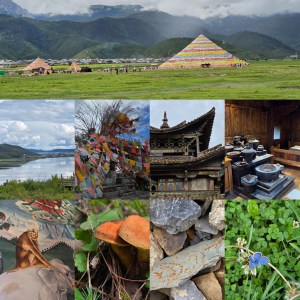
Departing straight into a local taxi (Didi滴滴) the flats of Xiānggélǐlā 香格里拉 spread out. A wide valley of farmland amongst mountains and foothills. Picturesque didn’t fit the description well enough. Cattle crossed the narrow road. Horses in lines moved with passengers on their backs. Many visitors wore Tibetan attire for photographs. Vast colourful prayer pyramids rose from the ground. Much was geared for photographers and travellers. Between the lines, the real Tibetan vibes and cultures intertwined a rapidly growing western front of China.

3km to the west of the railway station, a lodging was booked. The Lodge, Shangri-la Lao Shay Youth Hostel [香格里拉老谢车马店] is a dated yet cosy wooden lodge of three floors on the Napahai grasslands of Xiānggélǐlā at [石卡雪山纳帕海景区石卡路吉奴古村]. The sharp roof, underlay by two floors with fully-covered balconies, and timber towered over a small open courtyard. A secondary building, like a letter-L, stood to its left, housing an internal courtyard. The hotel’s names stretched across the side. A small faded sign erected at the roadside broke up a field of emptiness. In Tibetan the name looks better [སེམས་ཀྱི་ཉི་ཟླ།]. The barley wooden frames scattered by roadside and along the grasslands

A trip to the Shangri-La Alpine Botanical Garden (香格里拉高山植物园) didn’t disappoint. Seeing wild hares, a plethora of birds and insects, and countless plants filled the majority of an afternoon. The high-altitude 7,247 hectare garden of flora overlooked the expansive Napa lake below. The world first low and high altitude garden happens to be the Tibetan plain’s sole dedicated botanical garden. 30RMB well spent. We exited the park at 1830, slightly after the 1700 closing time. On returning, we walked to Gongbi Village Stop (贡比村站) and admired the drones flying iver the farmland spraying whatever it is on whatever was growing. Over the road the traditional hand methods tended to wheat fields.

Later, I’d research the longest tunnels and be shocked that a ten mile long tunnel we’d passed through didn’t even make China’s top 395 railway tunnels! The engineers of China have built incredible spans of bridges and underground tunnels, making it hard for you to comprehend or imagine the scale of the great nation of China. Its lands are 9.57 million km² (3.7 million miles). All of the land of Europe is 10.53 million km² (3.933 million miles²). And bigger than the USA. Only Russia (almost double) and Canada (by a smidgeon) are greater in size. Travelling in China really shows you how far and how diverse the landscape is, even if cities and towns take on a copy and paste feel. You’re never more than a mile from a Luckin Coffee (China’s equivalent to Starbucks or Costa Coffee). Other coffee shops are available.

Summer ’25: III – Bamboozled

Treated by family to a spot of travel and unwinding, we set off from a station nearly an hour from the place of residence.

In Guangdong, like many cities in China, you can drive by taxi for an hour and not leave the jurisdiction of that same city. Not even close. So, we arrived at station one, departed for station two, and arrived at station three in Yangshuo. 300 miles [482km] travelled across 2 hours and 42 minutes. Or further than London, and quicker than any British railway journey. Huizhou is massive at around 4,217 square miles [10,922 km²]. It is substantially large compared to neighbouring Dongguan, Shenzhen, and Guangzhou. A formidable region to navigate.

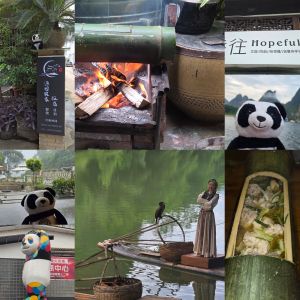
Badly Drawn Boy’s Everybody’s Stalking marked the train journey’s early moments through the tunnels of Guangxi. Through fine lyrics befitting the view out of train D1814’s window, the train rolled into the Karst-mountain surroundings of Yángshuò (阳朔). A quick lift from our hotel owner seen us dropped off at the digs, 阳朔源园饭店(20元人民币风景区店) 兴坪镇画山厄根底村76号, which is with Ergendi village. A bag of huángpí (黄皮) wampees (Clausena lansium) followed a delicious dinner. The grape-sized fragrant fruit, with a large seed core, sat well on a belly of bamboo-cooked sticky rice, some baby bamboo shoots, and pork sliced between taro. After seeing the cormorant fishing birds posing, the Li River (漓江Lí Jiāng) flower, and a multitude of tourist boats, nightfall followed a heavy storm. Bedtime soon followed.

Seems like many paradise regions become Piccadilly Gardens: that once flowery bowl of sunshine now covered in concrete and steel. The village of XingPing, near Yangshuo, has undertaken drastic growth in little over two decades, and really symbolised the idiom rén shān rén hǎi (人山人海) or people mountain, people sea. Allegedly the river Li below flows with over 215 cubic metres per sec9nd. The people on the shores seemed equally dense. Photographers, fashion people, tourists, local canvassers, and every manner of people seemed to congest the tiny footpaths of XingPing (兴坪) village.

We had a plastic bamboo raft trip upstream on the Li river, savouring the humongous Karst peaks and bends of the powerful river. More food, including a full chicken boiled in a soup within a bamboo tune followed. Plenty of wandering was had. Sadly, without speedy legs, the waterfall pond, Pubutang and Tiger Mountain Waterfall shall have to wait. Our train outwards to Guiyang was caught on time.

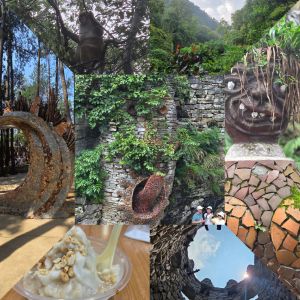
Guiyang straddles the eastern edge of the Yunnan-Guizhou Plateau and is apparently around 1100m [3600′] in altitude which may seem debatable as you traverse districts. The roads resemble Spaghetti Junction in Birmingham (England) with bridges crisscrossing lengthy tunnels and slopes throughout the surface routes. A decent subway and rail system serves the city and outer region. The Yelang valley was a pleasure to visit, a truly unique and hidden gem within China. Twenty years were taken for the recreation of an ancient culture. The stone sculptures and artwork are fantastic. Song Peilun’s vision is a highly recommended visit. Oh, and we saw a monkey at the Qianling Mountain Park, having clambered a large peak and being consumed by a passing storm. That was fun.

CN Lit.

Picking up a book, that usually I would never have picked up, one short story caught my eye. Then another. And another. Suddenly, I’d hit the halfway point of the annotated bilingual edition of the Selected Modern Chinese Essays 1.

The book, whilst a little gentle, rendered into英语 (English) by Zhang Peiji features a bland cover with a bare tree. The flimsy pages and cover almost feel disposable. Shanghai Foreign Language Education Press didn’t even supply a blurb on the 38RMB book. Never judge a book by its cover? Well, this book has all the appeal of a Mancunian skyline during the peak industrial revolution during a grey wintery rain shower.

“His name has spread far and wide and become more and more celebrated with the passing of time. Innumerable people have come to follow his example so that everybody has become a Mr. Cha Buduo.” – Mr About-the-Same – Hu Shih.

Despite the outward appearance and an inside cover telling you about the translator, little is given away as to the themes of the essays nor the 377 pages. So, reading on is the only way to delve deeper. First published in 2007, this edition arrived a decade later.

Through writing by the likes of Li Dazhao, Lu Xun, Xu Dishan, Hu Shih, Xia Mianzum, Ye Shengtao, Zhu Ziqing, Ba Jin and 24 other authors, I found myself transported from modern life to various times within Chinese history and at varied points of culture. Mosquitoes featured every now and then. Phrases and parodies of tales that I had heard clung to pages like my sweaty underwear in a Guangdong summer.

“A fighter is perennially young. He is never irresolute or inactive. He plunges deep into teeming crowds in search of such vermin as flies and venomous mosquitoes.” – Be a Fighter, Ba Jin*

Plenty of themes feature throughout, including hope, faith, and the need for family and friends. The book itself is deep in meaning and easily interpreted in many different ways. Rereading a few pages, I quickly realised how the Bible, the gospels, and other religious texts could be manipulated under one light or another. Books are powerful things. We should read more to understand more and always adapt or change to whatever life needs, rather than desires. Equally, we should read for pleasure in a diverse way.

I enjoyed something different.

*See also: Carpenter Lao Chen and Dreams but the same author, Ba Jin.

Guava plant pots

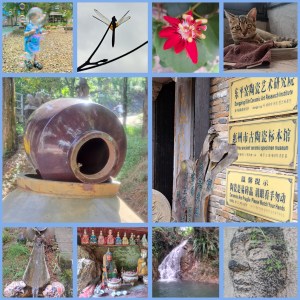
Never take a bull to a china shop. Equally, a toddler in a Chinese china museum and tourist spot is of little recommendation. Said toddler tumbling a plant pot into a fish pond, whilst trying to rip a leaf off a plant is quite an embarrassing happening.

Munching on hakka dim sum and 番石榴 Fān shíliú (Guava) with the sound of running water is quite relaxing. Even if the temperature is 33°C, with 75% humidity,  presenting a real feel temperature of 40°C. On top of that, your body melts, runs with sweat, and staying hydrated is a priority. Beyond these minor issues, the state of relaxation as birds tweet, red dragonflies fly past and and butterflies flutter between the bamboo tufts. Mosquitoes feast relentlessly. Relaxing.

Wandering around the extensive ceramic kilns, wood carving lodges, farm restaurants, and sculptured gardens was relaxing. The whole arena is fenced off and reasonably safe if you keep an eye on the deep water, fragile articles, and sharp bits all over the floors and walls. Complimentary kittens are provided in one of the toilets, and a local waterfall at temple XiHeGuMiao (西河古庙) is a pleasant stroll up a steep concrete road. Eagles and other wildlife like frogs, tree frogs, snakes, and mosquitoes can be seen.

The restaurant provides cabins, lodges, and open areas for a range of local food cooked well and enjoyed with the ambience of a dark evening. There are turtles, cats, and a happy dog. The centre and studios offer pottery experiences, fan making, and other activities for all. A few hours can be had away from city life.

Dongping Yao Ceramic Museum/ Dongping Kiln Cultural Scenic Spot, Huizhou City, Huiyang District, Huiyang District

Top Marks: GaoBangShan 高榜山

229.66m high isn’t much to an adult. But to a person of 83cm in height, it might as well be Mount Everest. That’s the gist of GaoBangShan mountain in Huizhou. A decent hill with a selection of pathways swoops around the summit. At the summit, a modern collection of Sinology, medicine experts, and important Chinese cultural architecture awaits.

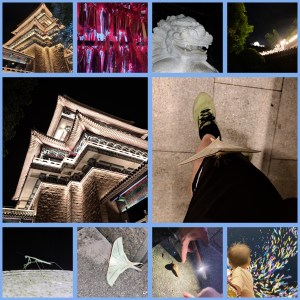
Under moon and floodlights, it is highly recommended to blow bubbles like a fan of West Ham Utd. Expect to see bats, moths of various sizes, and shapes. The odd preying mantis amongst the night insects (mosquitoes included) can be found hunting alongside geckos and amphibians.

Smells range from dirty bins to humid dank dark paths lined with fragrant tropical flowers. At the summit and several points, the usual food outlets sell overpriced food and drinks. Beyond the hundreds of steps, lighting and piped music fill the air opening to the northern skyline of Huizhou and its surroundings. Your heightened awareness grows under tree canopies. Their umbrella canvas with limited lighting along the lower pathways shades out the light pollution beyond the treetops. It cakes those who walk beneath in humidity.

The steps up are a struggle. They’re uneven, yet modern. Each step appears slippery, and with damp patches of leaves and giant snails throughout, they’ll test the best sporting footwear. The knobbly-bits of pebbles on some footpath interludes are equally perilous. All part of the parcel in a dark park walk. The dense foliage, abundant with local species, although manicured at the path edge, gives an authentic taste of more wilder parkland.

For a few hours of wandering, the park features toilets at the foot of the main gate pathways, a few temple structures, and benches here and there. It is a short distance from Xihu (West Lake) in Huizhou. Xiao Crocodile Lake and Luoshan mountain are visible from the rear of the mountain. The name GaoBang means something to do with first and study, I’m told. When the Chinese Gaokao exams happen, many family people and students come and ask for good luck. The moon over the hill looks pretty, and a nightwalk is most recommended, even in the heat of summer.

Address: 惠州市惠城區江南街道共聯東路紅花湖景區附近

China Travels: Recap.

“It’s coming home. It’s coming home. Football’s coming home.” – England football chant during the Women’s European Cup.

There has been a huge gap since travel has been possible and plausible. Never spending more than a few days in Huizhou, Shenzhen, and just hours in Zhongshan since October 2021 had been quite challenging. Travel, during 2021 and 2022, in Guangdong was unthinkable. The suffocation of humidity and toasting heat above thirty-five Celsius seemingly spelled death for me. Unthinkable. I have zero tolerance to being baked alive.

I’ve been blessed since February 2014. I’ve stepped from my comfort zone in UK living and managed to live abroad for over 8 years. Not every year has had a roasting summer. With just summer 2020 spent in Dongguan, owing to an 8 day change of employer, I’ve not had to endure too many hot days. The air conditioner had never been far away. Green parks like Dalingshan Forest Park and Tongsha wetlands have proved useful for distraction. Summer 2022 wasn’t like that. I found myself on crutches and once again trapped in Guangdong, being cooked. Far from other provinces and cooler ait.

Northern China stretches far and wide from west to east and vice versa. Here, journeys into Ningxia province have proved adventurous. Inner Mongolia and the chills of Heilongjiang have been a stark contrast to the warm southern regions. Gansu was a pleasant surprise. The stifling summer heat, broken by northern breezes and a dryer sunshine.

Through the coastal east and lands of Nanjing, Shanghai and Suzhou, I’ve managed a few looks at a variety of urban and green vistas. Touching down in Shandong and Qingdao was a spiritual connection I welcomed. Thanks, Granddad George Acton, for making me curious about that naval city you once stayed within. The trip there proved colourful and now brings fond memories.

Western China, especially Yunnan, has warmed my heart and claimed my love. Sichuan and Qinghai have equally gripped my passion for the outdoors. Those vast mountain landscapes and green pockets and valleys could fuel a thousand stories. Each one with tales and wilderness to inspire.

In the core of China, Hunan was varied in appearance and home to the mighty Zhangjiajie Nature Park. Forget it being the backdrop to James Cameron’s blue movie Avatar! It’s stunning for millions of other reasons. Xi’an proved an intense city surrounded by history and bathed in glorious culture. Shaanxi and Shanxi provinces each had many highlights.

Guangdong and Guangxi are side by side, and Fujian sits to the east of the former. Here, weekends and short breaks have been spent. Vietnamese coffees, seafood, and wanders along coastlines have gripped attention. All within a short distance of Dongguan and very much accessible before the Covid-19 pandemic.

Of course no trip to China is complete without swinging by modern day capital Beijing. Comedic travel and radio presenter Karl Pilkington visited there in a few episodes of An Idiot Abroad. Like his views, I don’t really like the capital city. How a city of that size doesn’t have a plethora of top flight football teams, or a heartbeat like many other capitals I’ve visited is beyond me. It felt very much like visiting how I imagine North Korea to be. Not my kind of place. Gridlock, grid lines and authoritarian concrete landscapes are a travel turn off. There are historic gems but how much has been remade is open to debate. Even the Great Wall looks too new. Apart from the wild bits. They’re glorious!

Macau, I could live without. It’s okay for a few hours, but not my kind of place. Hong Kong was the global city of cities, but times have changed, and I suspect so has Hong Kong. Many refer to it as just another Chinese city, now lacking its once famed uniqueness. The velodrome, mountain trails, and Clockenflap music festivals are just a few of the many highlights.

One day, I hope to visit Tibet and Xinjiang. For now, those journeys remain on a to-do list. Never say never. And, in September 2022, I found myself back in the UK. I didn’t think I would return to China so soon. The border reopened to tourism and many visa types in March 2023. That change and another more needy necessity led me back to the charms of the People’s Republic of China. This large swathe of lands often offers many attractions still. Would I move back? Never say never. Right now? No.

TRANSLATE & SOURCE

TRANSLATE & SOURCE

Maria Sun comes from Hunan (the landscape used for hit movie Avatar) and now resides at the centre of the Middle Kingdom that is China.

Dongguan Unique Trading Co. for translations, culture, social events and more.

We’re different.

东莞优昵科贸易有限公司

We translate, we source, we hire, we care, we create, we inspect, and we listen. You tell us your needs. We carry out your instructions. You have questions. We answer.

VARIED SERVICES AVAILABLE

Very simple and logical, right? The answer should be yes. We have experience working with partners and manufacturers in and around U.S.A., Turkey, south China, and Hong Kong. We are based in Dongguan, a city, only two hour’s drive from Hong Kong. Our convenient location is in the province of Guangdong, with the provincial capital Guangzhou (Canton) an hour to the north.

Zhongshan, Zhuhai, Shenzhen, Foshan and other large cities are easily reachable. High speed rail operates to the capital city of China, Beijing and financial hub of Shanghai.

We create things and take action. We have experience from humble beginnings, having founded Dongguan Speaker International English, alongside several partners, in 2008. Our training school serves students as young as kindergarten to adults learning at an advanced level, alongside factory staff. Our school has grown substantially and has grown to one that occupies an area of 2680 square meters. We now have franchises throughout China.

ETHOS

We talk the talk, and walk the walk…

We firmly believe in the following standards and practices:

  • Quality controlled services.
  • Dedication
  • Experience
  • Ease of flow services (offering stability in your overseas operations, here in China)
  • Flexibility
  • Clear communication and understanding (We will listen to your demands!)
  • After care (including, feedback and response)
  • Stability

We won’t take the biscuit.

请随时要求报价,这是一件无计价和无麻烦的事
PLEASE FEEL FREE TO REQUEST QUOTATIONS, WITHOUT OBLIGATION OR HASSLE
欢迎询价或分享您内心的那份平静
MAKE AN ENQUIRY OR SHARE YOUR PIECE OF MIND FOR PEACE IN MIND.

GET IN TOUCH

Maria Sun, Manager (孙佳, 经理)

电话/phone number: +8618988742358 [WhatsApp]
微信/WeChat: Maria-in-Speaker

邮箱/e-mail: 370105612@qq.com

Address: 东莞优昵科贸易有限公司 (贸易和翻译)中国广东省东莞市常平镇木輪创新路6号818室/ Dongguan Unique Trading Co., Ltd, Room 818, Chuangxin Road No. 6, Mulun, Chang Ping Town, Dong Guan City, Guang Dong Province, PRC

699618407681408799

“Maria answered our call, and did a wonderfully detailed job, answering all the questions as if she was the owner and developer of My Hills itself.”

HubHao Magazine


Former joint-owner of Winners Bar (Hengli, Dongguan).

Founded in 2014 [a little after Ye Olde Trip to Jerusalem (Nottingham, England) reported to have been opened in 1189AD], Winners has core public house values at its heart. We serve beer (cool and crisp), nuts and crisps, have a dartboard, there is a pool table (or billiards to our more international friends), delicious foods (until 10pm daily, with snacks afterwards), TVs for sports and music, and a friendly warm (or air-conditioned) atmosphere. Did we mention we had a special and private KTV room? Sadly, we had no pub dogs but feel free bring your own well-behaved canine friend. For other pets, please consult the bar staff. Now under new ownership. Winners has links on the interweb via TripAdvisorFacebook, etc

Address: A10-A11, RuiKang Road, Hengli Town, Dongguan, Guangdong, China

Examples of our services:

Presentation translation services for MyHills Group in Nancheng, Dongguan.

Pullman-Forum-Dongguan1

Proof-reading of menus and advertisements.

Conferences, trade shows and fairs.

We work and have worked closely with:

HubHao Media (Dongguan, China)

luffoliate

Luffoliate (USA)

MODEL COMPANIES (USA)

mmexport1489304482135

Speaker International English Village (Changping, Dongguan, China)

Speaker English Village (Hengli, Dongguan, China)

Speaker International English, (Dongcheng, Dongguan, China)

winners logo proposed

Winners English Bar & Restaurant (Dongguan, China)

Slide4

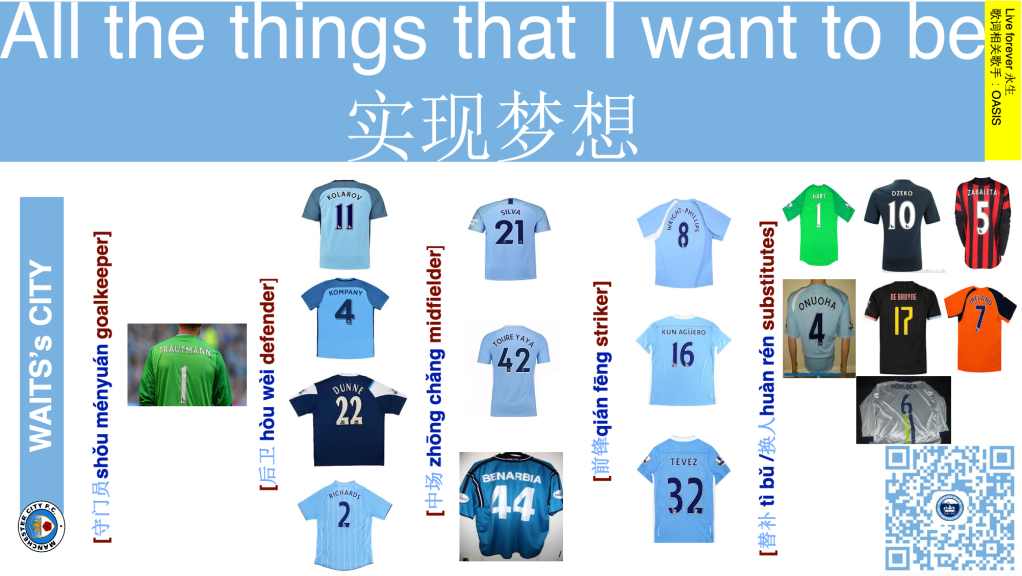
Shenzhen Blues – Manchester City Official Supporters Club & Murray’s FC (Guangdong, China)

Zahabian Enterprises, LLC (USA)


Say what?

Previous clients and current customers said this of Dongguan Unique Trading Co. Ltd. formerly, YiFan Dongguan Transaltion Co. Ltd.

Feel free to hunt them down and verify that we have copied and pasted what they said, unedited and directly to the below. We don’t lie. We don’t need to.

READ OUR REVIEWS BELOW

“SZBLUES IS BASED ENTIRELY ON THE HARD WORK OF VOLUNTEERS AND TO HAVE THE OPPORTUNITY TO USE MARIA’S SERVICES HAS BEEN A GREAT BENEFIT.” – SHENZHEN BLUES

[archived; converted from a site page: April 2023]

11th January MMXXIII

The 11th day of the Gregorian calendar. 354 days of 2023 remain. In Tunisia, it is Children’s Day. In England, Southampton F.C. host Manchester City in the E.F.L. League Cup. In. Nepal, Prithvi Jayanti is being celebrated.

January is a time of sales, newness, and winter blues in the northern hemisphere. My younger sister Astrid was born on the 20th day of this month and remains to this day, my younger sibling. Also, she’d be a star if Astrid found more hobbies. A new year means resolutions and opportunities to start something fresh. Go on, Astrid, give it a try! Spring is coming soon…

Newness means looking at new ideas. Talking about baby names with my future Prime Minister friend, some oddities were suggested. Brahma Timothy Dalton Kiki Glauber Berti Acton was not considered, although it was recalled by my mate Brahma as a great baby name suggestion. No chance. Maltese rebel Vincenzo Borg, born on this date in 1777, stood a better chance. Also born on this day was SAS founder Paddy Mayne. The name Mayne has a good ring to it. It sounds like Maine. Maine Road? Very direct. A main road. Never cross the main road, as were told as a kid. Never cross the Maine Road, as Manchester United fans used to say.

Suggested names often link to history, time, and dates. In the month of the wolf moon, Wrestler Mick “The Dulwich Destroyer” McManus was born on this day. Combining the letters of man with the letter u isn’t appropriate. He was born on the same date a few years before Arthur Scargill. They are in good company with Bud Acton, my all-time favourite basketball player. I’m fibbing. I don’t really like basketball. The Manchester Giants are okay. Manchester City are better. İlkay Gündoğan plays for the boys in blue. İlkay means first moon.

Today is former Halifax Town striker Jamie Vardy’s birthday. To save money on a party, he and former Manchester City player Leroy Sané can organise a joint party reading Thomas Hardy books in the memory of the great wordsmith. A photo of great mountaineering humanitarian Sir Edmund Hilary could be placed on a wall behind a breathalyser to ensure party guests don’t drive home under the influence of alcohol. That great invention by Welsh inventor Tom Parry Jones has probably saved more lives by being a deterrent than not. So, that all can appreciate the Chinese calendar year…

The Chinese year is somewhere between 4719 or 4659, 壬寅年 (water tiger) to 4720 or 4660 癸卯年 (water rabbit). Give or take. China has recently reopened and gives me a chance to try and book a flight back soon whilst applying for the visa. Perhaps I can call via Croatia, which has now fully adopted the Euro coinage, and will abandon the kuna as a currency in 4 days. These days, I’d simply favour a stable job and some pounds or RMB to help the future move along smoothly.

Indigo is a cool sounding word and same. It has passed from the Greek word, ‘indikon’, meaning ‘from India’ to Latin into common usage English. It reflects the meaning of a purplish blue colour produced by a plant with a similar name, Indigofera tinctoria. In naming formats for kids, it is gender-neutral and apparently appeared as far back as the year 1436. Marco Polo (1254-8 January 1324) is believed to have first brought back the plant and dye instructions to Europe. These days, the plants are often known to improve soil and bring new life to earth. This plant obviously provides a natural compound that allows blue to be added to clothes, canvas, and a multitude of materials. Naturally, I’m a blue as a Manchester City fan. Blue is natural. Look at the skies* and the sea. [*unless in Manchester, on this sodden wet morning]. There’s something about the moon and blue that feels right.

12:46pm China time, in Huizhou. 04:46am, Greenwich Mean Time…

The moon is rising.

CCTV Music Review (Kind of)

CCTV (Chinese state TV) didn’t commission me. I’m just reviewing musical experiences in China. By that, I don’t mean Mr Oliver making his students wild at an end of year school show. Melodic music seems completely endemic here. Rhythm and blues do not. The exploration of music in China has been limited. Pop concerts are plentiful. Traditional music is out there. KTV is everywhere, seemingly only beaten in numbers by the dreaded mosquitoes.

Throughout travels, I’ve overheard piped speakers repeating at shrieking levels “wǒ ài Mǎnzhōulǐ” in deepest darkest coldest Inner Mongolia (内蒙古) to two people, in a field of ice. Actually, almost every province I’ve visited has had Mandarin language to its music. Rarely have I overheard local dialects, other than Cantonese in Guangdong. I’m convinced when my Granddad George Acton visited Qīngdǎo (青岛) and ShànghǎI (上海) in the 1940s, he visited at a time when local dialects were rife and strong. Whilst Mandarin has brought uniformity and literacy, it did also deliver annoying song xiǎo píngguǒ (小苹果).

Released in May 2014, the catchy Xiao Pingguo song refuses to go away. I think of it as China’s answer to the Crazy Frog. Wang Taili (王太利) and Xiao Yang (肖央) are the successful Chopstick Brothers (筷子兄弟). They’re not on my Christmas card list. Ever. They were even parodied by the Chinese Ministry of Defence, for recruitment purposes, in July 2014. I remember it being irritating then but if that’s how they plan to tackle the Taiwan problem, so be it. Siege by surreal music. Like Christmas songs in July, Xiao Pingguo never exits your head or seemingly airplay.

In education, I’ve witnessed a wealth of traditional instruments from China. Students plucking the Guzheng’s (古箏)’s 16–26 strings, or pear-shaped Pipa (琵琶), or similar Liuqin (柳琴) have formed mini-orchestras and solo acts throughout many school shows. A whole wealth of other stringed instruments hasn’t been seen in Xinjiang or Tibet, because I’ve yet to visit either region. I have heard and seen the two-stringed fiddle (Erhu 二胡) in action. I’ve had a go in Yunnan too. Maybe one day I’ll try it again. It can have an upbeat melodic ring to it, or deep blues. Mandopop and Cantopop covers haven’t been far behind.

Hugely popular song: WoMen Bu Yi Yang 我們不一樣 – by 大壯 Da Zhuang

There are countless string and pipe instruments throughout the land of China, with names too unknown to write and sounds heard rarely to explain. Clay, bells, silk too, and other instruments are fantastic to see in villages and countryside areas. The húlúsī (葫芦丝) is a gourd wind instrument that looks like a bulbous pipe swallowed a recorder. It can be played in a haunting manner, as witnessed in the foothills of Yunnan. Unlike Eason Chan, G.E.M., Jackie Chan, Jay Chou, the TF Boys, BTS, and other Chinese pop stars, I will miss traditional instruments like the húlúsī.

Dagu (大鼓) means large drum and would have been found in countless drum towers across imperial China. These days they can be found at school shows alongside the Zhangu (战鼓) or war drum. Likewise museums may encase them, just up the aisle from flutes made of bones. Yǎyuè (雅樂) translates to something like elegant music. The aristocracy and Confucius believed music could only follow one path for self-cultivation and governmental ruling. “March of the Volunteers”(义勇军进行曲 Yiyǒngjūn Jìnxíngqǔ) probably fits the yǎyuè mindset.

Originally known as The March of the Anti-Manchukuo Counter-Japan Volunteers, the national anthem of China can be found weekly at school flag raising ceremonies, all national holidays, supermarkets, and even playing from children’s toys. The national anthem was penned by Tián Hàn (田汉), a novelist and playwright). It was set to music by Yunnan’s Niè Ěr (聂耳) AkA George Njal, as was his wish. Sadly Nie Er drowned at a young age and never expanded on a blossoming and flourishing musical career. Many moons later I passed through his native Kunming and listened to the sound of heavy traffic. This after days of bird song, didgeridoo, and drums in Dali.

Hong Kong, the Magic Island Festivals at Zhuhai, Guangzhou, Dongguan (mostly Irene’s Bar) and Shenzhen remain the places I’ve seen the most live music during my years in China. A few live bands and DJs in Shanghai and Dali probably complete a short list for a large land. It hasn’t been that I haven’t been looking for it of asking for live music. Even before bloody CoViD-19 struck, it was hard enough to see live music and a million times harder to get tickets. Strip away the VIP, VVVIP, of Golden Platinum VIP options and music tickets are hard to find. Expect nothing for anything labelled VIP. The gimmicks are status only.

In Dongguan, whilst writing for Hubhao magazine, I was lucky enough to enjoy Netherlands band Atlantic Attraction. Their website is now about knees so I guess they broke up or faded out. I went looking for answers. None. Perhaps when I fly home to the UK via the Netherlands, Kevin de Haas will swap vocals and guitar for baggage handling, and Arend Lacked may have moved to Airbnb, or Joris van der Pole may have shed bass in favour of bus driving. The drums are out so perhaps Sibren Huijsmans will sell me a coffee. A good band. Missed.

Epic festivals at Hong Kong such as Clockenflap, seeing Paul Draper at Guangzhou’s Mao Livehouse, swinging by So What Livehouse and the various Brown Sugar Jar venues have been good experiences. Watching Mr Irish Bastard at an intimate night in Shenzhen or spending Christmas Day with an acoustic guitar concert will remain fond memories. And of course, Dongguan foreign band, Revolution, now dissolved… and out if their ashes, come Reload. That’s Sunday’s entertainment sorted. Big Band Theory at Murray’s were electric, as has been almost every music night at Irene’s Bar in Houjie town.

The journey through music in Asia and from China won’t end on leaving this country. I’m already booked into seeing The Hu, a Mongolian rock band later this year, complete with instruments, the morin khuur and the tsuur. How China can water down Mongolian dialect in favour of Mandarin in Inner Mongolia (P.R of China) is beyond me? Languages need preservation, and music has long imbibed that theme. I can’t wait to experience my next installments of Mongolian music after Taiga band in Bar Ink, Dongguan.

And of course, I can always say my former St. Lorraine students featured on a music video of the Sun Yat Sens. Wechat微信… Wechat微信…

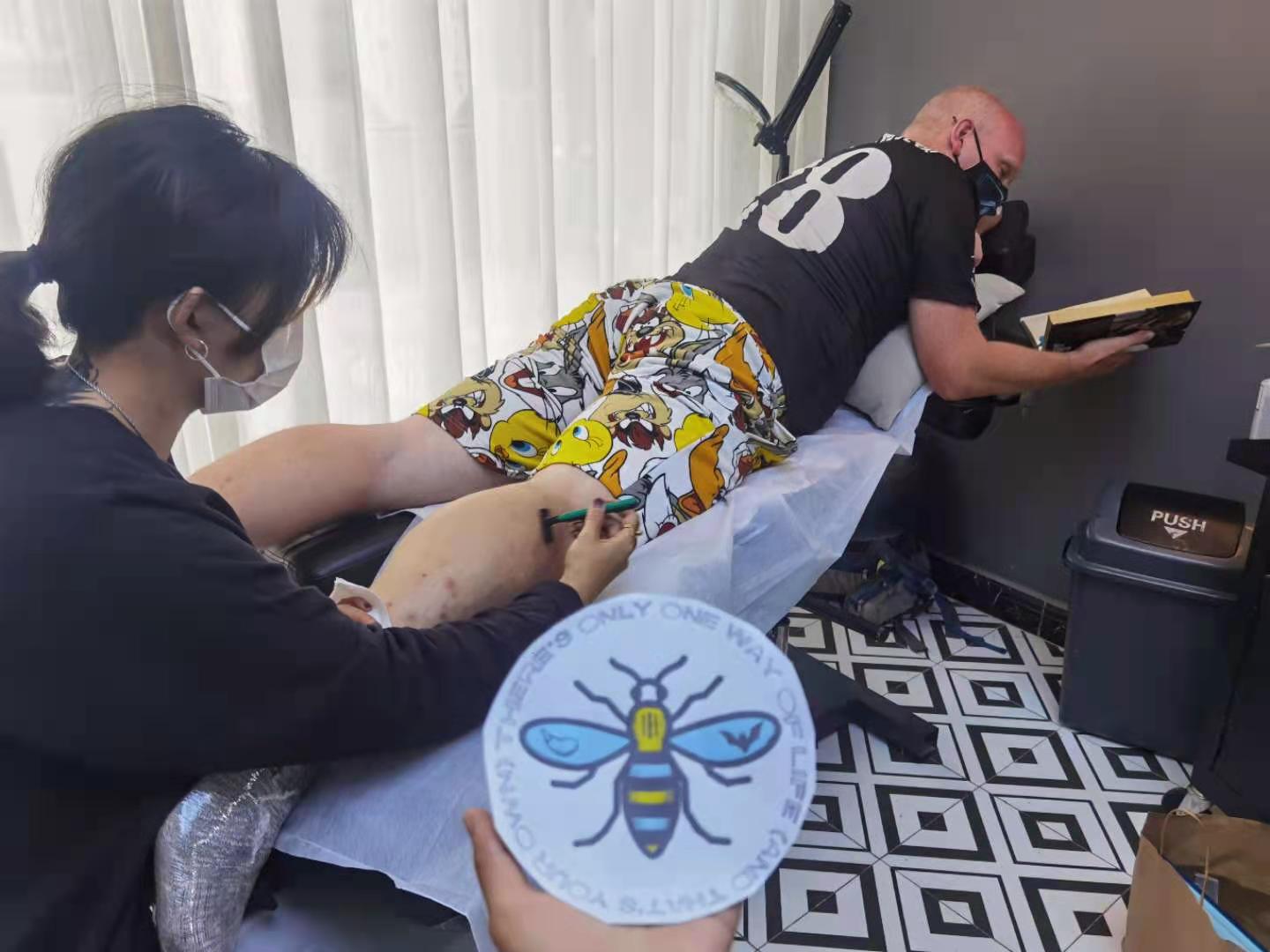
And my Levellers lyrics were tattooed in Yunnan.

Screen time.

How do.

Twenty classes a week of forty minutes each time. That’s 1600 minutes of screen time. A further week of online teaching to follow. That’ll be another 13 and a third in hours. That’s 40 hours looking into a camera before adding marking time, writing comments, preparation time and other activities needed to perform online classes. There are 360 available hours across 15 working days. Upto 120 of them should accommodate sleep (based on 8 hours sleep). At least 2 hours a day should be spent on reading, writing by hand and keeping the brain sharp.

The above discounts relaxing watching a TV series to switch off a little. That further screen time is an optional necessity. Hobbies and pass times make us who we are. A further 15-30 hours slips like a victim of Ozark onto the screen time tally. The addictive nature of the American drama-thriller Ozark drives further screen time. Marty Byrde’s predicament and the twists in the tale place that screen time closer to the full 30 hours. You need to know how series one concludes. Six and two thirds of an hour fills that first week of our daily post-online teaching.

Putting aside the Mexican drug cartels for walking Panda the dog takes up at least two hours a day. His little black and white legs need the pavement pounding. That’s a minimum of 30 hours gone. Happily gone, in fresh Dongguan air and winds with rain. Songshan Lake town’s reopening greeted our walking routes well. The township has treelined paths and gardens with roots. a the North-eastern end of Dalingshan does not quite match it. This town has its own long-lasting industrial revolution.

120 hours of sleep. 40 hours online. 30 hours dog walking. 30 hours of TV. 30 hours of reading, writing and puzzles. 360 hours over 15 working days. Too much screen time. My eyes have suffered. Coupled with the need for air conditioning at times, the dehumidifier for external 98% air humidity sweeping through the doors and now I’m feeling an opticians maybe a good shout. Apparently, after enquiry, I was told I must book one via my phone. Screen time.

Tonight is Earth Hour between 8.30pm and 9.30pm. It shouldn’t be difficult to switch all devices off. The desire to disconnect has been rampant this last two weeks. I suspect the next week shall be no different. The tomb-sweeping festival follows the week after this. Qīngmíng Jié (清明节) means ‘pure bright festival’ and this brightness or clearness celebrates ancestors. Around March and April, spring arrives bringing warm air, clearer skies and a more jovial atmosphere. It gets warmer, although in South China’s Guangdong it could be argued that the climate here hasn’t really been cool for some time, despite occasional cool snaps.

Qingming festival has a Cold Food Day, the day before the festival. No fire or heat should be used. Think of it as an old-fashioned Earth Hour dating back to around 1046-221BC. The Zhou Dynasty’s festival has origins in celebrating emperors and the wealthy. Even today some celebrations are extremely extraordinarily extravagant. Most people simply upkeep and repair tombs. They use their big brushes go sweep away the many fallen leaves of spring in Guangdong. Food, wine and incense are placed accordingly. Joss paper is set alight and a few thousand plastic plants are distributed regionally. Families often go on spring outings too. Although in Dongguan, following a smattering of COVID-19 cases, gatherings and tomb visits are banned this year. Bloody coronaviruses. I’m sure Dongguan did the same last year and the year before. Bloody COVID-19.

Screen time has also given me chance to communicate with home. It’s good to see Mum up and about on her road to recovery, accompanied by Paul and their adventures of pottery and gardens. Tomorrow is Mothering Sunday (or Mother’s Day) in the U.K. Every day should be Mother’s Day. Happy Mum’s Day. I would send flowers but that means more screen time ordering them online.

That’s that for now. Tally ho. Toodle pip.

Tiger Feet.

新年快乐 Xīnnián kuàilè / Happy New Year

It’s 2022 and Monday, January the 31st sees rockets zipping into the air, exploding into slivers of shimmering silvers and reds.

恭喜发财 gōng xǐ fā cái / happiness and prosperity

Children and adults play with firecrackers, and light spinning fireworks on the ground. Bang after boom echo and fill the smokey night air loud and long. The air wreaks of chemicals and smoke, remaining lit and shrouded by reactions, collision after crashing explosion. The onslaught, a man-made destruction of fresh air to celebrate a new year. A temporary volcanic blast of colourful joy.

虎年大吉 hǔ nián dà jí / Wishing you luck in the year of the Tiger!

The tiger (虎 hǔ) , faced with extinction, is third of twelve on the Chinese zodiac. Lucky colours in this wood tiger year include grey, white, blue, purple, orange, and black. We’re supposed to avoid gold, silver, brown and pink. The largest living cat species, Panthera tigris, is a critically endangered is an apex predator. This vertically striped beast has a hugely fragmented territory now, enjoying protection in parts of India and Russia. This macrofauna remains popular in culture, sports and at conservation parks globally.

Tigers have featured in folklore and mythology for countless years. The national animal of South Korea has little documented evidence that it is still present there, yet like many countries the symbolic value of the tiger remains powerful. Last official estimates show there to be less than fifty tigers wild in China. The anti-pest campaigns of the 1950s have decimated the genetic breeding populations. However, laws and regulations since 1993 have been strengthened. Sadly, traditional medicine still remains a threat. Bloody English game hunters wiped thousands out and to this day man-hunter tigers are often eliminated.

Zoos aren’t always as they seem. Many in Asia lack genetically valuable breeding specimens. Generations of inbreeding and circus or posing animals have weakened a vulnerable captive breeding population. Bluntly putting it, the tiger’s future is on its last legs. Fragmented habitat, poaching, habitat destruction, human-wildlife conflict, and medicinal beliefs put tigers firmly in the negative zone for the future. Globally there could be 5495 tigers in the wild. Or less. So, let’s hope the Year of the Tiger brings prosperity to the giant feline. Yann Martel’s Life of Pi softened tiger images, whilst Tigger in Winnie the Pooh hasn’t done so bad.

Tyger Tyger, burning bright,
In the forests of the night;
What immortal hand or eye,
Could frame thy fearful symmetry?’ – Tyger, a poem by William Blake

This year of 2022 will be haunted by COVID-19 and climate change, global differences and financial crisis. The bright sparks in the darkness include the Hunchun Reserve (珲春国家级自然保护区) and the South African Laohu Valley Reserve for South China tigers (Panthera tigris tigris). Li Quan (全莉) has been deeply involved in trying to rewild South China with tigers.

虎运连年 hǔ yùn lián nián / Wishing you the luck of the Tiger year after year!

Make note: 29th July 2022 – Global Tiger Day

Roar on.

Stage XI: Abuji Cuo

你好!Nihao! Hello!

Anticipation surrounded the morning. We after off for a selection of steamed, boiled and grilled breakfast mainstays of Chinese breakfasts (across this huge nation). With that, those without raincoats purchased those disposable rain jackets designed to be worn for an hour or so. The kind that would make Mr Macintosh roll in his grave with tears. Not to mention environmentalists. Sorry Greta!

Abuji Cuo (阿布吉措) sounds Japanese. It certainly seems unlike Mandarin Chinese. It’s surrounded by the Ajiagang Mountains and stands high over meadows and scattered pasture houses. It’s well off the beaten track and fairly clean of trail litter. The name comes from one of the many local Yunnan languages and people but I couldn’t find a true translation or meaning. It is apparently very holy. The China National Highway 214 and Xiangli Expressway (toll road) are to the west. Here a dirt track leads under two bridges (the new Shangri-la railway line).

The car journey led us to a gate. It had a weight on one end and two barriers across the path ahead. Here began the wander. The base camp was labelled just that. The pathway was an old track, now used by loggers as well as the original farming people of these steep damp foothills.

Rounding a bend, the footpath exited the road, passing between free-range pigs and towards a slim yet fast-rushing stream. Our group of six with a local man tagging along crossed the stream over felled logs now doubling as a bridge. Here the path gently led to an open plain standing below the face of the mountains. The phone signal had soon disappeared – something good for the quiet ahead, but unusual on mainland China.

After passing through the deep lush green meadow, the path banked left over several bubbling streams complete with stepping stones and bridging points. Here the path zig-zagged up and across gaining altitude fast. It’s steep sections were marred by slippy sticky clay interspersed by sharp shards of rock. The sides of the path displayed vivid biodiversity with wild gooseberries, something like rhubarb and wild strawberry plants amongst the plethora of greenery.

A local Yunnan man Qī Lín(七林), a girl from Anhui, a student from Guangzhou, a girl from Heyuan, a girl from Hubei, and another girl (from somewhere in China) walked up in light to heavy rain. The thick cloud thinned and grew in almost pulsating slow motion. At times the valley behind seemed hidden. At others it became a tapestry of various green hues.

The imposing mountain to our right shoulder (mostly) could have been Skull Island from the King Kong movies. It’s ferocious face looked brittle and completely impervious to those intrepid climbers who like such nooks and crannies. The artistry of nature had created such a detailed spectacle. The top range of peaks could have been a crown, or a bed of thorns. It truly sets the imagination running as wild as the fight ravines within.

The stream accompanied the walk up, and at times became the pathway giving clear flow to passersby in need of a quenching swig of freshness. After one small lake the path hugs a slope covered in knife-sharp vicious broken rocks. Blue flowers emerge where the rocks allow soil to gather. The rug of land is unforgiving and not a place to stand in awe of the view ahead.

What lies ahead is possibly the greatest lake view I have ever seen. The cauldron of clear green and blue water appears impossibly deep. Local legend has it that there is no bottom to the icy water. It’s entirely believable. The edges look crystal clear but beyond that, well diving would be the only way to know what lies beneath. The surrounding slopes are mixed in terms of harsh angles but most are barren. Life is not easy. We were stood around 4300m and the highest point is about 500m above here.

The caldera-shape of the valley spreads wide and long. From numerous vantage points it’s hard to tell what started this paradise on high. The geological features and lay of the land are mesmerising. It grips your heart whilst choking your throat of air. You can suddenly become breathtakingly awestruck. You look. It stares back blankly. Rumour has it, if you speak to loud then rain will come. Here at the top, for the most part, rain eluded our group. The feeling of healing as you look around you at the majestic landscape is overwhelming. I couldn’t help but feel my heartstrings being tugged and a tear in my eye. There are few places left that are this pristine.

Shangri-la (香格里拉县/Xiānggélǐlāxiàn) is a county and a city that draws it’s English and Chinese names from James Hilton’s Lost Horizon. It influenced China to rename the Yunnan city of Zhōngdiàn (中甸) in 2001 to Shangri-la. The Shangri-la of Hilton’s writing could have been Kashmir, Tibet or anywhere else along the Kunlun Mountains of the author’s description. But, if James Hilton had have travelled to Yunnan and Abuji Cuo to see the steep cliffs, loose and rocky earth scattered with flora and colour, he may have set his chapters here.

Abuji Cuo is about 4 to 5 hours (around 17-20km) up and only accessible from May to October. The gate (near a temple) is manned and access denied at other times to allow ecological balance. Non-slip shoes are essential, although I spied a few people in sport shoes. One unlucky soul was sporting a sprained wrist, leg injury and looked sheepish. Her local guide was guiding her down ever so slowly. The muddy pathways demand good grips. The steep falls are lethal in appearance. And there are yaks. Yaks can surprise from above, and they did on our walk once or twice. Death by yaks would be rather a bad day at the office. The road starts between to Bixiang and XiaoZhongDianZhen.

The hamlets of Nigeria, where we drank milk, and the Niguqe (尼古个) hamlet are sparsely populated so expect to see few people. The nearby hamlet of Gangzhemu (岗者木) is close to a scenic spot called Bitahai (碧塔海景区) but that could easily be a different world. However, it would make a tasty multi-day hike with camping. Scope to return? Head to Bengla (崩拉)?

The walk back down was every bit as unforgettable as the ascent. Ancient woodlands caked in drapes of moss and lichens, the sound of a chorus of different birds and the smell of flowers give your senses a tasty day. After reaching the pasture at the cliff face, a local woman gave us hot potatoes, and well wishes. After that we walked to the road and were greeted by a drift (or drove) of pigs. The curious tail-wagging group led us to discover some local fruits, to which nobody knows the name. QiéZi gave me one that looks like it is shaped like a bottom. Rather cheeky!

Soon after Qī Lín (七林) introduced us to an elderly farming couple. Here we had hot milk, sour homemade yogurt and delicious cheese. The wooden cabin was a good end to a day’s hike and we bid the farmers goodbye before jumping in a car back to Shangri-la. The unique and diverse holy Abuji pasture would occupy our minds for the evening and I’m sure that visiting there, we gained something more.

Grid reference: 27.666254378118495, 99.90886934422305 (Abuji Cuo) to Bixiang village (27.604282621386876, 99.78759058373961). 14km distance as a local chough would fly.

再见!Zai Jian! Goodbye!

Stage X: Shangri-la Too

Nihao! 你好!Hello!

I awoke on Wednesday just after 05:30. I’d had about 5 hours sleep. The rooster may have fell under the category of an unwanted alarm clock. Bizarrely, I couldn’t nod off again. Yesterday evening had been quite subdued. I’d hung out with Echo and QiéZi (茄子) in their funky friend Cici’s juice and snack bar. Over blueberry and banana toasties it was decided that QiéZi and I would visit the legendary Tiger Leaping Gorge (虎跳峡/Hǔtiào Xiá) on the Jinsha River (Jīnshājiāng/金沙江) in Lijiang Naxi autonomous county (Lìjiāng Nàxīzú Zìzhìxiàn/丽江纳西族自治县). The chance to see more of Yunnan (云南) wasn’t something to pass up. Besides which QiéZi is a wise traveling companion.

Checking my phone at 05:45, I see we’ve grown to a group of 6 people and we’re headed to a trek somewhere near Shangri-La county (香格里拉县/Xiānggélǐlāxiàn). I have until the 3rd of August to play with, so as the Reverend Gallaghers said:

“You gotta roll with it
You gotta take your time;
You gotta say what you say;
Don’t let anybody get in your way.” – Roll With It, Oasis

So, I gave in to not being able to sleep more, grabbed a coffee at the cosy Song Sisters Bookshop and Cafe before departing the fantastic hospitality of The Jade Emu. Song and Dave are most welcoming owners and have knitted a fantastic community for those wishing to pass through, or stay a little longer.

Nomadic QiéZi arrived with the driver and we set off, with her friend Cici to collect two more friends. The journey began with a chattering driver, who gave so much information along the way, and recommendations. We stopped for hot corn and potatoes – although I declined the corn. The driver also provided yogurt and a selection of fruit. QiéZi gave me a coffee early on too, so a welcome toilet break arrived at an ideal time. No sooner had we left than we arrived, give or take four to give hours of driving.

Our group of six entered a restaurant and ate delicious breads, with a sweet cottage cheese and a meaty potato dish. A jolly day with a few games of wéiqí (围棋, sometimes called Go). The game involves black and white stones and is a territorial game of strategy. There are variations on the original but for this occasion, it was first to five in a row. Simple. Fun. Entertainment.

The evening involved sitting on our arses talking and planning tomorrow. The heavy rain brought about my several freakish weather fronts will challenge the next two days and any potential wanderings. The group have their eyes on Abuji Lake (阿布吉错). This may prove overambitious, but not every journey has to complete. Some off the beaten tracks lack tracks at times. The hard to find details for the trail aren’t exactly clear or enlightening. If the walking starts at Jiulong Yangchang (九龙羊场) then all is good.

Right now the courtyard of Desti Youth Hostel, complete with two big cute dogs isn’t a bad place to chill and await the next day. With a giant screen showing an Indian movie and a variety of games in a covered area, it’s a great place to be.

Zai Jian! 再见!Goodbye!

Spit. Spat. Spitting.

你好 / Nihao! / Hello!

Firstly, I’m a resident in China enjoying a privileged position as a teacher at an international school. I’m a guest in an ancient country rich in history and culture. However,that does not mean I can’t be disgusted by something or other. One such thing often makes me feel sick inside my guts: spitting. [Note: not the light rain]

Spit happens, would make an accurate car bumper sticker in China. Bizarrely for at least seven years (since I arrived) there have been signs forbidding public gobbing. Not that those who do it, see the graphic warning signs. The comic book style head, usually male (or a woman with a very short hair cut), has a tilted head with three or more large drops of watery phlegm projectile in its flight, trying to defy gravity.

With the outbreak of the now devastating, everlasting boredom and annoyance that is COVID-19, especially it possibly (and allegedly) having an origin in China, you’d expect the mask wearing public to obey and end public displays of mouth splatter protection. No. Wrong! Wrong! Wrong! Aim. Fire! In fact many pull their masks down to fire their sludgy substances.

My first disaster came in Houjie, Dongguan in 2014. I was new to China. I walked past a multistorey building and SPLATT! Some dirty scrotebag had launched their throat contents from high, hitting my arm square on. At the time I didn’t have a tissue on me. A huge faux pas. So, I whipped off my shirt, revealing my palest of pale demeanour and rubbed the shirt sleeve on a wall, then some dirt in a small outdoor plant pot. After that on some tree bark, then on a wall. Then I out the shirt back on, cancelled a dinner with a friend and stormed back feeling like a tut wasn’t enough. Tut.

The women here, and not all, as well as many men have a good throat clearance. It crosses all provinces and all manner of careers. I’ve seen bank managers in Guangdong purge equally as much as a taxi driver in Gansu launch their own weapon of local destruction. In Manzhouli, Inner Mongolia I witnessed a local hotel owner turn an evening gob into ice. It being -30C, I was simultaneously amazed, disgusted and bloody cold. Microorganisms on ice.

Don’t get me wrong, spitting sometimes us necessary like when you swallow a spider to catch the fly that you’d previously swallowed. Or the following animal kingdom members that you swallow to catch the eight-legged freak. Or, when playing sports, that are highly aerobic and need a little clearance. We’ve all seen football players do it. Nobody is perfect. Or, do it in private. Away from others. Hide it. Don’t be so open and show everyone.

On one recent train journey, I witnessed a woman of middle age, whip her mask down, hawk a lookie after about a minute of snarling gasping rasping raking throat sounds. Everyone around her carried on as normal. I was sick in my throat. I had to keep my own sick down. She did this more than once. The railway carriage actually wreaked of her throat’s fragrance.

At Chapel Street Primary School I witnessed a few kids spit on other’s faces. It’s disgusting. I silently vowed if ever anyone did that to me, they would taste a knuckle sandwich. And at primary and secondary school, my fists were raised for such incidents. I’m not proud. Sticks and stones as we know, hurt. Name calling really hurts. Spitting is extremely rude. Contempt and anger should not lead to spitting. That’s something a wild animal may do in fear or aggression. Are you a llama, alpaca or cobra?

Spit is healthy. It’s a lubricant. It fights bacteria. It stops bad breath, sometimes. The bubbling fresh gross spit, that resembles the cuckoo spit, seen often across British grasslands in spring is vile. And across the globe laws are being changed to stop spitting as a weapon. Spitting has been deliberately used against key workers and caused death by contagion. Part of our two pints or so of gob a day should never ever find its way to anyone else’s vicinity.

Good or bad habits are often learned from peers, parents and television. This bad habit of shooting saliva from your mouth may have followed watching Jurassic Park and the Dilophosaurus. Spit being water, salt and antibodies is quite neutral, until the bacteria and viral materials that it’s designed to remove join in the liquid mess. The mass needs removing, for some but not others.

Inhaling hard to force ounces of nasal mucus is something that I find hard to stomach. Some argue smokers need to remove their excessive phlegm. Others say having a dry throat necessitates expectorated contents to soothe an absence. For me, it’s the sound, the lack of sanitary consideration for the dispelled vapour at the time of ejection. Then there’s the where factor. Where are they spitting? Will a child play on that part of the pavement?

The way I see it, is that if you spit in public, you’re spitting on the grounds that your people and family walk. In turn you’re spitting on friends and your civilisation. You have no respect for your flag or heritage. Is my view extreme? Only as extreme as spitting so rudely!

Rant over.

再见 / zai jian / Good bye!

Stage VIII: Chengdu & Don’t

你好! Nihao! Hello!

The first train from Chaka Lake station left on time. I’d spent an hour or so prior talking to a young your guide called Ethan. His tour group were busy exploring Chaka Lake. He kindly shown me the mine workers’ village and a nondescript shed that doubled up as a shop. Inside it was crammed with fresh vegetables, beers, spirits, dry foods and all the things life needs to survive. The dark shop had a big bottle of water and a bottle of lemon tea. That’s exactly what I wanted for the four hour train ride ahead.

As I went to pay, Ethan, born in Qinghai and a graduate of philosophy, beat me to it. He insisted. It’s hard to fight warmth and kindness from people at times. We sat on his your coach, complete with snoring driver, and talked about Buddhism, Confucius (孔夫子 Kǒngfūzǐ), Muslims (Hui), and harmonious people. He mentioned how one grandfather had fled persecution during the Cultural Revolution, on the advice of fellow villagers and how another had ridden his horse away from the late-World War II battlefield with Japan.

I changed at Xining for the second train. A sleeper carriage all the way to Chengdu (成都). I awoke, still with three hours to kill, flipped open Word By Word: The Secret Life of Dictionaries and half-read, half-day-dreamed. Alighting the train at Chengdu Railway Station, I emerged into a world of grey. Concrete and aged. My first impressions lacked enthusiastic joy. I headed down to the subway for a tube train to the Chengdu South Railway Station.

I departed the station’s subway via exit C, emerging into a barren building site. I turned right, trying to find a way to the other side of the surface railway. After about a kilometre of walking, I arrived at the Skytel hotel. I checked in without trouble, then headed out for an exploration of the city’s relics.

My initial impression of the city softened. Littered with monasteries, relics and life, the city of Chengdu became a green established city with limited construction (unlike many other cities) but sadly one that has far too many flyovers and cars. I visited a monument to Zhūgě Liàng (诸葛亮), the one time legendary military leader and prime minister of Shu Han (蜀汉) during the Three Kingdoms period. From there I tasted black ice cream from a black cone. No apparent explanation could be given. The Wuhouci (武侯祠) temple was okay but the modern Jinlin Ancient Street (锦里古街) around it was heavily commercial, in a way resembling so many other cities that have tourism at their hearts. The new version of an old style street is very much a photogenic tourist trap.

The biggest draw for tourists lies to the city’s northeast. The city of Chengdu is famous for the Chengdu Panda Research Base of Giant Panda Breeding Centre. It’s a kind of zoo limited to red pandas (the original panda) and a handful of aquatic birds… and Giant Pandas. The 58RMB ticket seemed a little harsh at first. Every enclosure had a sign saying that Giant Pandas can’t go outside in warm weather. For me it was no problem. For many other fare paying customers, they were angry on the border of irate.

On entering several internal enclosures, I managed to see a few scruffy Giant Pandas. Their housing having turned their white to grey and black to dirty. Usually Giant Pandas sit with their arse to the windows. Maybe to drowned out the think it on the glass by adults and kids alike. Tired looking security staff didn’t seem interested in keeping the noise down. Some opted for megaphone to make sure you didn’t stay still too long and enjoy the majestic mountain beasts.

Cameras and selfie sticks are all fair and good, but waving them around carelessly striking a Mancunian in the face will only result in an ouch and a tut. Said person then asked me to “小心” (xiǎoxin) which means be careful. It was entirely my fault to be stood still and swiped by a careless metal pole with an iPhone begging to be stamped on. But, instead I tutted. Tut!

I observed Sichuan Opera (四川歌剧院) on the way to meet a good friend Momo and also caught up with an organiser of the Dongguan World Cup for beers, a natter and midnight snacks. His former student friends were all policemen and lawyers. It was an interesting insight into Sichuanese language and culture. They were all so very friendly. Just like the Taoist people at Qingyanggong Temple (青羊宫) and Du Fu’s cottage (think Chinese Shakespeare). Most of the food I ate was not too spicy (微辣; wēilà) but often it was too oily and spicy. The midnight snack hotpot from a Chongqing boss (老板 lǎobǎn) was delicious, even though I’d ate earlier!

Sichuan pepper (花椒; huājiāo) isn’t too hot compared to Thai and Indian foods. It’s just a little more drying with a kind of mouth numbing effect. Although for one meal, passing a Scotts Fish & Chip shop I had to try it. For 110RMB, the large cod and chips with a drink didn’t disappoint at all! A huge Tibetan area by the Wuhouci temple also had my belly full far too much. Meeting Momo in Comfort Cafe (British-style) meant my two days in Chengdu featured a balanced diet of hot and bland. A good Ploughman’s is hard to find. Sorry, Comfort Cafe, I didn’t find it. The piccalilli wasn’t bad though.

Meeting a student who was travelling alone, I ended up exploring the Panda Museum at the Chengdu Panda Research Base of Giant Panda Breeding Centre with Jason. He explained how he was studying to be a soldier. I didn’t ask questions. Anyway, we tagged along together and ended up going to the immersive Jurassic World exhibition. The 168RMB allowed a wander through some animatronics and simulations. It wasn’t bad and took me back to the first Jurassic Park movie and book. A highly enjoyable contrast to other cultural parts of the days in Chengdu. Chengdu is truly a modern old city with a futuristic outlook.

Next stop: Dali (after a bloody noisy train journey… or three). It’d be nice if the obese woman and her young child that is full on slobbery would stop screaming down their phones. The phone calls are not really helped by the in-out, in-out nature of tunnels and mountains. Almost everyone around them is going on mad. I’ll just tut. Tut!

再见!Zai Jian! Goodbye!

Stage VII: Chaka

你好!Nihao! Hello!

I arrived at Chaka Station (茶卡站, Chákǎ Zhàn) 151km from the gargantuan Qinghai Lake, and 300km from Xining. The smooth railway journey was sandwiched between sweeping views and seemingly endless tunnels. The train ground to a halt on the single track. A chugging diesel engine had swapped with an electrical unit at some stage of the journey. I guess that hour where I had a nap.

The station was immediately at the gate of the scenic area. Chákǎ 茶卡盐湖 Salt Lake (Yánhú) has a salted bed. That’s the reason for such a high level of reflection. There are salt mines around these parts. It’s known as a photographer’s wet dream. For 60RMB (less in off season) and a further 50RMB to board a quaint sightseeing train, there’s much to be seen across the 105 square kilometres of lake. I walked the 3km to my hotel, checked in and then walked back.

Chákǎ is a Tibetan word meaning salt lake. It’s located around 3059m (10,036′) above sea level. That’s probably the reason the Gaoyuanhong Inn has disposable oxygen canisters for sale. That and some salt products. Salt seems to be a thing here, having been mined for three millennia. I read the salt below the water can be 5 to 15 metres in depth. And, every time it rains more salt is brought down the valleys. The once sea area keeps providing. Some claim it is infinite.

There are sightseeing platforms and decking everywhere: a tall 30m tower; a platform with the words ‘I love Caka’; two hearts in love as a platform; and the mirror of sky squares. It’s a real draw for tourism, apparently attracting over a million visitors a year. Sculptures are present and some honour the Wuxian tribes who once harvested the plains and salts of Chaka. Closer to the present there’s an abandoned salt factory and salt-mining transportation hub. There are yachts, helicopters and all manner of ways to see the lake’s splendour.

A smaller lake, Sky Number One Lake, is a little east of Chaka Lake. However, I’m not rushing to it. My experience of saltwater is that it stings broken blisters, makes you really dry and forms a crusty layer over your skin. I’ll take it easy and enjoy the sunrise then have a wander.

Zai jian! Goodbye! 再见

Stage VI: Xining & Kumbum

Nihao! Hello!

The train rolled into Xīníng (西宁) and I skipped immediately down the stairs, found a wee man’s room and had a piddle. As exciting as the journey was, I could not go to the toilet. The views and valleys were something else. The tunnels were also rather long, and I didn’t want to gamble on missing any scenery whilst urinating. Hence, the urgency at Xining’s plush railway station.

Xining is the provincial capital of Qinghai (青海). It is home to Mongols, Tibetans, Han Chinese, and Muslims (Hui). It has a mixture of vibrant cultures. Walking around Lotus Lake (Mayigou Reservoir), I witnessed Tibetan music, Muslims walking and relaxing and Han Chinese carrying umbrellas in the afternoon sun. The train journey into Qinghai crossed huge expanses of grasslands, tight valleys and mountains beyond mountains. There’s nature in and around the area. The WWF (not the wrestling lot) have an office here.

The language around here is different, it’s Mandarin but Qinghaihua dialect. Like the language the cultures and food are quite diverse too. Almost as diverse as the routes of water within this province. The three great rivers of China have their sources in Qinghai. The Mekong, Yellow (黃河) and Yangtze rivers all begin here. Xining’s Huángshuǐ hé (river/湟水河) is a tributary of the Yellow River.

I started Monday by moving hotels. My first choice hotel had no vacancies for two nights so I moved to the Xinsu 1357 Inn. I should have stayed here sooner. The wooden and brick lodge was cosy with lovely lighting and Tibetan decor throughout. Even the room key card came in a hand-carved wooden block. Immediately after checking-in, I set out for the Tǎ’ěr Sì (also known as Kumbum Monastery 塔爾寺). Near to Xining, the 14th Dalai Lama was born and he later spent time at Kumbum. As did Peter Fleming, journalist brother of James Bond creator Ian Fleming.

The monastery was dazzling and wrapped in the blanket of history. There were some buildings rebuilt after a fire in 1912 but mostly the temples and shrines dated to the 17th century. The number of monks is residence is close to 300, a tenth of its peak population. The odd cat and umpteen pigeons scattered between the natural bird population seen on the green fringes of the site.

Whilst wandering a passageway, a pretty young girl stopped me. I’d seen her distinctive glow in a courtyard just moments before. Her curious eyes and manner stopped me and asked me a few questions. My favourite question was, “It’s all in Chinese, how can you understand?” I replied that I’d visited many Buddhist places in Nepal and then we talked about travels. Stacey, as she introduced herself, was a recent Masters graduate and worked with the internet. Smart kid. She’d been to France to study and had a bubbly personality. I bid her goodbye and she scuttled off back towards her native Beijing.

The cultural day featured The Great Lama’s Residence, Yak Butter Scripture Temple (a huge butter sculpture in a refrigerator of a modern temple), then the Huangzhong Huanghe Cultural Museum. From there I wandered to Huangzhong County Museum, and a Tibetan Museum by the Mayigou lake/reservoir. I’d already walked the pleasant area around the reservoir the day before. Today I aimed for the food festival site at it’s far end.

I joined a Tibetan family’s stall and ate a kind if bread with lamb inside. This came with a spicy coleslaw-like salad and some rolled dough noodles (擀面皮 gǎnmiànpí). It was all delicious and a fantastic way to feel full on a walk back. That and an ice cream.

Frustrating things happen. That’s life. Some conversations lack progression or clarity. That’s the way of life. The important thing is to be polite and patient.

“When did you enter China?”
“March 2020.”
*pause*

“When did you enter China?”
“March 2020.”
*thinking*

“When did you enter China?”
“March 2020.”
*puzzlement*

“When did you enter China?”
“March 2020.”
*does not compute*

“Show me your vaccine certificate.”
I complied.

“Did you leave China since coming to China?”
“No.”

“Please wait a moment.”
Minutes pass.

“When did you enter China?”
I repeatedly point at my passport entry date stamp.

Questions about where I was yesterday, the day before, last week follow.
“So, you have no job?”
“I’m a teacher. I am on holidays.”

Guess the next question.
I ignore the train conductor. Until the next visit. This time she has an array of questions…

I was asked why I was on holidays; how I have worked in China since the pandemic; why I have no wife; why I didn’t go back to the UK; why I didn’t stay at home; which school I worked at; do the school allow travel; do the school know where I am; why am I travelling alone. I had an audience around me. One person insisted on translating for me. A kind stranger. One passerby stood an recorded it on his phone. I imagine I’ll be on TikTok/Douyin soon enough. After all of that I was none the wiser as to what I’d done wrong. Perhaps I’d stolen some hotel soap. I didn’t want to leave the bar of soap to be wasted. Perhaps, I didn’t give my first pet’s name?

Tuesday’s 8am train from Xining railway station arrives at Chaka Lake by 12:10. The hard sleeper service cost 275RMB return, but it meant sprawling out with a book would be possible, and not a hard seat for the bottom. The Gaoyuanhong Inn would provide a night’s sleep before returning at 17:10 on Wednesday for a 21:30 arrival in Xining. That should fit in a trip to the Dongguan Mosque (东关清真大寺; Dōngguān Qīngzhēndàsì) before departing Xining…

Chaka Lake and Chaka Khan are two very different things. The latter is a Singer-song writer, born in 1953, famed for I’m Every Woman and Ain’t Nobody. Chaka Salt Lake is often known as the ‘Mirror of the sky.’

Zai jian! Goodbye!

Stage V: Wall’s End (Jiayuguan)

Nihao! 你好! Hello!

The pass at Jiāyùguān (嘉峪关) is the Ming Dynasty‘s western end of the Great Wall of China. From 1368-1644, the Ming Dynasty rid China of Mongols and had 16 Emperors. During which time, 168 years of facial lifts have led the Great Wall to it’s current state of appearance. That and some careful restoration work in the 1980s too. The pass lies on the Hexi Corridor (河西走廊 Héxī Zǒuláng) at the narrowest point, which is a plain between the Tibetan & Mongolian Plateaus.

For the afternoon, I visited the Overhanging Wall (悬壁长城), the First Pier of the Great Wall (长城第一墩; changcheng diyi dun) and Jiayuguan’s original fort area. The taxi driver I had selected had agreed 180RMB for the routes and waiting times. The 120RMB tong piao (ticket) allowed access to all three sites. Although at the pier site an electric car is on offer for 20RMB for those wishing to avoid the baking sunshine. The dry hot sunshine is only comfortable for so long!

The Ming Dynasty’s Great Wall’s western end was a slog down a valley to a closed bridge to look up as the river sloshed by heavily. The River Lai fed by the Qilian mountains gave life to many regions but here few plants braved the unforgiving desert earth. After a while I headed to the museum in the 56 metre high cliff face and the final beacon of the Great Wall. The signposts were published in English, Chinese and Japanese. The English mostly resembled gibberish. Although I ascertained that this part of the Great Wall was built around 1539CE across 18 years. With that I went to the Overhanging Wall, next to a huge desert with military operations under way. Best to avoid that. I looked down from the picturesque wall at a ski slope and wondered how such a hot place could ever get snow!

The final stop was the fortified city of Jiayuguan. The Silk Road’s trading and tax station of old. Rammed earth, yellow and sand-like dried mud mixed with rice pastes, stones and straw have been shaped to scar the landscape around this region. The wall, of course, was a defensive garrison and outpost of a nation growing in strength and stature. It could even be said that some sections would blend into the surrounding desert. For unlucky invaders, trenches would lay hidden on approach to the wall, often filled with hazardous death-and-pain-inducing problems. Gansu’s northwestern city of Jiayuguan is named after the pass. The loess and windswept substrate reflected the sunlight up and at you.

After exiting the ancient walls of Jiayuguan, I found the Great Wall Museum was long closed. It shuts at the odd time of 16:30. It being 19:30, I tottered back to my hotel and ate some local barbecue foods on the way. My aching feet appreciated the early night’s sleep.

Following a good sleep at the Railway Station Ibis Hotel and an okay breakfast, I was lucky enough to hire the same taxi driver for 150RMB. I had initially enquired about the July 1st Glacier and mountain park (七一冰川) but was advised the whole area is closed for safety and conservation reasons. So, a new plan was made. First we stopped at the underground tombs of 魏晋墓葬 (Weijin Muzang). Here you could only visit one of nine unearthed tombs. It being far below the surface. The museum is a little underwhelming as most of the tombs had long been plundered. The few artefacts and coffins on display are nevertheless impressive. On, by cart, to the tomb site, and you alight in a wide open space.

I’m in a wide open space. There’s a wooden shelter. Beside that a concrete block the size of a small garden shed. A mound of earth covered in pebbles and grit protrudes. A small metallic vent sits atop. It looks out of place. The aggressive sunshine beats down. I feel out of place. An electric police cart parks in the shed’s shade. It is out of place. The shed’s metal door opens on aching hinges. A policeman gestures for me to enter. He’s the site security man and ticket officer. He clips my ticket and points to a staircase. I slip down underground. A welcome respite from the heated day overground.

The 36C heat of outside fades in just a few steps. Subterranean coolness wraps around me. After a few dozen steps, I’m at a largely concrete anteroom. Here I see a wall and facade of great detail. A small arch allows access to the tombs beyond. I crouch and enter admiring the majestic brickwork entrance.

Inside the tomb’s tight entrance, the dazzling array of colours leap from the four wall. The brick dome overhead looms over my tall frame. I strangely feel no claustrophobia but do feel calm. The air is still and silent. It’s eerily unmoving. The details of the drawings and the colours envelop my eyes. It’s morbid fascination has grasped me. I visit the three tombs in a line ducking through short archways to enter each ancient gallery. No photography is allowed. The light flickers ever so slightly. I reach for my phone to use the torch function. It radiates a deep pocket within the tomb. The drawings stretch into a smaller tube lined with bricks and stones. It’s a magical piece of history. The region has ruins everywhere to see.

Next the taxi driver kindly visited Yěmáwān Cūn (野麻湾村). This village with a sand and rammed earth fortress nestles between corn and other farmland. Watermelons were being grown across the road. I shuffled around the wire protection fence admiring the sparrows and swifts that had made nests in the crumbling ruins. The front of the fortress faces the main road and the rear is less dramatic but well worth a wander. The flooded farm fields next to this barren piece of earth are suitably contrasting. The modern art of survival alongside the old dried and decayed survival walls. All in sight of the snow capped Qilian Mountains many kilometres away!

The Qilian Mountains (祁连山; Qílián Shān) peaks at Kangze’gyai around 5808m (19055′), not the name of the whole mountain range. Interestingly, the uncle of the notorious flying ace Manfred Albrecht Freiherr von Richthofen (The Red Baron) had once named the almost 800km long mountain range. Uncle Baron Ferdinand went with the local name of Richthofen Range. He also created the name Seidenstraße which these days we know as the ‘Silk Road’.

My silk road following was almost over. The D2758 train at 11:09 from Jiayuguan South will whistled through Zhangye West  on Sunday passing through a place called Mingle before arriving at Qinghai’s provincial capital city Xining for 14:36. The seat I should have been on in carriage 11, had a sleeping individual across three seats on a packed carriage. His snoring was causing perturbation to other passengers. I should him. Nothing. Again. Nothing. I said excuse me in Chinese. Nowt. So, I moved to an empty seat and hoped for the best.

The Qilian Mountains straddled my right hand view. Their snow caps contrasted greatly with the foreground view if rolling desert hills and the northern reclaimed agriculture on a plain once covered in arid nothingness. That’s all for now. Time to enjoy this train journey.

再见Zai Jian/Goodbye

Stage IV: Rainbow Mountains

How do!

Here we go again…

A little later than expected the Z6207 train rolled into Zhāngyè (张掖) Railway Station. The Lanzhou to Xinjiang Railway (兰新铁路/Lánxīn Tiělù) Service was not expected to terminate there. It would carry on to somewhere along the 1904km (1183 miles) line, perhaps even Ürümqi itself. The train Oliver and I had arrived on was not the train we were supposed to arrive on. We were supposed to have arrived on the 12th by 12:51. Here we were, in Zhangye, on the 13th, at 16:40. Our replacement train had been six hours late leaving Yinchuan in Ningxia, so that had long missed the connection at Lanzhou West in Gansu. We’d looked at countless alternative routes, alternative plans, flights and in the end, just waited. No simple solution presented itself. Many dull hours in Yinchuan station led to us boarding a train and waking in Lanzhou, to then tackle 12306 Chinese Railway customer services, with a handful of crap Chinese and a bucketful of determination. With regret, we opted for a 5 hour train journey in standing room only. By room, there was little room, although for the last hour of the journey, we managed to sit down. The train was cooler than the outside 38°C.

After arriving the local security and medical team at the station made us supply dates of travel, PCR (COVID-19) test results, green codes, phone numbers, places we intended to stay and our pet dog’s mother’s maiden-name. It was just a small hiccup in an otherwise wonderful travel. COVID-19 had seen many people pull their masks up as we approached. A very thoughtful act! Their saliva and spray from breathing could no longer get in our pathway. Some even jumped out of our way. Being vaccinated and the current pandemic has made many question our arrival dates into China. My standard response is, “Wǒ cóng 2020 nián 3 yuè 26 rì kāishǐ zài zhōngguó, wǒ yǐjīng liǎng nián méiyǒu chūguò guóle.” I may get that on a T-shirt: 我从2020年3月26日开始在中国,我已经两年没有出过国了。I have been in China since March 26th, 2020. I have not left the country in two years. Maybe on the back of my new Manchester City shirt?

The first thing we did was say hello to Waits and then go for dinner, an early one, a local dish of chicken in thick noodles and plenty of sauce. Waits had recommended it. We devoured it. Little remained. Following that we enjoyed a walk around the Zhangye Wetland Reserves (a Ramsar site: Ramsar is in Iran and happens to be where the 1971 Convention on Wetlands was held). The Hēihé (Black River or Weak Water/弱水/黑河) banks give this fragile temperate desert environment a surreal edge. It is a set of oases – some small oasis, some huge. I spied a Baer’s pochard (Aythya baeri), some gulls and a stork flying over. The water, in the evening, had cool fresh feel, lowering the temperature of the air around. It gives life in a tough place to live. We talked a little before all retiring to our hotel, leaving Waits to drive the short road home.

On the recommendation of Waits, the Zhangye Pingshan Grand Canyon (平山湖大峡谷; Pingshanhu Daxiagu) became our destination for our first morning in Zhangye. We hired a taxi to the destination for 229RMB. With access, via tickets costing RMB, and paths spanning out to the 1040 square kilometres filled with red-layer Mesozoic Jurassic rocks and sands. Gullies, stacks, sandstone mountains and years of erosion capped with grasses, small shrubs and few signs of trees as the near-sterile mountain swept over an almost-infertile great distance to the barren desert below. Here, Oliver and I wandered and explored the desert area, where it was spitting and cloudy. The toasting desert temperature of 35°C dropped to a pleasantly mild 22°C. After our wanderings we headed to the car park, and the Didi app failed us. We tried in vain to get a taxi. No joy. Not until Oliver managed to ask a hotel to help us. A kind woman taxi driver offered to get us to our next port of call for 258RMB (including an 18RMB toll charge).

Looking back as the taxi car pulled onto the new highway, the towering mountain-scape beyond the canyons looked dark green. The aspens, spruces and cypresses soon disappeared and the bleak desert surrounded the highway for some time. Soon after passing through the tollroad, the car slid into a long tunnel appearing beyond a range of mountains closer to Zhangye’s city. The car slowed and the driver explained something, and that her friend would carry on the journey. Her friend drew alongside our car and we were delivered on the roadside like contraband. Her friend was a talker, and never shut up yapping, even after Oliver and I fell asleep. We awoke as the car skidded to a halt at another of Zhangye’s Danxia landforms. The driver took my Wechat for contacting later and pushed for us to use her taxi on the way back. I declined, because we didn’t want to be rushed. I said I’d order her taxi later and pay. She agreed but still persisted. I said to her, “Do not wait.”

The colourful mountains of 张掖七彩丹霞旅游景区 (Zhāngyè Guójiā Dìzhìgōngyuán/Zhangye Qicai Danxia Scenic Spot) rise and fall like towering sea waves. They are devoid of life. Few plants grow. This is the driest area of the desert. The strata of rocks displays multitudes of colour over an area of around 510 square kilometres (200 square miles). The public access to the park is limited to a handful of areas to prevent erosion. The organic sediments make for a rainbow effect with colours often hard to describe. I went with blue-yellow, but Oliver said it was green. We couldn’t agree. Iron, trace minerals, sands, salts, uplifted sediments and silicilastic rocks make for a vivid and overwhelming landscape. Hematite (a kind or iron oxide), Danxia formations, yellowing metallic sulfurous rock, green chlorite rich clays and purple slithers give the eyes a challenge to decipher the blend of colours. Cameras do not do the region justice. Watching sunset here was a treat, just like the superb market Waits recommended for dinner afterwards! Gansu knows how to do beef noodles!

The shuttle buses, walkways and guided routes of the Zhangye National Geopark are a must. Long may people witness the glory of nature’s Qilian foothills. At first Oliver and I were disgruntled at being corraled along a pre-designated route, but the volume of people (easily tens of thousands) merited the passing of numerous gift shops, cafes and hot air balloon ride areas. The millions of years that have seen dinosaurs and their terrain smashed to smithereens gives us the impressive ‘Rainbow Mountains’. Tourism is under regulation to allow for that to continue. The 74RMB ticket includes the shuttle bus journey. Walking solo is now banned. Walking out of the exit gate after our wander, and checking my phone, I spied I had 8 missed calls from the taxi driver who had got us there. Just as I looked up, Oliver said, “Here’s the driver!” And, she tried to push us to move faster. I purchased some delicious apricots and Oliver browsed the souvenirs casually. Eventually we boarded her car. She had gained another customer who was sat waiting. We went back to the city. She dropped off the man, and he paid 200RMB. At which stage, we were famished, and decided to find food there. We told the pleasant but pushy taxi driver. She then demanded 450RMB! We agreed at 100RMB. She had tried to rip us off.

At 东大街 (Dond DaJie) we found 甘州市场 (Ganzhou food market; Ganzhou is the old provincial name) and ate twisted dish noodles (without fish). Cuōyúmiàn 搓鱼面 looks like fish, beef noodles and a crispy crunchy 洋芋擦擦 (potato wipe?). It was so good, that we went there the next day for lunch and ate like pigs, drank lemon water like it was going out of fashion and chilled in the heat. The day had taken us around Zhangye’s city centre to see the old wooden pagoda (西来寺; 50RMB not well spent), Great Buddha Temple (大佛寺: to see a lay down 34.5m long Buddha; 40RMB well spent) and the Bell & Drum Tower (rebuilt 1668, which now doubles up as a traffic roundabout; 10RMB entry). The city of Zhangye has much to offer, but sadly time was limited. With Waits being busy, I decided, over a cold Dayao (大窑: an Inner Mongolian soft drink that tastes like bubblegum), to depart the day after Oliver.

Oliver departed, on Thursday, by Didi taxi car to the Lanxin Second Railway/Lánxīn tiělù dìèr shuāngxiàn (兰新铁路第二双线) Zhangye West Station (张掖西站) and I turned right from the food market area. His connecting flight in Shenzhen being a week or so away, and my need to carry on wandering led to the shaking of hands and goodwill words. Now solo, I wandered around the city’s many parks and then went for a late afternoon nap. Afterwards, I met Waits for dinner and nattered until late.

Departure for myself came the next morning (Friday), again from Zhāngyē Xī Zhàn. Here I caught the D4011 to Jiayuguan. As it was available, I grabbed a first class train ticket for 125RMB. I wouldn’t usually do that, but as Chester-born comedian Jeff Green used to say, “F**k it, I’m on holiday!” So, I sat comfortably and enjoyed the plains, mountains, and rolling parallel railway.

Ta’ra for now!

Waits (& see: City)

Dear all, interested or not, especially Blues,

I’ve known Waits since I joined Shenzhen Blues way back in 2014-ish. The oddity of it all, is that he and I hadn’t met in person until July 2021. Arriving in the old Zhangye Railway Station I spot Waits by the railway station entrance immediately. His sky blue t-shirt emblazoned with MCFC was exactly what I had expected to see. Us Blues stand out. What amazed me most is that Zhangye is 2865km from Shenzhen. There are no direct flights, and certainly no direct trains. The quickest flights via Lanzhou are 5 hours and 50 minutes.

Brother Waits.

Waits has been following Manchester City for years. We’re not talking about a glory-seeker at all. He latched onto the singers of the blues on the back of a certain Sun Jihai. He’s endured seasons of toil and mid-table football, before the good times came along. He even said he preferred watching City from 2001 to 2009. Most City fans have that romantic lust for those times. The expectation and the angry eye of the media these days can be all-so-consuming. He’s sat up at all hours of day to see the famous sky blue and white team play umpteen teams over land and sea… and Stretford. He’s one of our own.

Submitted December 2019 to SZBs.

Over the years I have acted as his football jersey mule, occasionally sourcing one or carrying his Classic Football Shirt orders from my Mam’s house to China. His collection, his famed home-office (man cave?) is full of City. Tencent and QQ media have interviewed him. He was interviewed for Shenzhen’s live fan gathering at the end of the last season. He’s featured on City’s Inside City shows and other places too. Sometimes, I wonder why Manchester City’s China office hasn’t offered him a position (of remote working). His passion for teaching English and his love of City is for all to see.

Waits reply to his best goal: “SWP nearly zero angle shot”

Waits has translated the poem This Is The Place by Tony Walsh, with permission. The Chinese edition featured in Dongguan’s defunct HubHao magazine and online. Shenzhen Blues also published it to Manchester City fans in China. For years Waits has translated Manchester City’s On This Day information, statistics, facts, stories and tales of City folklore. He’s encouraged young and new fans alike, giving advice, passion and fairness accordingly. He has championed the Champions before they won leagues, cups and trophies (this century). Recently, he translated an interview between Mark McCarthy (Manchester City Match Worn Shirts, MCMWS) and Pete ‘The Badge’ Berry.

这是我和@Waits 还有@二蛋💭 一起运营的公众号,会发一些曼城相关的好玩内容。欢迎订阅!
Miranda, @Waits and @二蛋 are running this public account. It will share some interesting content about City on it. Come and subscribe!Go on!

His favourite game remains City beating Tottenham Hotspurs having gone 3-0 down to come away 4-3 winners. Considering the games that have passed since, he’s sticking to that one game. He even chooses Kevin Keegan as top gaffer over the elite leaders that have managed the Citizens since. He told me once that he translated subtitles for There’s Only One Jimmy Grimble! Hey Manchester City China, “Go on, give it to Waits!”

Shenzhen Blues in Zhangye… and a mad Aussie called Oliver.

Waits has much more to him than football. Whilst he plays it with students and local Zhangye folk, he can often be found strumming his guitar. A few renditions of Blue Moon have been heard over the years. And, in recent years he has welcomed Amos to his family alongside Mrs Waits. The family can enjoy tales of how Waits was raised on a cavalry base by his mother and father. They can discover their Sichuanese heritage, without taking a panda! Whilst Waits asked more questions, than I asked him, when he spoke, he spoke in an articulated way about all manner of things. I learned about Zhangye’s three Buddha statues. One standing, one crouching (tired) and one resting.

Wandering chitchat Blues

One thing, I can say about Waits is that his English is fantastic. He asked me, “What do you think of my English accent?” I think I hurt him, with my joking response, “It sounds Chinese.” In actual fact, his English is very clear and follows a British tone similar to that found on Downton Abbey and other TV drama shows set in England. I probably have only met a dozen Chinese-born people who have such a great spoken English accent. Obviously, Waits is not speaking Mancunian-nasal tones but his heart is definitely in it! Innit.

A small snack of kidney, liver, stomach, intestines and breads. The local Zhangye food was delicious!

Ode to Hart


Time, flows in passing days,
Memories, flashes now and then,
And my tears, reluctantly falling,
Falling like I’m faking falsely by no means.

No more you on the pitch
No more your passion, your shouting and your encouragement
No more your commitment, no more your fighting, your joy and regret
Because I know, gone is gone
Like your waving to us
Your clapping, and your farewell words

“We are all grown man, we get over with it.”
Happy 30th, my HART. Happy everyday
It’s not something I won’t let go
It’s you.

They may forget, but I won’t
They may laugh, and I won’t
Neither will I forget nor will I laugh
I will keep it in my heart and keep you my SOUL AND HART

 Waits [April 19th, 2017]

Dinner and a local brew.

I hope that the next time I see Waits, we can enjoy a good old chinwag and I’ll get to know more about him. It was good to hear him talk with enthusiasm about how my Mum with Paul visited him on his trip to Manchester to see his first City game. I liked his response to how a City steward offered him tickets to Old Trafford swamp to see that lot play and he flat out refused, pointing to his badge. Pride in battle indeed. Until next time I meet Waits, I consider him a great friend and a wonderful person to know (with great English).

  1. 你为什么追随曼城?Why do you follow Manchester City?
  2. 你最深刻的曼城记忆是什么?What’s your favourite Manchester City memory?
  3. 你最钟情的曼城球衣是哪几件?What are your favourite Manchester City shirts?
  4. 说出你心目中的曼城最佳阵容。Name your all-time Manchester City XI (eleven).
  5. 这个赛季最终的结果将会如何?How will this season end?
  6. 你去过曼彻斯特吗?如果没有,你梦想去那里旅行吗?Have you been to Manchester? If not, do you dream to travel there?
  7. 在中国,你会推荐外国城迷们去哪里参观?他们应该尝尝哪些中国的食物呢?Where do you recommend City fans see in China? What food should they try?

如需提交您的问题或者答案,请发送电子邮件至 acton28@hotmail.co.uk,或者联系微信:acton28

To submit your questions and answers, please e-mail acton28@hotmail.co.uk or send a WeChat message to: acton28.

Stage III: Walls & Fences

Dear curious folk and readers,

I am writing from near the seat of the West Xia Kingdom (1038-1227). The city of Yinchuan is about 25 kilometers (15.5 miles) away from the tombs and mausoleum. The bone dry eastern face of the Helan mountain range towers over the mausoleum site. The site spans around 50 square kilometers (19.3 square miles) and approximately 9 imperial tombs, with a huge 253 lesser tombs. They’re still making discoveries to this day.

The tombs are incredible to witness. The museum at the entrance has six very modern galleries full of relics discovered across the site. The lighting, style and interactive nature of the artefacts is we’ll organised. There are plenty of opportunities to visit the a 3D cinema, gifts shops and grab plenty of water for the outdoor experience that follows. From the museum you can walk to a bus transfer. Here we opted to walk to the mausoleums and experience the desert ambiance.

The mausoleum site is spread out, striking and feature-rich. Steles, towers, sacrifice palaces, earth walls, and natural damage by winter floodwater alongside cracks in the earth covered the whole region. Using three-wheeled scooters after plenty of walking, we managed to see huge distances of the area. Sunblock was applied almost hourly, as grasshoppers flew by with clicking sounds and cute Gerbil-like rodents scampered around. With two litres of water, the day was comfortable, but more is advisable in 38 degrees heat! The sun is not your friend.

The day was a great investment in exploring the state’s deep history and culture. A taxi from Yinchuan cost 60RMB and a return Didi taxi car cost 85RMB with entrance fee being about a 100RMB. Just over two hours on the scooters cost 130RMB (but we certainly went off the beaten track).

The following day, Mr Oliver and I set out for the Great Wall. I’d suggested the Ming Great Wall stretch by a place called Sanguankou (三关口明长城). The three passes are about 2.5km apart. We didn’t go there. Mr Oliver found a section using Baidu maps and an overhead satellite photo near to the G307 highway (Ningxia to Inner Mongolia). So, after a Didi taxi car journey we hopped out in searing heat in the mountainous Alxa desert. Having left Yinchuan’s continental arid climate we were now at the mercy of the sun.

We scrambled up a mound of earth to see a watchtower, wandered down the road and looked at the adjacent wall sections. Here we respected every fence and sign. Then we went under the highway and followed a section of wall through fields and over hills. Horses, hares and hawks were frequent witnesses to our hiking. The enigmatic landscape surrounding the wall had so much to offer the eyes.

Fences came and went, so we walked close and far at times. We started trekking at about 10:30am and ended around 19:00hrs. Some sections had the backdrop of a Jeep safari driving range, whilst others had civilian roads with a handful of tourists driving by and saying hello. At some stage though we had to get back to Yinchuan. The map shown a road to the nearby Wuwa Highway and G110 highway. We avoided the military warning signs on a path seemingly headed into the mountains, passing some civilian contractors and wandered (now without any water left) along a bleak ever-expanding straight line slab of concrete. The road was intensely energy-consuming.

Towards the last 3km, just past the tanks, a car with two men gave us a lift to the highway. That journey was curtailed and after three hours of explaining our day’s walking route, photograph inspection and travel document verification we were driven to the village of Minning. The People’s Liberation Army were extremely hospitable. They seemed to understand that we’d strayed into their tank range unintentionally. They appreciated our desire to see the Ming Dynasty Great Wall.

The gate guardsmen gave us hot noodles, a cake and some fruit. And frequent, much needed water. The chief who came with at least three officers and the Public Security Bureau policemen kept apologising for taking our time. It was all rather surreal. We were able to cancel our onward train journey, and hotel for the next night. We also apologised politely and shown our sorrow at wandering into a restricted military zone.

The Public Security Bureau policemen waited with us whilst we tried to get a taxi or Didi car. As it was midnight, nothing was coming, so we spoke with a nearby hotel receptionist. He ordered a car for us. We got in, whilst being watched by the three policemen. They approached then checked the driver knew where we were going. Finally, they checked his credentials and found he was an illegal taxi driver. So, we stepped from the car, “for your safety” and the Police dealt with him. Annoyed by that inconvenience, we started to hike and try to get back. The Police gave up and headed back. Eventually we flagged down a van.

Nestled between chicken feet in buckets, flies on the roof and 400RMB lighter for it, we made it back to the hotel we’d checked out of that day. We retrieved our left luggage and checked-in. All is well that ends well. Our next journey is the 1842 train to Gansu’s Lanzhou city to meet a connection to Zhangye. What waits for us there?

Until next time, goodbye…

Blue Baron in battle.

The evening is March the 30th, in the 2021st year of the common era. Sergio Aguero has announced his decision to leave Manchester City.

Left leg. Right leg. Lower calf here, there and everywhere. Over the right shoulder. One to the elbow. In the right arm’s antecubital space. Also, the olecranal area above the elbow. They’ve got the measure of me. Wheal, really here. Them and their allergenic polypeptide!

Within minutes a puffy and reddish bump appears in one or two regions. Flaring up! Up to a day later, harder, more itchy incarnations show. On the right hand a small blister crests a knuckle. Allergic reactions of the microscopic level pus up to the macroscopic scale. Circumscribed erythema is on show. My hypersensitivity makes me feel like a monster.

I have had it up to here! No more! Mr Nice Guy has left the building. Diptera’s Nematocera family of Culicidea has been notified. War is coming. This tropical climate with its above thirty degrees of heat has openly spawned a swarm of camouflaged terror. Now, it’s time to fight back.

Left hook, open palm. Splat! Diving divinely off the sofa hands out like a rugby player forming a W-shape. Splat! That Dongguan Bulldogs tag rugby came in useful there. A lunging stamp. Game over. A swooping swirling slap onto the wood frame. Squashed like a boiled potato under a masher. As one sharply rises, seeking to blind me in the lighting, it doesn’t know I’ve been watching Reach For The Skies, and I let off thunder. No more flying for her. This Spitfire is out manoeuvring mosquitoes tonight. This one evening alone, I’ve been the Ivan Kozhedub of flying aces. Ten have met my fury.

For future use, my Johnson 3.0W Raid plugin hasn’t been enough. Nor has closing the windows. Mosquito foolproofing in numerous forms hasn’t worked at all this assault. The Blitzkrieg is upon me. The Erich Hartmann mosquito squadron armed with jet Messerschmitt Me 262s are here. Mosquito season is firmly in play. Even as I write this I’m distracted by the Alien-looking flight as one darts over me with its legs hanging back as if in a state of airborne crouch. The Red Baron of attack is out there lurking, waiting to feed…

We fight on. Itching all the way. Wish me luck. Until next time!

XinJiang: Itinerary

你好 / nǐ hǎo / How do, here we go again…

“Hey, are you coming to Ürümqi with me?”, an Aussie called Oliver clamoured. By clamoured, I mean kind of yelled, bawled, wailed or yawped but not in a negative kind of way. You see, Oliver is one of those nice Australian folk who happen to be part human, part megaphone. I don’t think I have heard him whisper. Not once. It may be the only way to get heard over his 21 grade 5 students. I’m not sure. But, anyway, he definitely said it in a voice where people in the far of Dongguan could have heard, or perhaps even the people of Ürümqi heard a little.

We were sat eating ‘shāokǎo (燒烤)‘ and not because barbecue is an Australian’s go-to meal. We’re not reinforcing stereotypes here! It was Friday evening, after school. Laura’s fella was having his birthday and it felt like a good thing to do. A mixture of Chinese, Spanish, French, Moroccan and Venezuelan, American, Australian and British people outside a Xinjiang-family’s restaurant eating great lamb, livery bits and other wonderful breads on a Friday after a long hot week seemed like a good idea. The Wusu beer and Nángbĭng (新疆烤馕 flat bread) went down a treat, following spicy peppers, mushrooms and okra. the chäyza (茄子, qiézi) was a little spicy but pealed away on my chopsticks delightfully. With Oliver’s words in my ears, I told him how I planned to go see my mate Waits up in Gansu province, but it would be a little rushed and not easy to get there and back again.

Having tried to order a rice dish polu (抓飯, zhuāfàn) containing raisins and carrots, I gnawed on meaty lamb skewers (新疆羊肉串) covered in red pepper flakes, cumin seeds and various peppers. The salty taste complimented the juicy flesh well.Oliver growled on, “Come see the Jiaohe ruins, mate.” The Jiāohé Gùchéng (交河故城) ruins have been on my radar for some time.The word mate has been echoing since the day I met Oliver in August, “Would you like an orange juice, mate?” He swiftly blended an orange or two with ice and has been ever-present at school in positive form.And now, after a recent December wander in Yunnan, he’s telling me Piotr and I are being called upon. He’s putting the band back together.

Elwood: “It’s 106 miles to Chicago, we got a full tank of gas, half a pack of cigarettes, it’s dark… and we’re wearing sunglasses.” Jake: “Hit it.” – The Blues Brothers starring John Belushi & Dan Ackroyd

Flights were booked hastily and probably without due diligence. Hand me the international baccalaureate risk-taker profile certificate please, Now, it’s time to book a swab test for the old COVID-19 proof that freedom of travel is okay. Then, there’s the weather. It could be a sandstorm, blizzard, snow, or sunny. Depends on the zone. And because China has one timezone, sun rises later and earlier than here in Dongguan. Next Sunday, sun rises around 07:46hrs over Ürümqi and sets at 20:39hrs. More than an hour later in difference than here in Dongguan! So, I am sat here with about a week to go making a loose itinerary. One that sadly won’t take in the songs of Dilraba Dilmurat. All this information research has happened inside a day. Pages 502-515 of the DK Eyewitness Travel China edition have been read. All this because of Oliver! Not Lionel Bart’s Oliver! Our very own colleague, Áleifr (the name meaning ancestor’s descendent) has set about a trip to a region of Uyghurs 维吾尔/Wéiwú’ěr) people one of China’s 55 officially recognized ethnic minorities. The region itself is a hotbed of multiculturalism and history.

On arriving, as I land in Ürümqi a day before Oliver, because I believe in maximum holiday time, the Xinjiang Silk Road Museum (新疆丝绸之路博物馆) next to the Grand Bazaar at No. 160 Shengli Road should be visited. Here I hope to find more information before Oliver lands on the Sunday, and hopefully catch Piotr up, who will already be there. The lay of the land and a good map may be helpful. My friend Ty, of Murray’s FC. has already said he will put us in contact with a driver and a guide from his home town area. Maybe I’ll look up sand therapy. Sadly, far east of there is Hāmì (哈密), famous for sweet melons of the same name, although the area and its fascinating ‘Devil City’ moniker intrigues. As does the ‘Ghost City‘ around Karamay and Wuerhe.

Nature needs to be seen and the receding faster than my hairline Urumqi No. 1 Glacier (乌鲁木齐1号冰川; wū lǔ mù qí 1 hào bīng chuān) seems to be a good start. Half of China’s 20,000 glaciers are all located in Xinjiang, and its proximity to the peak of Kyrgyzstan-Chinese Jengish Chokusu (托木尔峰) makes sense. That towering peak (7,439 m/24,406 ft) forms the roof of the poetically-named Mountains of Heaven (Tiān Shān 天山) mountain range heavily influences the geology and geography of the whole region. They’re part of the Himalayan orogenic belt so there’s certainly diverse terrain near to Ürümqi. Time spent in one of the world’s most remote and distal (to any seas) shall be a new experience.

At 6000-year old Turpan (tǔlǔfān/吐鲁番), there’s Huǒyàn (火州 place as hot as fire), the Flaming Mountain (火焰山 Huǒyànshān) to the north, an irrigation exploration at Kariz (meaning well) Well (吐魯番坎儿井乐园) and the Sugong Minaret(苏公塔) to the east. The Bezeklik Grottoes could be possible. Then there’s the Apandi people and their Grape Valley (葡萄沟), the Bezeklik Grottoes (Bózīkèlǐ Qiānfódòng 柏孜克里千佛洞), Gāochāng Ancient City (高昌古城), and the Astana cemetry (阿斯塔那古墓 Āsītǎnà Gǔmù). There’s certainly the oasis-village Turoq valley (吐峪沟 tǔyùgōu) 70km away. Travel around the region may be difficult but the lure of rail travel hold strong. Two railway lines pass through the region: 南疆铁路; Nánjiāng tiělù; and one from Lanzhou (兰新铁路第二双线). Seems Turpan will need a few days. And that’s before finding information on Biratar Bulak. I hear this region is often nicknamed as China’s Death Valley. Earth’s second-lowest depression is an incredible 155 metres (509 feet) below sea level! The world’s largest Naan stove sounds more at home in the U.S.A. but can be found at Darwaz. I’ll try and convince Oliver and Piotr to go.

The journey to the west will hopefully meet with less difficulty than the Monkey King met. In Journey to the West, by Ming dynasty writer, Wu Cheng’en, the protagonist met a wall of flames, which was likely at Xinjiang’s Flaming Mountain. Uighur (the people of the region) legend has it that a dragon lived in the Tianshan mountains (south of Ürümqi) but was slew by a hero who had grown annoyed at the dragon’s diets of children. That spawned the dragon blood to form a scarlet clot: eight valleys of the Flaming Mountain. One for each piece of the chopped dragon.

I told Waits that I’d go to Gansu in summer (because the UK is not a viable option) and from there I’d probably head to Xi’an to see the Terracotta Warriors. The armies of Qin Shi Huang really should be marketed to the basketball crowd here. I’d buy a basketball shirt with Terracotta Warriors Basketball Club on it. Maybe I should suggest to T.W.I.S. that Terracotta Warriors International Society would make a good history club. Or perhaps, in summer, I will enjoy the humidity and heat of Dongguan. Nothing is certain, but optimism and positivity being made by our souls. Scatter!

To quote Bugs Bunny and Daffy Duck, “That’s all folks!” That reminds me, I have still never watched Space Jam, and I heard there is a sequel this year!

yǒu kōng zài jù / 有空再聚 / See you soon


Some possible places to stay include the below, just in case somebody needs to see where we can stay. Or not. It seems camping is ill-advised.

Hotels in Urumqi
Bestay Hotel Express Urumqi Hongshan:No.49 Yangzijiang Road, Shayibake District, Urumqi
Bayinhe Hotel Zhongshan:No.71 Wenhua Road, Tianshan District, Urumqi
Sheraton Urumqi Hotel:No.669 Youhao North Road, Sayibake District, Urumqi
Bogeda Hotel: 253 Guangming Road (光明路253号), Urumqi Tel: 0991-8863910
Xinjiang Metian International Youth Hostel: 726 Youhao South Road (友好路726号), Urumqi Tel: 0991-4591488
Pea Fowl Mansions: 489 Youhao South Road (友好南路489), Urumqi Tel: 0991-4522988
Yema International Business Clubhouse: 158 Kunming Road (昆明路158),Urumqi Tel:0991-7688888
Suba Hotel: 140 Gongyuan North Street (公园北街), Urumqi Tel: 0991-5590666
Siver Birches International Youth Hostel: 186 South Lake Road (南湖路), Urumqi Tel: 0991-4811428

Hotels in Turpan
Huozhou Hotel:Shuiyun Square, Donghuan Road, Turpan
Silk Road Lodges – The Vines:Muna’er Road, Muna’er Village, Turpan
Tuha Petroleum Hotel:No.230 Wenhua Road, Turpan
Jiaotong Hotel: 125 Laocheng Road (老城路), Turpan Tel: 0995-8531320
Turpan Hotel: Qingnian South Road, Turpan Tel: 0995-8568888
Xizhou Grand Hotel: 882 Qingnian South Road, Turpan Tel: 0995-8554000
Dongfang Hotel: 324 Laocheng Road, Turpan Tel: 0995-6268228

© Google Earth

#VisitDongguan2021

Good morning/afternoon/evening/night/day,

Wherever you are, make sure it is a good one.

6th February 2021. Day 1 distance cycled: 94km. Tongsha Reservoir and Ecological Park (同沙生态公园) was the route chosen. Lodged beside the 107 National Highway, beginning at the Dongcheng District, the reservoir and ecological park stretches towards Foling Reservoir, linked by a stretch of road at the unknown named temple (under construction at grid reference 22.971147108234454, 113.82079775499022). The area is great for cycling, picnics, and walking. It has a mix of managed and wild forestry. There’s the odd farm selling fruits such as passion fruits, bananas and other such desideratum fruits. There’s often a good melody of bird calls and some wildlife can be found throughout, although patience is needed. The best way to enjoy the park, in my humble opinion, is on two wheels. There are some side cycle routes and the loop road throughout the area is safe enough to cycle on (with care). There’s a shop somewhere on the west flank and one towards the southern entrance (with cycle hire) which allows for snacks and refreshments. I often cycle to this parkland area just to buy my honey. I’ve yet to try flying kites or picking my own fruits. This park is the place for such joys.

On my return cycle, I swung by Songshan Lake and rolled through a new park (Central Park – ZhongXin GongYuan is next to 梦幻百花洲), discovering an abandoned theme park ruins and a good place to park my bottom whilst swigging a cup of hot cappuccino. Looking back at the day spent in a wetland and ecological park only built in 2006, I thought how quickly nature had taken hold of the area. For a teenage park, it has much more potential to blossom. The huge 40 square-kilometre region has small mountains, water bodies, flowery meadows and plenty of leafage. After that ride, I ate Hunan food with my friend Melody and then had dinner in Nancheng. It was a very pleasant day indeed.

7th February 2021. Day 2 distance cycled: 85km. Alongside my Spanish colleague Jaime, we set off for the most south-western point of Dongguan. We’re not allowed to leave Dongguan during the Chinese New Year festival. It’s part of the pandemic control. It makes sense. Why risk it? So, we headed to a place that overlooks Shenzhen’s most north-western tip. The new ecological park at JiaoYi Bay is so new that on arrival we found that most of the wild areas were under construction. The Marina Bay New District is being. Some land reclamation, some sea landscaping and plenty of soil was being moved. Still it was easy to work out what the end product would be. A Dongguan government propaganda piece has a alerted me to the area, and it wasn’t a bad wander. However the ride through Chang’an town and much of Dalingshan on the way there was an anticlimax. The ride back following the Dongbao river wasn’t bad even if sometimes the cycle path just vanished or had a construction site over it.

8th February 2021. Day 3 distance cycled: 70km. I went out for a coffee. I had no intention to do more than 20km. Songshan Lake has many inlets and side roads. Some areas are under intense building work, whilst others have immense environmental projects here and there. And then there’s Europe. Huawei’s European town is tacky and classy. It’s cheap and it’s extravagant. It’s simple and it’s complex. I’m unsure how I feel about this stack of contradictions. Although it does have a pretty cool railway system, I worry the scale is so large and so imposing that in a country struggling between Western and Eastern cultural identity that this piece of luxury is one step too far. Ox Horn Campus has 12 town styles inside it. And it seems to be growing, year on year, like a sinister James Bond nemesis set.

9th February 2021. Day 4 distance cycled: 0km. Today was our Murray’s F.C. x DGFC 30-man football tournament on Dongcheng rooftop. Between us all we had 5 teams, two fields (both 5 and 6 a-side) and a good evening of football, followed by beers and food at One For The Road and then Hollywood Baby Too. After many games throughout three hours, I was shattered and sore. The holiday needed me to have more energy…

Until next time.

7 years and a day…

新年快乐 / Happy Lunar New Year

It’s been seven years and a day since I arrived in China. There should be a lengthy piece of writing about that, but looking back is already documented. So, let’s look forward together to joy, happiness, City being top of the league and all that wonderful uncertainty that we get to kick in the dick. Don’t let the bastards wear you down. 2021 is the year of the (metal white?) Ox and we’re off and running.

To those lunatics who follow the lunar New Year, I wish you a happy new year. To those who follow the sun, you commit lunacy by not obeying the order of the moon. Each to their own. Blue moon will be played over the noise of the fireworks outside or maybe Saving Private Ryan is more appropriate.

To the future. So, what now?

Ta’ra / 再见

Idyllic Wild

新年快乐!Happy New Year!

The road from Feilaisi (飞来寺) is long and winding, with concrete under foot or wheel. Towering on the opposite side of the valley is Kawagarbo (6740m) and Yunnan province’s highest point. The roads bend and wind up and down to a checkpoint. At this point, one must surrender 27.5RMB. This gains you access to the Yubeng village scenic area (雨崩村). Starting an ascent at Xidang Spring (西当温泉), my colleagues Javier and Carmen headed up alongside me. We were to follow a trail marked by green bins. The spring of the village was rather an anti-climax.

Javier surveys the spring.

Those green litter bins and new saplings littered the pathway upwards. The path would zigzag across numerous dirt tracks and one under construction concrete road. For the entire ascent, I stopped only once for hot milk and some water in a tiny rickety-old-shack. The pleasure cost me a staggering 130RMB. The man had seen me coming. Each half litre bottle of water was 10RMB and the milk was 110RMB. The man charged 200RMB for noodles to a group calling by. In the future, always enquire about prices before accepting goods. I did wonder how at least 500 noodle pots stacked up at the wooden lodge’s side hadn’t improved the roughness of the building.

The route up had a positive gain of over 1100 metres. At its highest point, my lower legs enjoyed some much needed respite. At which point, a Snickers chocolate bar, not my favoured choice, tasted marvelous. I’d passed through some great panoramic viewing points before reaching Yubeng Upper Village (雨崩上村). Nazongla Yakou (那宗拉垭口) wasn’t too dramatic, but the views on entering Yubeng certainly brought a beaming smile to my face. A good 6 hours from Xidang to YuBeng was needed. On arriving, I checked into the Yak Butter Inn.

The Yak Butter Inn has a flowery name. It should be renamed to something feline like a cattery. The lodge has numerous large moggies strutting around. Young long-haired fuzz balls can be seen curled up in various baskets and cushions. A lone dog limps around, evidently resigned to being shy of any further pack members. The pleasant warmth of a wood stove heats one corner of the room, as the sun licks through windows at another. A busy kitchen emits fragrances of common Chinese cuisine and piping hot teas. A young cat thwacks my leg with its paws seeking attention.

Yak Butter Inn cattery

I elect to stay at the Yak Butter Inn for one night. A night in a shared dormitory reminds me that I no longer want that kind of experience. Farting, belching, snoring and a roundabout of lights-on, lights-off motions are one thing. Hearing Douyin/TikTok at every hour is another. With my colleague Oliver and his entourage arriving the following evening, I changed lodges. Two nights later, we changed lodges again. No rooms at the second inn, due to New Year bookings. The kind Tibetan owner had served us great Pu’er teas (普洱茶) and good hearty hiking food.

Before Oliver arrived, Carmen, Javier and I wandered upwards to the Sacred Waterfall (神瀑). A gain of 600 metres altitude. It being winter, the waterfall was mostly frozen and receding. The valley walk up from Yubeng Lower Village (雨崩下村) was gentle with a solid pathway built to guide tourists slowly in one direction and back again. CCTV and Chinese good luck shapes marked the route making it impossible to go off the beaten track. Walking poles needed a soft base and were generally of little use. The five hour round trip was pleasant enough with sweeping chains of prayer flags coating the latter stage of the route. Overflowing green rubbish bins and hundreds of scattered Red Bull drinks cans added shame to such a holy route. Chipmunks, adventurous and cute, sought treats amongst furry green moss-coated ancient trees. The cool fresh air a certain reward for stretching your legs out.

Sacred waterfall valley

Prior to walking up the valley, our trio had a few jumps and twists around the flowing streams that sit just above Lower YuBeng. The great boulders and pebbles are home to a logging camp which causes the water channels to splinter like roots from a tree. The transition into the old woodland beyond is chilling and in the shadow of the mountain. Like many places, frozen snow regulates the ambient temperature, giving a dark murky cool feel. It wouldn’t be a surprise if Master Yoda lived here. An icy world in opposition to the sun dried bank over the gentle flow of the stream. Perfect for Jedis in hiding.

A six to seven hour walk from Yubeng Upper Village (雨崩上村) via Xiaonong Base Camp (笑农大本营) gets you to the cold dry icy landscape of the Ice Lake (冰湖) at 3900m, nestled beneath Kawagarbo. The great overhanging peak condensed with snow from seasons of snowfall and heavy wind looms overhead. The wind reminds you of nature’s power, driving in, swirling and biting sharply. Remnants of receding glacier shelves and loose looking snow shelves linger menacingly. They will fall one day. The Ice Lake lived up to its name. Some of the ascent (around 800m gain) that day necessitated crampons. My tough boots bore the brunt of careful footwork and one walking pole, as I climbed the challenging route. No crampons for some. The donkey tracks and frozen soil pathways before it zig-zagged up and down various forestry climates battering my boots into disrepair on the return journey. Rhododendrons, pines, cypress trees and other green species reflected various browns, reds and greys. It was a real rainbow of a route.

Great place to lay down and look up

Mother Nature has been busy here. The valleys around YuBeng are dramatic. They’re microclimates with epic visual proportions. Each has a mysterious feel to which evidently religion has become attached. They’re places of stories and tales, entwined to folklore and legend. As a devout daydreamer, they’re a place to let the mind go and wonder as you wander. Every twisted tree, shadowy rock or distant sound could start a new story. Farming, the traditional Tibetan ways, mixes with a blend of the modern and the local wooden builds make way for tourism-aimed metal and concrete lodges. Glamping has arrived, but the Tibetan pilgrimage routes remain. New stories will yet be told.

Abandoned cabin

Beyond the idyllic setting of managed walking routes, it’s possible to trek along an ancient Buddhist pathways. That pathway leads to a glacier, snuggled beneath Kawagarbo. Remembering that climbing the mountain is banned and ill advised, it’s possible to follow an ancient trail through woodland, across a grass plain into a kind of Alpine tundra. The evident altitude cools much of the area and ice watetfalls, streams and ponds are frequently found higher up. The thickness of mosses, lichens and bearded trees drape on wilder routes. The mountain hinterland maintains a natural ecological state, and away from the beaten track, it’s the best place to witness it. Leave only footprints. Certainly don’t attempt the long walk to Myanmar. But enjoy the diversity of fungi and lichens.

The Northwest of Yunnan has quickly become my favourite place in China. YuBeng is itself a piece of heaven on Earth. Perhaps the nearby city of Shangri La should hand over its adopted name to the village of YuBeng. This growing tourist hotspot will see many pilgrimages, changes and challenges in the coming years. Will it sustain its beauty? Only time and UNESCO status will tell. I was told around twenty households made up YuBeng in the last decade. Now, there’s a Guangdong restaurant, Hong Kong style guesthouses, plenty of Sichuan options and even a family from Shandong (Eastern China). It will be tough to retain the Tibetan charm and character. Like much of the world, this corner of Dêqên is becoming quite samey-samey. The same old KTV can be heard by a shattered water prayer wheel. Up the way, steamed Cantonese food can be ate, with an ancient Stupa baked under a solar powered streetlight. Mani stones hide behind new hotel signage. The old ways are slipping from sight.

I’ve experienced a little altitude sickness, for most of the region is over 3200m. Discomfort in sleeping for the first few days, some muscle exhaustion, breathlessness at times and minor headaches resolved mostly yesterday. Enough so to enjoy a light Shangri La Beers lager or two, with delicious fresh yak meat, at the insistence of our lodge owner.

Hung out to dry

This morning when I walked into dining area of the lodge, I thought the weather-beaten looking Tibetan men had all had an argument. The dozen men, that seem to be ever present within the lodge (under renovation and expansion), were sat one per table at various parts of the room. On getting my door key, I spied that they were all head down and deep into Mandarin Chinese writing and reading textbooks. I left them to study in peace, passed the hanging yak meat, locked my door and joined Oliver, Piotr and Benedict for breakfast at another lodge.

Piotr works for shell. Oliver had met him and others on the way up from Xidang. Sociable Oliver teaches to travel and travels well, making friends as he goes. Knowledgeable as he is, he can be a little loud, as is the Australian way for many. He’s a sound lad with a keen eye to see more, do more and learn more. It’s a pleasure to have him as a colleague at Tungwah Wenzel International School. He met Piotr and you’d think they were best friends. It’s pleasing to see. The two entered the ice cave, skidded on the ice lake and galloped up the glacier together. Some people are more astronaut than astronomer. I’m happy flirting between active and observer. The mountains are familiar and here I feel relaxed. Wandering around watching jays feeding in the undergrowth satisfies me just as much as ascending ridge lines. We did enjoy a little camp fire and tea though.

Somewhere like this

Sat reading Roald Dahl’s Someone Like You, on a moss covered rock, shaded from the bright sun, as it dropped below the mountains overhead will no doubt remain my favourite place to read for many years. The gentle stream underneath that feeds into either of the three great rivers makes me feel dreamy and sleepy. The Jinsha (later Yangtze), Lancang (later Mekong), and Nujiang (soon to be known as Salween) rivers come from the Qinghai-Tibetan plateau. People from roughly 22 ethnic groups (Naxi, Lisu, Tibetan, Bai, Yi, Pumi, Nu, Dulong etc) live in and around the starting areas of these great rivers. One drop of rain water into this relatively narrow area of basins could end up in the Andaman sea by Myanmar, or flow by Vietnam’s Ho Chi Minh City, or slip through Tiger Leaping Gorge towards Jiangsu and Shanghai. I look up from my book, watching a clump of ice break up and drift downstream. What a pleasant little journey.

Until next time…

The Last Broadcast

How do! / 你好 (nĭ hăo) / Namaste / Welcome!

“So here we are; At the last broadcast; Here we are; Our last broadcast” – The Last BroadcastDoves

To the students, parents, colleagues, the principal, the parent/teacher association, the board of directors, and those concerned:

I write to say the deepest thank you to all of the above. I thank you for a sincere and wonderful experience at St Lorraine Anglo-Chinese Primary School. The experience was an excellent one and one that has helped our class take many more steps forwards than sideways. The classroom life may be drawn to a close this week, but we all leave here with unforgettable memories, a new port of calling for everlasting friendships and a sincere view of both Western and Chinese cultures. This will only serve to inspire and give us ample opportunity to gather smiles from our warm memories.

Each year has seen new challenges and requirements. The advantages of enjoying such festivals of Children’s Day or Mid-Autumn Festival helps bring balance to the routine of the teacher’s daily life. We must be open and honest by evaluating our progress. What could we have done better? What could I have worked harder on? How can teamwork improve each and every single one of us? Take some time to review the matters that matter and invest energy and time into conquering obstacles.

Three school years is a long time to a child. It hasn’t felt so long to me. I haven’t met a single foreign teacher who has stayed with students for longer than two years. And at times, it has seemed like madness. Many students develop a familiarity that can mean that they now, what they can get away with. They know the limits of a teacher very soon. They know your blind spots of vision. Thankfully, 3F have been mostly wonderful. The days of Billy climbing me like a tree come to an end. There will be no Tony calling me “disgusting” at every opportunity. Marline’s daydreams and assortment of wonderful questions have come to an end. The quiet star Kitty can take her big voice to the next teacher. Marcus can talk about Lego and Aaron about travels with their next teachers. Roselle’s great artwork; Candy’s enthusiasm; Angela’s endless questions; Jimmy’s brilliant curiosity; Tyler’s reading passion; Leon’s sporting skills; Allen’s desire to lead every team; Alice’s requests for a new pet hamster; Evan’s lack of fear to pick up challenging reading materials; Kim’s conversations about her mammoth sleeping habits; Kristy’s great descriptive capabilities; Natalie’s cheerful drive for dancing; and Sabrina’s sense of humour. They will all be missed. These three years have been a privilege.

In the beginning there were lots of students, and through various reasons (change of location, new school choices), we’ve been reduced from 27 students to presently just 19 (although 2 have been unable to return this semester due to COVID-19). We had three fixed classrooms with temporary residence in one other classroom whilst mosquito guards were fitted. Everywhere we have been, we have tried as a class to decorate and leave a touch of our own warmth and creation there. From the original white walls, we made colossal suns, song words, signs, and warnings. There has been a blend of east and west, with lanterns, vases and hexagonal bee collages. Idioms have been learnt through curiosity and stacks of books lifted-up and put back down again.

When I first stepped into room 110 of St Lorraine Primary School, I was faced by a group of parents and colleagues. It was quite a friendly atmosphere and any nerves subsided soon enough. I was introduced to everyone by the principal, Mr Lam, and my co-worker Miss Zeng. Miss Zeng, or Cici as she is sometimes called would go on to be my co-worker for two years. Cici’s hobbies are sleeping and eating. Cake pillows are her dream. Throughout the initial year Cici really helped me communicate my ideas with the parents and create a pleasant feel for the class. Those foundation months were critical to where we are at now. Parents have been receptive and encouraging throughout my time with our class, our team and our journey. Many parents would be familiar faces throughout my three years with class 1F, 2F and ultimately 3F. I hope we all remain in contact. Miss Li has accompanied us throughout this third year of school. I wish them all the very best in the future.

Footballs have been humped around the field, kicked with passion and passed to friends. Rugby balls have looped over heads and basketballs dribbled through legs. There have been hours of games, laughter and creativity in action. Students have become teachers to me. English, like Chinese, is a wonderful and beautifully crafted language – and foreign teachers usually feel most welcome in learning your native tongue, whilst giving our all to give the students our command of English. The students enjoyed laughing at or teaching me one or two words throughout our time together.

Like I tell students, I advise them, “Don’t believe everything you hear and see.” In fact, believe nothing of what you hear, for until you see or hear, how do you absolutely know it to be true? A good environment needs a positive feel and respect, whether through reward or simple acknowledgment. All classes need classmates to be balanced in their manners and respectful. Don’t accept everything as it is. Look for ways to enhance and improve the working practices, without wasting time and passions. Encouragement is a valuable tool for students and teachers alike. Teachers such as Miss Huang (Minna), and Miss Cheng (Paris), amongst many can take their energy and give it to those they teach and work with. Over the years I have been lucky enough to meet many great people.

Life doesn’t get better by chance. It gets better by change. We adapt and we are flexible. Proper planning prevents poor performances, but that doesn’t always mean circumstances can be suited each time. Planning just makes us better prepared. Free time to do the things we love helps us come into school refreshed and ready to be effective. Holidays give us time to see family and planning such trips can be irritating and difficult. Uncertainty and discomfort can be avoided. That should be what a good teacher should always do. Avoid overworking and stay fresh for school. After all, that is something which we encourage our students.

Now, nobody’s saying the international class at St. Lorraine is the Garden of Eden, but it’s been a good home to us, to me, John Acton – and my students, who I’m proud of! Because every single one of them reminds me a little of… me. They can all think for themselves! Which they’ve their parents to thank for. Allen, who’s a bit loud! Aaron who is a lot like his sister, which is handy because she’s quiet and polite. Alice who bounces around like a ballet dancer. Our Billy, the little bucket of questions. Angela and her big smile. Candy, a model student until you take her pen away. Evan! The biggest trip hazard for a hundred kilogram plus-size teacher. Jimmy, a face of innocence with a head full of wit and humour. Kim and Marcus, fantastic neighbours for other students – until they open their mouths… and never close them! Kristy, who seems hellbent on making me bench press her bodyweight with, “Pick me up!” every other day. Marline, she’s gonna be a star, when she focuses. Natalie, skipping and hopping around with a big smile day after day. Roselle, she’s the student every teacher wants but only ever gets one of them. Sabrina, so curious and such a total angle. You’ve to check your desk but she’ll go miles out of her way to do you a favour. Tony and Tyler, full of energy, smiles and oddity. All of them, to a man, know first and foremost the most vital necessity in the classroom, is they know how to be part of a team. Let’s party! SCATTER!

Turn off the subtitles, finetune your hearing and pick up those English newspapers, magazines and books. It’s always time to challenge yourself and push on for the next day of hard work. We can, little by little, make improvements. That’s why I’m saying thank you. You’ve improved me. Don’t stop learning. Don’t stop teaching. Look for those brighter and better days. The world’s future is calling you – and you must be ready for it. Anything is possible. A simple thank you is not enough. From the bottom of my heart to each and every one of you.

So, what now?

Yours in teaching; yours is passion for learning; yours truly and faithfully,

Mr John

The Final Report.

“Better three hours too soon, than one minute too late.” – William Shakespeare

How do! / 你好 (nĭ hăo) / Namaste / Welcome!

The school year of class 3F of St. Lorraine Anglo-Chinese Primary School is drawing to a close. To follow on from the final reports of class 2F, here is an end of year review.

“授人以鱼不如授人以渔” [Shòu rén yǐ yú bùrú shòu rén yǐ yú] / “Give a man a fish and you feed him for one day. Teach a man to fish and you feed him for a lifetime” – Chinese proverb

Education is a joint mission between schools, teachers and parents. A teacher will always need your help. We must work hard to discontinue inappropriate behaviour. We must work together to increase confidence and focus. Like parents, students must exercise consistent cooperation, show courtesy and good manners. The classroom should be like a family and a place of sanctuary from the world outside. Through escape we can nurture one another to develop rounded individuals and mature focused teams. The urge of distractions will be resisted and all will become an example of excellence in both behaviour and cooperation. Collectively class 3F have improved – even taking into account the difficulties faced during the pandemic.

“师父领进门,修行在个” [Shīfu lǐng jìnmén, xiūxíng zài gèrén] / “Teachers Open the Doors. You Enter by Yourself” – Chinese proverb

Groupwork and togetherness has been encouraged from an early age within our classroom environment. Teamwork is important. It encourages sharing and constructive improvements to one another. Students within 3F have demonstrated acceptance of recommendations, sensitivity towards thoughts and opinions and taken on varied roles within their teams. A good team needs a leader. Fairness needs a team to allow the leader to have a voice. By distributing, planning and carrying out task together, 3F have shown great encouragement to one another. For future teamwork, each student must continue to share and work together. Participation is often active, and little added encouragement is needed.

一口吃不成胖子” [Yīkǒu chī bùchéng pàngzi] / “it’s impossible to become fat with just one mouthful” – Chinese proverb

Behaviour and attitude are linked as one. Through enthusiasm we can encourage all to enjoy school. We will push initiative, creativity and give confidence to instinct. The full potential of each student must be strived for. As teachers we must be committed to doing our best and set an example to those learning from us. Only then can each student do their best. Students who take responsibility for their learning and seek new challenges are a joy to behold. Class 3F (just like 2F and 1F in previous years) has had many such examples from our students.

“未雨绸缪” [Wèiyǔchóumóu] / “Dig a well before you are thirsty” – Chinese proverb

Students must perform classroom tasks and respect their peers. Each student must have an honest and trustworthy character. When they deal with others, they should be encouraged to display citizenship and concern for the feelings of their peers. A dependable student is thoughtful, kind and helpful. The classroom, its belongings, and the possessions of others are to be treated with care and pride. Class 3F have overall earned trust and respected their enhanced classroom facilities. Social skills have improved. Most students are well-liked, friendly, and compassionate. Disagreements are natural and resolved accordingly. Fairness and understanding have made the classroom environment comfortable. During free periods there are no withdrawn students, and all engage in conversations or game play.

机不可失,时不再来” [Jī bùkě shī, shí bù zàilái] / “Opportunity knocks at the door only once” – Chinese proverb

Regarding communication skills, class 3F have fast become confident, bold and clear. They choose words with care, have a well-developed and often increasing vocabulary and express themselves clearly. They are vibrant and imaginative. Logical and persuasive arguments are coupled well with listening to the comments and ideas of others. Each student is now encouraged to be more patient and not interrupt one another.

“吃一堑,长一智” [Chī yī qiàn, zhǎng yī zhì] / “By falling we learn to go safely” – Chinese proverb

With regards to talents and interests, the students of 3F have a very well-developed sense of the world. They play drums and violins, dance, hike, eat new foods, travel and play games amongst a huge list of things. They hold a well-developed sense of humour and display many wonderful moments, that are completely unexpected. Their interests are shared, talked about and related to real world scenarios. Many students have an impressive understanding and depth of knowledge about their interests. Others are developing themselves and I have no doubt that many will become gifted performers. Within the classroom we have dramatic actors, passionate readers and musical students.

“种瓜得瓜, 种豆得豆” [Zhòngguā dé guā, zhòngdòu dé dòu] / “ You reap what you sow ” – Chinese proverb

Most students have well-developed independent learning skills. Self-motivation and hunger to learn is evident throughout the class. The work habits of the majority of class 3F is far above average. Several students require encouragement and support, and all should check their work before submission. Little mistakes can be erased by checking once, checking twice and checking again. There’s no harm in checking too much. Through a little supervision the less focused class members can grasp new concepts and ideas, whilst learning to display consistent self-discipline.

“Time isn’t the main thing. It’s the only thing.” – Miles Davies, Jazz musician.

Time management concerns homework, classroom assignments, tasks, groupwork and, overall, there has been an improvement. I’m a firm believer that students here have too much homework, and a reduction may be beneficial. It should be trialled accordingly. More creative homework would allow students to develop at different paces and express themselves individually.


“不怕慢, 就怕停”  [bù pà màn, jiù pà tíng] / “Be not afraid of growing slowly, be only afraid of standing still.” – Chinese proverb.

And with that, that’s all folks, well, kind of…

“请教别人一次是5分钟的傻子,从不请教别人是一辈子的傻子” [Qǐngjiào biérén yīcì shì 5 fēnzhōng de shǎzi, cóng bù qǐngjiào biérén shì yībèizi de shǎzi] / “He who asks a question is a fool for five minutes; he who does not ask a question remains a fool forever.” – Chinese proverb

Reach For The Stars

The below are comments meant for each student. I want every parent to know something unique about their student. It is important to give suggestions and open a discussion. Parents and teachers are doing the same job. We all want those little minds we are nurturing to blossom.

Attentive Aaron is committed to doing his best. Aaron has completed a great semester’s work. He should be really proud of his efforts. Aaron shows responsibility and follows directions whenever they are given. Aaron would benefit from showing a greater desire to contribute ideas in class. Aaron makes a good effort to make his handwriting legible. He is able to print on the lines, use good spacing, and form letters correctly. Encouragement of reading is a must for Aaron. Go on pick up more books!

Cheerful Alice appears well rested and ready for each day’s activities. Alice is a conscientious, hard-working student. Alice relates well to classmates and is appreciative of different perspectives and experiences. Alice works well with classmates in group work and often takes a leadership role. Alice is learning to offer more direct responses to her reading experiences supported by reasons, examples, and details. I encourage Alice to read more often.

Eager Allen seeks new challenges. Allen demonstrates a willing and conscientious effort in his daily work. Allen has done a great job facing and overcoming big challenges this year. Please continue to nurture and encourage this behaviour over the summer. Allen needs to show more appropriate behaviour when interacting with classmates. Allen is able to offer direct responses to his readings and supports ideas with sound reasoning and specific examples. Allen would benefit from opening new books often.

Imaginative Angela treats school property and the belongings of others with care and respect. Angela works independently. Angela manages her emotions maturely and responds to feedback appropriately. Angela needs to listen to directions more attentively during lessons. Angela needs to improve her cooperation in group settings. She should work on voicing feelings and opinions and listening to others. Angela shows good ability when completing reading comprehension tests. Angela is honest and trustworthy in dealings with others. Angela should remain curious and pick up new reading materials often.

Confident Billy often shows respect for teachers and peers. Billy is a cheerful and enthusiastic class member. He shows an interest in most learning tasks but often needs reminders to remain focused on his work. Billy needs reminding not to listen to any negative words of fellow classmates. Stay strong and focus on you. Don’t get too involved in the silly behaviours of others.  Billy needs frequent reminders to be attentive during instructions and lessons. Billy has a positive attitude towards math but continues to have trouble in a few key areas. He should practice every evening at home. Billy and books should be better friends.

Capable Candy is courteous and shows good manners in the classroom. Candy participates in class discussions and shares his ideas with others. Candy has achieved a personal writing goal by constructing an informative text without the use of a scaffold. She is now working towards punctuating her writing correctly. Candy shows maturity when solving problems with classmates and uses good communication. Candy continues to make excellent progress in spelling and reading. She works hard to submit work that is free of grammatical errors. By reading Candy will develop both her writing and imaginative skills.

Polite Evan is sometimes quiet and shy, but often vocal and creative. When reading, Evan uses a range of skills to identify the meaning of the text. Evan is accountable and responsible. He makes smart decisions, admits mistakes and listens to opportunities to improve. Evan listens to and follows directions precisely and attentively. Evan shows the ability to quickly use spelling, punctuation and grammar rules that were recently taught. He is able to quickly learn new skills and is eager to apply them to his writing. Evan is able to analyse character actions, story plots, and shows strong fluency with reading. Let’s all encourage Evan to read bigger scarier books!

Dynamic Jimmy displays the ability to reason, solve problems and resolve difficulties. During our paper making classes, Jimmy used reasoning and questions to understand the processes. Jimmy is confident, positive and a great role model for his classmates. It has been a pleasure to have Jimmy’s enthusiasm, positivity and maturity in my class. Jimmy demonstrates a good understanding of all math concepts studied and communicates with clarity and good justification of reasoning. Jimmy consistently demonstrates comprehension of short-spoken texts by answering questions, and explaining the events described. Jimmy’s head should be in a book more often.

Pleasant Kim displays an ability to work collaboratively. She takes responsibility in group tasks, listens to others and works towards a shared goal. An area of focus for Kim is to include punctuation (e.g. commas, capital letters, speech marks etc.) in her writing, as well as paragraph her ideas coherently. Kim is having a little difficulty with reading, particularly with fluency and comprehension. Take more time and care to read. Kim is creative and warm-hearted. There are many books she would benefit from reading.

Outgoing Kristy often follows directions promptly and accurately. Kristy should read before sleeping and at every other possible moment. A future goal for Kristy is to include more complex sentences, adding variance in sentence length to better engage the reader. Kristy consistently completes homework assignments. Kristy is frequently among the first to help and mentor other classmates. She is a valuable part of the classroom.

Courteous Kitty is a self-motivated student. Kitty is interested in her own learning, listens attentively, and makes a solid effort to avoid distractions that could interrupt the learning process. Kitty is focused during class and contributes ideas willingly. Every semester Kitty’s ability comes on in leaps and bounds. Her confidence is at a wonderful level now. Kitty’s hands would be best placed around a book, where possible.

Energetic Marcus, when focused within class, willingly participates in group discussion. Marcus is encouraged to demonstrate more responsible attitudes and behaviour in the classroom. An area to focus on for Marcus is his control. He needs to slow his work down and doublecheck everything. Review each piece of work for careless mistakes. Marcus is a very bright and sensitive boy. His understanding of science and geography is most pleasing. Marcus often looks for ways to be helpful in the classroom. Marcus has trouble with his handwriting. I believe he can form letters well, but has to slow down and take a little more time. Neater handwriting will improve his schoolwork overall. Marcus loves looking at new books. Marcus should get all the information from new books as often as possible.

Creative Marline has shown she can work independently and takes pride in work done well. A future goal for Marline is to proofread more carefully. Check everything with great detail. I recommend that Marline practices under test conditions. Marline will be much better prepared for any test or exam. Marline consistently needs reminders to use time effectively. Marline is easily distracted during math lessons and behavioural issues are interfering with her learning. In the future, she will be working on more difficult subjects and she will struggle if she does not pay attention in class. Marline would benefit from extra practice with reading aloud and discussion of content. Marline’s love of books needs to be encouraged.

Sincere Natalie is an absolute pleasure to teach. Natalie should pay particular attention to ensuring she has read the questions (or tasks) thoroughly. Natalie has shown excellent ability to set goals and be persistent in achieving them. Natalie’s (comprehension, spelling, reading) has greatly improved, but she still needs extra work in (comprehension, spelling, reading). Please contact me if you need supplemental learning materials to use at home for practice. It is imperative that Natalie finds time to read new books.

Cooperative Roselle demonstrates a real commitment to her studies and approaches new learning in an enthusiastic manner. She shows great initiative and commitment. She is highly organised and works independently when required. Roselle puts forth their best effort into homework assignments. I believe Roselle will benefit from trying her hand at creative writing. Roselle shows good ability when completing reading comprehension tests. Without doubt, Roselle must read books for an older level. She will benefit greatly from this.

Independent Sabrina exceeds expectations with the quality of their work. Sabrina readily grasps new concepts and ideas. Sabrina is dependable and reliable, follows directions effectively, and follows through on her commitments to herself and others. Sabrina is conscious of putting care into her daily writing work, and frequently goes beyond the minimum requirements for assignments. Little ‘Siri’ has a delightful mind that would benefit from new stories and adventures found in many books.

Resourceful Tony is thoughtful, insightful and thorough in written and verbal communication, and has a talent for expressing his ideas clearly. Tony requires encouragement to listen attentively during group sharing times. Tony has a good understanding of all math concepts taught so far this year. He continues to turn in excellent assignments and especially enjoys hands-on math activities. Tony consistently reads grade-level material independently. Tony has a great imagination that needs nurturing through new stories and books.

Constructive Tyler consistently reads grade-level material independently. Sadly, due to the pandemic, Tyler’s classes have been limited to video calls. The biggest reader in the class will no doubt have found his nose between pages of many books. Tyler’s questions and curiosity have sorely been missed in the classroom. He is an absolute model student with respect of his desire to share information and facts. Tyler’s passion for geography, science and technology and his mathematical skills will only improve. Keep going. Keep reading.

There have been other class members who have gone on to other schools (or classes). Rain, Justin, Kelly, Lewson, Henry, Victoire, Soffy, Jessie, Doris, Dongyee, Sharon, CK and Hardy. Poor old Leon is stuck in Japan due to the pandemic but his father tells me he is working very hard and improving in English. The people of the world are in a strange place but that doesn’t mean we have to worry. The pandemic will pass. We’ll be stronger because of it. Keep looking forwards and stay optimistic. Embrace change, because change is more normal than you may think. The weather changes. Socks [should] change. We grow. We should never stay the same. Change can be scary and worrying but being scared of something doesn’t mean you should hide from it. Why worry? How much of life can you control? Is worry constructive?

These last three years together have been a privilege and an honour. I wish every student a wonderful future and that they continue working hard in grade 4. Setting a good foundation today is important, but stay fair, stay humble and stay happy. Bring some sunshine to the bright and brand-new tomorrow.The journey of life goes on, and with it we often meet new people, new teachers, new students and new colleagues. Life finds a way. Adapt. Push on. Climb new mountains. Read new stories. Write new chapters. Draw new drawings. Dance like nobody is watching and sing like nobody is singing. Be yourself. You can be no-one else.