Farewell 2020. Happy New Year.

Dear all,

All the very best for 2021.

Let’s not dwell on COVID-19 and it’s terrible spread throughout the globe. It’s been a challenging and upsetting year for many. The less said on this eve of a new year, the better. Stay positive.

With trips to Nepal, Thailand (as a Corona refugee), Suzhou and now Yunnan, I’ve been lucky to experience a variety of cultures and religions in different shapes and forms during 2020. All have stood the test of time and all have stories about being adaptable. 2021 for the human race will be no exception. I’ve been lucky to get some travelling in, during this new norm but unlucky not to travel and see loved ones. The future is tingling with uncertainty but when a reunion comes about, I’m certain it won’t be wasted.

Climatic change, political indecision, blundering idleness by an impenetrable elite, racism and divide, disease and worry. Twenty twenty’s themes will carry on into this year as we all live as best we can. The gloom of a serious Sir David Attenborough message should stay with us. As should Amnesty International. Black Lives will always matter. #MeToo? Where changes are needed things will always need to happen. Vaccines and immunisation can only cure so much.

2020 allowed me opportunity. I’ve been blessed to start work at Tungwah Wenzel International School. A few weeks of expensive quarantine and drastically overpriced return flights got me back into China, as others faced even tougher routes to work or pathways no longer open. It’s been a good ride at work so far. I can only see it getting better.

Football for and with Murray’s FC has provided a regular escape from a landscape tinged by trepidation. Having also joined Dongguan Bulldogs, for a few games of tag rugby, and several solo bike rides, freedom has been a privilege.

I’m writing from a cold bed in YuBeng village, Yunnan, China. I’d like to write more but like the new journal in my bag, there’ll be plenty of opportunity and positive days ahead for the writing of new well remembered days. All the best for 2021. Keep hope in your head and heart.

Peace and love x

Tashi Delek

Tashi Delek / 你好 / Hey, hey!

It was Christmas Eve and I enjoyed scrambled eggs, with toast and cappuccino. I decided to have an easy day of wandering. To acclimatize to altitude is important. I drank ginger tea, water and ate bananas with other dried fruits. Other tricks include walking high and then sleeping low. So, for Christmas Eve, I looked for a bumpy mountain. I had my eye on a few peaks around this valley that envelopes Shangri La city. The cold was manageable with a City shirt and my trusted Sherpa jacket. The Italian wool socks were and are highly effective too. Nighttime hit -12C outside but inside a Green Tree Hotel it was standard room temperature.

Following a late breakfast at The Compass, I headed to LánYuèGǔ (蓝月谷) which translates to Blue Moon Valley. It’s real name is Shika Mountain (石卡山; Shíkǎshān) and it towers to the west above Diqing Shangri-La Airport (DIG). The airport is at at around 3280m. I was able to wander up to about 3500m, way shy of the peak towering above. There were too many people saying, “You shall not pass.” Strong winds had closed the nearby cable car and every path upwards. Rules is rules. I headed back and spotted some cranes, a photo opportunity or two and plenty of construction. Some splendid stupas and magnificent views made for a pleasant wander. Blue Moon wasn’t all that, but the name belongs to City’s chant so what’d you expect?

In the evening, I enjoyed local Tibetan food and hospitality before heading back to rest. I woke up in the same Green Tree hotel, opposite the city bus station. At 08:20, I was on a bus headed for Déqīn town or city. Unsure what it actually is. From there many trails lead off to waterfalls, glaciers and villages.  This area is spelled as Diqen, Díqìng and Deqin (བདེ་ཆེན་རྫོང་). It’s rather confusing. Since Tibet handed over Kham province to Yunnan province, it’s become autonomous (迪庆藏族自治州). The many names should be a starting point for a clear up. By noon, after a climbing route of a road trip, the bus pulled into Deqing city’s bus station. Here I was told that I could go onto Feilaisi (飞来寺) village. I agreed and returned after a quick lunch. Less than an hour later and the bus halted outside a terrace of hotels. Opposite stood a rather imposing two metre wall. Beyond that wall, a view to a kill. The picturesque and snow capped range of MeiLi Snow Mountain (梅里雪山).

After a few minutes standing outside I checked into the a catching named hotel, Deqin Snow Mountain Town Tourist Reception Center (No.2 Reception). I couldn’t find the sequel. After dropping my bag up four flights of stairs, I grabbed my camera and crossed the road into the Mingzhu Langka Viewing Platform, and following my health code check, I was away to wander and enjoy the view. The panoramic settings on cameras was made especially for this kind of scene. The clear air, beautiful blue skies and Lancang river valley below only added to the dramatic setting. A main deck with 8 stupas, a rare Mani wall, and an abundance of prayer flags made my Christmas Day special in ways I hadn’t previously imagined.

The fluttering sound of prayer flags, slapping each other, and spiraling up and down on winds with the fragrance of incense and juniper took me moments to clear my mind. The overwhelming scenery had swallowed me up. With each majestic cloud hovering like a pirouette over the many peaks, it was easy to catch my jaw falling lower than usual. The interjection ‘wow’ felt seriously below par, yet it flew out of my mouth with consummate ease. The main peak, Kawagarbo, is 6740m up. Tibetan people refer to it as Nyainqênkawagarbo. It’s a hugely sacred mountain and climbing is banned. Climbers have tried and in 1991 it claimed 17 members of one expedition. It is a sinister and magnificent looking mountain range with twenty peaks, of those 6 tower over 6000m. Tibetan pilgrims cover a different distance each year, circumambulating 240km (150 miles) around the mountain base, praying to the warrior God inside the mountain. This UNESCO World Heritage Site has a real spiritual ambience. I’d look upon the framed snow peaks on both Christmas Day and Boxing Day in wonder. Absolutely stunning.

On Boxing Day, my light stroll rewarded me with views of at least ten vultures and different angles of the mountains over the raging river below. Dinner was nothing to shout home about but the oranges and pomegranates around Feilaisi certainly need a positive mention.

The walk goes on…

School’s out for Christmas

How do. Nihao. 您好。

Parent Teacher Conferences? Check.

Student reports? Check.

Holiday homework? Check.

Bags packed? Check.

Pen and notepad? Check.

Green health QR code, masks and hand wash? Check.

Thunderbirds are go…

Can trekking be done in Yunnan, China? Only one way to find out..

明年见吗?See you next year?

TESMC ה: Hiraeth Strikes Back

It has started. We are too close to the door to close it now. The wind is too strong now to wind the sail. Anthony Horowitz gave empowerment to five. Enid Blyton made the number famous. Swordsman Miyamoto Musashi wrote a book about five rings. The Olympic games use five rings representing inhabited continents. Five-a-side football isn’t a bad game. In rugby a try gets you five points. “Give me five”, praises someone as you high five. Quintessence is essential to water, earth, fire and air. The five-second rule used to be applicable but then COVID-19 came along. UK pop band 5ive are best forgotten, just like the notes taken from the fifth TESMC module.

Words like dynamic and dynasty be so mellifluous. Pleasing to the ears. They make me all aquiver when tied to descriptive texts, like the bombinating of a bumblebee briskly buzzing by. Sometimes the words themselves are so ineffable that no words do them justice. These moments can appear ethereal like the petrichor (the sometimes pleasant fragrance of earth that follows rain). Try laying supine, facing the sky, closing your eyes and listening to the things around you. What sounds pleased? Which make a horrendous hum? Yesterday was the memorial day of the Nanjing massacre in China and at some stage a sonorous sound shrieked out from a siren. On the quieter side, there has been bird song and on opening my eyes, spheres danced in my vision, the phosphenes from the rubbing of my eyes.

Hiraeth [hiːrai̯θ] is here. A longing for home. The home of yesterday has changed. The world has changed. I cannot go back as easily as before. It’s a Welsh word. Pure beauty in meaning, a pining for nostalgia. A desire for home and an epoch gone by. I find myself as a somnambulist. I miss second-hand bookshops too. The kind of bookshop which is so full that it had to refuse more refuse. That vellichor. The fragrance and strangeness of so many gathered histories. The insurance has long been invalid for the invalid books.

A teacher must know words. Words are friends. Words need sharing. Words need to be entrusted and explained. How can we intimate this to our most intimate student friends? Students from ESL (English as a Second Language) backgrounds need new words. New words can help develop a love for language. Without these tiptoe steps into a world thesaurus and dictionary, what will a student learn? Are we sometimes guilty of assuming students can’t pick up new words? What are the ramifications of low expectations? Surely, if a student has been set low standards or an activity without a challenge then they will wither and fade like an autumn flower as winter arrives. Speaking of word play, congratulations to my mate Gerry on his third marathon finish. If he was a drummer, he could paint a bass fish on the head of the bass drum. Wordplay.

Ongoing and meaningful preparations are a must. You can’t make Christmas cards easily without card, colouring pencils or pens, and materials to stick onto the card. You may have the words to write ‘We Wish You A Merry Christmas’ but they’re null and void without a place to affix them. Now, you have prepared well, and now it is time for explicit and timely support – by teachers and their assistants. These key tools of learning are essential to educating ESL students. Think omnipresence. Even at a later stage a teacher should be guiding through support and reassurance, or corrective guidance, when and where appropriate. Give an ESL student supportive confidence and they’ll fly. No more wilting flowers.

Practice alone won’t hone writing as a skill. It needs companionship. Reading, a variety of examples, experimentation and bravery aren’t bad starting points. Encouragement and explicit guidance by all teachers will go far. Repetition may help an ESL student with handwriting or to spell a few words but it won’t do much more without a careful eye and a hand on the shoulder. Teachers are the Jedi masters of the classroom. They must be open-minded, flexible and experimental in teaching strategies to encourage students to adopt the same mindset. Practice is important, however, to get better a structured and reflective approach, of a clear nature is of greater benefit. What a teacher wants from a class should be discussed and explained clearly. The teacher has the task of progressively conveying their expectations in ways that don’t confuse or blur the outcome. Every opportunity for a student to write should be a chance to seek clarification and guidance. Perhaps like now, it is Christmas and the task is to write Christmas cards. Careful wording helps build a basic familiarity. If not worded correctly your Christmas card workshop class could easily become a paper aeroplane and origami showroom. In my classroom, anything is possible. Perhaps, they’d create a Picasso-style masterpiece then rip it up. Upon seeing the tears in their painting I would shed a tear or two.

Writing processes must be clear, with the genre of the task apparent from the off. The specificities of the genre will make the register of the writing task transparent and relevant. Joint construction, modelling, then independent construction each have different demands on both the student and the teacher. Here the right language choices can be made. They offer the chance to have a running dialogue between the teacher and the student. The activity of writing is integral to learning in many educational contexts. It is not simply to show what has been learned. Far from it! One piece of text could be construed by one reader as a different thing to another reader. The writer interacts with their audience via the text. Various semiotic systems make this possible. They could be multimodal, interactive and often they have meanings or interpretations that change over time or from culture to culture or from prior knowledge or even contextual factors. Society and culture changes. Technology changes. Word meanings evolve or fade away. Who knows what literacy skills we’ll need for the next century?!

Pariseetomol sounds like paracetamol. Whilst one is headache-reducing, the former could be headache inducing. Part of the text is below. Is it a hybrid of Dr Seuss or Roald Dahl, or JRR Tolkien or Lewis Caroll? Perhaps Shakespeare has made a comeback tour like all good big-haired 80s artists do (1580s, obviously). Anyway for more on the below, look at it first and then I’ll share something just after the below text:

“Pariseetomol ossildates the senses, demanding to be looged, hoshed, plessed, misted and spolt. From plooking along the Seine to scarbarsters on merse-sized canvases to the pick-an-ism dupers in cafes parlandering on the mis of garlic or the perster kolecks of Jerry Lewis, Pariseetomol is the embiffers of all things French. Morzel simplurously at its brousal boulevards, pressim monuments, highstopper works of art and larly lippers. Savour its gourmet stoop of premble, jasmerse, dorsims and marebits. Feel the rosset in your doppel as you glerglack through Bastille, or a wergle of frompt and plossule atop the Eiffel Toppletipper.– Is this gibberish? See below.

Google and other search engines can ruin a mystery, as can Ben Greuter, ace TESMC instructor. Without giving anything away, here’s a link to explain the above Lonely Planet piece. In the classroom we were asked to answer some questions. Again, see below.

1. What does Pariseetomol do to the senses?

2. How is one advised to morzel?

3. When are you likely to feel the rosset in your doppel?

4. Why might you have felt a wergle of frompt and plossule atop the Eiffel Toppletipper?

5. What is the writer’s view of Pariseetomol?

Now, where and how do you begin to answer that. The bandage was wound around the wound. That’s where I’d begin. Much of what we read in English is about context and prior knowledge. Many authors can skip the obvious in a series of novels, but pick up the latest Jack Reacher novel and you may need a few back-publications to fully follow the brutal ex-military officer created by Lee Child. His mind was used to produce produce. He polished his character with the odd Polish trip. I’m sure one novel has the main character deciding to desert his dessert in the desert. And, Jack Reacher definitely took aim at a dove which dove into the bushes, which he could lead others to do if he would get the lead out.

On returning from lunch I see there is no time like the present. Someone thought it was time to present the Christmas present. I do not object to this secret object. Now, who sent it? I shall subject the mysterious subject to a series of tests. I have a package with neat folds, level taping and handwriting that appears feminine. The colour scheme is light and cheery. After, “Hey John” there is “~” which is quite common to signify affection or warmth. The contents will remain secret until Friday when I open it at the staff gathering. I guess from the feel that it is a pin badge, a keyring or earrings. I shall pontificate in my best Sherlock Holmes fashion without sweat. Maybe i could watch a documentary about an Australian marsupial, let’s say the wombat. It eats roots, shoots, and leaves. I’ll get my coat…

WOFORO DUA PA A – “When you climb a good tree” – support, cooperation [from Adinkra, the language of west Africa]

You’re welcome.

You have no idea what I had to trade with the devil for that. No problem. Not a worry. My pleasure. Don’t mention it. It was nothing. Nothing makes me happier. Happy to help you. You are so welcome. Welcome, anytime. Anytime you need help, ask me. I am glad it helped you. I’ll count on your vote for the next election. I’m sure you’d have done the same for me. You’re welcome. You would have done the same if you were in my shoes. Sure. I’m happy to be of assistance. Happy to be of service. Sure thing. No big deal. The feeling is mutual. That’s why good friends do. I’m glad that you’re satisfied. You’ll get my bill by the morning. Oh, stop it, you! The invoice is on the way. You deserve it. It’s just a token of my appreciation. After all, it was my privilege. It was my honour to have helped. I’m just returning a favour. Let me know if I can help you in the future.

If only you had said thank you.

You’re welcome.

You have no idea what I had to trade with the devil for that. No problem. Not a worry. My pleasure. Don’t mention it. It was nothing. Nothing makes me happier. Happy to help you. You are so welcome. Welcome, anytime. Anytime you need help, ask me. I am glad it helped you. I’ll count on your vote for the next election. I’m sure you’d have done the same for me. You’re welcome. You would have done the same if you were in my shoes. Sure. I’m happy to be of assistance. Happy to be of service. Sure thing. No big deal. The feeling is mutual. That’s why good friends do. I’m glad that you’re satisfied. You’ll get my bill by the morning. Oh, stop it, you! The invoice is on the way. You deserve it. It’s just a token of my appreciation. After all, it was my privilege. It was my honour to have helped. I’m just returning a favour. Let me know if I can help you in the future.

If only you had said thank you.

Pavarotti and Weetabix

Previously on TESMC (Teaching ESL students in mainstream classrooms): Factors impacting on ESL students…

In conclusion, language is a tool, a mode of context and something that gives a valid outcome of learning. Success will depend upon fluence of the language. By success, I mean success in learning. In an ESL setting the fluency of English shouldn’t outshine or exceed that of the mother tongue. Students in an ESL environment, as a necessity, must develop and advance the native tongue’s skills, which will allow a faithful and genuine proficiency in English. The language environment with adequate support facility are vital. Attitudes, family ability and support alongside realistic expectations are just a few or many factors that influence language learning.

Language demands or language choices? Name, praise and the words we, our, and us. Connect as a team, and support will follow. A reduction of hesitation will allow confidence. The teachers and classmates need to avoid laughing at each other to promote a stable and safe space to allow expression and exploration of a second language. There will be a need to use their own native tongues to support one another.

Do students feel the pressure of their future on their shoulders? University, a life overseas and so on may follow…

Student-student interactions are different to teacher-student interactions in terms of language demands. Varied support is available. Language accompanies actions. Teachers can prompt, even just through one word. Encouragement follows. Small questions that act to prompt students to question and define facts. Students can direct a sequence, through shirt-sharp input. Collaboration can assist students to create a report, through gentle guidance. Abstract reports need definitions and information to educate and to report clearly to the reader.

Realia and materials allow negotiation of language without full technical statement. It and this are valuable words too. Students can support each other.

Process of routines can allow students to try to work alone. They can guess first, then do. Students can be observed before the teacher pushes them to use a little harder sentence structure. Simple experiments. Smaller groups make a comfort zone and task ownership. Once a teacher joins, they can expand the technical language and methodology. Strong guidance replaces exploration without prevention of free-thinking.

Last week, Supreme Training Leader Ben set us the task of gaining a profile of a specific student. To protect the student’s identity, I chose one, and for the purpose of writing, I’m going to call him Jay-Z.

Jay Z likes the colour yellow. He is about 10 years old. He likes football and basketball. He prefers football. He has an older sister and she attends a school nearby to our school. He shares a classroom with 9 other students. He joins his Dad running. He likes board games but doesn’t like to pay attention for too long. He is happiest studying maths but prefers online maths games to written work. At times he can demonstrate good leadership and organization skills. He likes to eat meat from the bone. He doesn’t like girls. 

Now, let’s imagine that famous Star Wars theme music in our heads:

Not so long ago in a galaxy where Earth resides, and I’m sat in a room admiring the sunset reflecting off Donghua Songshan Lake Hospital’s windows. The day has been long, and noisy. The room we’re in smells of pulled pork and pizza. There isn’t a beer in sight. EIP Supreme Training Leader Ben Greuter is overseeing a cohort of TESMC course learners and module 2 is on the approach…

(Did you picture it scrolling?)

In this module we introduced the theories of language, learning and teaching that underpin the course. It’s essential. A backbone. We develop our understanding of the relationship between text and context and the implications for our classroom. Interactions give us expectations, whether written or spoken. We can’t react to a piece of meaningful language if it misses key points or lacks weight of content. Text and context are often related, and gibberish is just that. With proper text set in the right context, we can predict how to respond.

A text message (SMS), and e-mail between friends, a letter or communication between a medical expert or letters between schools and parents all have different contextual usage and language content. Nuanced functional models of language are much like cultural changes. Those tones can be regional, national, or global. Likewise they can be like friends with shorter interactions or deeper in content. American, British and Chinese cultures influence the output language whereby an American kid, a Chinese child or a British brat is placed within. “Hey man, wassup?”, may be appropriate for the playground at an International School, but would it be heard in that same school’s principal’s office? By the principal? To their students? The student who always chooses trouble over calm? You know the student, the one with real energy? That student who makes teachers leave for foreign trade jobs? Language is influenced heavily by the context of the situation, which is in turn impelled by the context of language. Think specifically about the genre of a situation.

Genre – what’s occurring? E.g. Doctor-patient consultation. Genre is kind of like a topic.

The field is e.g. a doctor and his/her patient establish the problem. It is also a place to allow cattle some much needed energy-producing food consumption. Fields are good places to have music festivals, one such musician belted a song out in a Milan field in 1990 that many may recall. The London Philharmonic Orchestra conducted by Zubin Mehta had triggered a call for that one song.

A tenor gives the commanding role. The tenor and the relationship to the e.g. The doctor is producing a dialogue and leading the conversation. Luciano Pavarotti Cavaliere di Gran Croce OMRI was one of three tenors that always had something to voice. My Nana loved those three blokes singing their opera pieces. Nessun dorma, alone is a soft classic, made globally famous by football at FIFA Italia 1990’s World Cup. That aria from Turandot, and the voice of James Brown alongside James Brown, for It’s A Man’s Man’s Man’s World are such wonderful songs. They use the medium of songs, which is what needs discussing next…

Mode: how does the text and context take place? This is the channel of the language. E.g. face-to-face, using spoken language not usually found in written text. It’s a good example of contextualized language. In mathematics, the mode is the value that appears most often in a set of data values. Mode can also mean a way of living, operating or behaving.

Register time…

Is the field/subject matter everyday and concrete or technical and abstract? Students can feel uncertain or out of place, just like some foreign workers do overseas, or office workers do when they’re sent to run a warehouse. The rules of the playground at home, or school can be two different beasts. Socio-cultural practices differ. As do rules. Home is where the heart is. School is where the art is. Schools help students find comfort or ability to move from everyday fields on the field continuum to highly technical fields via specialized fields in the middle. New technical vocabulary, new challenges and a continued need to develop the everyday language makes the task all the more daunting for those learning a second language. Links and examples galore will be conveyed or pointed towards. Finer meanings will be challenging.

Is the tenor informal, personal or novice? Are they formal, impersonal or informed? That tenor continuum is important too. Flitting between informal and formal language, or other situations that require a slightly increased formal spoken ability could be as common as wearing a football shirt, business suit or the casual dress in between. Without the tenor continuum or field continuum the mode continuum would be useless. The ability to use most spoken-like dialogue, needs an air of spontaneity and to remain concrete and shared. Or, it could be written, as a reflection, shared or not, or better still presented well, concise and clear and edited or organized in an engaging way. Between these two polar regions sits language as a means of reporting (think BBC News) or recounting (The World At War), or gossip down The Sidings pub in Levenshulme, Manchester (post-lockdown).

Is the mode mostly spoken, “here and now”, with language accompanying action or mostly written, generalized or the language constitutes the text? Students need to know that they can flip between a good register continuum. A student who can write or talk as a professor might be needed for one task, but a functioning student needs to flip in and out of popular, social and other scenarios as and when. Talking like a Shakespearean actor is all well and good but will it be appropriate at a DMX concert? Many scientists engage in workshops and debates, but after these professional meetings, they may enjoy a game of chess, golf or a beer down Ziggy’s in Chang’an, where a good Reuben sandwich may be the topic of discussion, more than blooming COVID-19…

The classroom environment will have the inevitable spoken stage at which a challenge is given to students. It could be homework or guided classroom written work. It could be almost anything. They will need preparation for that written work task. The students need warming up and encouraging. Student engagement is everything. Engage. Inform. Educate. Make the students want to talk about something or ask questions. From my experience, correcting students too early will only switch them off from the task. Ensuring that students engage is not easy. It’s a challenge for sure but early stage conversation can be key to generating interest.

The mode continuum is a tool. This tool allows students numerous ways to break down and build both spoken and written forms of English. It helps students and adults alike to prepare writing and thoughts in a crisp clear way. It gives precision to a situation. The school life offers ample opportunity to play with, experiment and develop the mode continuum. It should allow students confidence and comfort in talking about what they’re learning and give opportunities, to learn that quite often some things can be written in different ways to how they are spoken. It can help to standardize the various ways and means of speaking and writing English as a language too. With or without this tool, students have the support or not, to take risks with language. This allows time to reflect on what was said as being accurate or inaccurate for a certain context. Can it be improved upon?

“You can’t write it if you’ve never said it. You can’t say it if you’ve never heard it.”Pie Corbett, Poet, storyteller and educational consultant.

Literacy is for life. It’s not just a test! This skillset is important. How well a person conducts themselves in conversations or writing can open or close doors, according to their ability. A fully articulate person at a job interview will have benefits, but without their written skills of a suitable level, they may find some careers beyond them. Talk For Writing, modelled by Pie Corbett & co., highlights the need to build oral literacy before pushing for excellent writing. At the end of the day, a good teacher brings words alive. Teachers have the power to guide language learners in ways others may not. With great power, comes great responsibility. So, if a student lacks that essential scaffolding, perhaps they weren’t exposed to beautiful elegant flowing constructed phrases or well-thought arguments. How many great teachers stick in your mind from your school days? What made them stay there? Mr Jones, Mr Meheran, Mr Mack, Miss Hodges, Miss Rowe, and so on all remain influential to my reading passion, and the biggest teacher of them all: my mum.

“Give me the place to stand, and I shall move the Earth.” – Archimedes of Syracuse (c. 287 BC – c. 212 BC), Greek mathematician, philosopher, scientist and engineer.

Is there a link in the class between proficient readers and superb writers? If one reads a large quantity of books, expect a larger quantity of output in their writing. Give a child Lego blocks, and they’ll build. Give a child Lego blocks, some demonstrations, some blueprints, some instructions and some examples and then take them away, and they’ll build something better. Just as an architect needs to be able to draw or use computer design technology, so do writers need to be readers.

Language and its context will always have a relationship. The two broad concepts of culture enveloping that of the situation register were well illustrated by Halliday and Martin, in their 1993 hit number: model of language. Language exists within a situation, which in turn exists within culture. From that, the genre, is usually a pattern or predictable way that language can be put to use for the purpose of something social. Have you had your Weetabix? It could be an advertisement, an information broadcast or a conversation about cheese. Lancashire cheese, crumbly, hands-down, every time, always the winner. Melted. Of course, some cultures and contexts may need to be learned cariad. And, as sorted as it is, that doesn’t just mean country or ethnicity, oh no! Not so buzzing, right? We’re talking ginnels and proper local dialects, regionalization and popular trends, religious stuff, organisations, schools, professional bodies, schools, families groups, clubs and fragments of society integral to making a diverse way of life into a patchwork quilt of living, breathing, amazing beauty. And Manchester Utd fans.

The more words we hear, the more we can use. As a second language learner, kids need more chance to see and hear new and unfamiliar vocabulary. Maybe they’ll like the sound or the way the word looks. Maybe they’ll hear a new word and it won’t be new next time. It could be the word that leads to a curious question. Word up! Being word poor can hold students back. With the power of words, students can be culturally enriched and have access to beautiful books, watch movies at cinemas with subtitles from many countries and feel confident talking to anyone. As someone in education, it is my responsibility to look to close these gaps. That chasm between word rich can be closed or bridged. By mastering standard English, students will both speak and write better.

Giving value, the Halliday and Martin model, helps us as educators to discuss the connection between language and context. It tells us there are patterns, and to our students, these are valid and predictable, to allow our students to choose contexts for each given situation.  

Language and learning and the role of scaffolding is all about producing texts for given contexts; finding the context in the text; a functional model of language (in terms of genre, field, tenor, and mode); plotting texts along the register continuum; patterns of the ESL development; implications for programming, teaching and assessment; teaching and the learning cycle; and all, in relation to the scaffolding of language. We as teachers can explore how we can make meaning-making systems, the benefits of visuals and music, so as to focus on the literacy demands that are intrinsic to curriculum statements. The battle for second language teaching goes on… but it can wait for me to tuck into a bowl of Weetabix. Cheers Taobao!

Tally ho and away I go.

Here are some cats:

The Mountains Are Calling

Greetings from Dalingshan, Dongguan, P. R. C.

I slept too much. Having showered around 6pm this evening, I lay on the bed drying in a towel. I woke up by 11pm. A glass of grapefruit juice and a bowl of honey nut loops followed. The crisp cold milk gave me a breakfast feel, despite no sunlight finding my balcony. I slowly awoke and reflected over a simple weekend.

For a few hours today, my Australian colleague, Mr Oliver and I walked up Lotus Mountain in Chang’an town. We descended towards Dalingshan. It was a pleasant walk but the questionable air quality and lack of visibility outside of the grey spectrum made it less impressive. Numerous people covered their mouths as two foreigners strode on by. The insulting behaviours have been less of late, but today it happened often enough to feel deliberate and perplexing. On the flip side, enough men cleared their throat whilst staring into my face, enough for me to remember this unusual yet familiar passing greeting. I still wonder if they clear their nose and throat out when they pass others, or even alone. If a tree falls in a forest and nobody is around to hear it, did it make a sound?

Today’s sweaty walk was riddled with steps. Yesterday’s activities involved an exchange of the B. Twin Rock rider 520ST for a Merida Challenger mountain bike. A need for a larger frame necessitated such a move. Plus the Decathlon bicycle seems cursed. Three punctures, two collisions and a creaky seat later, I feel 8 months of regret about this cycle needs to be resolved. Those who resolve conflict, seek solace.

A class with Tina, and a good salad made with heart yesterday were highlights amongst a day filled with BBC’s McMafia TV series and very little else. The autumn grey skies are here. It feels cooler but also warm at times. My mind is muggy and in need of something more. The mountains are calling.

Time to sleep. Peace and love x

It all starts with coffee…

It all starts with coffee…

Coffee foam shimmers on top as art is one thing, but swirly creamy pieces as masterpieces are another. Her Coffee have long been decorating coffees in dragons, hearts, swirls of passion and all manner of gorgeousness. One when enters Her Coffee, there’s an air of freshly grounded coffee. An instinctive pull to the counter in order to select a fine coffee gives you chance to observe three pieces of unique Suzhou artwork. Behind you on a brick-style war sit three cute animals peering at you. A waving cat signals for good luck sat on a marble-style worktop. East and west have met here perfectly. I have a massive discrimination for bad coffee. I’m sure that I have written that line many a time. So, here it appears once again. Drifting from Her Coffee with a takeaway smoothie, fruit tea or latte is forgivable but the cappuccino is the star attraction, so why not?  

At last a warm mug arrives and instantly appeal to one’s sensitive palate. Opened in the hardest year on record, Her Coffee has defied the odds and gone from strength to strength. Tina Peng opened it, inspired by her own visits to local coffee shops. “I sat there thinking, I can do this”, Tina beamed with enthusiasm, “and soon enough I was looking a place to call my own.” Her Coffee is ideally situated for an escape from the hustle and bustle, sat between Changping’s centre and the edge of Huangjiang. “And then we needed a name,” Tina smiled, “and the Chinese word for drink sounds like her, and I’m definitely a her, so that’s how it began.” Coffee culture has many corners across our city of Dongguan and few blow their own trumpet loud enough. Her Coffee has something of a blended fusion of comfort and familiarity.

Known within the local and expat community for consistently good coffee, Her Coffee also offers meals, snacks, sorbets and a selection of fine beers. Outside there is a patio area beneath palm trees and next to a lawn. A fountain display is within short eyeshot. Inside it is snug, with plush sofas, chairs and a variety of seating plans. There’s warmth and ambience with a lively family team running the business. Manager Tina Peng has been experimenting with the menu from the first day of opening, “With some market research and after listening to our customers we enhanced the salad range. We’re always looking to better ourselves.” Whilst green and black logos of mainstream coffee shops and many brands that have modelled themselves upon their success litter Dongguan like discarded coffee cups, this place stands out as different.

There’s space upstairs to watch a movie, share sporting events, throw a party or relax with those nearest and dearest to you.  Tina’s ethos is about making the coffee shop much more than a place for a hot brewed beverage. She explained, “We have fruit teas, from the freshest ingredients, and the finest quality. We believe our coffee shop is your coffee shop and your place to come to enjoy. We return your respect and trust by delivering a value for money experience. We want you to come as a stranger and leave as a friend. We even have an English corner, to help build confidence in spoken English. Everything is possible over coffee.” Tucked on the edge of Changping, behind the American Embassy that is McDonald’s and straddled by a future Spar supermarket, Her Coffee is worth a warm cup of coffee (or tea). The chance of hearing good music is never a bad thing.

It all begins with coffee…

DUCT TAPE

Thank you kindly to everyone who has wished me well today. A few moments of kindness have made my heart feel warm inside. x

If I leave here tomorrow,
I’ll travel far on your love.
If I need strength to walk on,
you’ll carry me further.
If I find myself lonely,
memories will strengthen me.
If I stumble and fall,
I’ll stand up once more tall.
If all around me crumbles,
you’ll be there to hold it altogether.
Hope, relentless hope, you’re inside my heart.
Dreams big, and small, realised and unreleased, you’re in my company.
38 years and I’m still here. 38 years and you’re still here. The years, we’re still here.

Mobile thoughts

Good evening, from a bumpy road somewhere between Changping and Dalingshan. I’m sat in the back seat of an electric car. Right now they seem almost normal around here, yet it’s probably only been three years since I first noticed them in the taxi and Didi car (Chinese Uber) industry. They’re zippy little cars, which is more than I can say than for some of the roads.

Have you ever travelled away from somewhere else you’d rather be? Even though I’m tired (and sore from last night’s Murray’s FC football), I wish I could stay out a little later, or even all night. Sadly, but truly not sadly, I have to go home early. I’m an adult. The days of 1am on a school night are not with me. They haven’t been for a long, long time.

After a terrible salad at Mixed Salad, in Changping town (Dongguan) and a little walk, I’m heading back. My mind is with other thoughts but I am also previewing tomorrow’s lesson plans and actions for? the day ahead. I’m seriously enjoying my job and the challenges faced on a regular basis. There are so many great things to explore with my class and so many monotonous tasks that need bringing to life to capture the imagination of my students. I’m feeling rather thankful for this.

Having ate a little salad and pasta, my belly is full. My head also. I don’t recall many times in life involving discussions centred around white shoes and discounts. Conversations need variety and that’s the spice of life. That or Costa Rican coffee.

Is there a point to this latest mobile-phone- typed dribble. Not really. But, I feel good. James Brown on the mp3 player certainly helps but good company feeds the soul. To next time, and hopefully not quite so late…

Peace and love x

SAVE PEGGY

Good day/Namaste/S’mae/How do/Hello/Nihao,

“When I stopped working five years ago, I went on vacation, I rested, I traveled. And when I decided to work again, I told myself it would be in decoration, more than fashion.” – Kenzō Takada, fashion designer and founder of brand Kenzo, 27 February 1939 – 4 October 2020

First there was a mixed message about face masks and then there was a law. The UK government has flapped around on this subject and caused derision and disparagement. The UK healthcare system, National Health Service (N.H.S.) is quite clear on the matter. Disrespect of a simple face mask has shrouded the UK. Yet, here in China, people respect the masks on the whole. They understand, it isn’t just about choice, it’s about making sure they don’t become part of a chain of infection that passes to vulnerable and senior citizens. The humble face mask has had its golden year in 2020, having really stepped up following 2003’s SARS outbreak that originated in Guangdong, China. Production following the spread of our time’s infamous COVID-19 pandemic. The socio-economic disaster of the year has been constantly in our eye. Oxford University, England and Duke University, U.S.A. and actual actions taken in China and other Asian nations saw huge and fast reductions in the spread of the SARS-CoV-2 virus that causes the COVID-19 disease. So, based on science and experience, health officials around the world advise about wearing face masks. A simple request (even if by law) to help stop spread the risk of transmission. Just like handwashing.

“It’s not a law. There’s too many f***ing liberties being taken away from us now … I choose not to wear one. If I get the virus it’s on me, it’s not on anyone else … it’s a piss-take. There’s no need for it … They’re pointless.” – Noel Gallagher, singer, Matt Morgan podcast.

So, populists like well-respected bobbing-head-mascot Donald of the Trump (P.O.T.U.S. for now) and Noel Gallagher banging on about not wearing masks doesn’t help. Just remember that Trump and U.K. Prime Minister didn’t wear masks and both endured hospital care. Maybe, it wasn’t as bad for them, with their super healthcare plans and support, but for Joe Bloggs and Belinda Blogg of Birmingham, furloughed on zero salary, times may be much harder. Much harder if they attend a Noel Gallagher solo night at the Crown and Anchor pub, then spread his germs onwards to their aunty, uncle and widow grandma. Flattening the curve of active transmissions allows hospitals to raise their game. As they increase their capacity, they can deal with their already stretched resources and add a few more World Health Organization (W.H.O.) posters about wearing face masks. Just like the use of condoms, prevention is better than the cure.

Face masks are just a barrier. When we speak, we release microscopic water droplets and other stuff. This stuff carries that stuff that harms. Expiration was learned as part of primary school science in the U.K. I recall quite clearly that when we breath out, we release water. Talking can spread the simple cold virus that comes and goes annually. Doesn’t it make sense to protect each other? If I was in an enclosed shop, say Aldi or Waitrose, with the presence of Peggy Gallagher perusing the frozen mushy peas, then I’d ensure I was wearing a mask. William John Paul Gallagher and Noel Thomas David Gallagher would be a tad annoyed if I passed on something bad to their mam. So, Noel, if you can’t talk proper, perhaps shut your mouth. Bigmouth Strikes Again was The Smiths, but perhaps another cover version needs Noel’s focus.

The world needs less xenophobia, racism, fear and worry. Religion and politics are taking a hit during this pandemic. Cinemas are closing. Movies are being delayed. Concerts are being cancelled and shows moved online. Football is just about making it to television screens, albeit a flatter atmospheric version than what we’ve experienced for decades. As Manchester City ground out a 1-0 win over London club Arsenal, famines rage on (after locust infestations), recessions cripple families, crimes rise and fake treatments slip under the radar globally. There is hope though, with Yiwu, Zhejiang (the manufacturing hub of all hubs) offering vaccine shots. That’s before they have been approved by any medical organization. It hasn’t even completed medical trials. Vaccines can drive pathogens to evolve, so let’s hope this speedy jab in the arm isn’t a driver to a more complicated future. Our immunogenicity, mucosal immunity and reactogenicity are being tested, as much as our patience. These jabs could protect many non-vaccinated by interrupting transmission. The world watches anxiously. Or, in the case of English learners, they keep busy by cracking on and learning the basics of their new language, such as:

English nouns that people really need to know include the words people [plural of person], thing [What is that thing?], time (What time should we meet?), day [Have a good day], man and woman [The man is by the woman], and child/children/son/daughter. Armed with these nouns, how many questions and sentences can you make? I’d argue there to be near-countless varieties. Now throw in the verbs (to) be [I want to be a scientist], have, do, say, go, get, make, know, see, come, look, want, and use. Then put your knowledge to use:

e.g. Noel Gallagher is one of many people who may or may not want to wear the clothing brand Kenzo. Maybe Noel Gallagher will use a Kenzo face mask.

“Life breaks free. Life expands to new territories. Painfully, perhaps even dangerously. But life finds a way.”  – character Ian Malcolm, from Michael Crichton’s novel Jurassic Park

Thank you kindly for your time.

From the mobile #1

Good evening,

Well it’s 2300hrs here in China. This is the first post ever typed on my phone and slapped online. There won’t be much by way of content, thought or matters of interest. Nothing changes then. Same old junk e-mail style blog. Here’s a thought, and by no means original, imagine I was typing crap at 23:59 (or having an actual pooh on a loo), but didn’t finish either scenario until two minutes later. Same crap different day?

Today was spent with good company over coffee and a great salad full of beans and healthiness. Following that a swift train ride got me from Changping town to Xiping in Nancheng inside 40 minutes plus waiting time (easily 20 minutes). Football was tiring and hard, with Murray’s FC playing 8 a side in a training game against ourselves. Although during the game, I felt it was more against myself and my body than usual. Age and recovery are not best friends these days. Long before tearing muscles in football, I had to tear three sheets of two-ply at Changping South Railway Station. Big bro’is having a gander, and he knows that I tried to scan twice. Luckily, I only needed three sheets but prior to deploying my excess materials into the squatter toilet, I didn’t know my demands. The pleasure of the Dambusters reenactment over a Tony reservoir was met by the need for only three sheets of paper.

Today wasn’t all doom and gloom. Stay shining. Peace and love,

John

Rails to Suzhou

Good day/Namaste/S’mae/How do/Hello/Nihao,

I’ve never done the U.K.’s longest train journey. If you depart Aberdeen at 08:20 you can be stepping into the Cornish night at 21:43 that same day. The destination of Penzance is around 13.5 hours (1162km/722 miles) from Aberdeen station (built 1867), via about 33 stops. The CrossCountry train costs £102.50 in advance or £241.00 on the day. It isn’t a sleeper train. It sounds tortuous.

So, boarding the sleeper train from Humen (Dongguan) via Shenzhen North (深圳北站) to Shanghai was a little less daunting. I could spend most of the journey kipping. I departed at 19:43 and arrived by 06:50 in Shanghai Hongqiao (上海虹桥站). Aside from a man taking my photos and two girls playing on their bright phones in the shared bedroom cubicle, it was an unremarkable but comfortable journey. Wearing a mask for the duration was a necessary evil. The return journey (10:20 from Hangzhou East[(杭州东站) to Shenzhen at 20:39) was much tougher, having to be seated for so long with little chance to stretch. The connecting journeys at either end made for a short wander (less than an hour each time). Considering Shenzhen’s station opened in 2011, Shanghai’s station the year before, and Hangzhou was built in 1992, but refitted in 2013, and all the trains were modern, it was surprisingly easy to scan my passport and travel ticketless, all for about 700rmb each way (around £79.10). Modern rail network. Fair prices – even if they were inflated for the Golden Week holiday period (黄金周).

Why did I travel so far? Well, madness. I haven’t left Dongguan’s city prefecture boundaries since March 26th 2020. The post-COVID-19 restrictions and worries haven’t helped. The first holiday of the school year gave me 8 days to play with. So, armed with an invitation by Tina, my coffee shop friend, off I trotted. The ancient city of Sūzhōu [苏州] is twinned with and often compared to Venice. It is in the same province as Nanjing, a walled-city I visited last summer. I liked there. I was certain that with everyone’s love for Suzhou that I wouldn’t be disappointed. For years I have been hearing from Tom, Dick and Harry how good the city is for travelling around. The hotel selected was the swanky Pan Pacific Suzhou (苏州吴宫泛太平洋酒店). Located close to the Auspicious Light Pagoda (1004 B.C.) it included access to the Panmen gardens and original South Gate of the once-walled-city. Built in 1996, the hotel bizarrely has U.K. plug sockets and other western trimmings but is now undergoing a substantial refurbishment. The location is ideal and relaxing with a great Xinjiang restaurant over the road, and restaurants onsite. The swimming pool looked good, but I didn’t take my trunks.

Suzhou’s tourist areas are colourful and lively. They’re a blend of the old world and new. There’re heaps of plastic and mass-produced goods claiming to be handmade and local. The shops that sell them, and snacks, are numerous. It can feel like Groundhog Day going by the frontages but amongst the clutter there are some genuine brilliant pieces of gold dust. There are collectible shops offering keepsakes and relics, coffee shops that have art galleries and art galleries that have coffee shops. There are hidden away alleys with tiny teashops and real dabs of history throughout the city. There’s a Finnish restaurant, the usual array of western food (Sera Nera [十全街吴衙场40-1号, 近迎枫桥弄] is one Italian place I will recommend), Ann’s teahouse offers English-style food, and then there’s local bites from bugs to great fish to choose from. Suzhou seems green and spread out, it’s rather like Norfolk in that hills and mountains are rare (as goes most of that general region to Hangzhou and Shanghai). It isn’t a terrible place to be, but it isn’t amazing either. Perhaps I hanker for the sea and mountains more.

So after a few days, I am sat back in Dongguan. Echobelly’s Great Things has just played on BBC Radio 6 Music. The bass and treble were just perfect for a summer’s day. It’s not summer here. It’s 24°C. This is autumn. It’s cooler and much more comfortable than other days this year. Yesterday’s walk around Dalingshan (from Cháng’ān [长安] town’s Lotus Mountain) was nevertheless a little sweaty and warm. I’d ate an excellent breakfast (English, of course) at Ziggy’s American Diner before zipping past Chang’an Park, and heading for what’s know as Lotus Mountain. Here I spotted a lake by the Lotus Villa Hotel (莲花山庄酒店, 长安镇莲花山). Within seconds the familiar flash of a kingfisher whisked by, and disappeared into a tree. Various herons, bitterns and egrets scattered around the quiet lakeside. A smell of sewage ruined the impression.

From the lakeside I headed upwards along a road, gently winding its way to a temple under restoration. Beyond that steps and a clearly marked-path guided me to numerous summits, but not the main peak (capped by radio masts and fenced off). The huge advantage of walking to the peak is that you can carry on towards Dalingshan Forest Park (大岭山森林公园)/. That is a far quieter and greener route, however like the Lotus Mountain litter lined many pathways and piled up hugely at rubbish bins. For a country with so many plastic reusable water bottles, single use plastics really do ruin parks. The reward of a wander through Dalingshan gave me the sight of the worst camouflaged moth ever and a pretty green mantid. That and a good stretch after the long train journey back from Suzhou via Hangzhou, Shenzhen North station and Humen town.

I’ve lived in China for six and a bit years. Too many flash bars pop up, look shiny and then go. Ziggy’s Bar has come, evolved and carries on, withing Chang’an town. With the nearby diner, and a proper set aside bar, it is a refreshing collective. Mitch, the boss, and his team are welcoming. The bar has great decor with movies, music and western culture slipping between a touch of the east. Expect great ciders and beers (domestic and imported). There’s Boddingtons Bitter from Manchester (well, now Luton), cider from Beijing, great ales on tap and in bottles. Spirits needed? Plenty here. Worth a ride out of central Dongguan or other areas for a proper knees-up, pool game, board game or a chill out session. Live music is also available. I didn’t visit the bar before the walk. I stopped by the diner. Joining friends, I grabbed the English breakfast and supped good coffee. The breakfast had great bacon, hash browns, warm beans, proper black pudding and filled my belly nicely. I can also recommend the fish and chips or the burger range, having been a few times in recent weeks. I don’t too much like the colour red, but the mood of the diner, with a jukebox, appears like an advertisement for Coca Cola. There’s other décor that makes you feel you’re no longer in China. It’s an oddity to step from the footpath of Chang’an into a different world. The good thing was that my belly enjoyed the leap of faith.

The world’s first purpose-built railway station terminus was Liverpool Road in Manchester. It opened in 1830. It was the start of the first true railway too. Two tracks, timetables and proper stations accompanied the steam locomotives. Not surprisingly the first railway warehouse, Liverpool Road Railway Warehouse followed. It houses much of the Manchester Museum of Science and Industry now. Looking at that example, it’s amazing to see the speed at which China slaps railway lines across its national soil. That day when Manchester and Liverpool opened their railway, the MP for Liverpool William Huskisson slipped and was ran over by Robert Stephenson’s Rocket. The Liverpool and Manchester Railway (L&MR) was the first of its kind, and just 50 kilometres long (31 miles). Now, in China, the network of rail covers 121,000 km (75,186 miles) and it is growing every year. It plans to plan to expand the network to 274,000 km (170,000 miles) by the year 2050. I am just thankful that the 1,758 kilometres (1,091 miles) from Dongguan (Humen) to Suzhou involved music by Los Lobos and the latest Doves album, alongside John Bude’s The Lake District Murder novel (a classical detective yarn with plenty of detail and little happening).

Thank you kindly for your time.

ALL CHANGE.

How do! / 你好 (nĭ hăo) / Namaste / Welcome!

August 2020 has seen a few new components to my life. A new apartment. A new place of work. A new kettle. A new model bridge in the balcony garden. And finally, like Star Wars, a new hope. Moving from Changping to Songshan Lake and Dàlǐngshān (大岭山) was relatively straight forwards.

The new apartment sits over the line of the township borders. I live in Dàlǐngshān but I work in Sōngshānhú district (piànqū / 松山湖片区). Dàlǐngshān Zhèn (大岭山镇) is part of Sōngshānhú but these days Sōngshānhú is a very high-tech centre within the 6 townships that surround Sōngshān lake itself. Shilong (石龙), Chashan (茶山), and Shipai (石排) aren’t really that close to the lake area but they’re part of the district. The lake area is mainly surrounded by Dàlǐngshān, Dàlǎng (大朗) and Liáobù (寮步). Sōngshānhú as a town has grown from 2003, from a simple high-tech park to the mammoth green living space around the lake that is now. Huawei and many other tech giants are here. It has a railway station on The Dongguan West to Huizhou railway and will soon join the subway with three stations in Dàlǐngshān on the line 1 route (东莞轨道交通1号线/Dōngguǎn Guǐdào Jiāotōng Yī Hào Xiàn), and one at Sōngshānhú itself. The new line opens in 2022, so I won’t get too excited right now. The subway Line 3 will also have 4 stations in Sōngshānhú but that hasn’t began construction.

The new job has been welcoming, well-paced and full of encouragement. I am confident that this is a new start with great potential. Two former students are following me from grade 3 at St Lorraine Anglo-Chinese School to the new Tungwah Wenzel International School (TWIS). I’m sure that they will enjoy their grade 4 class – and I will have to work hard as their Home Room Teacher to ensure that they do. Between various conference calls, meetings and introductions there has been good coffee and ample time to down tools to think of a plan of action. I am terribly excited about the coming semester. Even amongst these COVID-19 times there is a lighthouse and beacon when we look in the right places.

Dàlǐngshān town isn’t far away, and in the relatively short time since I first went to Dàlǐngshān, the place has grown and has modern districts, several branches of Lauren’s Pizza and even a Walmart. There are universities and amongst the Guangdong Medical University is just over the road from me and DG University of Technology (东莞理工学院) isn’t far off. The lake has one large section that is completely free of cycles and cars. There is a parallel cycle route below a highway and under a cooling tree canopy. Cycling around the rest of the lake is a must. It is a great spot for tourism with backdrops of Huawei’s impressive European-style town and numerous picturesque places along the way. Lotus leaves, lush green sprawls, flowers and bird call should be abundant. Around the many tranquil pathways, you can see Tai Chi, yoga, dates holding hands and families flying kites. I can’t wait to hang up my hammock sooner or later.

“I feel invigorated.” – Those were my words spoken to a new colleague on Friday. The evening was finished with a leaving day drink for Calum from Murray’s F.C. He’s only moving to Shenzhen but felt the need to arrange a leaving meal and drinks. I didn’t attend the meal as all new team members of Tungwah Wenzel International School were treated to a splendid buffet meal at the stylish Dongcheng International Hotel (owned by Tungwah/Donghua group). Even the coach journey was on a Tungwah group coach. They own factories, gardens, estates, hospitals and schools. They’re a sizable group and well-known in this region. Between the blooming peach and plum trees of Dongguan, the group’s assets aren’t far off. The ministry of optimism within my head is thankful for such a great opportunity. My only regret is not buying a crane from the car park exhibition at the Dongcheng International Hotel. Dahan Construction Machinery have some great pieces, ideal for placing hammocks within.

There are plenty of places within a short cycle ride now. Tongsha lake and the parks around it are just a stone’s throw away. Dalingshan Park is between here and Houjie. I’ve already cycled back to Irene’s Bar for a sandwich. There’s much to see and do in the area that I have yet to explore. On my doorstep, I will find the Tongji Bridge (通济桥 Song Dynasty, 920-1279) and cross that bridge soon. It will help me forget my worries. That’s the literal meaning, I believe.

“Quite apart from its meaty content, we believe we have found a real dramatist” – Gerry Raffles of Theatre Workshop speaking about Shelagh Delaney’s play A Taste of Honey.

Every story should have a beginning, an end, and some middle parts. There should be a plot, a setting with characters, some form of conflict (because something must happen), and a resolution (the smooth end). Some books carry the resolution or conflict over a series. That is life. Some things drag on. Others happen and fade away. There is no one-size-fits-all story to life. There will le a logical following and flow to a story because they must run smoothly to allow the follower to tag along. British dramatist and screenwriter Shelagh Delaney (who featured on album cover Louder Than Bombs, by The Smiths) intended A Taste of Honey to be a novel. It is a very famous play now. The drunken working-class single mum of Helen, and a daughter called Jo have spread from the monotonous 1958 skyline of a desolate Salford to London’s West End, Broadway, BBC Radio 3 and the Royal Exchange Theatre amongst other places. Peter, the wealthy southern lover of Jo’s mother Helen and a black sailor called Jimmy feature alongside a camp art student called Geoffrey. It is a complex and heavily questioning piece of drama. Class, gender, sexuality, and race are dissected which for mid-twentieth-century Britain was highly risky. The stars have followed the play with Stockport’s Sally Lindsay, a cluster of soap TV stars and Dr Who extras, Joan Ann Olivier, Baroness Olivier, DBE (born 28th October 1929) and notably Dame Angela Brigid Lansbury DBE joining the productions. A certain Billy Dee Williams (Lando Calrissian) has also featured on the stage for this production. From Salford to Home and Away to a Galaxy far, far away…

But, right here, right now my story at Dongguan’s Tungwah Wenzel International School has just began.

Wilson x Silva: Musical Football Hero

How do! / 你好 (nĭ hăo) / Namaste / Welcome!

Spanish footballer David Silva is a part of Manchester. Tony Wilson is ‘Mr Manchester’. What an ace city to be part of?! It’s got Shameless, it’s got Coronation Street and it’s got football and music by the bucketload. Some are born here. Some arrive here and fit right in.

I remember hearing the local tones of Anthony Wilson on Granada Reports news as a kid. In contrast to the home counties accents of England, used by the BBC, here was ITV’s regional voice with a proper twang. Known for his nightclub (Hacienda) and Factory Record, Anthony H. Wilson was deeply rooted in Manc culture. He still is, even after his early death, aged 57, in 2007.

Born in 1986, in Gran Canaria’s Arguineguín, a small fishing village, David Josué Jiménez Silva’s rise in football has been dramatic. His 5’ 7” (1.7m) stature has been iconic in the Premier League since his arrival at Manchester City in 2010. He leaves the club having won 4 league titles, 2 F.A. Cups, and 5 E.F.L. League Cups. There were also 3 Community Shields. During his time at City he has represented Spain and gained two UEFA European Championship trophies. All on the back of 2010’s FIFA World Cup crown. Bizarrely there has only been one Premier League Player of The Month award (September 2011). Many other individual awards have been picked up. David “El Mago” Silva is and has been Mr Manchester City.

“The best signing we [Manchester City] have made.” – Carlos Tevez, former Manchester City footballer, October 2011.

After finishing the delayed Champions League campaign, David Silva will leave the sky-blue base of Manchester for a new challenge. Seen as one of the best and exquisite midfielders around, he will leave buckets of memories for his adoring fans. His possession-retaining ball play, his rarity in losing the ball, his deft passes and his nimble runs along the Etihad Stadium turf will be missed.

Born in Pendleton (Salford), the man dubbed ‘Mr Manchester’ slotted into journalism, concert arrangement, and radio. His record label, Factory Records hugged Britpop and Mancunian music. His love of the city of Manchester can be seen throughout his colourful career. As an entrepreneur his Factory Records gave us Happy Mondays, A Certain Ratio, Joy Division and New Order. Madchester was born here in the late 1980s. Amongst the gloom yellow smiley faces and exciting vivid colour schemes gave pride back to the people of Manchester. He threw money at music and was a little careless in terms of making a profit. By the end of the 20th century both Factory Record and the Haçienda went bump. No money. No glory. His voice carried on and even down the road in Liverpool he was identified with. He didn’t like centralisation and clearly wanted more regionalism.

Xavi and Andrés Iniesta played alongside David Silva, and it can easily be argued that such dynamic playing styles will have influenced each another. Between the trio, how many future stars, current players and fans will have been inspired or motivated by them. The drool spilled from each twist and turn would probably fill Victoria Baths (Manchester) many times over.

“He pulls the strings on the pitch. A brilliant footballer with great movement, he can score, assist, a player who decides a game. He’s got so much to his game, that I would consider him one of the best ever.” – Andres Iniesta, footballer, Manchester Evening News, January 2020

Steve Coogan didn’t do too much of a bad impression in 24 Hour Party People. In fact, if anything, he elevated a charisma known to few of the younger generation and brought real warmth for Manc culture and the main man, Anthony Wilson. I’ve seen him star on World in Action and After Dark amongst other shows. What always truck me was his voice and his belief in what he said or did. When he started on Channel M it was exciting but never lasted beyond one episode due to his illness.

“I used to say ‘some people make money and some make history’, which is very funny until you find you can’t afford to keep yourself alive. I’ve never paid for private healthcare because I’m a socialist. Now I find you can get tummy tucks and cosmetic surgery on the NHS but not the drugs I need to stay alive. It is a scandal.” – Anthony H. Wilson, BBC News, 11/7/2007

In Spanish and Mancunian footballing history David Silva ranks at the highest orders. The boy from UD San Fernando (Maspalomas, Gran Canaria, Spain) will leave Manchester as a man – a man who has touched the hearts and minds of many City fans. His son Mateo will be able to look back on his father’s time at City with pride. Not bad for a boy born into City’s culture without knowing it. At the end of the day David Silva has been an exemplary custodian of Manchester City. To think that he started his playing days as a goalkeeper before switching to a winger and then midfield dynamo or trequartista. It’s been a journey with City and it all started under Roberto Mancini. The rest they say is history. Tomorrow night’s game against Real Madrid could be his final, or it could be close to the last game. The UEFA Champions League final would be a fitting farewell, but not all fairy tale has a happy ending.

Manchester Town Hall’s flag flew at half-mast in August 2007 following Tony Wilson’s death. FAC 501 was the number on his catalogued coffin. Peter Saville, famed designer and artist, alongside Ben Kelly (an interior designer) designed the gravestone. The headstone is marked as Anthony H. Wilson, ‘Cultural Catalyst’. Since then Factory Records has been reborn in some shapes and forms, and HOME/First Street in Manchester has a new square, Tony Wilson Place. A fitting tribute for a true champion of Manchester.

“Mutability is the epitaph of worlds/ Change alone is changeless/ People drop out of the history of a life as of a land though their work or their influence remains.” – Mrs G Linneaus Banks’s 1876 novel The Manchester Man

Retirement.

How do! / 你好 (nĭ hăo) / Namaste / Welcome!

Dear Birmingham City,

When you withdraw a number from squad use, it is probably a good idea to have a good reason. Usually that player should retire after great service, or perhaps it honours a great player for their achievements on and off the football pitch.

NBA, NFL and other franchises may like to retire numbers for other reasons. Their game, their gaff, their rules. Football in Britain may cling to tradition and hug sponsors in ways that contradict one another, but mostly, on the whole, the home nations of Wales, England, Scotland, Northern Ireland and the other bits do a pretty good job of honouring their own.

“Well, I only ever cried over two people, Billy Bremner and Bob… [long pause] He was a lovely man.” – Sir John Charlton OBE DL (8th May 1935 – 10th July 2020), footballer (England/Leeds Utd.) & manager (Ireland)

Norwegian club Fredrikstad retired Dagfinn Enerly’s number 8. He had been paralysed in a game against I.K. Start. West Ham Utd. dropped the number 6 shirt several years after club legend Bobby Moore OBE passed away from cancer. This created great dialogue and gave attention to bowel and cancer charities. It opened up conversation for quiet men. It did positive and wonderful things. Chesterfield F.C. retired the number 14 to mark Jack Lester’s retirement from the game in 2013. Six years of football weren’t ideal for his spell as manager at ‘The Spireites’. His 24.3% may have made the club reconsider retiring his club squad number…

Dropping a shirt number is a big thing. That number will never ever be used again. Never. Even adding someone else’s name is insulting. We’re talking memorials and recognition of players’ loyal service mostly. Squad numbers, that replaced a more traditional model (of 1 through to 11 plus subs of higher numbers) came into fruition in the 1990s and soon after North American (it came from Mexico in the ‘80s) sports influenced squad numbers. With it the notion of retiring numbers came about. New York Cosmos in the ill-fortuned NASL retired number 10. A certain Pelé had worn that shirt for around 56 games through three years upt0 1977. At first glance, he barely featured for them, but had years of wonderful football for Santos (18 years) and Brazil. What he did off the field for N.Y. Cosmos was remarkable, with exhibition games in Lebanon and the Dominican Republic. He used his pull to make a statement. Edson Arantes do Nascimento played at full houses in the Estádio do Maracanã and lifted the FIFA World Cup three times, amongst stacks of domestic awards. Off the field he remains a fantastic humanitarian. That’s why baby club (founded 1970) deserved to retire that number.

On one hand, if you drop any number 1-31, it is risky. They may represent somebody’s date of birth. Likewise if you drop numbers 1-12, as they are symbolic to months. The time-honoured 1-11 should be avoided for the sake of always having these numbers and conventional related positions available for aspiring youth players. What would the supporters or families of Jason Mayélé, Vittorio Mero, Marc-Vivien Foé, Miklós Fehér, Ray Jones, Dylan Tombides, François Sterchele, David di Tommaso, Antonio Puerta, Besian Idrizaj, Piermario Morosini and Davide Astori feel about Birmingham City’s seemingly soft approach to retiring the number 22? Who exactly is Jude Bellingham?

Jude Victor William Bellingham is now subject to mockery. That’s who. He’s a 17-year-old lad thrust into the public eye and has in the last week signed for Borussia Dortmund in the Bundesliga. Jude Victor William Bellingham has buckets of potential and had been at Birmingham City from the age of 8. Like many youth players before him, and a plethora of clubs, he dreamt of playing for his almost-hometown club (the glass-making town of Stourbridge is 16km/10 miles from Birmingham).  Born after Maine Road closed, and the City of Manchester (now Etihad) Stadium prepared to open, Bellingham has bagged 4 goals from 44 games, and a few assists during his only season of professional football. His England Under-16 and U-17 record isn’t bad too. FourFourTwo magazine amongst others describe him as “50 most exciting teenagers in English football”.

Bellingham leaves, to his rear, a Birmingham City team that narrowly avoided relegation. Like sex-symbol Fiona Butler (she was a tennis player caught scratching her bare behind) he has gone far since Stourbridge. Her posters are eveywhere. Well, not her posters, but here bottom in poster form. Good luck to Jude Bellingham at ‘The Black & Yellows’, who won’t be far behind. Pun intended.

Does Jude Bellingham deserve to join other shirt numbers that have been retired? Maybe, maybe not. Future Birmingham City players will no longer be able to wear the number 22. Still, you could be at other clubs with less choice. Good luck at C.F. Pachuca (a club founded by Cornish miners in 1901) in Mexico as they have retired shirt numbers 110, 17, 20 and 1.

#99 Bradley Wright-Phillips (New York Red Bulls): played 2013-2019.

#61 Gökdeniz Karadeniz (Rubin Kazan): played 2008-2018.

#55 Five-year old Joshua McCormack passed away from cancer, and his club Rochdale Rovers took note.

#50 Filbert Fox @ Leicester City F.C.

#61 Gökdeniz Karadeniz (Rubin Kazan): played 2008-2018.

#24 Hadi Norouzi (Persepolis): played 2008-2015 (died in his sleep)

#17 Former Chairman Massimo Cellino retired the number 17 at Leeds Utd due to superstitions. New chairman Andrea Radrizzani reinstated the number. Leeds have since been promoted. Wolverhampton Wanderers loan-star Hélder Costa wore 17.

#12 many clubs use this number as dedication to fans. Such as Borussia Mönchengladbach, Lech Poznan, Kerala Blasters, Beijing Guoan, Plymouth Argyle, Guadalajara and AC Omonia. The twelfth man indeed (or woman, or boy, or girl, or other)

#10 Diego Maradona (Napoli): played 1984-1991.

#8 Avi Nimni (Maccabi Tel Aviv): played in three stints, totalling around 15 years.

#7 Stanislav Vlček (Slavia Prague): played over 7 years at the club. Shirt number on pause. 7 conditions must be met to wear the shirt. Score three goals against Sparta Prague to start the list of 7…

#4 Franco Baresi (AC Milan): played 1977-1997

#3 Paolo Maldini (AC Milan): played 1984-2009 [although his offspring may wear it if they turn professional]

#3 Naoki Matsuda (Yokohama F. Marinos): played 1995-2010

For more retired numbers, have a gander here.

In memory of #23

The late great Marc-Vivien Foé (Manchester City, played 2002-2003)

The Last Broadcast

How do! / 你好 (nĭ hăo) / Namaste / Welcome!

“So here we are; At the last broadcast; Here we are; Our last broadcast” – The Last BroadcastDoves

To the students, parents, colleagues, the principal, the parent/teacher association, the board of directors, and those concerned:

I write to say the deepest thank you to all of the above. I thank you for a sincere and wonderful experience at St Lorraine Anglo-Chinese Primary School. The experience was an excellent one and one that has helped our class take many more steps forwards than sideways. The classroom life may be drawn to a close this week, but we all leave here with unforgettable memories, a new port of calling for everlasting friendships and a sincere view of both Western and Chinese cultures. This will only serve to inspire and give us ample opportunity to gather smiles from our warm memories.

Each year has seen new challenges and requirements. The advantages of enjoying such festivals of Children’s Day or Mid-Autumn Festival helps bring balance to the routine of the teacher’s daily life. We must be open and honest by evaluating our progress. What could we have done better? What could I have worked harder on? How can teamwork improve each and every single one of us? Take some time to review the matters that matter and invest energy and time into conquering obstacles.

Three school years is a long time to a child. It hasn’t felt so long to me. I haven’t met a single foreign teacher who has stayed with students for longer than two years. And at times, it has seemed like madness. Many students develop a familiarity that can mean that they now, what they can get away with. They know the limits of a teacher very soon. They know your blind spots of vision. Thankfully, 3F have been mostly wonderful. The days of Billy climbing me like a tree come to an end. There will be no Tony calling me “disgusting” at every opportunity. Marline’s daydreams and assortment of wonderful questions have come to an end. The quiet star Kitty can take her big voice to the next teacher. Marcus can talk about Lego and Aaron about travels with their next teachers. Roselle’s great artwork; Candy’s enthusiasm; Angela’s endless questions; Jimmy’s brilliant curiosity; Tyler’s reading passion; Leon’s sporting skills; Allen’s desire to lead every team; Alice’s requests for a new pet hamster; Evan’s lack of fear to pick up challenging reading materials; Kim’s conversations about her mammoth sleeping habits; Kristy’s great descriptive capabilities; Natalie’s cheerful drive for dancing; and Sabrina’s sense of humour. They will all be missed. These three years have been a privilege.

In the beginning there were lots of students, and through various reasons (change of location, new school choices), we’ve been reduced from 27 students to presently just 19 (although 2 have been unable to return this semester due to COVID-19). We had three fixed classrooms with temporary residence in one other classroom whilst mosquito guards were fitted. Everywhere we have been, we have tried as a class to decorate and leave a touch of our own warmth and creation there. From the original white walls, we made colossal suns, song words, signs, and warnings. There has been a blend of east and west, with lanterns, vases and hexagonal bee collages. Idioms have been learnt through curiosity and stacks of books lifted-up and put back down again.

When I first stepped into room 110 of St Lorraine Primary School, I was faced by a group of parents and colleagues. It was quite a friendly atmosphere and any nerves subsided soon enough. I was introduced to everyone by the principal, Mr Lam, and my co-worker Miss Zeng. Miss Zeng, or Cici as she is sometimes called would go on to be my co-worker for two years. Cici’s hobbies are sleeping and eating. Cake pillows are her dream. Throughout the initial year Cici really helped me communicate my ideas with the parents and create a pleasant feel for the class. Those foundation months were critical to where we are at now. Parents have been receptive and encouraging throughout my time with our class, our team and our journey. Many parents would be familiar faces throughout my three years with class 1F, 2F and ultimately 3F. I hope we all remain in contact. Miss Li has accompanied us throughout this third year of school. I wish them all the very best in the future.

Footballs have been humped around the field, kicked with passion and passed to friends. Rugby balls have looped over heads and basketballs dribbled through legs. There have been hours of games, laughter and creativity in action. Students have become teachers to me. English, like Chinese, is a wonderful and beautifully crafted language – and foreign teachers usually feel most welcome in learning your native tongue, whilst giving our all to give the students our command of English. The students enjoyed laughing at or teaching me one or two words throughout our time together.

Like I tell students, I advise them, “Don’t believe everything you hear and see.” In fact, believe nothing of what you hear, for until you see or hear, how do you absolutely know it to be true? A good environment needs a positive feel and respect, whether through reward or simple acknowledgment. All classes need classmates to be balanced in their manners and respectful. Don’t accept everything as it is. Look for ways to enhance and improve the working practices, without wasting time and passions. Encouragement is a valuable tool for students and teachers alike. Teachers such as Miss Huang (Minna), and Miss Cheng (Paris), amongst many can take their energy and give it to those they teach and work with. Over the years I have been lucky enough to meet many great people.

Life doesn’t get better by chance. It gets better by change. We adapt and we are flexible. Proper planning prevents poor performances, but that doesn’t always mean circumstances can be suited each time. Planning just makes us better prepared. Free time to do the things we love helps us come into school refreshed and ready to be effective. Holidays give us time to see family and planning such trips can be irritating and difficult. Uncertainty and discomfort can be avoided. That should be what a good teacher should always do. Avoid overworking and stay fresh for school. After all, that is something which we encourage our students.

Now, nobody’s saying the international class at St. Lorraine is the Garden of Eden, but it’s been a good home to us, to me, John Acton – and my students, who I’m proud of! Because every single one of them reminds me a little of… me. They can all think for themselves! Which they’ve their parents to thank for. Allen, who’s a bit loud! Aaron who is a lot like his sister, which is handy because she’s quiet and polite. Alice who bounces around like a ballet dancer. Our Billy, the little bucket of questions. Angela and her big smile. Candy, a model student until you take her pen away. Evan! The biggest trip hazard for a hundred kilogram plus-size teacher. Jimmy, a face of innocence with a head full of wit and humour. Kim and Marcus, fantastic neighbours for other students – until they open their mouths… and never close them! Kristy, who seems hellbent on making me bench press her bodyweight with, “Pick me up!” every other day. Marline, she’s gonna be a star, when she focuses. Natalie, skipping and hopping around with a big smile day after day. Roselle, she’s the student every teacher wants but only ever gets one of them. Sabrina, so curious and such a total angle. You’ve to check your desk but she’ll go miles out of her way to do you a favour. Tony and Tyler, full of energy, smiles and oddity. All of them, to a man, know first and foremost the most vital necessity in the classroom, is they know how to be part of a team. Let’s party! SCATTER!

Turn off the subtitles, finetune your hearing and pick up those English newspapers, magazines and books. It’s always time to challenge yourself and push on for the next day of hard work. We can, little by little, make improvements. That’s why I’m saying thank you. You’ve improved me. Don’t stop learning. Don’t stop teaching. Look for those brighter and better days. The world’s future is calling you – and you must be ready for it. Anything is possible. A simple thank you is not enough. From the bottom of my heart to each and every one of you.

So, what now?

Yours in teaching; yours is passion for learning; yours truly and faithfully,

Mr John

The Final Report.

“Better three hours too soon, than one minute too late.” – William Shakespeare

How do! / 你好 (nĭ hăo) / Namaste / Welcome!

The school year of class 3F of St. Lorraine Anglo-Chinese Primary School is drawing to a close. To follow on from the final reports of class 2F, here is an end of year review.

“授人以鱼不如授人以渔” [Shòu rén yǐ yú bùrú shòu rén yǐ yú] / “Give a man a fish and you feed him for one day. Teach a man to fish and you feed him for a lifetime” – Chinese proverb

Education is a joint mission between schools, teachers and parents. A teacher will always need your help. We must work hard to discontinue inappropriate behaviour. We must work together to increase confidence and focus. Like parents, students must exercise consistent cooperation, show courtesy and good manners. The classroom should be like a family and a place of sanctuary from the world outside. Through escape we can nurture one another to develop rounded individuals and mature focused teams. The urge of distractions will be resisted and all will become an example of excellence in both behaviour and cooperation. Collectively class 3F have improved – even taking into account the difficulties faced during the pandemic.

“师父领进门,修行在个” [Shīfu lǐng jìnmén, xiūxíng zài gèrén] / “Teachers Open the Doors. You Enter by Yourself” – Chinese proverb

Groupwork and togetherness has been encouraged from an early age within our classroom environment. Teamwork is important. It encourages sharing and constructive improvements to one another. Students within 3F have demonstrated acceptance of recommendations, sensitivity towards thoughts and opinions and taken on varied roles within their teams. A good team needs a leader. Fairness needs a team to allow the leader to have a voice. By distributing, planning and carrying out task together, 3F have shown great encouragement to one another. For future teamwork, each student must continue to share and work together. Participation is often active, and little added encouragement is needed.

一口吃不成胖子” [Yīkǒu chī bùchéng pàngzi] / “it’s impossible to become fat with just one mouthful” – Chinese proverb

Behaviour and attitude are linked as one. Through enthusiasm we can encourage all to enjoy school. We will push initiative, creativity and give confidence to instinct. The full potential of each student must be strived for. As teachers we must be committed to doing our best and set an example to those learning from us. Only then can each student do their best. Students who take responsibility for their learning and seek new challenges are a joy to behold. Class 3F (just like 2F and 1F in previous years) has had many such examples from our students.

“未雨绸缪” [Wèiyǔchóumóu] / “Dig a well before you are thirsty” – Chinese proverb

Students must perform classroom tasks and respect their peers. Each student must have an honest and trustworthy character. When they deal with others, they should be encouraged to display citizenship and concern for the feelings of their peers. A dependable student is thoughtful, kind and helpful. The classroom, its belongings, and the possessions of others are to be treated with care and pride. Class 3F have overall earned trust and respected their enhanced classroom facilities. Social skills have improved. Most students are well-liked, friendly, and compassionate. Disagreements are natural and resolved accordingly. Fairness and understanding have made the classroom environment comfortable. During free periods there are no withdrawn students, and all engage in conversations or game play.

机不可失,时不再来” [Jī bùkě shī, shí bù zàilái] / “Opportunity knocks at the door only once” – Chinese proverb

Regarding communication skills, class 3F have fast become confident, bold and clear. They choose words with care, have a well-developed and often increasing vocabulary and express themselves clearly. They are vibrant and imaginative. Logical and persuasive arguments are coupled well with listening to the comments and ideas of others. Each student is now encouraged to be more patient and not interrupt one another.

“吃一堑,长一智” [Chī yī qiàn, zhǎng yī zhì] / “By falling we learn to go safely” – Chinese proverb

With regards to talents and interests, the students of 3F have a very well-developed sense of the world. They play drums and violins, dance, hike, eat new foods, travel and play games amongst a huge list of things. They hold a well-developed sense of humour and display many wonderful moments, that are completely unexpected. Their interests are shared, talked about and related to real world scenarios. Many students have an impressive understanding and depth of knowledge about their interests. Others are developing themselves and I have no doubt that many will become gifted performers. Within the classroom we have dramatic actors, passionate readers and musical students.

“种瓜得瓜, 种豆得豆” [Zhòngguā dé guā, zhòngdòu dé dòu] / “ You reap what you sow ” – Chinese proverb

Most students have well-developed independent learning skills. Self-motivation and hunger to learn is evident throughout the class. The work habits of the majority of class 3F is far above average. Several students require encouragement and support, and all should check their work before submission. Little mistakes can be erased by checking once, checking twice and checking again. There’s no harm in checking too much. Through a little supervision the less focused class members can grasp new concepts and ideas, whilst learning to display consistent self-discipline.

“Time isn’t the main thing. It’s the only thing.” – Miles Davies, Jazz musician.

Time management concerns homework, classroom assignments, tasks, groupwork and, overall, there has been an improvement. I’m a firm believer that students here have too much homework, and a reduction may be beneficial. It should be trialled accordingly. More creative homework would allow students to develop at different paces and express themselves individually.


“不怕慢, 就怕停”  [bù pà màn, jiù pà tíng] / “Be not afraid of growing slowly, be only afraid of standing still.” – Chinese proverb.

And with that, that’s all folks, well, kind of…

“请教别人一次是5分钟的傻子,从不请教别人是一辈子的傻子” [Qǐngjiào biérén yīcì shì 5 fēnzhōng de shǎzi, cóng bù qǐngjiào biérén shì yībèizi de shǎzi] / “He who asks a question is a fool for five minutes; he who does not ask a question remains a fool forever.” – Chinese proverb

Reach For The Stars

The below are comments meant for each student. I want every parent to know something unique about their student. It is important to give suggestions and open a discussion. Parents and teachers are doing the same job. We all want those little minds we are nurturing to blossom.

Attentive Aaron is committed to doing his best. Aaron has completed a great semester’s work. He should be really proud of his efforts. Aaron shows responsibility and follows directions whenever they are given. Aaron would benefit from showing a greater desire to contribute ideas in class. Aaron makes a good effort to make his handwriting legible. He is able to print on the lines, use good spacing, and form letters correctly. Encouragement of reading is a must for Aaron. Go on pick up more books!

Cheerful Alice appears well rested and ready for each day’s activities. Alice is a conscientious, hard-working student. Alice relates well to classmates and is appreciative of different perspectives and experiences. Alice works well with classmates in group work and often takes a leadership role. Alice is learning to offer more direct responses to her reading experiences supported by reasons, examples, and details. I encourage Alice to read more often.

Eager Allen seeks new challenges. Allen demonstrates a willing and conscientious effort in his daily work. Allen has done a great job facing and overcoming big challenges this year. Please continue to nurture and encourage this behaviour over the summer. Allen needs to show more appropriate behaviour when interacting with classmates. Allen is able to offer direct responses to his readings and supports ideas with sound reasoning and specific examples. Allen would benefit from opening new books often.

Imaginative Angela treats school property and the belongings of others with care and respect. Angela works independently. Angela manages her emotions maturely and responds to feedback appropriately. Angela needs to listen to directions more attentively during lessons. Angela needs to improve her cooperation in group settings. She should work on voicing feelings and opinions and listening to others. Angela shows good ability when completing reading comprehension tests. Angela is honest and trustworthy in dealings with others. Angela should remain curious and pick up new reading materials often.

Confident Billy often shows respect for teachers and peers. Billy is a cheerful and enthusiastic class member. He shows an interest in most learning tasks but often needs reminders to remain focused on his work. Billy needs reminding not to listen to any negative words of fellow classmates. Stay strong and focus on you. Don’t get too involved in the silly behaviours of others.  Billy needs frequent reminders to be attentive during instructions and lessons. Billy has a positive attitude towards math but continues to have trouble in a few key areas. He should practice every evening at home. Billy and books should be better friends.

Capable Candy is courteous and shows good manners in the classroom. Candy participates in class discussions and shares his ideas with others. Candy has achieved a personal writing goal by constructing an informative text without the use of a scaffold. She is now working towards punctuating her writing correctly. Candy shows maturity when solving problems with classmates and uses good communication. Candy continues to make excellent progress in spelling and reading. She works hard to submit work that is free of grammatical errors. By reading Candy will develop both her writing and imaginative skills.

Polite Evan is sometimes quiet and shy, but often vocal and creative. When reading, Evan uses a range of skills to identify the meaning of the text. Evan is accountable and responsible. He makes smart decisions, admits mistakes and listens to opportunities to improve. Evan listens to and follows directions precisely and attentively. Evan shows the ability to quickly use spelling, punctuation and grammar rules that were recently taught. He is able to quickly learn new skills and is eager to apply them to his writing. Evan is able to analyse character actions, story plots, and shows strong fluency with reading. Let’s all encourage Evan to read bigger scarier books!

Dynamic Jimmy displays the ability to reason, solve problems and resolve difficulties. During our paper making classes, Jimmy used reasoning and questions to understand the processes. Jimmy is confident, positive and a great role model for his classmates. It has been a pleasure to have Jimmy’s enthusiasm, positivity and maturity in my class. Jimmy demonstrates a good understanding of all math concepts studied and communicates with clarity and good justification of reasoning. Jimmy consistently demonstrates comprehension of short-spoken texts by answering questions, and explaining the events described. Jimmy’s head should be in a book more often.

Pleasant Kim displays an ability to work collaboratively. She takes responsibility in group tasks, listens to others and works towards a shared goal. An area of focus for Kim is to include punctuation (e.g. commas, capital letters, speech marks etc.) in her writing, as well as paragraph her ideas coherently. Kim is having a little difficulty with reading, particularly with fluency and comprehension. Take more time and care to read. Kim is creative and warm-hearted. There are many books she would benefit from reading.

Outgoing Kristy often follows directions promptly and accurately. Kristy should read before sleeping and at every other possible moment. A future goal for Kristy is to include more complex sentences, adding variance in sentence length to better engage the reader. Kristy consistently completes homework assignments. Kristy is frequently among the first to help and mentor other classmates. She is a valuable part of the classroom.

Courteous Kitty is a self-motivated student. Kitty is interested in her own learning, listens attentively, and makes a solid effort to avoid distractions that could interrupt the learning process. Kitty is focused during class and contributes ideas willingly. Every semester Kitty’s ability comes on in leaps and bounds. Her confidence is at a wonderful level now. Kitty’s hands would be best placed around a book, where possible.

Energetic Marcus, when focused within class, willingly participates in group discussion. Marcus is encouraged to demonstrate more responsible attitudes and behaviour in the classroom. An area to focus on for Marcus is his control. He needs to slow his work down and doublecheck everything. Review each piece of work for careless mistakes. Marcus is a very bright and sensitive boy. His understanding of science and geography is most pleasing. Marcus often looks for ways to be helpful in the classroom. Marcus has trouble with his handwriting. I believe he can form letters well, but has to slow down and take a little more time. Neater handwriting will improve his schoolwork overall. Marcus loves looking at new books. Marcus should get all the information from new books as often as possible.

Creative Marline has shown she can work independently and takes pride in work done well. A future goal for Marline is to proofread more carefully. Check everything with great detail. I recommend that Marline practices under test conditions. Marline will be much better prepared for any test or exam. Marline consistently needs reminders to use time effectively. Marline is easily distracted during math lessons and behavioural issues are interfering with her learning. In the future, she will be working on more difficult subjects and she will struggle if she does not pay attention in class. Marline would benefit from extra practice with reading aloud and discussion of content. Marline’s love of books needs to be encouraged.

Sincere Natalie is an absolute pleasure to teach. Natalie should pay particular attention to ensuring she has read the questions (or tasks) thoroughly. Natalie has shown excellent ability to set goals and be persistent in achieving them. Natalie’s (comprehension, spelling, reading) has greatly improved, but she still needs extra work in (comprehension, spelling, reading). Please contact me if you need supplemental learning materials to use at home for practice. It is imperative that Natalie finds time to read new books.

Cooperative Roselle demonstrates a real commitment to her studies and approaches new learning in an enthusiastic manner. She shows great initiative and commitment. She is highly organised and works independently when required. Roselle puts forth their best effort into homework assignments. I believe Roselle will benefit from trying her hand at creative writing. Roselle shows good ability when completing reading comprehension tests. Without doubt, Roselle must read books for an older level. She will benefit greatly from this.

Independent Sabrina exceeds expectations with the quality of their work. Sabrina readily grasps new concepts and ideas. Sabrina is dependable and reliable, follows directions effectively, and follows through on her commitments to herself and others. Sabrina is conscious of putting care into her daily writing work, and frequently goes beyond the minimum requirements for assignments. Little ‘Siri’ has a delightful mind that would benefit from new stories and adventures found in many books.

Resourceful Tony is thoughtful, insightful and thorough in written and verbal communication, and has a talent for expressing his ideas clearly. Tony requires encouragement to listen attentively during group sharing times. Tony has a good understanding of all math concepts taught so far this year. He continues to turn in excellent assignments and especially enjoys hands-on math activities. Tony consistently reads grade-level material independently. Tony has a great imagination that needs nurturing through new stories and books.

Constructive Tyler consistently reads grade-level material independently. Sadly, due to the pandemic, Tyler’s classes have been limited to video calls. The biggest reader in the class will no doubt have found his nose between pages of many books. Tyler’s questions and curiosity have sorely been missed in the classroom. He is an absolute model student with respect of his desire to share information and facts. Tyler’s passion for geography, science and technology and his mathematical skills will only improve. Keep going. Keep reading.

There have been other class members who have gone on to other schools (or classes). Rain, Justin, Kelly, Lewson, Henry, Victoire, Soffy, Jessie, Doris, Dongyee, Sharon, CK and Hardy. Poor old Leon is stuck in Japan due to the pandemic but his father tells me he is working very hard and improving in English. The people of the world are in a strange place but that doesn’t mean we have to worry. The pandemic will pass. We’ll be stronger because of it. Keep looking forwards and stay optimistic. Embrace change, because change is more normal than you may think. The weather changes. Socks [should] change. We grow. We should never stay the same. Change can be scary and worrying but being scared of something doesn’t mean you should hide from it. Why worry? How much of life can you control? Is worry constructive?

These last three years together have been a privilege and an honour. I wish every student a wonderful future and that they continue working hard in grade 4. Setting a good foundation today is important, but stay fair, stay humble and stay happy. Bring some sunshine to the bright and brand-new tomorrow.The journey of life goes on, and with it we often meet new people, new teachers, new students and new colleagues. Life finds a way. Adapt. Push on. Climb new mountains. Read new stories. Write new chapters. Draw new drawings. Dance like nobody is watching and sing like nobody is singing. Be yourself. You can be no-one else.

THE URBANATHLETIC MEDALION

DSCF0883

Found in my documents, on the archives of my old computer, here’s some writing from July 14th in 2008:

GREENBLUE AND THE URBANATHLETIC MEDALION

The morning of Sunday July the 13th 2008 marked something rather different for me.  I woke up, had three Shreddies breakfast bars, a bowl of muesli and a banana.  I decided to skip having a bath or shower.  I affixed the bog standard shop’s own roll-on to my armpits.  I then walked my family’s dog Bailey around Highfield Country Park (Levenshulme) in glorious shimmering summer sunshine.  The bus journey into town and out towards Sportscity filled me with nerves.  Prior to today, I had only ever ran around chasing a football or on Aberystwyth Town reserve team runs with Richie Jones barking his orders at decibels only heard near commercial aeroplanes.

The full three months of training were about to come into fruition.  Had running like a Monty Python sketch artist up stairs in Plymouth’s Hoe before diving to the ground to do a transverse abdominal stretch on the grass made a difference?  Had cycling insane distances and mentally challenging hills improved my stamina?  Did laying off the real ale and whiskey make one iota of a difference?  Only today would tell all.

Watching The Gladiators since I was younger and occasionally catching great Olympians like Linford Christie and Sir Steve Redgrave on television should have been a big influence.  I should have done more sport back in my University days at Aberystwyth.  However, the Latin Superbia in proelia stuck to mind.  Having gotten sponsors that combined a total of over £700 between them, I had to do this as best possible for my chosen cause the Genesis Appeal.  I had chosen the Genesis Appeal for several reasons.  I like boobs.  One in ten women develop breast cancer (and even 1 in a 1000 men develop this too).  That’s shocking!  Imagine the days back at your secondary school, I went to Reddish Vale where we had around 1400 students at the time.  Just pin-balling figures around to say half the students were female to give us 700 and then dividing that by ten to give us 70 possible breast cancer sufferers.  Astoundingly large numbers.  Scary.  The other factors for choosing The Genesis Appeal included someone within the family undergoing treatment for breast cancer and my football club, MCFC (okay) choosing to nominate a cause I had up until then never heard of.  I perused the matchday programmes and visited their excellent website, www.genesisuk.org, to find they are a national charity based in my homeland of Mancunia.

Preparing for the run did not just involve physical preparations, but I had to bug people, kneecap them, and scrape for pennies towards my chosen charity.  The medium of Facebook proved easiest, setting up a group called the, “John Acton’s Urbanathlon Run In Aid Of The Genesis Appeal Charity” which could also have been named, “Oi, gimme cash for a bloody good cause, and I’ll do something stupid.”  Then there was the T-shirt… having emailed many custom-made t-shirt providers and got no response, I contacted a firm in Plymouth who took my order, then lost it, then re-took my order before eventually deciding a week before they could not find the order again.  I still await a refund.  So, off to the shops I go, I grasp the blue dye and apply liberally to a cheap polo shirt from a high street sports shop (the night before the run).

So, to the task in hand, the Original Source 2008 Urbanathlon in Sportscity, East Manchester… the warm-up was bloody hard work.  Diane Modahl launched the race, the first of its kind in Europe, and then on the day started us off.  And off I jogged.  Ouch, why do you always need a piddle after only a few minutes running?  The race started on the Regional Athletics Stadium, looped around the City of Manchester Stadium forecourts, over some concrete blocks, looped around beneath the F of The Fart (I mean B of The Bang), up the spiral staircases into the City of Manchester Stadium (I stopped enroute to use the men’s toilets), back out of the stadium and past the City Social café, over another wall, through a man-made lake of water, lemons and oranges, back out feet drenched before tumbling over a few logs, following the course below, alongside the canal, then up into Phillips Park, through towards the bridge, under the bridge, up a hill, over a pyramid of hay bails, down a dip, up a slope, over some trees, through stinging nettles, up a muddy embankment, down a hill, up a steep winding path, slid down a huge waterslide aided by Fireman Sam’s hosepipes (no pun intended), up a grassy slope, across more green fields, down a path, banking left, following the pathway alongside the river Medlock, through the river Medlock and up a steep bank of mud, following the river pathway yet again but on the opposing bank, back through the river, this time over more slippery pebbles, up onto the dry land in drenched trainers (will they ever wash clean?)…

…up a hill of hell, no car could ever climb this hill, it is far too steep and long, through more green pastures, descend some steps, crawl through the pipelines, grab some water where a lady informs me I’m halfway (is there no end to this hell?), a lad shouts to me, “well done Genesis Appeal, its horrible what happens in a Genocide.”  I slow my pace and inform him of what The Genesis Appeal is, I clamber through ropes aplenty in a horrible sapping rope course, waddle along the pathway, transcend a hill banking up towards Newton Heath, a silver car passes me by on the pathway with its hazard lights flashing to reflect my feelings, over an assault course (similar to that seen on parks), through some tyres one foot at a time, then run over the bridge, towards Ravensbury in Clayton, down a cobbled alley way, over a platter of car tyres, over the road back into Phillips Park.  Under the old bridge, onto the straights towards the finishing line which is now in sight…

over a sadistic climbing wall, I decide to leap two footed onto the cars just before the finish line before jogging over to glory, collecting my medal and goody bag before grabbing a drink and striding away in sheer agony.  Who’s idea was this?!  One milkshake later, a warm down and some water I decide to go and collect my time.  I was assaulted on the way by a Gazebo and promptly St. John’s ambulances called into action.  One superficial cut to the noggin cleaned up later and then a whiz round the Party In The Park before watching hundreds more cross the finish line. I had finished the 10k Urbanathlon in around an hour.  Not bad for a non-distance runner!

And even today my muscles twinge, my feet burn and my body demands energy.  If you sponsored me, thank you kindly.

John Acton,

www.justgiving.com/greenblue (open until September 2014  for sponsorship)

From my archives.

Len Johnson & Radical Manchester

How do! / 你好 (nĭ hăo) / Namaste / Welcome!

I was reading about Manchester’s radical history in terms of racism and prejudice. I came across one Len Johnson and decided I needed to influence some fiction with some fact. The below is my noted interpretation of Manchester’s first black boxing legend. Somebody I knew nothing about, and someone who surely needs celebrating. Radical Manchester’s blog and website has a true account, but the below is a kind of reimagining:


In fiction there is truth

Years on ships had taught him how to breathe and observe calm seas without making a sound. Len Johnson towered above the people in the room. He was a strong figure of a man, just twenty-five years of age. His father, William, once a handsome seaman who emigrated from Sierra Leone, Africa had travelled to Manchester, a place known for its inland seaport. There he had met his young and beautiful mother Margaret. Len was now an engineer on ships, just like his father had been. On shore-leave he would put the deck-side practice into bouts within boxing rings. His middle-weight career had been growing in stature for some time. He had been prevented the chance to fight for titles though. Only white boxers had been permitted by the British Board of Boxing Control. He had been born, in Clayton, into a land and afforded little freedom, just because his father was African and his skin was not white.

Len had known that his father had suffered racism and abuse from an early age. His father, being a strong man mentally and physically, had always tried to shield him from the revulsion around him. Len’s mother was as heavy-weight as his father. Her durable resilience had led her to marry William. Unconcealed and sometimes ferocious actions were cast at the Johnson family. All they wanted to do was live a life of peace. Len’s father had always told him to stand up for himself and the people around him. His mother Margaret, despite being mutilated by attack remained beautiful in his eyes. Her purity gave him strength for many years.

Manchester and Salford did not have too many black community members. The Manchester Ship Canal gave a touch of African spirit to the city and region. Len’s pathway was not simple but he was big brother to two brothers and a younger sister. He wasn’t going to stay quiet or be walked over. His community may have been small, but he so wanted to give it a voice. Boxing for now was his strength. Skin colour didn’t seem to count against him.

After years of toughing it out in a foundry, Crossley Engines, Len had found trouble waiting for him in work. Rather than scold him, his father William took Len alongside his brothers to the Ashton Old Road’s Alhambra. Here boxing was watched. Len’s eyes opened wide with each brutal swing, the ballet as each boxer edged around the ring, inching for space and willing their opponent to let their guard down. It was beautiful art. Just as the boxing was then, here he stood listening to voices and comprehending new ideas. Perhaps, here, in this room, he would find the tools for the new battle ahead. Perhaps not. Either way, he had little to do, no fights to fight and his next ship wasn’t due for some time.

The boxing booths of Bert Hughes were distant memories, yet he allowed a moment to think how far he had progressed. Yet, he knew the journey to be regarded as an equal by the white man was far from over. Hitting sacks was one thing, or flooring a challenge with one blow, nonetheless he wanted to spar with words and skills not seen in the ring. Inside his belly he had fire and hunger for a fight. His head was just cool enough to learn slowly and listen often. It didn’t matter if he would need years of stamina to reach his goal.

The Free Trade Hall of Manchester wasn’t too far down the road. His first big fight had been there. Eddie Pearson. That path had seen him visit Australia. To date he had won more than he had lost. He knew deep down that he would be much more than a pair of fists at packed houses in Belle Vue. He desired a world where Imperial politics wouldn’t hinder people born in Britain, just because they were black. The British Empire and its stupid white supremacy feared defeat to the black man, he thought. He thought and he fought. He looked on. He listened. This was not for him. Not yet. But one day.


1_Len-Johnson

(Image: Manchester Libraries)

Leonard Benker Johnson: 22nd October 1902 – 28th September 1974


  • In 1921, Len Johnson‘s first professional boxing bout was a third round knockout of Jerry Hogan.
  • Johnson would knock out 35 more opponents in his 99 wins.
  • Amongst 33 losses Johnson suffered 5 knock outs.
  • Seven fights were draws.
  • Johnson fought in Dublin (Croke Park), Brussels, Antwerp, Sydney Stadium, West Melbourne Stadium, Brisbane, Milan, the Royal Albert Hall (London) and many other venues.
  • World War II: Civil Defence heavy Rescue Squad, Manchester
  • On September 30th, 1953, Len Johnson ordered a beer in his local pub
  • Columnist: The Daily Worker
  • Active in civil rights and the community of Moss Side
  • Trade unionist
  • Co-founder: New International Society 


“Our true nationality is mankind.” – H.G. Wells (September 21st, 1866 – August 13th, 1946), author.

Ships, slavery and suffering are no stranger to Manchester’s shadowy story. Nor any other great U.K. city for that matter.. The narration of our fair city isn’t quite as black and white or good or bad as many say. If a true memoire was to be written about Manchester, then now in the important time of #BlackLivesMatter, Manchester must take a look at itself and talk the talk that needs talking. There shouldn’t be a need for racism campaigns or months dedicated to Black History. Inequality needs to be kicked away and told never to return. Black History should be as integrated as the very people it serves to highlight. Manchester seems reasonably integrated these days. There are pockets of stupidity and hate, but they aren’t tolerated by the majority. Not at all.


“No matter how big a nation is, it is no stronger than its weakest people” – Marian Anderson

In 1806, the Atlantic slave trade ended. How much global change has happened? Not enough. One viewing of Spike Lee’s BlackKklansman movie should be enough to see that the USA still has buckets of hate and divide. How can any race of people consider itself above another? Isn’t genetic purity a load of old cobblers? How many ‘mericans have European blood? How many genetic ancestry routes does a European have? Vikings, Norsemen, Greeks, Romans, Ottomans, French, Spanish, Germanic, Barvarians, Albanians, Russians… Look at any number of races, times and people and intermingling was commonplace. The status quo may have kept their noble bloodlines mixed with other bloods of royalty but very few (read that as none) could be seen as being superior, untainted or the blessings of God(s).

“We treat racism in this country like it’s a style that America went through. Like flared legs and lava lamps. Oh, that crazy thing we did. We were hanging black people. We treat it like a fad instead of a disease that eradicates millions of people. You’ve got to get it at a lab, and study it, and see its origins, and see what it’s immune to and what breaks it down.” – Chris Rock, comedian, Vultures.

What is lit like to be white? Some of us Caucasians burn easy in the sun and some of us have ugly freckles, blotches of melatonin and all the imperfections of every other race. Because, we’re all the same! A species of human beings, Homo sapiens, despite some of us being so thick that other anthropological species, no longer with us, get insulting comparisons thrown at them. Our social and mortal species of humanoid is a being that is both individual and the same, yet different and with unique souls. This creature that inhabits and inhibits humanity on the form or a racist and uses radicalism impedes progression. There is radical for the sake of equality or balance – and then there is radical for the sake of ensuring the human being stays still with a banjo playing whilst avoiding all forms of bettering themselves.

“In this country American means white. Everybody else has to hyphenate.”- Toni Morrison, author & professor

There are tiny genetic differences that make some of us exhibit different behaviours, have different physical features and think differently, but we are one as a species. Anyone is capable of destruction and most can rip up a book easier than write one. Unpopular author Adolf Hitler wrote Mein Kampf, which is proof to all that anybody can write a book, and someone can influence. He drew on Popularism in ways that possible 21st Century apprentice Donald of the Trump has rebirthed in less than 280 characters. One used a book, marches and actions as a weapon. One uses Twitter, public gatherings and the media, alongside actions. I’d hate to be seen as being better for being Caucasian. Sometimes I am giving that approach in China and it does not feel comfortable. I always push for equality, even if I make somebody lose face. I’m not their puppet and I won’t be treated as a dancing monkey for their favour.

In Manchester, we’re lucky. We have been blessed by radicals. Some radicals have battled for equality and supported what we now have. I wonder how they will feel at the progress, or lack of progress that has been made. The Portico Library in Manchester was first chaired by anti-slavery campaigner John Ferriar. John Ferriar, a Scottish physician (Manchester Infirmary, 1789–1815) and a poet. He founded a Board of Health in Manchester in 1795. In 1788, a hundred years after Aphra Behn’s novel Oroonoko was published, John Ferriar published The Prince of Angola, a Tragedy, Altered from the Play of Oroonoko. And Adapted to the Circumstances of the Present Times. His play canvassed against slavery. Many other Portico Library members signed a petition to abolish the slavery trade.

“Men build too many walls and not enough bridges.” – Joseph Fort Newton (1876–1950), American Baptist minister

John Ferriar’s obituary read as:He was endowed by nature with an acute and vigorous understanding, which he had matured by a life of diligent study, and of careful and well-digested observation, into a judgment unusually correct and prompt in its decisions.’ I love this sentence as it contains so much and could be simply mean he observed, took a step back, evaluated and then delivered. It could be that inside his head he laboured with countless ideas and always stood by the one he took action with. It seems his ‘inflexible integrity’ set a fine example. The legacy of the Portico Library and his campaigning are far-reaching. Formed in 1784, The Manchester Literary and Philosophical Society, housed themselves on Mosley Street in a kind of Greek Revival style of building. The Bank of Athens even leased some of the property at one stage (Portico Library: A History, by Ann Brooks and Bryan Haworth, Carnegie Publishing). Nowadays the downstairs is The Bank, a public house.

Other Mancunians or honorary Mancs signed a counterpetition including Robert Peel (father of future Prime Minister Sir Robert Peel). George Hibbert, slave-owner and sugar plantation magnate would have probably added his signature. He came from a Mancunian family but was obviously not a very good person. Nowadays we are blessed by so much anti-racism and togetherness across the city of Manchester.

“Hating people because of their colour is wrong. And it doesn’t matter which colour does the hating. It’s just plain wrong.” – Muhammad Ali [Cassius Marcellus Clay] (January 17th, 1942 – June 3rd  2016), boxer and social activist

On the 15th  July 1978, Rock Against Racism and the Anti-Nazi League jointly threw a bash called, Rock Against Racism Northern Carnival. It followed a procession from Strangeways (a prison) up Bury New Road to Alexandra Park. 40,000 or so revellers enjoyed Buzzcocks and other great bands. Lodon’s Carnival Against the Nazis may have been an influence but to the people of Manchester, here was a valid cause to unify the people against racial prejudice on Mancunian soil.

“In the year of the disturbances in Moss Side there were running battles between us and the National Front.” – Gus John, Moss Side Defence Committee

Now, I’ve managed to get this far without really hitting on Moss Side. Moss Side has had a bad reputation for a long time. It was regarded to be a wee bit dangerous. The area that surrounded Manchester City’s old Maine Road home has so often be looked down upon. There were riots in 1981. So much so, that soon after the Moss Side Defence Committee was formed. They helped support youths, stood up against Police violence and tried to tell the story of what was happening in an area targeted by systemic Police racism. Andrew Bowman’s article is worth a gander over at the Manchester’s Radical History blog. Here you can also find a piece about The Ahmed Iqbal Ullah Race Relations Centre. The centre is named after a murdered Bangladeshi boy. It is an open access library specialising in the study of race, migration and ethnic diversity. The collection is unique and features a huge archive of resource. It is now part of the University of Manchester and a member of the Manchester Library-backed Archives+ partnership.

“The only disease right now is the racism that we are fighting. Just like the [new coronavirus] pandemic, we want to find a solution to stop it.” – Raheem Sterling, BBC interview, 8th June 2020.

Football is often seen as the screen to fight racism with City & United together against racism, but the problem is social, and pandemic. It needs to be fought head on by all. Universities, schools, the media, governments and so on – everybody together as one.

“Why is it that this question so often asked of people of colour? Not all ‘white’ people are British.” – Erinma Bell MBE, of We Stand Together, Manchester Evening News

Stand Up To Racism shares a great presence in Manchester. I can remember a black and white sticker I was given in primary school. I slapped it between my Jurassic Park, Supermarine Spitfire and Red Arrow stickers. Racism didn’t mean much to me as a kid. I knew people came from different families, countries and had different beliefs. As far as I was concerned, and still am, we’re all human. Even as June 15th 1996 a bomb blew the crap out of Manchester, I didn’t feel an ounce of hate towards the Irish or Ireland. I lived, at the time, in Levenshulme with a huge Irish community. I couldn’t blame anyone around me, and nor could anybody else. Manchester had for years been growing tighter with its Irish community. Since then, I believe that Manchester’s communities have tightened and the Irish in Britain Representation Group gaining a good footing. Where fear and divide could have conquered, a great sense of community and integration has stepped in. People with identity, their heart-felt history, and a desire to end marginalisation will prevail. They just need support, understanding and a strong will. That’s why I love Manchester. It is a city capable of bringing all together, no matter what race or religion.

“Racism is a weapon of mass destruction; Whether inflation or globalization; Fear is a weapon of mass destruction.” – Mass Destruction, lyrics Faithless

0_Len-Johnson

(Image: Manchester Libraries)

Racism has no room in our society.

Exam stress: COVID-19 style.

How do! / 你好 (nĭ hăo) / Namaste / Welcome!

This has been the most testing semester of my time teaching within China. When we look back on the spread of the pandemic from China outwards, we can count the tragic loss of lives, the social effects and far more damage to community. Many will look back at the economic impact with aversion. There will be hatred by some, about how governments and leaders globally have failed some and their nations. Loathing and abhorrence towards such matters as travel. There may be limited opportunity to flourish in this COVID-19 era. Trouble is already rife. How many people have lost out? How many people plan right now? Is there a disinclination to trust bug business? Has repugnance crawled around the globe like a thick mist? Do many feel a new kind of animosity?

My personal antipathy is towards the setbacks slung upon education. For many students and parents, they were locked in. Properly shut away. No outreaches and limits held over their head like a noose. Some students have been apart from one of their parents for so long. A mother in China here. A father over in Singapore, or Japan, or Korea, or France there. This isn’t a way for a kid to grow up. How many families are split up by the control of disease? Some will find their father or mother as close as Hong Kong to Shenzhen is, but to their tiny innocent minds, the distance may as well be as far as Kathmandu is from Sao Paulo. These are testing times as we approach the examination periods. Students are being drilled in test papers, exams, and assessments at a rate like bullets spraying from a machine gun in battle.

These poor little minds need protecting with less demands so early in their primary life. In China, students are tested mid-term, end of semester, mid-term and end of year. On top of this there are other tests, so many tests, and very little time to stop thinking about tests. Outside of the primary classroom, they may be assessed at extra learning and training centres, or even via online teaching assessments. I don’t recall seeing a test until I was in year 6 of Chapel Street Primary School. And then, year 9 of secondary school was key for testing. After that every secondary year, college and university year had tests. Yet, outside of England, and the U.K., testing can be little (like Finland) or frequently often (like China).

The pandemic claimed weeks of teaching, then came online teaching which many believed to be near-ineffective. The excitement and rush to the classroom was filled with joy, but soon the happy faces fell away as the weight of condensed programmes filled their tiny blossoming minds. A nine-year-old girl shouldn’t tell you she feels pressure. A ten-year-old boy shouldn’t break down in tears and worry about missing his drumming class. They should be playing in sand, building towers of Lego or shoving their fingers up their nose with not a worry in the world.

Last night’s defeat in the football game between City and Liverpool F.C.’s feeder team Southampton is thrown away. The perspective I have today is clear. These exams should be lighter and easier on the young minds of primary school kids. This is not a way to learn. My first foray into contact rugby on Saturday with Dongguan Bulldogs was tough physically but mentally it was far easier than what these students are facing in China. The gloomy feel of a pandemic lurking in shadows, worries about family and life are entering the world of children too early. Let’s be sensible and try to help them out. Less exams please.

Statue of Limitation

How do! / 你好 (nĭ hăo) / Namaste / Welcome!

There’s a financial crisis, then there is austerity, the Grenfell Tower disaster, then a global pandemic, and recessions, and environmental disasters, and climate change, before race battles and financial meltdowns and worries. Oh, there are worries. So many worries. A book written and translated in the 1880s is as ever-relating now as it ever was. We have the translation skills of Florence Kelley Wischnewetzky to thank. Following the 1848 revolutions, Friedrich Engels moved to Manchester for around two decades. Through capitalism he was afforded the luxury of revolutionary ideas.

Friedrich Engels dated Irish immigrant Mary Burns. After Mary’s death, his love passed to her sister Fenian (Irish Republican Brotherhood (IRB)) Lizzie. They married on her deathbed. In ways he had a Clark Kent and Superman lifestyle. Between riding in hunts in Cheshire, chasing foxes for fixes, he was slipping money out of his accounts to revolutionaries. This Bruce Wayne on one hand, Batman on the other existence was a huge contradiction. Part knight in shining armour and protector to part capitalist imperialist pig. A life beautiful and ugly in the reflection of contradictions.

“social murder”  – Friedrich Engels, The Condition of the Working Class in England

Artist Phil Collins gave Friedrich Engels a home next to HOME in Tony Wilson Place. What was all that about? Our Friedrich Engels was an honorary Manc back in the day. He lived in and around the area for many years. He observed industry at its most brutal and gathered his thoughts in and around the city. The statue of German Friedrich Engels stands outside HOME, an arts and entertainment complex in the heart of the city of Manchester. Phil Colins gave Manchester a piece of its history that is well-documented in paper form, but little seen in the day to day tapestry of the city’s vast structures.

“The way in which the vast mass of the poor are treated by modern society is truly scandalous. They are herded into great cities where they breathe a fouler air than in the countryside which they have left.” – Friedrich Engels, The Condition of the Working Class in England

Whereas Engles came from Barmen, Kingdom of Prussia, the artist Phil Collins moved to Berlin, from Britain. Back in 2017, a 3.5 metre monster of a stone statue, fractured and left for ruin was moved from the eastern Ukrainian village of Mala Pereshchepina to Manchester. As part of the Manchester International Festival, it was unveiled as part of a show called Ceremony, featuring songs and dance, with a ditty by the Super Furry Animals’ frontman Gruff Rhys. In an unassuming carpark, the procession moved over to Tony Wilson Place and all around newbuilds sat and towered above old mills, relics of the Industrial Revolution, and people sipped coffee from Starbucks cups and held Tesco carrier bags. The statue passed by Engels’s birthplace in Barmen, Berlin and was subject to great interest.

“The capitalists soon had everything in their hands and nothing remained to the workers.” – Principles of Communism (1847)

Like Christ, Mohammed and many other Gods, their words have been responsible for countless deaths through misinterpretation or abuse. They have been used by the powerful to suppress or enhance those who choose to use them. Think Trump with Twitter, or Elliot Carver (actor Jonathan Pryce) in the 1997 instalment of James Bond, Tomorrow Never Dies. So, having a legacy or words and ideas, a multifaceted figure arrived to Mancunian soil. A now-outlawed sign of communism may now be outlawed in the Ukraine, but in Manchester this statue of Engels symbolises the then, the now and the future. The scar where the statue was severed in half of the waist is clear. The artist Phil Collins had negotiated the statue as a gift from one community to another. Its journey was documented – with a video commissioned.

The writer of The Condition of the Working Class in England, in sculpture form fits in with the spirit of Manchester. A radical, against the establishment and for the people. The concrete structure looms over the paving slabs below, featuring patches of lichens and a broad beard. The very city he once developed his philosophies in has changed much but many social issues remain. The horrific conditions of workhouses have gone, but in the COVID-19 days of capitalism and struggle, new challenges are present. I’m lucky, as are many Mancs, that we grew up later in better times. Our Engels though, he was here when misery and suffering were commonplace.

“Manchester is a meeting point. It represents both the birth of capitalism and the factory system and the magic of capitalism, the magic of surplus value.” – Phil Collins, The Guardian, to writer Charlotte Higgins (30/6/2017).

Engels had such an influence on what would happen in the 20th century that even today, his relevance and legacy is present. This German philosopher, historian, communist, social scientist, sociologist, journalist and businessman understood Dialectical materialism and Continental philosophy whilst remaining a keen advocate of solutions to class struggle. So, on July the 16th 2017, Engels came home and Manchester had a bash to mark the occasion.

As per the ideas of Collins, he shifted a statue from one space to another, and an idea from one place that once embraced communism to one that in all fairness skirts closer to Labour and Socialism than the media would have you think. Now in 2020, we’re seeing statues of slavers, Romans, imperial figures and all under deep scrutiny. Just as Saddam Hussein and Colonel Muammar Mohammed Abu Minyar Gaddafi fell, so to, are the busts of Sir Winston Curchill and co. It’s like a historical hunt in the manner of Operation Yew Tree, but without BBC stars. Just like some of the childhood stars of old, even the big guns of history are there to be torn at with our claws. #BlackLivesMatter is opening a whole range of debates and dialogue.

“That the Materialistic Socialists will improve H. [History] for the poor. Their best writer, Engels, made known the errors and the horrors of our Factory System.” –  Lord Acton, quoted in Gertrude Himmelfarb, Lord Acton: A Study in Conscience and Politics (1952), pp. 181–82

It has been around three years since we could dress up like Engels, make banners or talk with academics in the then named Engels Exchange at Tony Wilson Place. The statue still stands. The beauty of history is that it has happened. Now we’re in an era when more and more history is being questioned. That’s good. That’s evolution in action. We have to be careful what we do with our history. Some statues remind us of different times and give us a voice for that period. They don’t always need to be celebrated and respected. They stand as a reminder of progress. All symbols must be questioned. It is our right and instinct as a species to want to be better. History shows us that Marx was more celebrated than Engels. As Engels slaved away writing Marx’s notes and supporting the Marx family, Marx had already departed this world. Engels may have come from a wealthy cotton-mill owning family but his time from 1842 to 1844 was profound.

In memory of those who have died in the workhouses and during this modern austerity.

Manchester Liners

How do! / 你好 (nĭ hăo) / Namaste / Welcome!

Manchester Liners ran ships to such exotic places at the Philadelphia (U.S.A.), Mediterranean, Montreal (Canada) and Boston, U.S.A. Other ships operated were the Manchester Progress, Manchester Enterprise, Manchester Port, and Manchester Merchant. There was war involvement for the Manchester Miller (1903) and Manchester Civilian (1913), helping to supply naval ships. Manchester Commerce (1899) was sank on the 26th October 1914 by mine. The first such ship to be sank by a mine in the Great War. The Manchester Trader was sunk by U-Boat on the 4th June 1917 in the Mediterranean. Manchester Engineer marked another loss on the 16th of August 1918. Manchester Division bucked the trend by ramming a German submarine and sinking it not far from the resting place of the Manchester Engineer. Typical Mancunian thing to go ramming an attacker with a ship.

Ship_Canal_Cartoon_PunchThis small but active shipping firm was gathering international recognition long after Manchester Spinner carried coal out of Sydney, Nova Scotia (Canada). In 1923 it carried aid to the Great Kanto Earthquake victims, from the U.S.A. The Manchester Regiment sailed in 1922. It could get to Quebec (Canada) in around seven days and nine hours. For all the pomp and ceremony, the years leading up to the Great Depression and the ones that followed forced Manchester Liners to scrap and sell many ships. As things improved, World War II erupted.
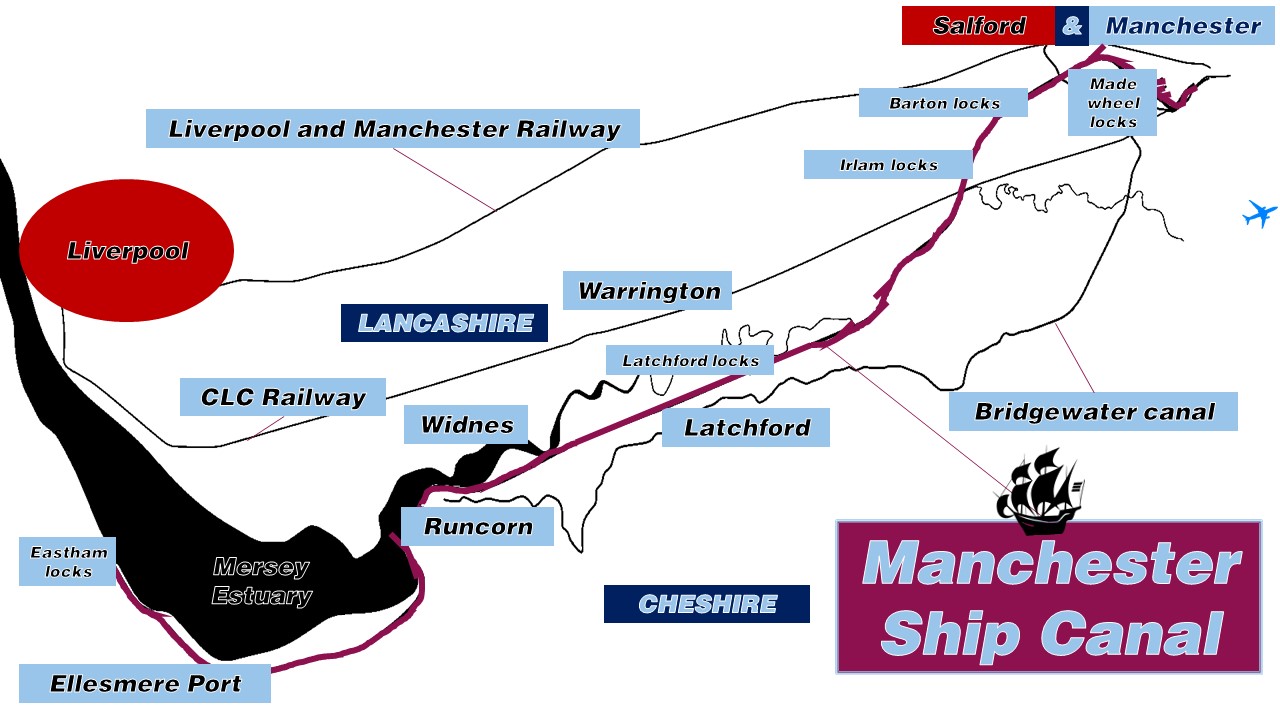
Manchester Liners’ ten ships would see varied action. Manchester City was at first a minelayer, then sent to the far east to act as a naval auxiliary ship. Many lives were lost and many ships sank. One of Manchester Liners’ ships rest-off the coast of Juno Beach Normandy having acted as a breakwater (Manchester Spinner); the Manchester Citizen, on passage to Lagos was sank by U-Boat. Manchester Merchant, sank was sank by U-boats in the Atlantic. Manchester Brigade, sank by the north of Ireland, having been torpedoed.

ship canal

Manchester Division would rescue beached passengers in Namibia. Peacetime resumed after the conclusion of World War II and Manchester Liners, much like the rest of the world counted the lost lives. Manchester Exporter, Manchester Shipper, Manchester Prospector, Manchester Vanguard, Manchester Venture, Manchester Faith and Manchester Fame are just some of the other great names. Look out for Manchester Commerce in the movie A Taste of Honey.

Some interesting stories surround Manchester Liners. Firstly, Captain F. Struss survived two ships that had been sank across The Great War and World War II. Then there is the huge ten-engine U.S. Air Force RB-36 Peacemaker that crashed off west-Ireland. Here the inbound Manchester Shipper, and the outbound Manchester Pioneer came to the rescue, in harsh weather, of the four surviving crew members. In another incident, a ditched Flying Tiger Line Lockheed Super Constellation landed in the Atlantic west of Shannon, Ireland. 48 passengers survived thanks to the works of temporary-rescue ship Manchester Faith and temporary-radio ship Manchester Progress. Heavy seas claimed 28 people that day. Another point to mention is that the chairman of Manchester Liners, a Robert B. Stoker, retired after 47 years with the company. That was in 1979. He left as his industry expanded to larger shipping company capacities, dockyard strikes, shipping, a decrease in profitability and a radically global market with corporations and investments networking far beyond regional and national gain.

Furness Withy were once part-owners of Manchester Liners but in 1970, they purchased the remainder of the company. In 1980, barely teenaged Orient Overseas Container Line snapped up Furness Withy. The company once owned by C. Y. Tung (董兆荣Dǒng Zhàoróng) was sold on again in 1990 to German multinational company Dr. Oetker (they make cakes, breakfast cereals and bakery stuff). All ships had been sold on by 1985.

There were firsts, the Manchester Challenge, was Britain’s first built and operated container ship. It would be joined by sister ships, Manchester Courage, Manchester Concorde and the Manchester Crusade. Not only that, like some of their early sister ships, this group of ships could break ice like the best of them – which was just as well, because Canadian water had plenty of ice. As the small shipping company expanded through Italy, Greece, Lebanon and Syria it acquired Manchester Dry Docks Ltd in the 1970s.

The line operated a flag with a red oval, over a white background and white lettering for ML. Their funnel was red and black. Some ships were painted red. I shouldn’t like anything to do with this red-loving shipping line, but Manchester Liners have a fascinating history, and all because in 1894, somebody opened a canal, 58km/36 miles long from the sea. Who is laughing now Punch magazine?

In memory of those who died in service for Manchester Liners.

Bypassing Liverpool since ’94

How do! / 你好 (nĭ hăo) / Namaste / Welcome!

This week Liverpool F.C. won the Premier League. Well done to them. There has been some boasting [19?] and gloating [mainly aimed at Man Utd and City]. James Milner, now a Champion at Liverpool F.C. had left Manchester City for pastures new and ended up in Anfield. He could have taken a train, car or even a ship to his new club.

Manchester by the Sea may sound like a crap funfair placed by a pond in Heaton Park, but it is actually a title of a movie by Kenneth Lonergan released in 2016. It won awards for acting and stuff like that. It has a soundtrack that doesn’t feature Oasis, The Charlatans or the Happy Mondays. Is it worth seeing? Not a clue. I’ll get round to it, but this movie set in the seaside town, first settled in 1629, of Manchester, Essex County, Massachusetts hasn’t got me yet. No hard feelings Casey Affleck.

Mark Vincent Collins, of The Charlatans, was born in Barton-on-Irwell, which is almost Manchester, but we call it the City of Salford. The Barton Swing Aqueduct allows a canal to pass over a canal. This Roman invention of the Aqueduct was modernised to become a moveable navigable aqueduct. It was a first at the time and many believe it is still the only of its kind. It opened in 1894, year of Manchester City’s naming, and remains working now Built to last by a Derbyshire firm from a plan by Sir Edward Leader Williams. A proper leader he was. So much so, few, if any have followed.

Birmingham may be the city of canals with more miles (56km/35 miles) of canals than Venice (42km/26 miles) but Manchester started the modern canal trend. The Bridgewater Canal runs from Runcorn to Leigh via Manchester. There was no river or stream. It was all dug in deep and long. Since 1761, steamboats, barges and small boats have utilised this modern canal. Used to ferry cotton goods and materials from the sea by Runcorn to Manchester and beyond, and vice versa, the canal was a great innovation. But, after over a hundred years if use it got mucky and couldn’t handle the traffic. Small ships could no longer navigate the near-impassable rivers Mersey and Irwell. The Irish Sea was an awfully long way away.

So, Manchester, faced with the problem of low rainfall, an expensive and limited railway cargo network and rivers ‘hopelessly choked with silt and filth’ (Owen, David, The Manchester Ship Canal, Manchester University Press) removed the barriers. Liverpool’s excessive goods fees had made it cheaper to head east to Hull for goods. That wasn’t good. On October the 7th, 1882 Punch magazine illustrated that Manchester’s idea to bring the sea inland was laughable, “MANCHESTER-SUR-MER. A SEA-DUCTIVE PROSPECT.” Proposals, legal matters and paperwork were underway, and within five years the ground for a new canal was broken.

ship canal

Opened a few days after completion, on the 1st of January 1894, by Queen Victoria, the Manchester Ship Canal was 58km/36 miles long. It is now the 10th longest ship canal in the world. At the time of opening it was second only to the Suez Canal (193km/120 miles) in terms of length for ship canals. Setbacks such as the lead contractor dying, harsh weather, floods (in a dry canal!), and serious money shortages, it was a miracle the canal had been completed. The Pioneer, a steamer, owned by the Cooperative Wholesale Society unloaded sugar that first day. Rouen, Normandy (France) and Manchester were connected and the Stereo MC’s weren’t around to record it.

There’s a great bleak and brown looking landscape by Benjamin Williams Leader (brother of lead engineer Edward Leader Williams) entitled ‘The Excavation of the Manchester Ship Canal: Eastham Cutting with Mount Manisty in the Distance’. Short names for paintings were evidently being rationed around the Long Depression era. The scarred Mount Manisty, Cheshire (a 30m/100’ tall hillock from earth extracted to form the ship canal) sits over the canal in present day and with its coating of trees, it looks to have been there forever. Manchester Liners used to pass this point and their ship the Manchester City, launched on the 27th October 1898.

The oldest proper canal is the Grand Canal of China (大運河 A.K.A. 京杭大運河; Jīng-Háng Dà Yùnhé or the Beijing–Hangzhou Grand Canal). It was started in the 5th century before what is known as the common era. Since then, this now UNESCO World Heritage Site, has ran over 1,794 km (1,115 miles). This Chinese mammoth of a canal is mostly improved rivers, watercourses and some extant diversions of rivers. Merchant Marco Polo, scholar Ibn Battuta, Italian priest Matteo Ricci and Scottish tea-hunter Robert Fortune went to the Grand Canal. The Grand Canal was intended for barges and not shipping.

By comparison, the Panama Canal, opened in 1914. It is 82km long and now is the 8th longest ship canal in the world. The Port of Manchester was once the U.K.’s third-busiest port. Just as the Panama Canals fortunes flagged then raised again, so did Manchester’s Ship Canal. Following slumps from the 1950s to 1960s, the Manchester Ship Canal almost faded away. Nowadays the city’s ship canal ends in Salford and is home to Media City (IV, BBC, Coronation Street, Blue Peter and CBBC), the Imperial War Museum and other leisure facilities, such as The Lowry Centre. You can still take a cruise to the sea – by way of leisure on regular excursion boats (take the Snowdrop from Irlam Locks). The Port of Manchester closed in 1982 and it wasn’t until regeneration kicked in around Salford Quays in the 1990s and then a greater rejuvenation in the decades that follows that the Manchester Ship Canal experienced a new wave of glory.

Far from the times when the Manchester Blitz saw bombs rain down on Trafford, the Manchester Ship Canal and the Port of Manchester, the sights now are much more of green banks and pleasing on the eyes. There’s prosperity around the wharfs, Detroit Swing Bridge, and the National Waterways Museum sits by the Ellesmere Port branch of the Shropshire Union Canal. There’s still a heart beat to the old ship canal yet.

Peel Holdings owns both the Manchester Ship Canal and the Port of Liverpool. Port Salford and the Atlantic Gateway may arrive by the year 2030. The locks, sluices and weirs of the old Manchester Ship Canal are far from closed yet. Ships will continue to sail under the high-level Acton Grange Railway Viaduct, as Network Rail work overhead on the West Coast Main Line, and the dramatic Queen Ethelfleda Viaduct Britannia Bridge (Runcorn Railway Bridge). The linear port has been accessible for over 125 years now and the once nick-named dirty ‘big ditch’dug by navvies is synonymous with the name of Manchester.

In memory of those who died creating the Manchester Ship Canal.

Manchester Baby (Happy Father’s Day)

How do! / 你好 (nĭ hăo) / Namaste / Welcome!

The Manchester Baby, A.K.A., the small-scale experimental machine (SSEM) was not a device of torture or something living. It was a huge innovation and giver to the future. Here’s a little more about the Manchester Baby and how it came about on the 21st June 1948, just 71 years ago.

F.C. Williams sounds like a football team. There is a Manchester connection. It doesn’t involve a centre-half called Tom Kilburn. Kilburn, from Dewsbury in Yorkshire, resident of Blackpool, was actually a regular at Old Trafford. His being a Manchester Utd fan should exclude him from my writing but Tom Kilburn CBE FRS alongside Stockport-born Sir Frederic Calland Williams, CBE FRS changed the world. Much of our modern world owes itself to this dynamic duo. Geoff Tootill, from Chadderton, where my Gran worked at Avro once, also worked in the Electrical Engineering Department of the University of Manchester.

Freddie Williams was a dreamer and a doer. This pioneer in radar technology carried on a wave of momentum following World War II and applied his science to research for numerous years. Look up his thesis, ‘Problems of spontaneous oscillation in electrical circuits for some light reading. Much of what was written then is widespread knowledge now. He’d be known for Manchester Baby and the Williams tube (or Williams–Kilburn tube) – a device of computer memory. Geoff C. Tootill passed away on 26th October 2017. His contributions are long and illustrious. There’s a replica of Manchester Baby in the Museum of Science and Industry (Manchester), created in 1998, by the Computer Conservation Society. Tootill’s extensive notes and recollections made this possible.

Without this trio of grafters and trend-setters, the computer era could have been years, if not decades away. The Manchester Baby and Ferranti Mark 1 are iconic technological advancements. They represent the first electronic stored-program digital computers. Famous mathematician, computer scientist, logician, cryptanalyst, philosopher, and theoretical biologist Alan Turing ran a programme on Manchester Baby, having had it initially debugged by Geoff C. Tootill. Turing and the National Physical Laboratory had also been trying to make their own programmable computer. The former codebreaker and his team also spent much time in Manchester and greatly contributed to the future.


Happy Father’s Day Dad!

My father, David Acton, or Dad as I call him, because that’s what he is and always will be has given me many great memories. Caravan trips to Cleveleys, Morecambe and countless other days out have been had. There could have been more time spent together, but for divorce, Dad’s work schedule and other factors. It is water under the bridge now. Not every day growing up was wonderful, much was spent in anticipation and uncertainty. Other kids have had far worse feelings, but my dread was all I knew. On the days when Dad and Pup, or my elder brother Asa were around, then it was delightful. Having dinner at my Nana’s house, seeing my Granddad and listening to his many war and travel stories were treats.

I don’t look back with sadness on having my parents divorce so young. Around me many of my friends were in the same boat. That’s life. It is what it is. I was lucky. Some friends had lost their father at a young age, and some never even knew who their father was. Growing up in Manchester, you weren’t far away from a fatherless child. Then, I also knew kids who grew up with fathers who were abusive or neglectful. So, which is best? There are templates and ideals, but for many these were distant dreams not granted to us. Dad did his best, and always has done his best, and understanding my Dad is key. He’s laidback, relaxed and I love him unreservedly.

Dad often took me to Manchester Victoria station, where I’d meet his colleagues in a bland room above the main railway concourse. Broken biscuits, piping hot pint mugs of tea and natter would be had. Or, we’d nip over the road, down some steps to a subterranean Railway Men’s Club with the best corned beef and onion barmcakes (a bread roll) with proper mustard. When Dad wasn’t working, we’d be at the allotment on Joyce Street, Moston. Our dog Pup would be alongside us, and I’d be let out of the back gate alongside my best friend Pup. We’d run riot on Broadhurst Park, climbing trees, jumping the valleys and over the red brick stream within the park. We’d often sit together on a perch overlooking the allotment and Dad’s plot, watching as Dad bodged a greenhouse together or planted row after row of potatoes. Just by the Ronald Johnson Playing Field, Pup and I used to chase footballs. That’s now the site of F.C. United of Manchester. I like to think that Pup and I had a pooh there. I’m certain that a bush doubled-up as an open toilet for me, at least.

From time to time the Ronald Johnson Playing Field would host cycling events. It was the first place that I witnessed competitive cycling in Manchester. How lucky the city of Manchester has been since. Wandering within the confines of Broadhurst Park, Pup and I would never cross the line at Nuthurst Road, and we’d rarely walk down Lightbowne Road towards the junction at Kenyon Lane. My Gran and Ernie lived near there (off Judd Street), plus my Aunty Susan was on Joyce Street, just down Kenyon Lane. The risk of being seen was too high. We were sometimes allowed out of the allotment front gate and crossed over the road by Dad. Here in the armpit of St Mary’s Road and Joyce Street, up against the railway was a new scrub of parkland that ran behind Newton Heath Train Maintenance Depot.

Newton Heath Train Maintenance Depot, mostly known to us as ‘Newton Heath Loco’. It may or not have had a connection to a certain Manchester Utd., but for me it was a mysterious place full of oil and metallic smells. The Lancashire and Yorkshire Railway Company had long maintained a presence at this depot. My grandfather George Acton had worked here, as did my Dad at several points. Sometimes, Dad would drive into there to grab some tools or paints for his job. With Dad and Granddad, I was lucky enough to see under a train once or twice and wander around guided in ways health and safety executives now would grimace at.

The railway was central to my youth and time spent with Dad. Train rides to see aunts, uncles and relatives was normal. From time to time, car rides out to parks, the seaside and to see Nana and Granddad at the caravan were treats. I can recall numerous pilgrimages to see the legendary Blackpool Lights, with return trips sat on old Intercity diesel trains in the luggage and goods compartments. Lugging bags of seaweed for the allotment and garden was standard practice, in Dad’s eyes. Asa said how he, as a teenager, held a greenhouse on the roof of the possibly old Princess car, as it hurtled down the steep hill of St Mary’s Road towards Moston Brook. The residents of St. Mary’s Nursing Home may have seen a flying greenhouse as Asa lost his grip.

Dad’s cars have been antiquarian at best. Workhorses over shiny pride. I can recollect a Lada Riva in beige and faded cream. Further to that there was a black Ford Mondeo with air conditioning. The air-conditioning being electronic windows that seldom worked. Sometimes they’d roll down, but never roll up. There were occasional diesel railway vans and pick-ups. Dad had been for a long-time part of British Railways and then Network Rail as a painter and decorator. His job description was pretty much paint anything and everything – but not the trains. Work was scattered nationally but mostly confined the Lancashire and Greater Manchester area. Between work Dad, would have us nip up to what is now Julie’s Homebrew by Jessie Street and Copenhagen Street off Oldham Road. The Sharp factory would be nearby, so as sponsors of Man Utd, I was allowed to boo.

Taking Nana to Newton Heath market was always exciting as it usually meant a custard slice or Chewits. The dentist’s nightmares were through fault of Nana spoiling me. If I said that I liked a Cadbury’s Boost, Nana, a diabetic would fuel my requests. We’d even jib over the canal, Nana on the concrete walkway parallel to the Old Church Street road bridge, and me springing over the dangerous wooden canal lock gates. What is now Lidl, was once Kwik Save, and our Asa would sometimes be seen working out the back or on the graveyard evening shifts at the weekend.

Our ‘Ace’ was a hero to me, as a kid, and even though we never spent much time together, I always wanted to be him. I had brown curly unruly hair. Asa had well-kept curly black hair. Asa has and had chiseled looks. I resembled a pallet of spilt paint. My freckles and pale skin was quite far from our ‘Ace’. The good thing about ‘Ace’ was that he liked computers and would rarely touch my books. Books were everywhere and I’d pick up anything with words. Asa preferred computers, coding and all that. Picking up books from barrow stalls at Manchester Victoria was something Dad and Mum both gifted me. With my many questions, Dad would often have an answer and if he didn’t, he’d point me at a book or tell me who to ask.

Anyway Dad, have a Happy Father’s Day – see you for a drink and some City as soon as possible.

All my love, John

goater

“OK, mum’s the word!”

How do! / 你好 (nĭ hăo) / Namaste / Welcome!

“Let’s sing it and rhyme; Let’s give it one more time; Let’s show the kids how to do it fine, fine, fine, fine” – All The Best, R.E.M.

Happy birthday to my dearest Mum. Much can be said for my Mum. I want to write it though. Maybe the video says a little, but I think some words are best and need jotting down. Call it reinforcement. Call it a child of a mother without means to display emotion through a hug. Afterall geography and COVID-19 keep us apart. Mothering Sunday and Mother’s Day celebrate mums and mothers (or moms) around the world. A birthday is much more personal than that but by no means less important. Every day I live and breathe on this here Earth is because of my Mum. Dad too. But, deep down we all know mums are more important.

Mums are your first true friend. They’re the best friend we should all have from day one of our lives. They are a forever friend. Mums stick by you no matter what, or they should. There are always exceptions. If a mum disowns you for liking Man Utd, then that’s your own fault. Thankfully, my mum, Mum, as I call her, because she is my mum and Mum to two others: my dreaded siblings Astrid and Paul; yes, thankfully my Mum is brilliant. She’s always listened to great music like Pulp, R.E.M., James, Finley Quaye, and Led Zeppelin. Mum has encouraged me from an early age to read. I was deep into the worlds of Tolkien long before they were fashionable. Armed with knowledge of The Lord of The Rings. Mum made sure I was presented with a stage show version long before a live action version hit the silver screen. The Tameside Hippodrome remains a fond memory with orcs and lasers casting haunting imagery from the central stage. To receive books was always wonderful. Mum and Dad provided great volumes from an early age. Collecting Weetabix tokens sometimes led to great books. Some I still have today and share amongst my classroom. These were the books that set me on my way.

Mum has grafted and strived to make each of us better. Likewise, Mum has set a prime of example of improving herself. Mum has studied at the Open University in Sociology. Mum has always tried to reason her socialist values and community spirit. She has imparted her knowledge on me and always allowed me to make my own judgements and find my own way. As Mum has shared so many great things, I always want to show her my world. I have loved being able to see Mum at Manchester City, or go to a music gig like The Levellers with me. Mum may have heard of and witnessed the Waterboys when they first came around, but my musical world is constantly expanding. As I was experiencing James singing Sit Down at an Air Cadet Christmas party, Mum was being attending their live gigs. Over the years I have grew to love James, and their song Getting Away With It (All Messed Up) is an emotional track. It reminds me of me as a nuisance and a liability towards my mum, as I stuttered and faulted my way through secondary school. Mum has been great for me. My rock. My believer.

Mum treated me once to a birthday trip, with Neil Fanning, to Blackpool and it rained heavily. We were drenched. Mum took me to the Roxy Cinema to see Ghostbusters II and it was flooded. Mum showed me the V.E. celebrations at Manchester Town hall and we had fireworks rain down on us. At Woodford Airshow, Mum calmed me down after seeing a Spitfire crash. As the Supermarine Spitfire Mk XIV struck the ground at the bottom of a low level loop during an air display, Mum must have felt as sick as everyone around them. Pilot David Moore didn’t survive. Bizarrely the aircraft did and was moved to Rolls Royce in Derby for restoration to flying condition. Mum explained everything to me, a young boy, a bit upset by the huge explosion on 27/6/92 at 15:08. I’ve just seen the video again, and it made my eyes water with tears. That’s what mums do, they put their kids ahead of them. They’re the strongest people on Earth. They sacrifice their own time, space and energy to look after and protect us. That’s why Mum spotted me crying when Bambi’s mother died. I can’t explain the tears shed at E.T. or Thomas the Tank Engine. Perhaps those days were dusty.

Eating fresh bread at the observation area (not medical) of Manchester Airport and watching planes land made a few different days. Trips to museums in and around Greater Manchester gave me an appreciation of British heritage early on. Big steam wheels at Wigan Pier and seeing Gran and Ernie at the Manchester Museum of Science and Industry. You can’t fault Mum’s ability to keep our young brains active. Ernie gave me an Engine Driver hat that day.

I wanted to get Mum an experience day, or a stay at a hotel somewhere nice, but the climate around COVID-19/coronavirus isn’t so ideal. Besides, it is safer to remain indoors, stay at home and stay alert. You have to look after your mother because you can only have one. Unless you were adopted. Some of those foster mothers are brave lots, aren’t they?! Anyway, with the world being as it is, vouchers aren’t ideal. I remember Mum gave me a Borders bookstore voucher for Christmas but the company went into administration and closed, so I never used it. Well, I kind of did, but I can’t explain how or where. Those Stephen King horror-thrillers have since move on. I have an idea what to gift Mum, but I need to wait for this COVID-19/coronavirus to all blow over…

My passion for camping came from budget holidays as a kid, usually in the north of England or Wales. The fiscally challenged as those who suffer from political correctness would recognise that times were hard. Money was scarce but we had good food, holidays, and a roof over our head always. There were treats and Fridays used to be the day that maybe a Mars bar or another chocolate treat was waiting. Mum allowed me treats like staying up late on a Sunday to watch London’s Burning or other days to watch comedy shows like Have I Got News For You. On the whole early nights were encouraged and bed would be around 9 o’clock and often with a book under the duvet. Walking was encouraged and as Mum didn’t have a car, walking became normal. The Levenshulme to Reddish Vale and back, via Houldsworth Mill was a favourite trot. Zipping around Disley and Lyme Park was a bigger treat.

Whenever there has been a challenge and times have been tough, Mum has been there to support me and has very much been the 12th player that many football clubs claim to have. That knowledge that my Mum has been around the corner or a quick phone call away, has always made me feel stronger. Usually it takes very little conversation to wipe away any doubt or reduce a huge worry to little more than a niggling ache. I always think Marlon Brando’s farewell to his son speech in Superman: The Movie could easily fit my Mum, obviously with some gender realignments and name changes.

“You will travel far, my little Kal-El. But we will never leave you… even in the face of our death. The richness of our lives shall be yours. All that I have, all that I’ve learned, everything I feel… all this, and more, I… I bequeath you, my son. You will carry me inside you, all the days of your life. You will make my strength your own, and see my life through your eyes, as your life will be seen through mine. The son becomes the father, and the father the son. This is all I… all I can send you, Kal-El.” – Marlon Brando as Jor-El, Superman: The Movie

Mum’s the word

(a popular English idiom)

Used by William Shakespeare, in Henry VI, Part 2.

“Seal up your lips and give no words but mum.” – Henry VI, Part 2, Act 1, Scene 2

“Mum” is slang for momme. Momme means: be silent (or do not reveal). Old English: “mīma“. Latin: mimus (meaning silent actor/imitator).

It was used between 1350-1400 in Middle English.

“Thou mightest beter meten the myst on Malverne hulles; Then geten a mom of heore mouth til moneye weore schewed!” – Piers Plowman, William Langland

So, on this 20th of June, it is Mum’s birthday, the day before Bermuda’s Shaun Goater Day. Both should be in your calendar. And if not, why not? My Mum is ace. Shaun Goater was an ace player. Perhaps I can get Shaun Goater to say happy birthday to my Mum. That’d be fitting seeing as my Mum asked ‘The Goat’ to write me a Christmas card once. Mums are ace, right!?

goater


P.S. Mum, let’s go to Blackpool Tower and recreate this photograph in 2021. Good idea?

mumjohntowerblackpool

I’d also like to invite you to write some Blog posts for me too. Thanks in advance Mum!

Your loving son, John, aged 37.5-ish.

Ronald Lindsay Johnson (24 September 1889 – 29 May 1917)

How do! / 你好 (nĭ hăo) / Namaste / Welcome!

Ronald Lindsay Johnson (24 September 1889 – 29 May 1917)

I knew of the Ronald Johnson Playing Fields long before FC United of Manchester went slicing into the earth around it. Located on Broadhurst Park, in Manchester’s Moston, I always recall the red brick cycling track within a fenced compound adjacent to the passing St. Mary’s Road. Discovering the Western Front Association website, I recently read about Ronald Johnson. Together with a profile on the Friends of Broadhurst Park, I started clicking left, right and centre.

Like many that saw battle in the horrors of The Great War, Captain Ronald Lindsay Johnson (picture courtesy of the Altrincham Guardian) died in action. He was just 28-years old. His shares at Johnson, Clapham & Morris engineers were put to use in creating a sports ground. Initially for employees it became a public ground in the 1930s following Johnson, Clapham & Morris’s move to Trafford Park. It has since seen cricket, football (notably Moston Juniors F.C.), school sports days, car boot sales, fun fairs and life.

I can still recall the damp earthly smells of the ground that measured around 8-acres, sandwiched between a primary school and number 335 St. Mary’s Road. The recreation area was in memorial to Captain Ronald Lindsay Johnson and opened on the 17th June 1922 (or 1925), with Ronald Johnson’s mother present. The cycle speedway track was unique to the area – and existed long before the Manchester Velodrome was created in anticipation of the 2002 Commonwealth Games. I wonder if any cyclist transitioned from there to the often named ‘medal factory’ in Clayton.

By 2011, F.C. United of Manchester were offered the land and their 4,400-seater stadium (for £6.5 million) followed. The name Broadhurst Park was naturally fitting, following a brief period as the Moston Community Stadium. The all-weather pitch has seen a Benfica B team all in a stone’s throw from what was once Moston Hall, and residence to local industrialist Sir Edward Tootal Broadhurst. The park itself a World War One donation to recognise victory.

The New East Manchester and Manchester City Council development, once the home of a metal working and fabrication business team, had been resisted by local residents. The loss of public open space coupled with inadequate parking provision seemed to be the main problems. 2,226 letters of objection (mostly locally sent) were beaten back by 5,635 letters (many outside of Manchester) of support. Manchester Council plodded on with a success at the Court of Appeal in March 2013. The covenant on the land has always been recreation – and for the people of Moston. The one thing I find upsetting is that there isn’t a plaque or statue to honour that for almost 90 years these fields held a different name – but perhaps it hasn’t been made yet, or notified well.

Significant contribution was made by the Football Foundation Community Facilities Fund, Sport England, F.C. United Community Shares scheme, fundraising, Manchester City Council loan and the Football Foundation Football Stadia Improvement Fund amongst others. F.C. Ted (see the link for reasoning about the name) moved in eventually. At an Annual General Meeting of FC United, 10 April 2014, the Ronald Johnson Ground was one of seven names proposed for the new ground. Sadly, the historic Ronald Johnson Playing Fields seemingly vanished. F.C. United played Benfica B to mark the date of Man United’s 1968 European Cup Final, the day Ronald Johnson ceased to live.

Ronald_Lindsay_Johnson

Ronald Lindsay Johnson (24 September 1889 – 29 May 1917)

Family: His parents were William Henry Johnson, died 1914 and Agnes Morton Johnson née Brown. Brother, William Morton Johnson, educated in Cambridge, died July 1916 (in military action, aged just 34 years old). Mother, opened the playing field in June 1922. Ronald was the youngest of six children.

Raised: Woodleigh on Bradgate Road in Dunham Massay

Studied: Summer Fields School, Eton. BA Classics (posthumous MA awarded), @ King’s College, Cambridge.

Lived: Australia, 1912 until August 1914 (at the Sydney branch of Messrs Johnson, Clapham & Morris)

Partner/Chairman: Johnson, Clapham & Morris’ Wire Works (engineers)

Served: As a junior in the Cadet Corps; then Officer Training Corps at Cambridge. Enlisted (2nd October 1914) in the 23rd Division [103 Brigade RFA], Royal Field Artillery. Commissioned as a 2nd Lieutenant.

Rank: Acting Captain and Divisional Trench Mortar Officer (DTMO). Entered the theatre of war from 27th August 1915 (landed Boulogne).

Medals: 1914-15 Star, British War Medal and Victory Medal

Responsibilities: co-ordinating the targeting and positioning of mortar batteries

Notable events: Survived a rifle bullet to the ear, 19th September 1916. Evacuated by H S Dieppe (hospital ship) but returned to service by 11th December 1916.

Cause of death: Pre-Battle of Messines (Flanders, Belgium) preparations. Hit by a German shell, near Zillebeke Lake by ‘Hill 60’. He died in transit on the way to the Field Hospital near Brandhoek.

Place of Rest: Brandhoek Military Cemetery, Belgium (Plot II, Row D, Grave 1).

Commemorated: Dunham (St. Mark’s) war memorial and the Kings College, Cambridge War Memorial.

Other than the Ronald Johnson Playing Fields, he was honoured with the naming of the Johnson Chemicals Labs, Adelaide University, Australia. He is also mentioned in the Cambridge University Book of Honour.

Further reading:  Who was Ronald Johnson ? (David O’Mara, Western Front Association (WFA))